Negotiation.gr | Strategic Wisdom for the Technological Age
“Strategic resilience emerges when technical capability (techne) is
continuously guided by practical wisdom (phronesis) through adaptive
negotiation across interconnected systems.”
From Reusable Rockets and Experimental Learning to Sustainable Space Infrastructure
TPNF Research Essay | Space Technology, Strategic Adaptation and Multidimensional Value Creation | November 15, 2026
Central Idea (Thesis)
SpaceX Starship illustrates how technological ambition can be transformed into long-term strategic value through experimentation, systems integration, institutional learning, and practical adaptation.
Its significance extends beyond developing the world’s most powerful launch vehicle. Starship seeks to establish a reusable transportation architecture capable of supporting commercial activities, scientific missions, lunar exploration, and eventually interplanetary operations.
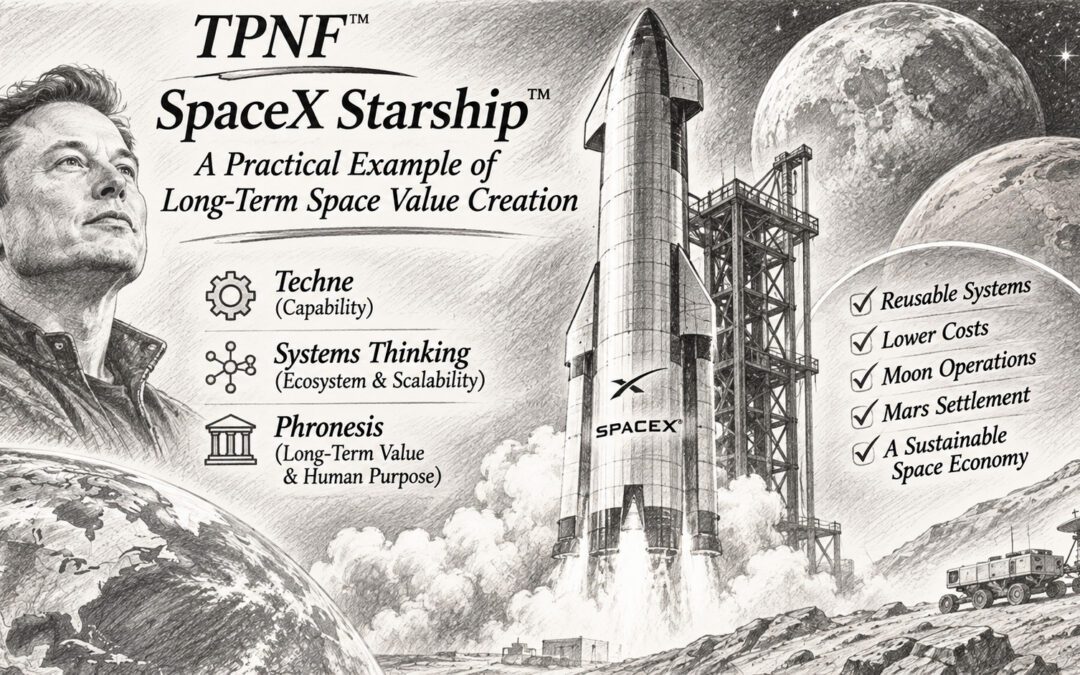
Through the Techne–Phronesis Negotiation Framework™ (TPNF), this development can be examined through three interconnected dimensions: Techne (Capability), Systems Thinking (Understanding), and Phronesis (Strategic Wisdom).
The central challenge is transforming experimental breakthroughs into reliable, economically sustainable, and socially responsible space capabilities.
Purpose
This TPNF essay examines Starship as a practical example of long-term value creation.
It explores how reusable technology, iterative experimentation, organizational adaptability, and ecosystem development may contribute to the future space economy.
Abstract
SpaceX is developing Starship as a fully reusable transportation system consisting of the Super Heavy booster and Starship spacecraft.
On November 14, 2026, its fifteenth integrated flight test achieved a significant milestone when the upper stage returned from orbit and was captured by the launch tower.
The mission also deployed 26 Starlink satellites.
Although complete operational reusability remains unproven, the achievement demonstrates progress toward a new space transportation architecture.
TPNF provides a complementary analytical framework for examining how such technological developments may generate sustainable multidimensional value.
1. Starship: Beyond a Conventional Rocket
Starship represents an ambitious attempt to transform the economics and operational characteristics of space transportation.
The integrated system measures approximately 124 meters in height and has a diameter of nine meters.
SpaceX designs the vehicle to transport more than 100 metric tons to orbit in a fully reusable configuration.
Its Super Heavy booster uses methane-fueled Raptor engines, while the upper stage combines propulsion, payload transportation, and atmospheric reentry capabilities.
However, Starship’s defining ambition is not simply payload capacity.
It is the possibility of operating large orbital transportation vehicles repeatedly.
If demonstrated at scale, this could change how space infrastructure is designed, deployed, and maintained.
2. Flight 15: A Historic Technological Milestone
Starship’s fifteenth integrated flight test launched from Starbase, Texas, on November 13, 2026.
The spacecraft reached orbit, deployed 26 Starlink V3 satellites, and completed approximately 14 revolutions around Earth.
On November 14, the upper stage returned to Starbase and was captured by the launch tower’s mechanical arms.
This represented an important achievement in the development of reusable orbital spacecraft.
However, the Super Heavy booster did not complete its planned recovery.
The flight therefore demonstrated successful upper-stage orbital recovery, not complete two-stage reuse.
Moreover, recovering a spacecraft does not automatically establish rapid turnaround or economically efficient repeated operations.
These remain important development objectives.
3. Techne: Reusability as Technological Capability
Within TPNF, Techne represents practical knowledge, technological capability, and engineering competence.
Starship embodies this dimension through advanced propulsion, thermal protection, flight control, structural engineering, and recovery technologies.
Reusable orbital transportation creates demanding engineering requirements.
Vehicles must survive launch stresses, atmospheric reentry, extreme temperatures, and repeated operational cycles.
The recovery of Starship’s upper stage demonstrates progress in integrating these capabilities.
Yet the long-term objective requires more than successful recovery.
Vehicles must be inspected, maintained, refurbished when necessary, and launched again reliably.
TPNF principle: Technological achievement becomes sustainable capability when performance can be repeated under economically and operationally acceptable conditions.
4. Systems Thinking: Starship as an Ecosystem
Starship cannot be understood exclusively as a rocket.
Its operation depends upon manufacturing facilities, launch infrastructure, propellant production, software systems, regulatory approvals, logistics, customers, and skilled personnel.
SpaceX’s Starbase facilities illustrate the importance of integrating these elements.
Launch towers, production lines, ground systems, and flight operations must function as a coordinated system.
A successful spacecraft recovery has limited economic value if extensive refurbishment prevents frequent launches.
Similarly, increased payload capacity becomes valuable when customers can develop missions that utilize it.
Systems Thinking therefore shifts attention from individual technological achievements toward the performance of the complete transportation ecosystem.
5. Phronesis: Strategic Wisdom and Responsible Innovation
Phronesis represents practical wisdom and responsible judgment under uncertainty.
Starship development involves substantial financial commitments, technical risks, environmental considerations, and public safety responsibilities.
Rapid experimentation can accelerate learning.
However, it must remain compatible with appropriate engineering validation and regulatory oversight.
Decision-makers must balance innovation speed against reliability, safety, and long-term institutional credibility.
This includes evaluating launch-site impacts, operational hazards, and the consequences of unsuccessful tests.
Phronesis does not oppose technological ambition.
It asks how ambition can be pursued responsibly while preserving the conditions necessary for sustainable progress.
6. Iterative Experimentation and Practical Adaptation
Starship development illustrates the importance of learning through repeated experimentation.
Flight tests generate evidence concerning propulsion, vehicle structures, thermal protection, control systems, and recovery procedures.
Engineers can use these findings to modify subsequent designs.
This approach differs from treating a technological system as complete before exposing it to demanding operational conditions.
Nevertheless, experimentation creates value only when lessons are accurately identified and incorporated into future development.
Failures may reveal weaknesses, but they do not automatically produce improvements.
TPNF interprets practical adaptation as the disciplined process connecting observation, technical modification, validation, and institutional learning.
7. Reusability and the Economics of Space
Traditional launch systems frequently discard major components after a single mission.
Reusability offers the possibility of distributing manufacturing costs across multiple flights.
However, economic benefits depend upon actual refurbishment expenses, launch frequency, reliability, and market demand.
A reusable vehicle that requires extensive maintenance may provide less economic advantage than anticipated.
Likewise, very large payload capacity creates value only when sufficient demand exists.
Starship’s commercial potential therefore depends upon demonstrating repeatable operations and developing an appropriate customer ecosystem.
TPNF emphasizes that engineering efficiency and economic sustainability must be evaluated together.
8. Starlink and Commercial Infrastructure
Starlink provides an important example of the relationship between launch technology and commercial services.
The deployment of 26 Starlink V3 satellites during Flight 15 demonstrated Starship’s ability to support an operational satellite network.
This connects space transportation with communications infrastructure and commercial revenue opportunities.
Larger launch capabilities may support different satellite architectures and more substantial orbital payloads.
However, the relationship between launch capacity and commercial value remains conditional.
Demand, competition, regulation, and service quality influence economic outcomes.
The broader strategic lesson is that transportation systems become valuable when they enable useful services beyond transportation itself.
9. NASA Artemis and Lunar Exploration
Starship also forms part of NASA’s Artemis lunar exploration program.
SpaceX is developing a specialized Human Landing System version intended to transport astronauts to and from the lunar surface.
NASA’s revised October 2026 architecture involves assembling propellant in Earth orbit using multiple Starship tanker missions and a storage vehicle.
The lunar lander would subsequently receive propellant before undertaking its mission.
This approach introduces important technological and operational challenges.
Cryogenic propellant transfer, orbital coordination, spacecraft reliability, and human safety require further demonstration.
NASA’s current planning targets crewed lunar landings in 2028, but schedules remain dependent upon development progress and certification.
10. Orbital Refueling and Future Space Logistics
Orbital refueling could fundamentally influence future space mission design.
Instead of launching a spacecraft with all the propellant required for a distant destination, additional vehicles could supply fuel in orbit.
This may support larger payloads and more ambitious missions.
However, orbital refueling requires precise rendezvous, reliable fluid transfer, thermal management, and coordinated launch operations.
The complexity increases when several vehicles participate.
Within TPNF, orbital refueling illustrates the relationship between individual technological capabilities and wider logistical systems.
Its strategic value will depend upon reliable integration rather than conceptual feasibility alone.
11. Multidimensional Space Value Creation
Starship’s potential value extends across several dimensions.
Technological value: Advances in reusable propulsion, spacecraft recovery, and orbital transportation.
Economic value: Potential reductions in transportation costs and expansion of commercial services.
Institutional value: New relationships among space agencies, manufacturers, regulators, and customers.
Human value: Development of engineering expertise, operational skills, and scientific opportunities.
Societal value: Potential benefits through communications, research, and exploration.
These outcomes should not be treated as guaranteed.
Their realization depends upon technical maturity, economic viability, responsible governance, and sustained demand.
12. Strategic Competition and Space Access
Reusable heavy-lift transportation may influence the international distribution of space capabilities.
Countries increasingly recognize the strategic importance of satellite infrastructure, scientific research, and independent access to orbit.
A mature Starship system could affect commercial competition and future space infrastructure planning.
However, technological leadership does not eliminate geopolitical or institutional challenges.
Space activities remain subject to national regulation, international obligations, security considerations, and competition among public and private actors.
TPNF encourages examining space technology as part of a wider strategic ecosystem rather than merely comparing launch-vehicle performance.
13. The TPNF Long-Term Value Creation Pathway
Starship can be examined through a proposed seven-stage progression:
Technological Capability → Experimental Validation → Reusable Operations → Systems Integration → Commercial Adaptation → Institutional Learning → Long-Term Multidimensional Value
The stages are interconnected.
Technological capability enables experimentation.
Validation establishes performance.
Reusable operations may improve efficiency.
Systems integration connects transportation with customers and infrastructure.
Commercial adaptation responds to actual demand.
Institutional learning supports continued improvement.
Long-term value emerges when these elements reinforce one another.
This pathway is a TPNF analytical proposal, not an official SpaceX development model.
Strategic Lessons for Leaders
- Distinguish technological milestones from mature operational capabilities.
- Evaluate reusability through actual turnaround costs and reliability.
- Connect engineering innovation with commercial demand.
- Treat experimental failures as evidence requiring disciplined analysis.
- Integrate safety, regulation, and environmental considerations.
- Develop institutions capable of continuous technological adaptation.
- Measure strategic success through lasting multidimensional outcomes.
SpaceX Starship represents an ambitious attempt to transform space transportation through reusable technology and iterative development.
The successful orbital recovery of its upper stage in November 2026 marks significant progress.
However, the achievement does not establish complete operational reusability or guarantee future commercial success.
Through TPNF, Starship demonstrates how technological capability must be integrated with systems understanding, responsible judgment, and practical adaptation.
Its ultimate strategic importance will depend upon whether experimental achievements become reliable transportation services supporting sustainable economic, scientific, and societal value.
Key Takeaways
Starship is designed as a fully reusable heavy-lift space transportation system.
Flight 15 achieved upper-stage recovery after orbital flight.
Complete two-stage reuse and rapid operational turnaround remain development objectives.
Starship may support commercial satellite infrastructure and NASA’s lunar exploration plans.
TPNF connects engineering capability with ecosystem integration, responsible innovation, and long-term value creation.
Author’s Reflection
Human progress has often depended upon the ability to transform ambitious technological ideas into practical systems that expand the boundaries of possibility.
Space exploration illustrates this relationship particularly clearly.
Yet the significance of a powerful rocket extends beyond its engines, payload capacity, or spectacular flight achievements.
Its lasting value depends upon the knowledge it generates, the infrastructure it enables, and the opportunities it creates for future generations.
For TPNF, Starship offers a practical example of how capability, understanding, and wisdom must operate together.
The central challenge is not simply reaching space.
It is developing the technological, institutional, and strategic foundations necessary to create sustainable value through continued access to space.
Nikolaos Chatzis
Primary Research Sources
Flight 15 — November 13–14, 2026
The orbital recovery milestone, 26 satellite deployments, and unsuccessful booster recovery are documented in contemporary reporting.
SpaceX — Starship Technical Overview
Official descriptions of the integrated vehicle, intended reusability, payload capabilities, and orbital refueling concept. These are design objectives, not proof of operational performance.
SpaceX Starship official websiteNASA — Artemis Lunar Lander Development, October 23, 2026
Explains the revised Artemis architecture, Starship’s propellant aggregation strategy, and outstanding human-landing-system milestones.
NASA official announcementReuters — Starship Flight 15, November 13–14, 2026
Independent reporting on launch operations, satellite deployment, recovery challenges, and the broader economic objectives of Starship.
Reuters
Source: Open Sources Analysis, Relative Data Analysis by Nikos Chatzis
© Nikolaos Chatzis. All Rights Reserved.
The Techne–Phronesis Negotiation Framework™
An Integrative Theory of Strategic Negotiation, Complex Adaptive Systems and Practical Wisdom
Technology Creates Capability • Systems Thinking Creates Understanding • Strategic Wisdom Creates Lasting Value.
Negotiation.gr | Strategic Wisdom for the Technological Age