Negotiation.gr | Strategic Wisdom for the Technological Age
“Strategic resilience emerges when technical capability (techne) is
continuously guided by practical wisdom (phronesis) through adaptive
negotiation across interconnected systems.”
Defense Technology, Military Innovation, and Strategic Wisdom | 28 October 2026
Central Idea (Thesis)
The strategic value of military technology should be measured not only by its ability to destroy enemy capabilities, but also by its ability to preserve human life and sustain operational effectiveness.
Ukraine’s StarGate casualty evacuation drone illustrates an emerging transformation in modern warfare: unmanned aerial systems are evolving from reconnaissance and combat platforms into potentially life-saving instruments of battlefield medical logistics.
Through the Techne–Phronesis Negotiation Framework™ (TPNF), this innovation demonstrates how technological capability, systems understanding, and practical wisdom can combine to address a critical operational problem.
Purpose of the Essay
This TPNF essay examines Ukraine’s StarGate aerial evacuation system, its initial reported battlefield successes in October 2026, and its implications for military medicine, unmanned systems, organizational adaptation, and strategic innovation.
It applies TPNF to distinguish technological novelty from sustainable operational value.
Abstract
Modern battlefields increasingly expose medical evacuation teams to drones, artillery, electronic warfare, mines, and disrupted transport routes.
Traditional evacuation vehicles may be unable to reach wounded personnel without unacceptable risks to rescuers.
Ukraine’s SkyFall company developed StarGate, a heavy-lift unmanned aerial platform designed specifically for casualty evacuation.
In October 2026, Ukrainian forces reported successfully evacuating two severely wounded soldiers using the system.
The case demonstrates a promising operational breakthrough while raising questions about reliability, medical safety, cost, scalability, and integration into military medical organizations.
TPNF identifies the innovation’s strategic significance in its potential to transform technological capability into humanitarian and operational value.
Introduction: The Changing Geography of Battlefield Survival
For generations, battlefield casualty evacuation depended upon medical personnel, ambulances, armored vehicles, helicopters, and established evacuation routes.
Modern drone-intensive warfare has disrupted these assumptions.
In Ukraine, first-person-view attack drones and persistent aerial surveillance make movement through contested areas increasingly dangerous.
Roads may be mined, destroyed, observed, or exposed to repeated attacks.
Wounded soldiers can remain isolated because evacuation teams cannot safely reach them.
The resulting challenge is not simply medical.
It is technological, organizational, logistical, and strategic.
Ukraine’s StarGate represents an attempt to redesign the evacuation process around the conditions of the contemporary battlefield.
1. StarGate: From Combat Drone Technology to Casualty Evacuation
StarGate was developed by Ukrainian defense technology company SkyFall in response to an operational requirement identified by frontline personnel.
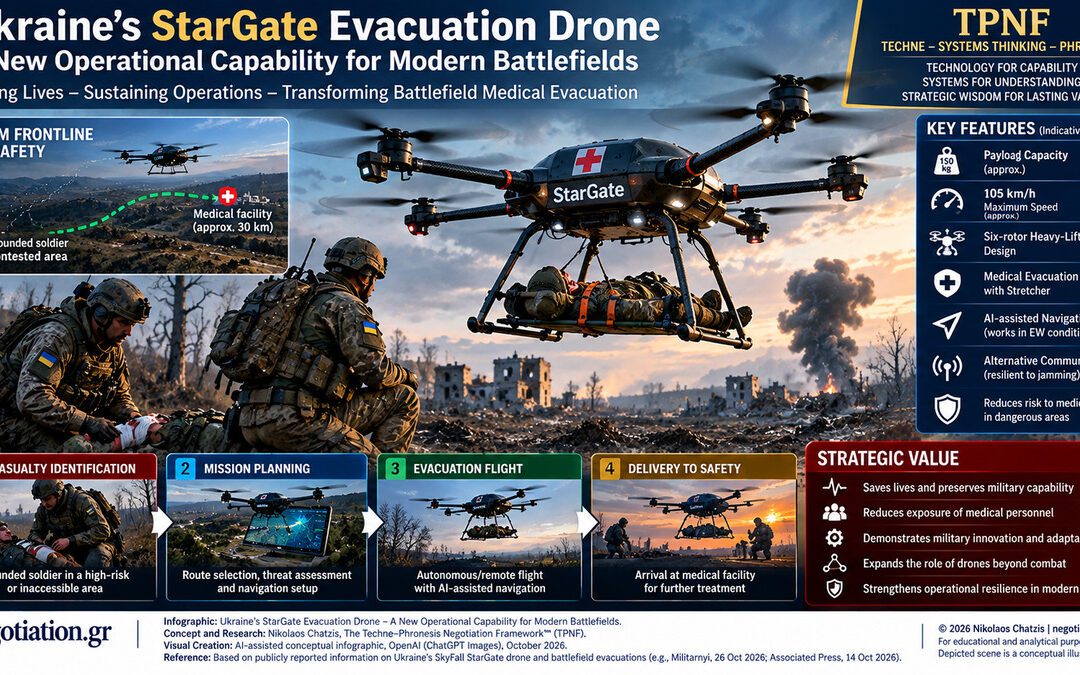
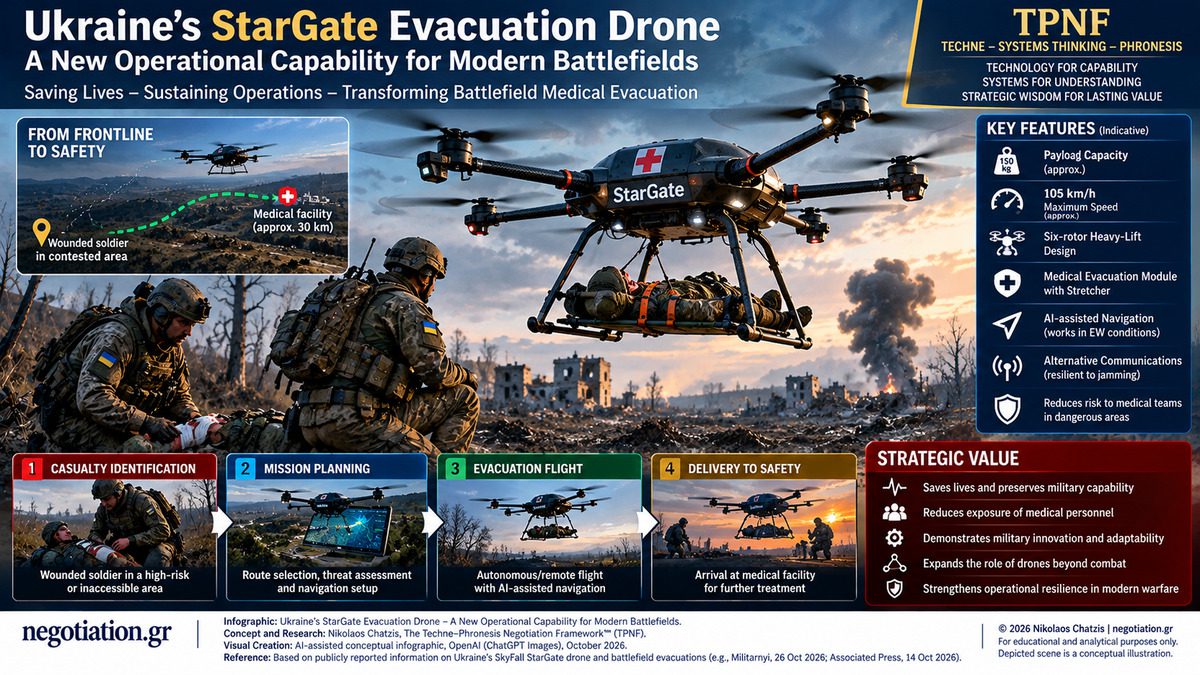
The system is a six-rotor unmanned aircraft fitted with a medical evacuation module built around a stretcher.
According to its developer, StarGate can carry approximately 150 kilograms, including a wounded soldier and equipment.
Its reported maximum speed is 105 kilometers per hour.
The system combines remote piloting with artificial intelligence-assisted navigation and alternative communication capabilities.
These features are intended to support operations when electronic warfare disrupts satellite navigation or communications.
Its significance lies in its mission-specific design.
Unlike an ordinary cargo drone adapted for occasional rescue operations, StarGate was developed to transport wounded personnel from dangerous or inaccessible positions.
This represents a potential shift from improvised battlefield adaptation toward specialized unmanned medical aviation.
2. October 2026: Initial Operational Success
On 26 October 2026, Ukraine’s 475th Separate Assault Regiment, CODE 9.2, reported two successful casualty evacuations conducted over approximately one week.
The rescued soldiers were identified as Yevhen, call sign Izium, and Artem, call sign Kolobok.
Both had sustained serious limb injuries while positioned in contested territory near the Russian border.
Ground evacuation was reportedly prevented by difficult terrain, water obstacles, and the threat of Russian attack drones.
During one mission, StarGate reportedly flew nearly 30 kilometers to reach a wounded soldier and approximately the same distance back.
Russian electronic warfare disrupted satellite navigation, but Ukrainian operators reportedly completed the evacuation using the drone’s onboard navigation capabilities.
The operations required coordination among military units and assistance from SkyFall.
These reported successes demonstrate operational feasibility under demanding conditions.
However, the available evidence does not yet establish the system’s reliability across a large number of missions.
TPNF distinction: A successful operational demonstration is evidence of potential strategic value, not proof of mature technological effectiveness.
3. Techne: Creating a New Operational Capability
Within TPNF, Techne represents the practical knowledge, technological resources, and operational capabilities required to achieve an objective.
StarGate integrates several technological elements.
Heavy-lift propulsion enables the transportation of human casualties.
Specialized medical accommodation provides a means of securing the wounded passenger.
Navigation technologies support flight when conventional positioning systems are unavailable.
Remote operation reduces the need to expose evacuation personnel directly to dangerous terrain.
These capabilities address a previously difficult operational problem: transporting wounded soldiers through areas where conventional rescue methods may be impractical.
Yet engineering performance alone is insufficient.
The system must demonstrate acceptable reliability, passenger safety, maintainability, and compatibility with medical procedures.
A drone capable of carrying 150 kilograms is not automatically a safe medical evacuation platform.
Its value depends upon the complete operational system supporting it.
4. Systems Thinking: Battlefield Evacuation as an Integrated Ecosystem
The evacuation of a wounded soldier involves far more than transportation.
It requires casualty identification, medical assessment, communication, mission planning, aircraft availability, safe loading, transit, reception, and continued treatment.
Every component influences the outcome.
An advanced drone may become ineffective if medical personnel cannot prepare the casualty for transport.
Similarly, successful flight does not guarantee improved survival if definitive treatment remains unavailable.
Systems thinking therefore evaluates the entire evacuation chain.
StarGate must operate alongside ground medical teams, command structures, maintenance personnel, communication networks, and receiving medical facilities.
Its effectiveness also depends on environmental conditions, enemy activity, and the availability of alternative evacuation methods.
TPNF principle: The value of an innovative platform depends upon the effectiveness of the ecosystem into which it is integrated.
5. Phronesis: Strategic Wisdom and the Protection of Human Life
Phronesis concerns the exercise of practical judgment under uncertainty.
For battlefield evacuation, this means determining when unmanned aerial extraction offers a better balance of risks than available alternatives.
A drone may reduce exposure for rescue personnel while introducing other dangers.
Mechanical failure, severe weather, communications disruption, and the absence of medical care during flight may threaten the patient.
Consequently, commanders and medical personnel must evaluate whether the expected benefits justify these risks.
Phronesis also requires avoiding technological enthusiasm unsupported by operational evidence.
The objective is not to demonstrate that drones can carry wounded soldiers.
It is to establish whether they can improve casualty outcomes safely and consistently.
This distinction separates innovation as technological achievement from innovation as responsible strategic progress.
6. The Transformation of Battlefield Medical Logistics
StarGate illustrates a wider evolution in military logistics.
Unmanned systems increasingly perform transportation tasks that previously required personnel or crewed vehicles.
Ground robots can deliver supplies and evacuate casualties, but their effectiveness depends upon terrain accessibility.
Aerial platforms may bypass certain physical obstacles.
However, they remain vulnerable to weather, airspace threats, payload limitations, and technical failures.
The emerging military medical ecosystem may therefore combine crewed evacuation vehicles, unmanned ground systems, aerial casualty evacuation drones, and conventional medical facilities.
These technologies should be viewed as complementary rather than universally interchangeable.
The appropriate platform depends upon the patient’s condition, operational environment, distance, and available support.
The strategic objective is to create more evacuation options, not technological dependence upon one system.
7. From Battlefield Innovation to Institutional Capability
One particularly important aspect of the StarGate case concerns organizational adaptation.
Following the reported evacuations, the commander of CODE 9.2 indicated plans to establish a specialized medical aviation element within the regiment’s medical company.
This suggests that the innovation may move beyond individual missions toward an institutionalized operational function.
Such a transition requires trained personnel, maintenance procedures, medical protocols, procurement arrangements, and systematic performance evaluation.
Successful adoption must also address cost.
A technically sophisticated aircraft may be difficult to sustain if production, replacement, training, and maintenance requirements exceed available resources.
Institutional integration is therefore the decisive next stage.
TPNF principle: Technological innovation becomes strategic capability when organizations can reproduce its benefits reliably and sustainably.
8. The Humanitarian Dimension of Military Innovation
Modern military innovation is frequently evaluated through destructive effectiveness.
StarGate introduces a different measure of technological value.
Its intended purpose is to retrieve wounded personnel while reducing the exposure of evacuation teams.
This does not eliminate the military context of the technology.
Nor does it automatically make every deployment medically appropriate.
Nevertheless, it demonstrates that the same technological ecosystem supporting combat operations can also generate life-preserving applications.
This distinction has implications beyond Ukraine.
Future unmanned evacuation systems may eventually support disaster response, remote rescue operations, and emergency transportation in inaccessible environments.
Such civilian applications remain possibilities requiring separate development, testing, and regulation.
9. The TPNF Strategic Value Pathway
StarGate’s development can be represented through the following analytical sequence:
Battlefield Medical Problem → Frontline Operational Requirement → Technological Innovation → Systems Integration → Initial Operational Validation → Institutional Adaptation → Medical Outcome Evaluation → Sustainable Operational Capability
This pathway identifies the stages required to convert an innovative prototype into a mature military medical service.
The October 2026 evacuations provide evidence of initial operational validation.
They do not yet establish the final stages.
Long-term assessment should examine mission reliability, evacuation time, patient outcomes, operational cost, and the risks imposed upon patients and supporting personnel.
These indicators would enable decision-makers to distinguish genuine strategic improvement from isolated technological success.
Strategic Implications
Ukraine’s experience offers lessons for military organizations confronting increasingly dangerous evacuation environments.
First, frontline operational problems can stimulate valuable technological innovation.
Second, unmanned systems may expand evacuation options where conventional vehicles cannot operate.
Third, navigation resilience is important in electronically contested environments.
Fourth, organizational adaptation is necessary to transform successful missions into dependable capabilities.
Finally, military medical innovation should be assessed primarily through its contribution to survival, safety, and operational sustainability.
The strategic significance of StarGate lies not merely in the aircraft itself, but in the possibility of redesigning how wounded personnel are recovered from dangerous battlefields.
Ukraine’s StarGate represents a promising development in modern battlefield casualty evacuation.
Its reported October 2026 missions demonstrate that specialized aerial drones can retrieve wounded soldiers under conditions that obstruct conventional evacuation.
Nevertheless, successful initial missions must be followed by rigorous evaluation before claims of mature operational effectiveness are justified.
TPNF reveals the deeper lesson.
Technology creates a new capability.
Systems thinking determines how that capability interacts with military medicine and operational logistics.
Phronesis ensures that innovation serves the responsible protection of human life.
The ultimate measure of battlefield innovation is not technological sophistication alone, but the sustainable human and strategic value it creates.
Key Takeaways
- StarGate demonstrates a promising new application of heavy-lift unmanned aerial systems.
- Its reported October 2026 missions provide initial evidence of battlefield feasibility.
- AI-assisted navigation may improve resilience under electronic warfare conditions.
- Safe casualty evacuation requires integration with medical and operational systems.
- Institutional adaptation is essential for reliable and repeatable deployment.
- The strategic value of evacuation technology must be measured through patient safety, survival, and sustainability.
Author’s Reflection
The history of warfare is often written through the development of technologies designed to defeat an adversary.
Yet one of the most meaningful applications of military innovation may be the ability to retrieve a wounded human being from a battlefield that rescuers can no longer safely enter.
StarGate illustrates this possibility.
Its ultimate significance will depend not on the novelty of its design, but on whether it can repeatedly transform technological capability into lives saved.
For TPNF, this is an essential expression of strategic wisdom: recognizing that the preservation of human life is itself a form of lasting strategic value.
Nikolaos Chatzis
Research Sources — October 2026
Associated Press — 15 October 2026
Exclusive reporting on SkyFall’s StarGate development, technical characteristics, frontline testing, and early reliability concerns.
Read Associated Press investigation
AP News
Ukraine’s Ministry of Defence / ArmyInform — 28 October 2026
Official reporting on the emerging casualty evacuation drone category, Brave1 innovation support, and the StarGate system.
Read official Ukrainian report
ArmyInform
The Kyiv Independent — 26 October 2026
Reporting on the two evacuations, the participating regiment, and the electronic warfare conditions.
Read battlefield evacuation report
The Kyiv Independent
Source: Open Sources Analysis, Relative Data Analysis by Nikos Chatzis
© Nikolaos Chatzis. All Rights Reserved.
The Techne–Phronesis Negotiation Framework™
An Integrative Theory of Strategic Negotiation, Complex Adaptive Systems and Practical Wisdom
Technology Creates Capability • Systems Thinking Creates Understanding • Strategic Wisdom Creates Lasting Value.
Negotiation.gr | Strategic Wisdom for the Technological Age