Negotiation.gr | Strategic Wisdom for the Technological Age
“Strategic resilience emerges when technical capability (techne) is
continuously guided by practical wisdom (phronesis) through adaptive
negotiation across interconnected systems.”
Strategic Theory and International Relations | October 2026
Central Idea (Thesis)
International law establishes the legitimacy of rights, but the integration of credible capabilities, systemic understanding, and strategic wisdom determines whether those rights become effective security outcomes.
The Techne–Phronesis Negotiation Framework™ (TPNF) proposes that legal legitimacy acquires lasting strategic value when states convert it into credible deterrence, effective negotiation leverage, institutional resilience, and sustainable security without abandoning the legal principles they seek to defend.
Purpose
This TPNF essay identifies the strategic instruments that enable states to protect legitimate rights when confronted by geopolitical coercion. It develops a TPNF-based analytical model connecting international law, technology, diplomacy, military capabilities, systems thinking, and practical wisdom.
Abstract
International law provides the normative foundation of international order. Yet its effectiveness often depends upon political institutions, state capabilities, and the willingness of governments to respect or defend established principles.
When geopolitical power challenges legal legitimacy, states confront a strategic dilemma: how can they protect their rights without undermining the rules-based order?
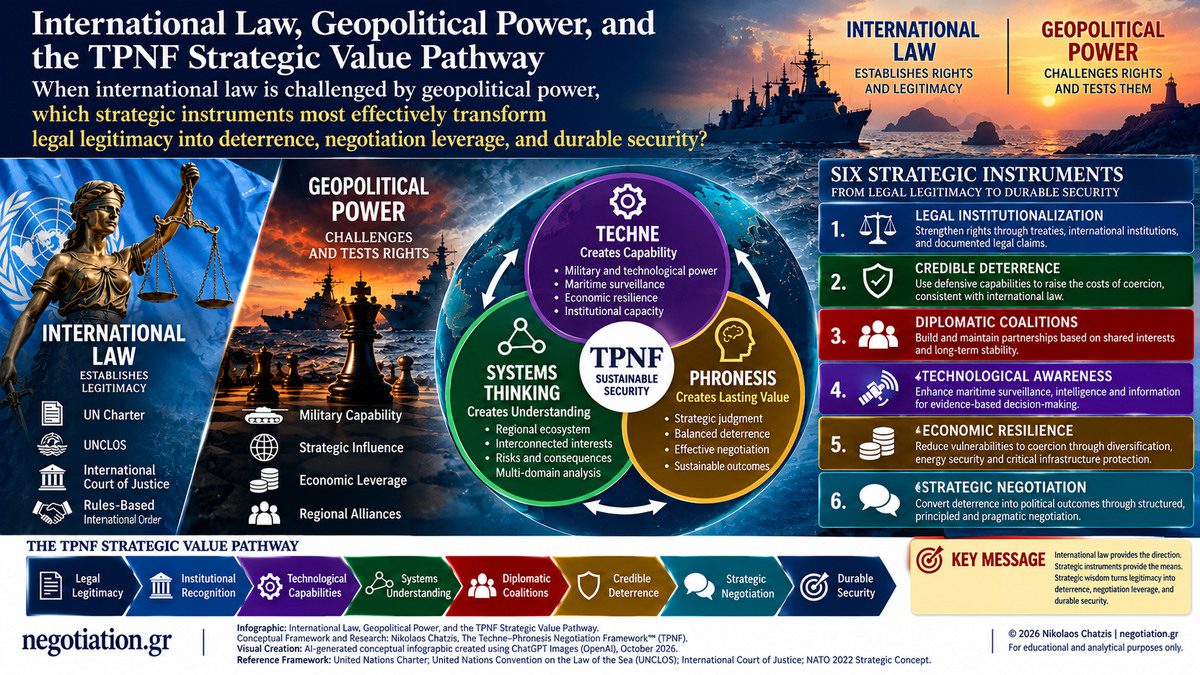
TPNF identifies six mutually reinforcing instruments: legal institutionalization, credible deterrence, diplomatic coalition-building, technological awareness, economic resilience, and strategically structured negotiation.
Their effectiveness depends less on individual strength than on their integration into a coherent system of decision-making.
Introduction: The Strategic Enforcement Gap
The relationship between international law and geopolitical power represents one of the oldest problems in international relations.
Law defines obligations and entitlements. Power influences the behavior of states.
The difficulty emerges when a state possesses a legitimate legal position but lacks sufficient capabilities or political influence to secure compliance.
The United Nations Charter prohibits unlawful threats or uses of force and requires the peaceful settlement of disputes. Nevertheless, international institutions do not operate through a universally available enforcement mechanism comparable to domestic policing.
Even binding judicial decisions may encounter implementation difficulties.
This produces what TPNF identifies as the Legal Legitimacy–Strategic Effectiveness Gap.
Closing this gap requires more than accumulating military strength. It requires understanding how legal, diplomatic, technological, economic, and security instruments interact.
1. Legal Institutionalization: Converting Rights into International Commitments
The first strategic instrument is the systematic institutionalization of legitimate legal claims.
States can strengthen their positions through treaty commitments, documented evidence, diplomatic notifications, international adjudication where jurisdiction exists, and participation in multilateral institutions.
Legal institutionalization makes disputes more transparent and creates reference points against which state behavior can be evaluated.
For maritime disputes, UNCLOS provides a framework for maritime entitlements, delimitation, and dispute settlement.
Articles 74 and 83 encourage agreement-based delimitation and provisional practical arrangements pending final settlement.
However, legal processes must be distinguished from automatic enforcement.
The International Court of Justice generally requires a jurisdictional basis to hear contentious cases. A favorable judgment does not independently guarantee immediate compliance.
TPNF implication: Legal legitimacy becomes more strategically valuable when translated into institutional commitments that raise the diplomatic and reputational costs of non-compliance.
2. Credible Deterrence: Protecting Rights Without Replacing Law
Deterrence is the second instrument.
Its purpose is to influence an adversary’s calculations by making coercive actions appear unlikely to succeed or too costly to undertake.
Two principal mechanisms are relevant.
Deterrence by denial reduces the probability that coercion will achieve its objectives.
Deterrence by punishment threatens costs if aggression occurs.
However, deterrence must remain consistent with international legal obligations.
The possession of military capabilities does not authorize unlawful threats or uses of force.
A strategically responsible approach emphasizes defensive readiness, proportionality, clarity of purpose, and credible communication.
For maritime security, deterrence may involve surveillance, defensive naval presence, infrastructure protection, and cooperation with partners.
The essential question is whether capabilities reinforce legitimate policy objectives rather than becoming independent drivers of confrontation.
TPNF principle: Deterrence is strategically effective when capability, credibility, communication, and lawful purpose reinforce one another.
3. Diplomatic Coalitions: Transforming Individual Rights into Shared Interests
The third instrument is diplomatic coalition-building.
A legal claim supported by one state may carry greater strategic influence when other governments recognize that its protection also serves their interests.
Coalitions can increase diplomatic visibility, distribute political costs, and discourage unilateral attempts to change established arrangements.
However, coalitions cannot be evaluated merely by counting participating states.
Their effectiveness depends upon the depth of shared interests, institutional commitments, and willingness to act.
A partnership built around a temporary disagreement may dissolve when circumstances change.
A partnership based on overlapping economic, security, and institutional interests is potentially more durable.
Systems thinking is therefore essential.
States must identify not only who supports their position but also why that support exists and under what conditions it might weaken.
TPNF implication: Sustainable diplomatic leverage derives from the quality of interconnected interests, not simply the number of political declarations.
4. Technology and Intelligence: Creating Strategic Awareness
The fourth instrument is technological and informational capability.
Satellites, maritime surveillance systems, artificial intelligence, secure communications, and intelligence analysis can improve situational awareness.
Such technologies enable governments to monitor developments, identify emerging risks, document incidents, and evaluate competing courses of action.
They also support evidence-based diplomacy.
Reliable information may help distinguish routine activities from coercive behavior and reduce the likelihood of decisions based on incomplete assessments.
Nevertheless, information superiority does not automatically produce strategic superiority.
A government may possess extensive surveillance capabilities while misunderstanding an adversary’s political intentions.
Artificial intelligence can accelerate analysis without resolving questions of legitimacy, proportionality, or acceptable risk.
Technology creates options.
Strategic wisdom determines which options should be exercised.
5. Economic Resilience: Reducing Vulnerability to Coercion
The fifth instrument is economic and institutional resilience.
Geopolitical coercion frequently exploits dependencies involving energy, trade, investment, infrastructure, and supply chains.
A state heavily dependent upon a single external provider may find its diplomatic choices constrained.
Diversification, critical infrastructure protection, energy security, and financial resilience can reduce these vulnerabilities.
Economic resilience also strengthens deterrence by denial.
If coercive pressure cannot easily disrupt essential national functions, its expected effectiveness declines.
However, economic measures must be designed carefully.
Sanctions, export restrictions, and other instruments may impose costs on third parties and create unintended consequences.
TPNF therefore evaluates economic tools according to legality, proportionality, systemic effects, and long-term strategic value.
The objective is not economic isolation but greater freedom of responsible political action.
6. Strategic Negotiation: Converting Deterrence into Political Outcomes
The sixth instrument is structured negotiation.
Deterrence may prevent an adversary from achieving immediate objectives, but it does not necessarily resolve the underlying dispute.
Negotiation provides the mechanism through which competing interests can be transformed into arrangements that reduce uncertainty and create mutual commitments.
Successful negotiation requires identifying stakeholders, interests, alternatives, incentives, and credible commitments.
States should distinguish between rights that cannot legitimately be surrendered and practical arrangements that may reduce tension without prejudicing legal positions.
For example, provisional maritime arrangements may facilitate cooperation while preserving disagreement over final boundaries.
This distinction is strategically important.
Negotiation need not imply acceptance of an opposing legal interpretation.
Equally, refusing all dialogue may eliminate opportunities to reduce risk.
TPNF principle: Deterrence creates strategic space; negotiation converts that space into potentially sustainable political arrangements.
7. Systems Thinking: Why Individual Instruments Are Insufficient
The six instruments do not operate independently.
Legal institutionalization strengthens diplomatic credibility.
Diplomatic partnerships may improve deterrence.
Technology supports awareness and documentation.
Economic resilience reduces vulnerability.
Negotiation creates opportunities to transform temporary stability into durable commitments.
Yet poorly coordinated instruments may undermine one another.
An aggressive military signal may weaken diplomatic support.
Economic pressure may alienate potential partners.
Public declarations may create expectations that available capabilities cannot sustain.
Systems thinking identifies these relationships before decisions are implemented.
Within TPNF, the central analytical task is to determine how the entire strategic ecosystem behaves under pressure.
The effectiveness of a national strategy depends upon the coherence of its instruments and the adaptability of the institutions employing them.
8. Phronesis: The Decisive Instrument of Strategic Judgment
The final integrating element is Phronesis: practical wisdom exercised under uncertainty.
Strategic decision-makers must evaluate competing objectives, anticipate consequences, and distinguish between actions that demonstrate power and actions that generate lasting value.
Three questions are particularly important.
First, does the proposed action strengthen the state’s legitimate position?
Second, does it improve deterrence or negotiation leverage without creating disproportionate escalation risks?
Third, will its consequences remain beneficial after the immediate confrontation ends?
These questions prevent military capability, diplomatic prestige, or technological sophistication from becoming ends in themselves.
Phronesis also requires restraint.
Restraint is not necessarily weakness; when supported by credible capability, it may preserve flexibility and strengthen legitimacy.
The objective is not to win every confrontation.
It is to protect essential interests while preserving conditions for future security and cooperation.
9. The TPNF Strategic Value Pathway
The relationship between international law and strategic power can be expressed through the following sequence:
Legal Legitimacy → Institutional Recognition → Technological and Defensive Capabilities → Systems Understanding → Diplomatic Coalition-Building → Credible Deterrence → Structured Negotiation → Phronesis → Durable Security
This pathway represents an analytical model rather than an automatic progression.
Some stages may occur simultaneously, while others require continuous reassessment.
The decisive transformation occurs when legitimate rights are supported by credible capabilities and translated into sustainable political commitments.
TPNF therefore distinguishes three outcomes:
Deterrence: preventing coercive actions.
Negotiation leverage: increasing the ability to secure acceptable agreements.
Durable security: creating conditions under which rights remain protected without continuous crisis escalation.
Strategic Implications
For states confronting revisionist pressures, three strategic priorities emerge.
First, legal legitimacy must be preserved as the foundation of policy.
Second, credible capabilities must be integrated with diplomacy and institutional resilience.
Third, negotiations must seek sustainable arrangements rather than symbolic victories.
The Eastern Mediterranean offers an important application.
Greece’s maritime positions, Turkey’s competing claims, Libya’s political relationships, and the interests of Egypt, Cyprus, and the European Union form an interconnected strategic system.
No individual instrument can resolve every contradiction.
The strategic requirement is to integrate lawful claims, credible security measures, regional partnerships, and diplomatic initiatives into a coherent long-term approach.
International law does not become irrelevant when challenged by geopolitical power.
Nor does military strength automatically establish legal legitimacy.
The fundamental strategic problem is how to transform legitimate rights into effective and sustainable protection.
TPNF identifies the answer in the integration of law, capabilities, systems understanding, and practical wisdom.
Technology creates capability. Systems Thinking creates understanding. Strategic Wisdom creates lasting value.
The most effective strategy does not replace international law with power.
It employs legitimate, credible, and carefully coordinated instruments to create conditions in which international law can remain effective.
Key Takeaways
- Legal legitimacy requires institutional and strategic support.
- Credible deterrence must reinforce lawful objectives.
- Diplomatic coalitions are strongest when based on durable shared interests.
- Technology improves awareness but cannot replace political judgment.
- Economic resilience reduces exposure to coercion.
- Negotiation transforms temporary deterrence into possible lasting agreements.
- Phronesis integrates all instruments into sustainable security.
Author’s Reflection
The true test of strategic wisdom is not whether a state possesses sufficient power to challenge its adversaries.
It is whether that state can employ its capabilities without undermining the principles that justify their use.
International law provides the normative direction.
Technology, diplomacy, and deterrence provide instruments.
Systems thinking reveals their interdependence.
Phronesis determines whether their combined application produces enduring security or merely postpones the next confrontation.
Nikolaos Chatzis
Research References
The theoretical analysis is supported by the following primary legal and strategic documents.
United Nations Charter — Articles 2, 33 and 51
The legal foundations of peaceful dispute settlement, the prohibition of unlawful threats or uses of force, and the inherent right of self-defense.
United Nations
United Nations Convention on the Law of the Sea — Articles 74 and 83
Maritime delimitation, equitable solutions, and provisional arrangements pending agreement.

static.un.org+1
International Court of Justice — UN Charter Article 94
Compliance with judgments and the possible role of the Security Council when obligations remain unfulfilled.
ICJ and UN Charter — Chapter XIV
United Nations
NATO — 2022 Strategic Concept
An established strategic model linking deterrence and defense, crisis management, cooperative security, and resilience.
NATO Topic
Source: Open Sources Analysis, Relative Data Analysis by Nikos Chatzis
© Nikolaos Chatzis. All Rights Reserved.
The Techne–Phronesis Negotiation Framework™
An Integrative Theory of Strategic Negotiation, Complex Adaptive Systems and Practical Wisdom
Technology Creates Capability • Systems Thinking Creates Understanding • Strategic Wisdom Creates Lasting Value.
Negotiation.gr | Strategic Wisdom for the Technological Age