Negotiation.gr | Strategic Wisdom for the Technological Age
“Strategic resilience emerges when technical capability (techne) is
continuously guided by practical wisdom (phronesis) through adaptive
negotiation across interconnected systems.”
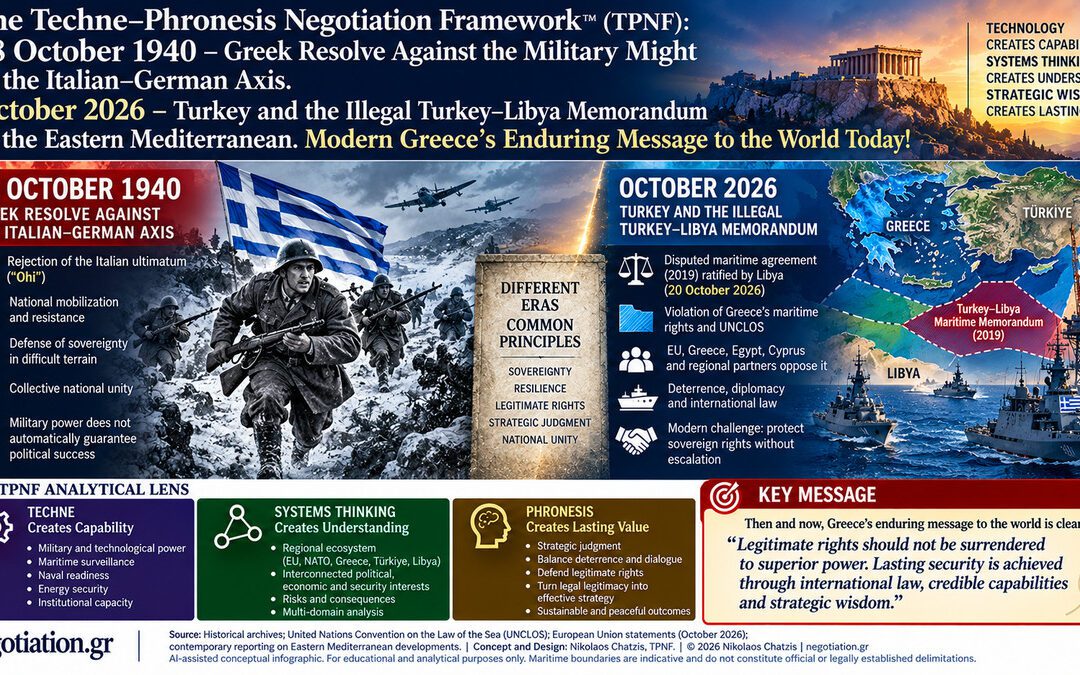
An Anniversary Essay on National Resolve, International Law, and Strategic Wisdom
28 October 2026
Central Idea (Thesis)
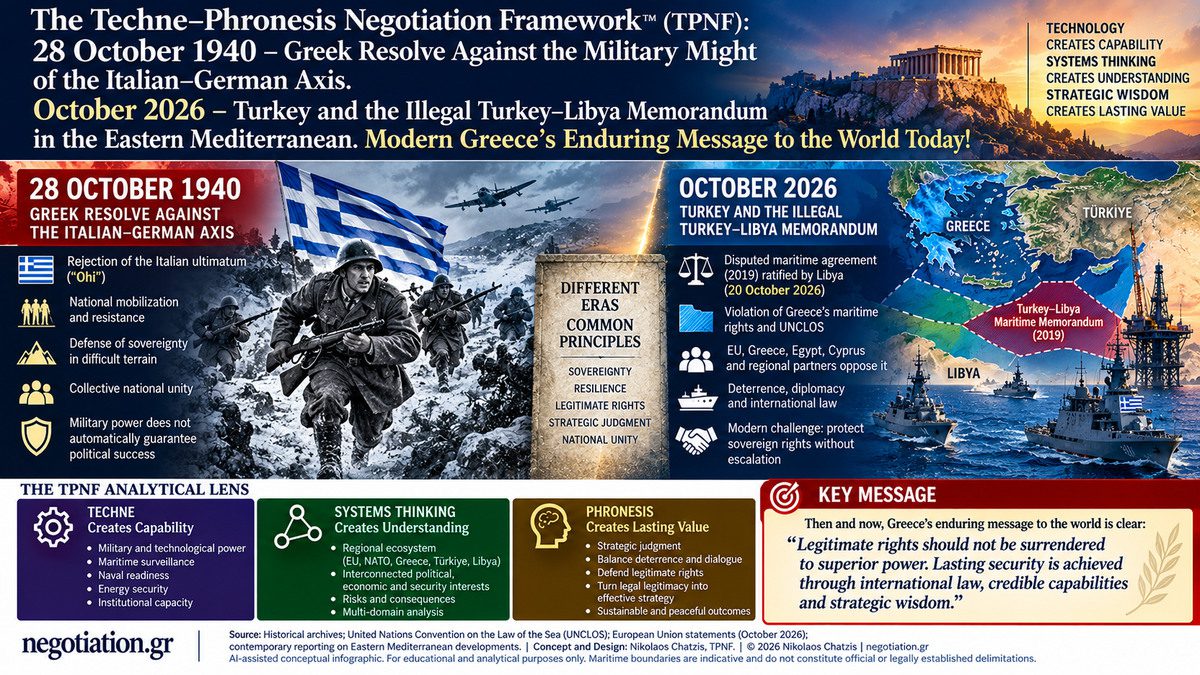
The enduring message of 28 October 1940 is that military superiority does not automatically confer political legitimacy or guarantee strategic success.
Eighty-six years later, Greece confronts a different challenge: defending its maritime rights against the disputed Turkey–Libya Memorandum.
Through the Techne–Phronesis Negotiation Framework™ (TPNF), the historical comparison reveals a fundamental principle: national sovereignty requires the integration of legitimate rights, credible capabilities, collective resilience, and strategic wisdom.
Purpose of the Essay
This TPNF essay examines the strategic significance of Greece’s resistance to Fascist Italy in 1940 and considers its relevance to the Eastern Mediterranean maritime dispute in October 2026.
It distinguishes historical military aggression from contemporary legal and diplomatic confrontation while identifying lessons concerning sovereignty, deterrence, national resilience, and international legitimacy.
Abstract
On 28 October 1940, Greece rejected an Italian ultimatum demanding military access and occupation of strategic positions. Its subsequent resistance demonstrated how political determination, military preparedness, and national cohesion could challenge a materially stronger aggressor.
In October 2026, Libya’s parliamentary ratification of the 2019 Turkey–Libya Maritime Memorandum revived tensions over maritime jurisdiction.
Although the circumstances differ fundamentally, both cases raise an enduring strategic question: how can a state protect its legitimate rights when confronted by a more powerful actor?
TPNF identifies the answer in the relationship between Techne, Systems Thinking, and Phronesis.
Introduction: The Meaning of Ohi
At approximately 3 a.m. on 28 October 1940, Italian Ambassador Emanuele Grazzi presented Prime Minister Ioannis Metaxas with an ultimatum demanding permission for Italian forces to occupy strategic positions in Greece.
Metaxas rejected the demand.
The famous national expression Ohi—No—became the symbol of Greece’s refusal to surrender its sovereignty.
The original exchange was conducted in French, but the political meaning was unmistakable.
Italy attacked shortly afterward.
The Greek response was not merely rhetorical. Mobilization, military resistance, and popular determination transformed refusal into action.
The anniversary commemorates that collective resistance, without requiring an uncritical assessment of the authoritarian Metaxas regime.
Its enduring significance lies in the defense of national independence against foreign aggression.
1. October 1940: Military Power Meets National Resolve
Fascist Italy expected its invasion to achieve rapid political and military results.
Instead, Greek forces resisted and subsequently advanced into Italian-held Albania.
Several factors contributed to this outcome.
Greek commanders understood the mountainous terrain. Defensive preparations supported resistance. Mobilization generated substantial military participation, while Italian planning and operational performance suffered important weaknesses.
National determination mattered, but it was not sufficient by itself.
Geography, logistics, command decisions, and the adversary’s mistakes also influenced events.
This distinction is essential for TPNF.
Courage creates strategic value when connected to organization, capabilities, and informed judgment.
Greek resistance demonstrated that numerical and material advantages cannot be evaluated independently of operational circumstances and political commitment.
2. April 1941: The Limits of Resolve Without Sufficient Capabilities
The historical narrative must also acknowledge what followed.
Germany invaded Greece on 6 April 1941, after the Italian campaign had failed to secure its objectives.
Greek and Allied forces resisted, but Germany’s military capabilities and operational advantages contributed to the eventual occupation.
Greece’s resistance did not prevent defeat or the suffering that followed.
This reality does not diminish the significance of 1940.
It makes the strategic lesson more complete.
National resolve can frustrate an aggressor, but resolve alone cannot guarantee victory against overwhelming military capabilities.
For TPNF, this illustrates the relationship between determination and strategic sustainability.
The defense of sovereignty requires both the willingness to resist and the practical means to sustain resistance.
3. October 2026: A Different Challenge to Greek Sovereign Rights
On 27 November 2019, Turkey and Libya’s Government of National Accord signed a memorandum delimiting maritime jurisdiction areas in the Mediterranean.
Greece rejected the agreement because it disregards maritime entitlements claimed by Greek islands, including Crete and Rhodes.
On 20 October 2026, Libya’s House of Representatives approved the memorandum, reversing its earlier opposition.
The European Union reaffirmed its position that the agreement violates third-state sovereign rights, conflicts with the law of the sea, and cannot produce legal consequences for third states.
Greece, Egypt, Cyprus, Bahrain, the United Arab Emirates, and the European Union subsequently expressed collective opposition.
Turkey maintains that its maritime position is legitimate.
The dispute therefore involves competing legal interpretations, geopolitical interests, and regional diplomatic alignments.
Importantly, a maritime memorandum is not equivalent to a military invasion.
The relevant contemporary instruments are international law, diplomacy, economic policy, maritime capabilities, and deterrence.
4. International Law: The Foundation of Legitimate Rights
UNCLOS provides the principal treaty framework governing maritime zones.
Article 121 recognizes maritime entitlements for islands, subject to its specific provisions.
Articles 74 and 83 address delimitation between states with overlapping exclusive economic zone and continental shelf claims.
International law distinguishes the existence of maritime entitlements from the precise boundaries established through delimitation.
Turkey is not a party to UNCLOS, but relevant customary international law may apply independently of treaty participation.
A bilateral agreement cannot, without consent, extinguish the rights of third states.
This principle is central to Greece’s objections.
Nevertheless, legal legitimacy does not automatically guarantee practical protection.
International legal arguments require diplomatic effectiveness, institutional support, and credible national capabilities.
The strategic challenge is converting lawful rights into sustainable outcomes.
5. Techne: From Military Preparedness to Modern Capabilities
In TPNF, Techne represents practical knowledge and operational capability.
In 1940, Techne included defensive preparation, military organization, logistics, command decisions, and adaptation to difficult terrain.
In 2026, the relevant capabilities are considerably broader.
They include maritime surveillance, satellite intelligence, naval readiness, secure communications, diplomatic expertise, and technological infrastructure.
Modern Greece possesses instruments unavailable to the generation of 1940.
However, advanced technology does not automatically create strategic effectiveness.
A modern naval force cannot independently establish legal legitimacy.
A sophisticated surveillance system cannot replace diplomatic judgment.
Technology becomes valuable when integrated into a coherent national strategy.
TPNF principle: Technology creates capability, but capability requires legitimate purpose and strategic direction.
6. Systems Thinking: Greece Within a Wider Strategic Ecosystem
The Greece of 1940 operated within the emerging global conflict of the Second World War.
Its military resistance interacted with British support, Axis calculations, Balkan geography, and wider Allied strategy.
Modern Greece operates within a different institutional environment.
It belongs to the European Union and NATO and maintains important regional relationships.
Its maritime interests intersect with those of Cyprus, Egypt, Libya, Turkey, and other Mediterranean actors.
These relationships create both opportunities and constraints.
European solidarity strengthens diplomatic legitimacy, but institutional declarations require effective implementation.
Regional partnerships can improve negotiating leverage, but their durability depends on shared interests.
NATO membership provides a collective security framework while also placing Greece and Turkey within the same alliance.
Systems thinking therefore prevents the reduction of complex geopolitical challenges to a simple confrontation between two states.
7. Phronesis: The Strategic Wisdom of National Resolve
Phronesis concerns practical wisdom: choosing effective action under uncertainty.
In 1940, Greece faced an ultimatum threatening its territorial sovereignty.
Refusal carried enormous risks, but acceptance would have meant permitting foreign military occupation.
In 2026, the strategic choices are different.
Greece must defend its maritime rights while avoiding unnecessary escalation.
This requires legal consistency, credible deterrence, regional diplomacy, and careful evaluation of competing interests.
Strategic wisdom distinguishes firmness from impulsiveness.
Firmness protects essential interests.
Impulsiveness can transform manageable disagreements into dangerous confrontations.
The modern expression of national resolve should therefore combine principled resistance to unlawful claims with a commitment to peaceful dispute settlement.
The lesson of Ohi is not permanent confrontation. It is the refusal to surrender legitimate rights through intimidation.
8. The TPNF Historical–Strategic Value Pathway
The comparison can be expressed through two related pathways.
1940:
National Sovereignty → Political Resolve → Military Mobilization → Operational Resistance → Collective National Resilience
2026:
Maritime Rights → International Legal Legitimacy → Technological and Institutional Capabilities → Regional Partnerships → Credible Deterrence → Strategic Negotiation → Durable Security
These pathways are analytical models, not claims that the two situations are historically equivalent.
Their common element is the transformation of legitimate national objectives into organized strategic action.
Their principal difference lies in the instruments available and the nature of the challenge.
In 1940, Greece confronted invasion.
In 2026, it confronts a disputed maritime agreement and its geopolitical consequences.
TPNF identifies the continuity of strategic principles without confusing distinct historical realities.
9. Greece’s Enduring Message to the International Community
The anniversary of 28 October offers a message extending beyond Greece.
International relations cannot be governed sustainably by the assumption that stronger states may disregard the legitimate rights of others.
Military power, economic influence, and diplomatic pressure are realities of international politics.
But they do not automatically establish lawful entitlement.
For smaller and medium-sized states, international law provides essential protection against arbitrary power.
For the international community, consistent respect for legal principles contributes to predictability and stability.
Modern Greece’s strategic message should therefore combine three commitments:
Defense of sovereign rights.
Respect for international law.
Peaceful settlement supported by credible national capabilities.
This approach is neither passive nor unnecessarily confrontational.
It is an expression of responsible strategic autonomy.
Conclusion: From the Ohi of 1940 to Strategic Wisdom in 2026
The Greek resistance of October 1940 remains an enduring example of national determination against aggression.
Its historical significance rests not on a romantic assumption that courage guarantees victory, but on the demonstrated willingness of a society to defend its independence.
In October 2026, Greece faces a fundamentally different challenge in the Eastern Mediterranean.
The appropriate response requires neither historical imitation nor military adventurism.
It requires the integration of international law, technological capability, diplomatic partnerships, credible deterrence, and practical judgment.
The enduring message of 28 October is that legitimate rights should not be surrendered to superior power.
TPNF adds a contemporary requirement: those rights must be defended through intelligent, coordinated, and sustainable strategy.
Technology creates capability. Systems Thinking creates understanding. Strategic Wisdom creates lasting value.
Key Takeaways
- The Greek resistance of 1940 demonstrates the importance of national resolve and operational preparedness.
- Germany’s subsequent occupation illustrates the limits of determination without sufficient capabilities.
- The Turkey–Libya memorandum raises legal and geopolitical questions fundamentally different from wartime invasion.
- International law establishes rights, while diplomacy and credible capabilities help protect them.
- Regional partnerships strengthen strategic options when grounded in durable shared interests.
- Phronesis transforms national resolve into proportionate, sustainable strategic action.
Author’s Reflection
The greatest tribute to the generation of 1940 is not to repeat its language without understanding its circumstances.
It is to preserve its commitment to national independence while applying the knowledge, institutions, and strategic instruments available today.
Greece honors its history most effectively when it combines courage with judgment, sovereignty with international law, and national determination with responsibility.
The message remains relevant beyond Greece: legitimate rights deserve protection, and lasting security requires more than power alone.
Nikolaos Chatzis
Selected Research Sources
The historical and contemporary sections can be supported by the following references:
-
Hellenic Army — 28 October 1940 and the Greco-Italian War. Official historical account of the ultimatum and Greek mobilization.
Army.gr
-
National Army Museum — War in the Balkans, 1941–1945. Historical analysis of the German invasion on 6 April 1941.
National Army Museum
-
European Union — Official Statement, 21 October 2026. The EU’s legal and diplomatic position following Libya’s ratification.
Consilium
-
Reuters — 27 October 2026. Reporting on the joint diplomatic opposition by Greece, Egypt, Bahrain, and the UAE.
-
United Nations — UNCLOS. Articles 74, 83, and 121 concerning maritime delimitation and island entitlements.
Source: Open Sources Analysis, Relative Data Analysis by Nikos Chatzis
© Nikolaos Chatzis. All Rights Reserved.
The Techne–Phronesis Negotiation Framework™
An Integrative Theory of Strategic Negotiation, Complex Adaptive Systems and Practical Wisdom
Technology Creates Capability • Systems Thinking Creates Understanding • Strategic Wisdom Creates Lasting Value.
Negotiation.gr | Strategic Wisdom for the Technological Age