Negotiation.gr | Strategic Wisdom for the Technological Age
“Strategic resilience emerges when technical capability (techne) is
continuously guided by practical wisdom (phronesis) through adaptive
negotiation across interconnected systems.”
Central Idea (Thesis)
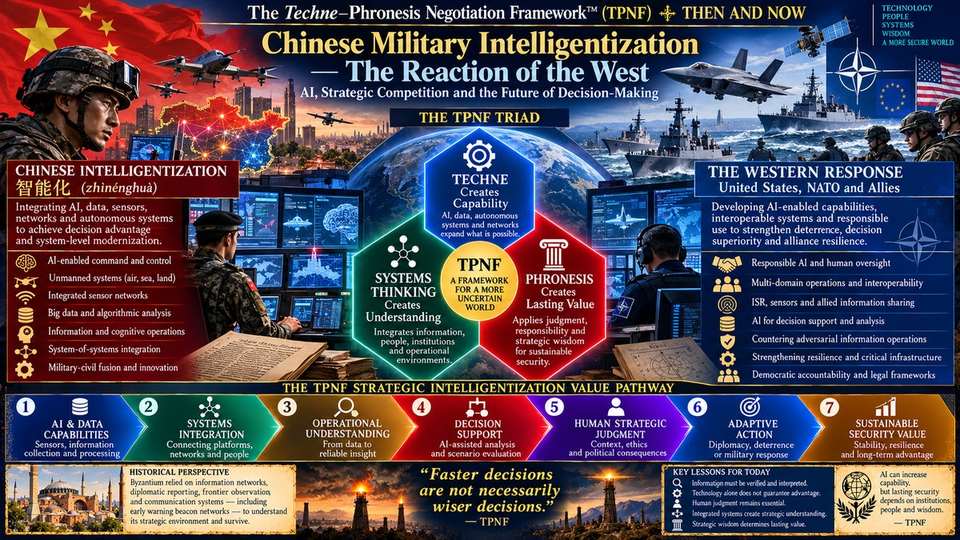
China’s concept of intelligentization (智能化, zhìnénghuà) represents more than the introduction of artificial intelligence into military operations. It expresses an ambition to reorganize warfare around data, algorithms, interconnected systems, autonomous capabilities and accelerated decision-making.
Western governments are responding through AI-enabled defense modernization, multi-domain operations, digital interoperability and responsible human-machine collaboration.
The Techne–Phronesis Negotiation Framework™ (TPNF) identifies the central strategic challenge:
Artificial intelligence creates capability. Systems Thinking converts interconnected technologies into operational understanding. Strategic Wisdom determines whether accelerated decisions generate lasting security or dangerous instability.
Purpose of the Essay
This TPNF essay examines the meaning of Chinese military intelligentization, its relationship to the People’s Liberation Army’s modernization, and the responses emerging within the United States and NATO.
It evaluates whether intelligentization represents a technological revolution, an organizational transformation or a new form of strategic competition.
Abstract
Chinese military discussions increasingly describe intelligentization as an important stage in the evolution of warfare.
The concept encompasses AI-assisted command, intelligence processing, autonomous systems, information confrontation and cognitive-domain operations.
Western responses emphasize decision advantage, interoperability, digital transformation and the responsible integration of emerging technologies.
TPNF suggests that the decisive variable is not technological sophistication alone, but the interaction of technological capability, organizational integration and human strategic judgment.
Introduction: A New Vocabulary of Warfare
Military history has repeatedly introduced concepts intended to describe transformations in the character of conflict.
Mechanization emphasized machines and industrial mobility.
Informatization emphasized information networks, surveillance and command systems.
Intelligentization adds algorithmic analysis, machine-assisted decision-making and increasing degrees of autonomy.
Chinese military discourse frequently presents these developments as interconnected stages of modernization.
However, the emergence of a new strategic vocabulary does not automatically demonstrate the successful transformation of military institutions.
Understanding intelligentization requires examining both its technological ambitions and its organizational limitations.
What Does Intelligentization Mean?
The Chinese term zhìnénghuà broadly refers to the process of making systems more intelligent through advanced computational and automated capabilities.
In military discussions, it includes applications of artificial intelligence to sensing, information processing, command support, unmanned platforms and operational coordination.
Its meaning is broader than autonomous weapons.
The ambition is to connect increasingly capable machines with information networks and military organizations.
The resulting system would ideally identify relevant developments, evaluate options and support decisions faster than traditional command arrangements.
Yet intelligentization remains an evolving concept rather than a universally standardized military doctrine.
From Informatization to Intelligentization
Informatized warfare emphasizes the collection, distribution and exploitation of information.
Intelligentized warfare seeks to extract operational advantage from that information through algorithmic interpretation and adaptive systems.
The distinction is important.
A military organization may possess sophisticated sensors and communications networks without effectively interpreting the information they produce.
AI potentially assists by detecting patterns, combining data and supporting decisions under time pressure.
However, increased processing speed cannot compensate automatically for unreliable information or poorly structured institutions.
Intelligentization therefore depends upon the quality of the entire decision-making ecosystem.
The PLA’s Technological Ambitions
Chinese military modernization includes substantial investment in unmanned systems, advanced sensors, electronic warfare, cyber capabilities and AI-related applications.
Research examining PLA procurement requests from 2023–2024 identifies interest in decision-support tools, sensor enhancement, data fusion and surveillance.
These documents demonstrate institutional priorities and acquisition ambitions.
They do not establish that every proposed capability has been successfully deployed.
This distinction is essential.
Technological aspirations must be evaluated separately from demonstrated operational performance.
Decision Advantage and Command Transformation
A central promise of intelligentization is improved decision speed.
Algorithms may assist commanders by identifying threats, processing intelligence and comparing possible responses.
In theory, such systems could shorten the interval between detection and action.
But military decision-making involves more than technical optimization.
Commanders must interpret political objectives, anticipate adversary reactions and assess consequences.
An algorithm may produce a rapid recommendation without understanding the broader strategic implications.
The critical question becomes whether intelligentization improves judgment or merely accelerates existing weaknesses.
Cognitive Warfare and Strategic Perception
Chinese discussions also examine competition within the cognitive domain.
Information manipulation, deception, psychological influence and AI-generated content may affect how adversaries interpret events.
The objective can extend beyond damaging physical capabilities to influencing perceptions and decisions.
However, cognitive warfare is not uniquely Chinese.
Information operations and psychological warfare have long histories across different military traditions.
AI changes their potential scale, speed and sophistication.
It also creates vulnerabilities involving fabricated information, manipulated evidence and misplaced confidence in automated assessments.
The Western Response: United States and NATO
Western governments are pursuing related technological transformations, although their terminology and institutional frameworks differ.
The United States emphasizes decision advantage, joint integration and AI-enabled military capabilities.
NATO emphasizes multi-domain operations, interoperable information systems, technological innovation and responsible AI adoption.
Its revised AI strategy, released in July 2024, addresses responsible use, interoperability and adversarial exploitation.
The Alliance Digital Strategy of January 2026 explicitly connects digital transformation with information superiority and human-machine collaboration.
Western modernization is therefore not simply a reaction to Chinese terminology.
It reflects independent technological developments and evolving security requirements.
Different Strategic Approaches
China’s intelligentization discourse often emphasizes military modernization, system-level competition and opportunities to overcome established technological advantages.
NATO’s institutional approach places particular emphasis on interoperability among sovereign allies, collective defense and agreed principles of responsible use.
These differences reflect political and organizational structures.
However, neither side should be treated as technologically uniform.
China faces difficulties integrating new capabilities across complex institutions.
Western alliances face their own problems involving procurement delays, fragmented systems and competing national priorities.
Both confront the challenge of converting technological innovation into reliable operational capability.
Techne: Technology Creates Capability
The first TPNF dimension states:
Technology Creates Capability.
AI can expand the capacity to analyze information, identify patterns and support complex operations.
Autonomous platforms can perform selected tasks without continuous direct human control.
Advanced computing can accelerate planning and simulation.
Yet capabilities remain conditional upon data quality, secure infrastructure, technical reliability and effective training.
Technology expands what an institution may accomplish.
It does not guarantee successful outcomes.
Systems Thinking: Integration Creates Understanding
The second TPNF dimension states:
Systems Thinking Creates Understanding.
Intelligentization is fundamentally a systems-integration challenge.
Sensors, communications networks, algorithms, commanders and operational units must function within a coherent architecture.
Failures can propagate across interconnected systems.
Incorrect data may influence automated assessments.
Cyber disruption may undermine communications.
Organizational fragmentation may prevent timely coordination.
Systems Thinking identifies these dependencies and evaluates how technical and institutional components interact.
The strategic value of AI depends not merely on individual algorithms, but on the reliability and adaptability of the ecosystem connecting them.
Phronesis: Strategic Wisdom in Algorithmic Warfare
The third TPNF dimension states:
Strategic Wisdom Creates Lasting Value.
Faster decisions are not necessarily better decisions.
In military crises, accelerated responses may reduce opportunities for verification, consultation and de-escalation.
Human judgment remains essential when assessing political intentions, legal responsibilities and escalation risks.
Strategic wisdom requires distinguishing operational efficiency from strategic success.
A technically effective military action can produce politically damaging consequences.
Consequently, intelligentization must be evaluated against the broader objectives of security, stability and responsible decision-making.
The TPNF Intelligentization Value Pathway
The relationship can be expressed through the following analytical progression:
AI and Data Capabilities → Systems Integration → Operational Understanding → Decision Support → Human Strategic Judgment → Adaptive Action → Sustainable Security Value
AI generates analytical possibilities.
Systems integration connects capabilities.
Operational understanding establishes context.
Decision support identifies alternatives.
Human judgment evaluates consequences.
Adaptive action responds to changing circumstances.
Sustainable value depends upon whether these actions advance legitimate strategic objectives without creating disproportionate risks.
This is a proposed TPNF analytical pathway, not an official Chinese or NATO doctrine.
Strategic Implications
Intelligentization may reshape military competition, but its outcomes remain uncertain.
Technological investment must be accompanied by institutional reform.
Human-machine cooperation requires realistic testing and clearly defined responsibilities.
Data integrity and cyber resilience become strategic priorities.
Interoperability matters as much as individual platform performance.
Diplomacy must also address the risks associated with accelerated, opaque and potentially destabilizing decision systems.
The ultimate competition may concern the quality of national and allied decision-making ecosystems rather than possession of the largest number of AI-enabled platforms.
Chinese intelligentization expresses an ambitious vision of warfare shaped by artificial intelligence and interconnected systems.
Western governments are responding with their own approaches to AI integration, digital transformation and multi-domain coordination.
Yet technological convergence does not imply identical strategic cultures or institutional capabilities.
TPNF provides a framework for understanding the deeper challenge.
Technology Creates Capability. Systems Thinking Creates Understanding. Strategic Wisdom Creates Lasting Value.
The future strategic advantage will not necessarily belong to the military that automates decisions most rapidly.
It may belong to the institutions that combine technological sophistication with reliable integration, critical evaluation and responsible strategic judgment.
Key Takeaways
- Intelligentization is broader than military AI or autonomous weapons.
- China’s ambitions emphasize system-level integration and decision advantage.
- Procurement evidence demonstrates priorities, not necessarily deployed capabilities.
- NATO and the United States pursue related but institutionally distinct approaches.
- Faster information processing does not guarantee better strategic decisions.
- Systems integration, data reliability and organizational competence are decisive.
- Strategic wisdom remains essential for crisis stability and responsible action.
Author’s Reflection
The concept of intelligentization raises a question extending far beyond military technology.
Are societies becoming strategically wiser as their machines become more capable?
China’s technological ambitions and the Western response reveal an accelerating competition to process information and make decisions.
Yet technological acceleration may exceed the ability of institutions to understand its consequences.
This creates a fundamental strategic challenge.
Human judgment must develop alongside artificial intelligence.
Institutions must learn to integrate new capabilities without surrendering responsibility for their decisions.
The greatest strategic risk is not that machines will become increasingly intelligent, but that human institutions may confuse technological intelligence with strategic wisdom.
Nikolaos Chatzis
Research References and Sources
The following sources provide a strong foundation for the essay, including recent Chinese military research and official Western strategic documents.
1. NATO Defense College, September 2026. Decoding the Dragon — A Language-Based Analysis of China’s Vision of AI Warfare. Particularly relevant because it analyzes Chinese strategic texts, scientific publications, media and PLA-linked procurement records from 2000–2025.
2. Georgetown University, Center for Security and Emerging Technology, February 2026. China’s Military AI Wish List. An empirical examination of PLA procurement requests revealing interest in AI decision support, sensor integration, targeting and surveillance.
3. Asia-Pacific Leadership Network, May 2026. China and AI-Military Integration: Perspectives, Opportunities, and Challenges. Discusses China’s transition toward intelligentization and its technological and organizational implications.
4. U.S. National Defense University, Joint Force Quarterly. Is the PLA Overestimating the Potential of Artificial Intelligence?. Evaluates Chinese military expectations alongside technical limitations, organizational weaknesses and risks.
5. NATO, January 2026. Alliance Digital Strategy. An important primary source connecting AI, data-centric operations, human-machine collaboration and decision superiority.
6. NATO, July 2024. NATO Releases Revised Artificial Intelligence Strategy. Establishes NATO’s emphasis on interoperability, responsible AI use and protection against adversarial applications.
7. U.S. Army War College, May 2026. Decision Advantage Through Intelligentization by 2035. Offers an especially useful assessment: the PLA may achieve temporary decision advantages without necessarily attaining sustained decision dominance.
Source: Open Sources Analysis, Relative Data Analysis by Nikos Chatzis
© Nikolaos Chatzis. All Rights Reserved.
The Techne–Phronesis Negotiation Framework™
An Integrative Theory of Strategic Negotiation, Complex Adaptive Systems and Practical Wisdom
Technology Creates Capability • Systems Thinking Creates Understanding • Strategic Wisdom Creates Lasting Value.
Negotiation.gr | Strategic Wisdom for the Technological Age