Negotiation.gr | Strategic Wisdom for the Technological Age
“Strategic resilience emerges when technical capability (techne) is
continuously guided by practical wisdom (phronesis) through adaptive
negotiation across interconnected systems.”
The November 11 Maiden Flight and the Challenge of Long-Term Multidimensional Value Creation
TPNF Research Essay | Renewable Energy, Unmanned Aviation and Technological Adaptability | November 12, 2026
Central Idea (Thesis)
The successful maiden flight of China’s Light Cavalry solar-powered drone on November 11, 2026, represents an important development in the relationship between renewable energy, unmanned aviation, and commercial technological innovation.
Through the Techne–Phronesis Negotiation Framework™ (TPNF), its significance extends beyond aircraft performance.
The central strategic challenge is transforming solar-powered flight capability into reliable, economically viable, and environmentally responsible aviation services.
This transformation requires integrating Techne (Capability), Systems Thinking (Understanding), and Phronesis (Strategic Wisdom) to generate sustainable multidimensional value.
Purpose
This TPNF essay examines the Light Cavalry’s technological characteristics, intended commercial applications, and potential implications for China’s unmanned aviation ecosystem.
It evaluates how renewable-energy technologies may contribute to operational adaptability, institutional learning, and long-term value creation.
Abstract
China’s Light Cavalry, developed by the China Academy of Aerospace Aerodynamics under the China Aerospace Science and Technology Corporation (CASC), completed its maiden flight on November 11, 2026.
The aircraft is designed to operate entirely on solar energy, with a maximum intended endurance of 30 hours.
Its modular architecture supports different mission payloads, while rapid deployment may increase operational flexibility.
The development illustrates opportunities and challenges associated with integrating renewable energy into commercial unmanned aviation.
TPNF offers a complementary framework for evaluating its technological, economic, institutional, and societal implications.
1. Light Cavalry: A New Chinese Aviation Development
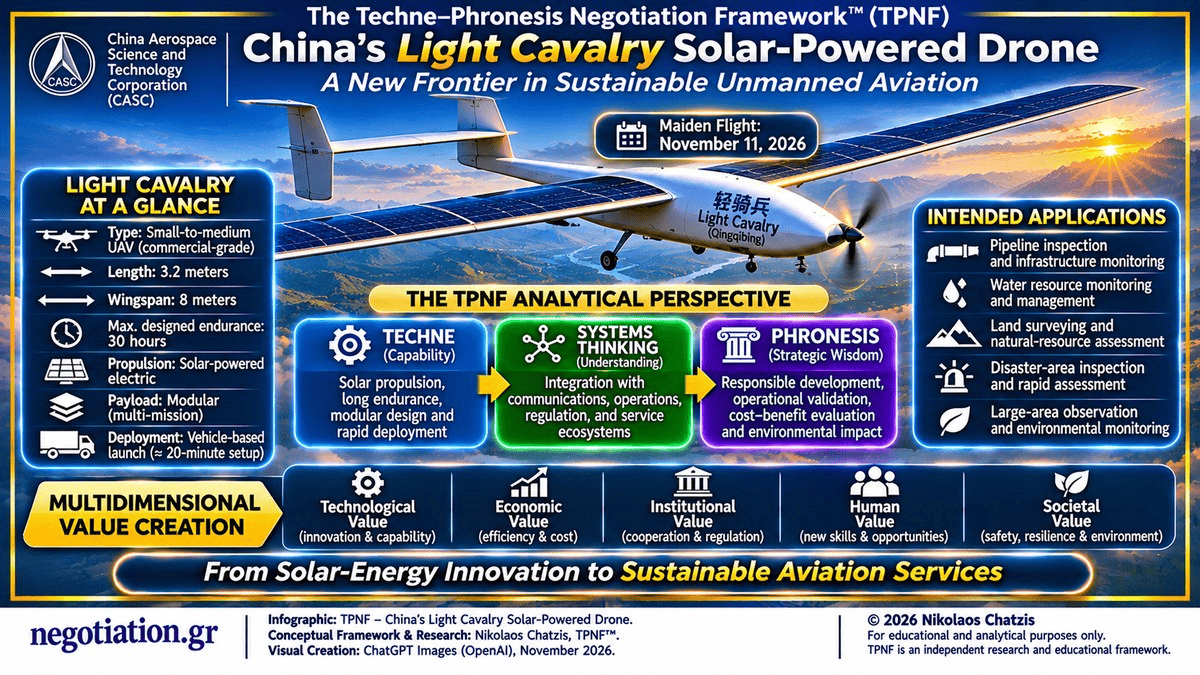
According to Xinhua, Light Cavalry is a small-to-medium-sized, commercial-grade solar-powered unmanned aerial vehicle.
Its development emphasizes long endurance, low operating costs, rapid deployment, and practical commercial applications.
The announced specifications include:
| Characteristic | Reported specification |
|---|---|
| Developer | China Academy of Aerospace Aerodynamics, CASC |
| Maiden flight | November 11, 2026 |
| Aircraft length | 3.2 meters |
| Wingspan | 8 meters |
| Maximum designed endurance | 30 hours |
| Propulsion energy | Solar-powered electric |
| Ground preparation | Approximately 20 minutes |
| Payload architecture | Modular |
| Deployment | Vehicle-based launch capability |
The 30-hour endurance figure represents a design objective, not a publicly verified continuous-flight achievement.
This distinction is essential when evaluating the aircraft’s technological maturity.
2. Techne: Solar Energy as Aviation Capability
Within TPNF, Techne represents practical knowledge, technological competence, and the capacity to accomplish defined objectives.
Light Cavalry demonstrates the application of solar-energy technologies to unmanned aviation.
Solar-powered aircraft convert sunlight into electrical energy, enabling propulsion and supporting onboard systems.
Energy storage may allow continued operation when sunlight becomes insufficient.
However, the aircraft’s actual performance depends upon solar radiation, weather conditions, aerodynamic efficiency, payload requirements, and energy-management capabilities.
The technological challenge involves balancing available energy against operational demands.
A successful design must therefore integrate aerodynamics, electrical systems, flight control, and mission equipment.
The maiden flight represents an initial milestone in this integration.
3. Systems Thinking: Beyond the Aircraft
A solar-powered drone cannot be evaluated exclusively through its propulsion technology.
Commercial operations require interaction among aircraft systems, communications infrastructure, regulatory authorities, operators, customers, and maintenance organizations.
For example, a drone inspecting long-distance pipelines must collect reliable information, communicate with ground systems, and operate safely within applicable airspace restrictions.
Its endurance becomes valuable only when the wider operational system can utilize it effectively.
Systems Thinking emphasizes these relationships.
Within TPNF, the Light Cavalry’s strategic significance depends upon its integration into functioning service ecosystems.
Technological capability is necessary, but insufficient by itself.
4. Phronesis: Responsible Technological Development
Phronesis represents practical wisdom and responsible judgment.
Renewable-energy aviation offers attractive opportunities, but technological enthusiasm must not replace evidence-based evaluation.
A solar-powered aircraft may reduce dependence upon conventional fuel while introducing limitations associated with weather, energy storage, and operational reliability.
Decision-makers must evaluate these trade-offs.
Questions include whether the aircraft can complete intended missions consistently, whether its economic benefits justify investment, and whether operations meet appropriate safety requirements.
Environmental claims also require consideration of manufacturing, batteries, maintenance, and eventual disposal.
Phronesis encourages responsible decisions based upon demonstrated performance rather than technological expectations alone.
5. The Strategic Importance of Long Endurance
Flight endurance is an important characteristic of unmanned aviation.
Conventional battery-powered drones often face operational limitations requiring frequent landing and recharging.
Solar energy offers a potential pathway toward longer missions.
Light Cavalry’s maximum designed endurance of 30 hours could support extended observation and inspection activities if demonstrated under relevant operating conditions.
Long endurance may reduce the frequency of aircraft recovery and redeployment.
However, endurance must be considered alongside payload capacity, operating altitude, weather resilience, and communications reliability.
A longer flight is valuable only when it produces useful operational results.
6. Modular Design and Technological Adaptability
The aircraft’s modular architecture is intended to accommodate different mission payloads, including communications and remote-sensing equipment.
This design philosophy may improve adaptability.
Rather than developing a separate aircraft for every application, operators could potentially configure one platform for multiple purposes.
Modularity may also support maintenance, technological upgrades, and future commercial development.
Nevertheless, payload flexibility introduces engineering requirements.
Different equipment configurations affect weight, energy consumption, aerodynamic performance, and operational characteristics.
TPNF interprets modularity as a potential source of strategic value when supported by reliable systems integration and appropriate validation.
7. Commercial Applications and China’s Low-Altitude Economy
Light Cavalry’s developers identify several intended applications.
These include pipeline inspection, water infrastructure monitoring, land surveying, natural-resource assessment, disaster-area inspection, and large-area observation.
Such activities often require coverage of extensive geographical regions.
A long-endurance drone could potentially reduce certain operational costs compared with repeated short-duration missions.
China’s broader low-altitude economy encompasses commercial activities involving drones and other aircraft operating at relatively low altitudes.
Light Cavalry may contribute to this developing ecosystem.
However, commercial success depends upon customer demand, regulatory permissions, operational reliability, and competitive costs.
The maiden flight alone does not establish market viability.
8. Environmental Sustainability and Aviation Innovation
Solar-powered aviation connects aerospace engineering with renewable-energy development.
Its potential environmental advantages include reduced dependence upon conventional aviation fuel and lower direct operational emissions.
However, environmental sustainability requires a broader assessment.
Solar cells, batteries, structural materials, manufacturing processes, and maintenance activities all have environmental consequences.
Operational efficiency must therefore be evaluated across the aircraft’s lifecycle.
TPNF encourages distinguishing technological sustainability claims from measurable environmental outcomes.
The relevant question is not merely whether an aircraft uses renewable energy.
It is whether its complete operational ecosystem creates demonstrable environmental and societal benefits.
9. China’s Aerospace Innovation Ecosystem
CASC represents an important component of China’s aerospace industrial and research capabilities.
The development of Light Cavalry illustrates the potential transfer of aerospace knowledge into commercial aviation applications.
Such technological transfer can connect research institutions, manufacturers, infrastructure operators, and service providers.
It may also support the development of specialized professional skills and commercial supply chains.
Nevertheless, translating research achievements into sustainable products requires production quality, maintenance support, regulatory compliance, and customer confidence.
Systems Thinking highlights the importance of these institutional relationships.
10. The Challenge of Practical Strategic Adaptation
Technological innovation becomes strategically meaningful when it can respond effectively to changing operational requirements.
Light Cavalry’s proposed combination of endurance, modularity, and rapid deployment suggests potential adaptability.
However, different missions create different requirements.
Disaster assessment may prioritize rapid availability and reliable imaging.
Infrastructure inspection may emphasize endurance and repeatable data collection.
Environmental monitoring may require specialized sensors and consistent measurement quality.
A successful commercial platform must balance these competing objectives.
Within TPNF, practical strategic adaptation connects technological capabilities with actual operational needs.
11. Multidimensional Value Creation
The aircraft’s potential value can be examined through five dimensions.
Technological value: Advances in solar propulsion, energy management, and modular aircraft integration.
Economic value: Potential improvements in inspection efficiency and operational costs.
Institutional value: Cooperation among research organizations, regulators, manufacturers, and service providers.
Human value: New technical competencies and professional opportunities.
Societal value: Potential improvements in infrastructure monitoring, disaster assessment, and environmental observation.
These benefits remain prospective until demonstrated through operational evidence.
12. The TPNF Strategic Value Pathway
The development can be examined through the following progression:
Solar-Energy Capability → Aircraft Integration → Operational Validation → Modular Applications → Ecosystem Coordination → Commercial Adaptation → Sustainable Multidimensional Value
This pathway distinguishes technological achievement from commercial and societal outcomes.
The maiden flight represents an early stage.
Further testing, operational experience, and institutional coordination will determine whether the aircraft advances through subsequent stages.
Strategic Lessons for Leaders
- Evaluate renewable-energy aircraft through demonstrated operational performance.
- Connect technological endurance with practical mission requirements.
- Treat modularity as a systems-integration challenge.
- Examine economic and environmental value across the complete operational lifecycle.
- Strengthen cooperation among aviation research, industry, and regulatory institutions.
- Convert technological experimentation into measurable commercial and societal benefits.
The maiden flight of China’s Light Cavalry represents a promising development in commercial solar-powered unmanned aviation.
Its intended endurance, modular architecture, and rapid deployment capabilities suggest opportunities for new aviation services.
However, technological potential must be distinguished from validated operational performance.
Through TPNF, the aircraft illustrates how Techne, Systems Thinking, and Phronesis can contribute to evaluating emerging aviation technologies.
Its lasting significance will depend upon whether renewable-energy capability can be transformed into reliable, responsible, and economically sustainable services.
Key Takeaways
Light Cavalry completed its maiden flight on November 11, 2026.
Its maximum designed endurance is 30 hours.
The aircraft emphasizes solar propulsion, modular payloads, and rapid deployment.
Commercial and environmental benefits require further validation.
TPNF connects technological capability with ecosystem integration and responsible strategic adaptation.
Author’s Reflection
The development of solar-powered aviation demonstrates how technological innovation can challenge established operational limitations.
Yet the most important achievement is not simply extending flight endurance.
It is understanding how new capabilities can contribute to practical human needs.
For TPNF, the Light Cavalry offers an opportunity to examine the relationship between renewable energy, technological adaptability, and sustainable value creation.
The ultimate measure of progress will be whether such technologies improve operational effectiveness while contributing responsibly to economic development, environmental sustainability, and societal well-being.
Nikolaos Chatzis
Research Sources
The following contemporary reports establish the aircraft’s identity, developer, first-flight date, announced specifications, and intended applications.
-
Xinhua, November 11, 2026: Original reporting on Light Cavalry’s maiden flight, 8-meter wingspan, 30-hour designed endurance, modular payloads, and vehicle-based launch.
xinhuanet.com+1
-
Xinhua, English-language report: Confirms the commercial positioning, solar-only electric propulsion, and proposed applications.
XINHUA NEWS – ဆင်ဟွာသတင်း
-
China Aerospace Academy reporting, November 12, 2026: Additional reporting on rapid deployment and modular research capabilities.
news.metal.com
Source: Open Sources Analysis, Relative Data Analysis by Nikos Chatzis
© Nikolaos Chatzis. All Rights Reserved.
The Techne–Phronesis Negotiation Framework™
An Integrative Theory of Strategic Negotiation, Complex Adaptive Systems and Practical Wisdom
Technology Creates Capability • Systems Thinking Creates Understanding • Strategic Wisdom Creates Lasting Value.
Negotiation.gr | Strategic Wisdom for the Technological Age