Negotiation.gr | Strategic Wisdom for the Technological Age
“Strategic resilience emerges when technical capability (techne) is
continuously guided by practical wisdom (phronesis) through adaptive
negotiation across interconnected systems.”
Central Idea (Thesis)
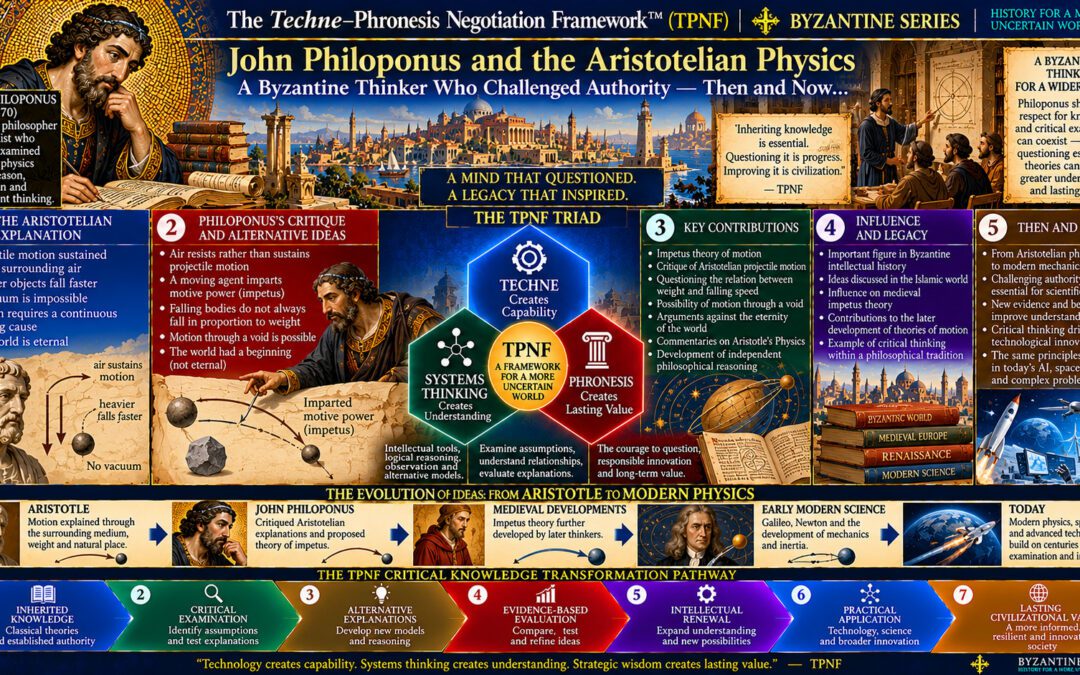
John Philoponus represents a decisive intellectual transition: from preserving established scientific authority toward critically examining its assumptions.
Working in sixth-century Alexandria, within the Eastern Roman Empire, Philoponus challenged important elements of Aristotle’s physics through logical argument, observation and alternative explanations.
His achievement illustrates a fundamental principle of the Techne–Phronesis Negotiation Framework™ (TPNF):
Knowledge creates intellectual capability; Systems Thinking reveals the relationships and assumptions underlying established explanations; strategic wisdom enables societies to question inherited models and develop more effective understanding.
Purpose of the Essay
This twelfth essay in the TPNF Byzantine Series examines John Philoponus’s contributions to natural philosophy, particularly his criticism of Aristotelian theories of motion.
It explores how inherited scientific knowledge can become the foundation for intellectual innovation rather than unquestioned authority.
The essay also investigates functional parallels between Philoponus’s reasoning and contemporary scientific inquiry, technological development and strategic decision-making.
Abstract
John Philoponus, approximately 490–570 CE, was a philosopher, commentator and theologian associated with the Alexandrian intellectual tradition.
Although educated within Neoplatonic Aristotelian scholarship, he challenged established explanations of projectile motion, falling bodies and the possibility of motion through empty space.
His proposed theory of imparted motive power represented an important departure from conventional Aristotelian dynamics.
TPNF interprets his intellectual contribution as a case of critical knowledge transformation: inherited ideas were examined, challenged and reorganized into alternative explanatory models.
Introduction: When Intellectual Authority Becomes a Constraint
Civilizations depend upon accumulated knowledge.
Yet established knowledge can become an obstacle when intellectual authority discourages criticism.
Aristotle’s natural philosophy shaped scientific thinking for many centuries.
His writings offered systematic explanations of movement, causation, matter and the structure of the physical world.
However, systematic explanations are not necessarily correct.
John Philoponus recognized that even an influential philosophical tradition must remain open to examination.
His work demonstrates the importance of distinguishing respect for intellectual inheritance from unconditional acceptance of inherited conclusions.
Alexandria: An Intellectual Environment of Continuity and Debate
Philoponus studied under Ammonius, son of Hermias, an influential teacher associated with the Neoplatonic school of Alexandria.
His early intellectual activity included commentaries on Aristotle.
These works initially reflected the educational practices of late antique philosophical scholarship.
However, Philoponus increasingly developed independent arguments challenging established positions.
His intellectual career also intersected with Christian theological controversies.
He should be situated within the broader late antique Eastern Roman intellectual world rather than presented as a Constantinopolitan court scholar.
His importance lies in demonstrating that philosophical criticism remained possible within this complex intellectual environment.
Aristotle’s Explanation of Projectile Motion
Aristotle maintained that motion required an appropriate moving cause.
In his explanation of projectile motion, the surrounding medium helped sustain movement after the projectile separated from its original mover.
For example, air was understood to contribute to the continued flight of a thrown object.
Philoponus challenged this explanation.
Why should air sustain motion when it also resists the movement of an object passing through it?
The problem exposed an apparent contradiction within the established model.
Rather than accepting the explanation because of Aristotle’s authority, Philoponus examined whether it adequately described observable phenomena.
Philoponus and the Theory of Impetus
Philoponus proposed that a moving agent imparts a motive power to a projectile.
This imparted power enables the object to continue moving after direct contact with the original mover ends.
The theory represented an important conceptual departure from Aristotle’s explanation.
The continued motion of the projectile no longer depended upon the surrounding air pushing it forward.
However, Philoponus believed that the imparted motive power was gradually exhausted.
His explanation was therefore not equivalent to Newton’s later principle of inertia.
Nevertheless, it created an alternative conceptual framework for investigating motion.
The strategic intellectual achievement was not a complete modern theory, but the identification of weaknesses in an authoritative explanation and the construction of a competing model.
Falling Bodies and the Role of Observation
Philoponus also criticized Aristotle’s account of falling bodies.
Aristotelian physics associated the speed of natural falling motion with the weight of the object and the resistance of the surrounding medium.
Philoponus argued that bodies with substantially different weights did not necessarily fall at speeds proportional to their weights.
He appealed to observable comparisons involving falling objects.
His reasoning anticipated questions later investigated systematically in early modern physics.
However, these observations should not be confused with Galileo’s later mathematical and experimental investigations.
Philoponus contributed an important criticism, not a fully developed modern account of gravitational acceleration.
The Possibility of Motion Through a Void
Aristotle rejected the existence of a vacuum and developed arguments against motion through empty space.
Philoponus challenged aspects of this position.
If air resisted rather than sustained projectile motion, the absence of air need not make movement impossible.
His reasoning opened conceptual space for reconsidering motion without a surrounding material medium.
This was a significant philosophical development.
It demonstrated how revising one assumption could alter an entire explanatory system.
Beyond Physics: The Eternity of the World
Philoponus also challenged the Aristotelian position that the world had existed eternally.
In works including Against Proclus on the Eternity of the World, he criticized arguments defending an eternal cosmos.
His position was influenced by Christian commitments concerning creation.
Nevertheless, his arguments also employed philosophical reasoning and criticism of established cosmological assumptions.
This aspect of his work demonstrates the complex interaction between theology, philosophy and scientific explanation in late antiquity.
His cosmological arguments should not be interpreted as modern empirical cosmology.
Techne: Knowledge Creates Intellectual Capability
The first TPNF dimension states:
Technology Creates Capability.
In this case, techne encompasses intellectual techniques: logical analysis, mathematical reasoning, observation and the formulation of explanatory models.
Philoponus inherited a sophisticated philosophical vocabulary.
He understood the established theories he criticized.
This intellectual inheritance provided the capabilities necessary for challenging them.
His case demonstrates that innovation often begins with deep knowledge of an existing system.
Criticism without understanding is rarely productive.
Systems Thinking: Examining the Structure of Scientific Explanations
The second TPNF dimension states:
Systems Thinking Creates Understanding.
Aristotelian physics was not a collection of unrelated propositions.
Its explanations connected motion, matter, place, causation and the surrounding medium.
Philoponus recognized that challenging the role of air in projectile motion had wider implications.
It affected the explanation of continued movement.
It raised questions about the vacuum.
It required reconsideration of the relationship between mover and moving object.
This illustrates a central systems-thinking principle:
A weakness in one foundational assumption may affect the explanatory coherence of an entire intellectual system.
Then and Now: Scientific Paradigms and Technological Innovation
Modern scientific progress frequently involves challenging established explanations.
New evidence may reveal limitations in accepted models.
Alternative hypotheses can generate more accurate predictions.
Improved instruments allow previously inaccessible phenomena to be investigated.
Contemporary examples include developments in artificial intelligence, materials science and aerospace engineering.
However, scientific criticism must remain disciplined.
Not every unconventional hypothesis represents progress.
Alternative explanations require logical consistency, evidence and testing.
The comparison with Philoponus is methodological rather than technological.
He did not practice modern experimental physics.
He demonstrated an important willingness to challenge authority through argument and observation.
Phronesis: Strategic Wisdom and Intellectual Independence
The third TPNF dimension states:
Strategic Wisdom Creates Lasting Value.
Strategic wisdom requires knowing when to preserve established knowledge and when to challenge it.
Uncritical acceptance can perpetuate errors.
Unrestrained rejection can destroy valuable intellectual inheritance.
Philoponus illustrates the productive relationship between these alternatives.
He studied Aristotle carefully before criticizing specific conclusions.
His example suggests that intellectual independence is most valuable when supported by knowledge, disciplined reasoning and openness to correction.
The TPNF Critical Knowledge Transformation Pathway
Philoponus’s intellectual contribution suggests the following progression:
Inherited Knowledge → Critical Examination → Assumption Identification → Alternative Explanation → Evidence-Based Evaluation → Intellectual Renewal → Lasting Scientific Value
Inherited knowledge provides the foundation.
Critical examination identifies weaknesses.
Assumption analysis reveals underlying structures.
Alternative explanations create new possibilities.
Evaluation determines their explanatory strength.
Intellectual renewal expands understanding.
Lasting value emerges when improved knowledge can be transmitted and developed further.
This pathway is a contemporary TPNF interpretation, not a historical doctrine formulated by Philoponus.
Strategic Implications
The Philoponus case suggests important lessons for modern institutions.
First, intellectual authority should not replace evidence.
Second, innovation requires understanding existing theories before challenging them.
Third, systems thinking helps identify assumptions that constrain progress.
Fourth, institutional environments should permit reasoned criticism.
Finally, strategic wisdom requires distinguishing constructive intellectual dissent from unsupported speculation.
John Philoponus occupies an important position in the history of scientific thought.
His criticisms of Aristotelian motion challenged explanations that had long enjoyed philosophical authority.
Although his theories were not equivalent to modern physics, they contributed to the historical development of alternative approaches to motion and causation.
TPNF captures the enduring relationship:
Technology Creates Capability. Systems Thinking Creates Understanding. Strategic Wisdom Creates Lasting Value.
The lasting significance of Philoponus lies in demonstrating that inherited knowledge becomes most productive when societies preserve the freedom to examine, question and improve it.
Key Takeaways
- Philoponus challenged established elements of Aristotelian physics.
- His impetus theory offered an alternative explanation of projectile motion.
- He questioned assumptions concerning falling bodies and the vacuum.
- His theories should not be equated with Newtonian mechanics.
- Intellectual innovation requires both inherited knowledge and critical examination.
- Systems Thinking reveals relationships among foundational assumptions.
- Strategic wisdom connects intellectual independence with disciplined reasoning.
Author’s Reflection
John Philoponus demonstrates that preserving civilization’s intellectual inheritance does not require accepting every inherited conclusion.
The greatest contribution of a scholar may be the willingness to identify where respected authorities were mistaken.
This lesson is particularly relevant in an age of artificial intelligence and accelerating technological change.
Modern institutions possess unprecedented analytical capabilities.
Yet technological sophistication cannot replace independent judgment.
Scientific and strategic progress require individuals capable of questioning assumptions while respecting evidence.
The true strength of an intellectual civilization lies not merely in preserving knowledge, but in maintaining the courage and competence to improve it.
Nikolaos Chatzis
Research References
1. Wildberg, Christian. John Philoponus — Stanford Encyclopedia of Philosophy. A comprehensive scholarly treatment of his intellectual career, criticism of Aristotle, impetus theory, vacuum and cosmology.
2. Aristotle. Physics, particularly Books IV and VIII. Primary source for Aristotelian arguments concerning place, motion, causation and the void. See Aristotle’s Natural Philosophy — Stanford Encyclopedia of Philosophy.
3. Philoponus, John. Commentary on Aristotle’s Physics, especially discussions corresponding to In Phys. 639–642 and 681–684. Primary evidence for his theory of imparted motive power and his criticism of Aristotelian motion.
4. Lindberg, David C. The Beginnings of Western Science. Discussion of Philoponus and the subsequent medieval development of theories of motion.
5. Vatican Observatory (2017). John Philoponus — Impetus. An accessible introduction to Philoponus’s criticism of Aristotle and its place in the history of physics.
Source: Open Sources Analysis, Relative Data Analysis by Nikos Chatzis
© Nikolaos Chatzis. All Rights Reserved.
The Techne–Phronesis Negotiation Framework™
An Integrative Theory of Strategic Negotiation, Complex Adaptive Systems and Practical Wisdom
Technology Creates Capability • Systems Thinking Creates Understanding • Strategic Wisdom Creates Lasting Value.
Negotiation.gr | Strategic Wisdom for the Technological Age