Negotiation.gr | Strategic Wisdom for the Technological Age
“Strategic resilience emerges when technical capability (techne) is
continuously guided by practical wisdom (phronesis) through adaptive
negotiation across interconnected systems.”
TPNF Byzantine Series — Essay XIII | Concluding Essay
Central Idea (Thesis)
The Byzantine Empire’s longevity depended not only on military strength, fortifications and diplomacy, but also on its capacity to acquire, interpret and exploit information.
Through frontier observation, diplomatic reporting, informants, military reconnaissance and communication networks, Byzantine rulers sought to anticipate threats and influence their strategic environment.
The Techne–Phronesis Negotiation Framework™ (TPNF) identifies a fundamental principle:
Information creates potential capability; Systems Thinking transforms dispersed intelligence into strategic understanding; Phronesis converts that understanding into decisions supporting institutional resilience and state survival.
Purpose of the Essay
This concluding TPNF essay examines Byzantine intelligence practices and their relationship with diplomacy, military preparedness and political survival.
It investigates how information moved through institutional networks and how rulers attempted to convert knowledge into strategic advantage.
It also brings together the technological, institutional and philosophical dimensions explored throughout the Byzantine Series.
Abstract
Byzantine rulers operated within a complex geopolitical environment involving rival empires, neighboring kingdoms, frontier societies and internal political competition.
Intelligence gathering supported military operations, diplomatic negotiations and assessments of foreign intentions.
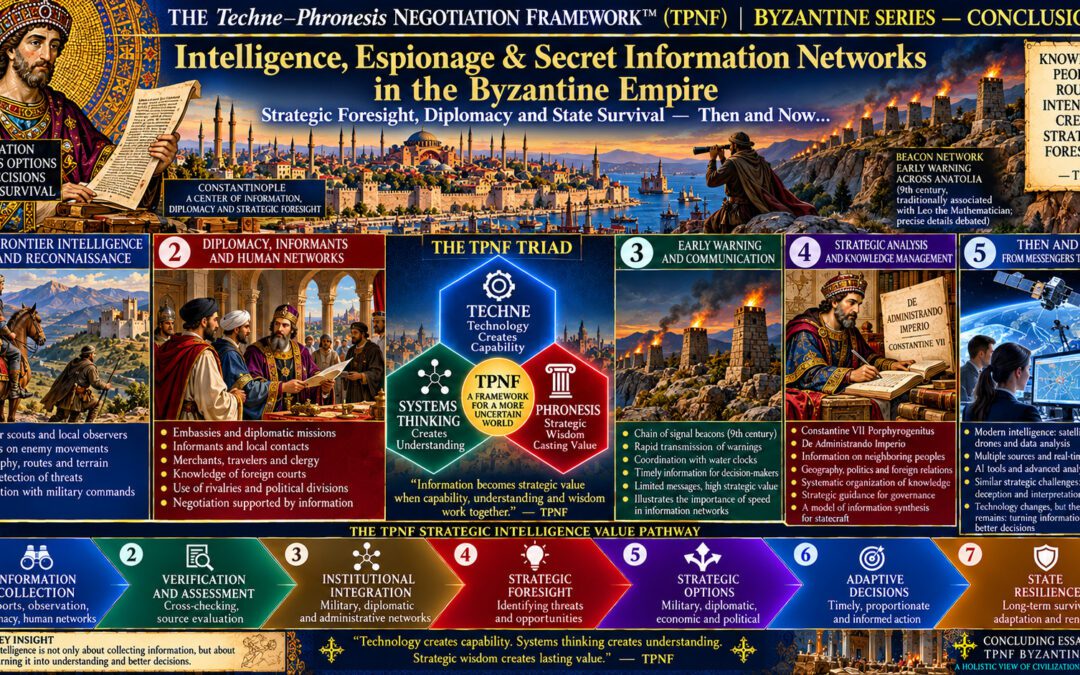
The ninth-century beacon system and Constantine VII’s De Administrando Imperio illustrate different dimensions of information management.
TPNF interprets these practices as historical examples of information-dependent strategic adaptation, while recognizing that Byzantine intelligence was neither centralized nor equivalent to a modern intelligence agency.
Introduction: Survival Through Understanding
For centuries, Byzantium confronted adversaries possessing substantial military and economic resources.
Its strategic environment changed repeatedly.
Persians, Arab caliphates, Bulgarians, steppe peoples, Crusaders and Ottoman forces presented different challenges across different periods.
Military strength remained essential, but military action without adequate information could produce disastrous consequences.
Byzantine rulers therefore needed to understand enemy movements, political divisions, diplomatic opportunities and emerging threats.
The fundamental challenge was not simply collecting information.
It was transforming incomplete and sometimes unreliable reports into useful decisions.
Intelligence Before Modern Intelligence Agencies
Byzantium did not possess a permanently unified intelligence organization comparable to contemporary national intelligence services.
Information was gathered through multiple channels.
Military commanders reported frontier developments.
Ambassadors observed foreign courts.
Merchants and travelers could convey information about neighboring territories.
Informants and spies sometimes operated within hostile environments.
Imperial officials evaluated reports according to their responsibilities and access to political authority.
The evidence does not justify imagining a single empire-wide clandestine organization controlling every intelligence activity.
Instead, Byzantine intelligence operated through overlapping military, diplomatic and administrative relationships.
Diplomacy as an Information Network
Byzantine diplomacy served purposes beyond negotiating agreements.
Diplomatic missions created opportunities to observe foreign rulers, political relationships, military capabilities and competing interests.
Foreign embassies visiting Constantinople also provided opportunities for observation and information exchange.
Imperial officials could use knowledge of rivalries among neighboring peoples to develop diplomatic alternatives.
Alliances, subsidies, ceremonial recognition and negotiated settlements formed part of this strategic repertoire.
Diplomatic effectiveness depended upon understanding the interests and vulnerabilities of other actors.
Information made negotiation more purposeful by revealing where interests converged, diverged or could be reshaped.
Constantine VII: Knowledge as a Strategic Resource
The tenth-century emperor Constantine VII Porphyrogenitus provides particularly important evidence.
His De Administrando Imperio, compiled around the middle of the tenth century, assembled information concerning neighboring peoples, political relationships, geography and diplomatic practices.
Intended for his son Romanos II, it combined inherited knowledge with information relevant to contemporary imperial policy.
The work demonstrates an effort to organize disparate material into guidance for governance.
Its contents were not uniformly accurate or objective.
Nevertheless, it illustrates a significant principle: strategic knowledge becomes more useful when it is systematically organized for decision-makers.
The Byzantine Beacon System: Early Warning and Communication
During the ninth century, Byzantine sources describe a chain of signal beacons connecting the eastern frontier with Constantinople.
The system is traditionally associated with Leo the Mathematician and Emperor Theophilos.
According to later accounts, synchronized water clocks enabled predetermined messages to be communicated through signal fires.
The purpose was to transmit warnings concerning developments along the frontier.
The precise reconstruction, locations and operating procedures remain debated.
Nevertheless, the system illustrates an important strategic relationship:
Early warning is valuable only when information can reach decision-makers rapidly enough to influence their response.
Espionage, Secrecy and Counterintelligence
Intelligence gathering also involved secrecy.
Foreign observers might conceal their intentions.
Military reconnaissance sought information unavailable through ordinary diplomatic communication.
Political authorities needed to protect sensitive plans while evaluating information received from potentially interested or hostile sources.
However, surviving evidence does not permit a complete reconstruction of Byzantine clandestine networks.
Espionage should therefore be distinguished from routine diplomacy, military scouting and ordinary administrative reporting.
Counterintelligence likewise must not be portrayed as a fully documented modern institutional system.
The historical record supports the importance of secrecy and information protection without establishing a comprehensive intelligence bureaucracy.
Strategic Foresight: Anticipation Rather Than Prediction
Strategic foresight does not require perfect prediction.
It requires recognizing emerging possibilities and preparing appropriate responses.
Byzantine decision-makers frequently confronted uncertainty about enemy intentions, alliance stability and military movements.
Information from frontier commanders, diplomats and other sources could help identify alternative scenarios.
Yet intelligence could also be incomplete, delayed or misleading.
Successful anticipation depended upon judgment rather than information volume alone.
This distinction remains central to contemporary strategic planning.
Techne: Technology Creates Capability
The first TPNF dimension states:
Technology Creates Capability.
In Byzantine intelligence, techne included observation techniques, communications infrastructure, recordkeeping and administrative methods.
Beacon signals increased the speed of selected warnings.
Written reports preserved information.
Geographical and political knowledge supported planning.
These capabilities expanded the empire’s capacity to understand developments beyond the imperial capital.
However, collecting information did not automatically produce effective policy.
Systems Thinking: Connecting Dispersed Information
The second TPNF dimension states:
Systems Thinking Creates Understanding.
A frontier warning had to be interpreted alongside military resources, diplomatic relationships and political priorities.
A report about a neighboring ruler acquired greater meaning when connected with alliances, trade interests and internal rivalries.
Intelligence therefore required integration.
Different sources could provide incomplete or contradictory perspectives.
Institutional coordination helped convert isolated observations into a broader assessment.
The central systems-thinking lesson is clear:
Strategic understanding emerges from relationships among information sources, institutions, capabilities and changing circumstances.
Then and Now: Intelligence in the Digital Age
Contemporary intelligence organizations employ satellites, electronic surveillance, cyber capabilities, geospatial analysis and artificial intelligence.
Their technical capabilities vastly exceed those available to Byzantine rulers.
Nevertheless, fundamental strategic problems remain recognizable.
Information must be evaluated.
Sources may be unreliable.
Adversaries may practice deception.
Decision-makers may misunderstand warnings or allow political preferences to distort interpretation.
The historical parallel is functional, not technological.
Byzantine information practices were not modern intelligence operations.
Yet they illustrate enduring difficulties in converting information into sound strategic decisions.
Phronesis: Strategic Wisdom Under Uncertainty
The third TPNF dimension states:
Strategic Wisdom Creates Lasting Value.
Intelligence may reveal threats, but it cannot determine automatically how governments should respond.
Leaders must weigh military action, negotiation, deterrence, accommodation and delay.
They must also consider the reliability of their information and the consequences of mistaken decisions.
Strategic wisdom requires proportionality, institutional responsibility and awareness of uncertainty.
Information becomes valuable when decision-makers use it to select sustainable courses of action.
The TPNF Strategic Intelligence Value Pathway
The Byzantine experience suggests the following analytical progression:
Information Collection → Verification and Interpretation → Institutional Integration → Strategic Foresight → Diplomatic and Military Options → Adaptive Decision-Making → State Resilience
Collection provides observations.
Verification assesses reliability.
Integration establishes relationships.
Foresight identifies plausible developments.
Strategic options expand freedom of action.
Decision-making converts understanding into policy.
Resilience emerges when institutions repeatedly adapt to changing circumstances.
This pathway is a contemporary TPNF interpretation, not a Byzantine intelligence doctrine.
Strategic Implications
The Byzantine experience suggests that intelligence effectiveness depends upon more than secrecy or technological sophistication.
Reliable information requires diverse sources and critical evaluation.
Diplomacy and intelligence can reinforce one another without becoming identical activities.
Early-warning systems must connect with institutions capable of responding.
Strategic planning must acknowledge uncertainty and deception.
Above all, information should expand the quality of decision-making rather than encourage unwarranted confidence.
The Byzantine Empire provides a remarkable historical laboratory for studying technological capability, institutional organization and strategic adaptation.
Its military systems, infrastructure, economic institutions, medical establishments, mechanical technologies and scholarly traditions reveal different dimensions of civilizational resilience.
Intelligence connects these dimensions.
It enabled decision-makers to assess threats, coordinate responses and identify opportunities within a changing geopolitical environment.
Yet intelligence alone did not guarantee survival.
Byzantium ultimately disappeared as a sovereign empire in 1453.
Its history therefore illustrates both the possibilities and limits of strategic adaptation.
Technology Creates Capability. Systems Thinking Creates Understanding. Strategic Wisdom Creates Lasting Value.
The ultimate lesson of the Byzantine Series is not that technology or institutional sophistication guarantees permanence.
It is that civilizations strengthen their prospects for resilience when they transform capabilities and knowledge into informed, coordinated and adaptable strategic action.
Key Takeaways
- Byzantine intelligence operated through overlapping military, diplomatic and administrative networks.
- Diplomatic reporting supported understanding of foreign interests and rivalries.
- Constantine VII’s writings illustrate organized strategic information.
- Beacon systems demonstrate the importance of timely warning.
- Intelligence required interpretation, not merely collection.
- Modern intelligence offers functional comparisons, not institutional equivalence.
- Civilizational resilience depends upon informed judgment and adaptive governance.
Author’s Reflection
The Byzantine Series began with a question about the survival of civilizations in complex and frequently hostile environments.
Thirteen essays later, the answer has become clearer.
Technology mattered enormously.
But technology alone was insufficient.
Institutions had to coordinate capabilities, preserve knowledge, allocate resources and respond to changing conditions.
Intelligence adds the final dimension: the capacity to understand an uncertain strategic environment before committing to action.
Byzantium demonstrates that civilization is not sustained by isolated achievements.
It depends upon the relationships connecting knowledge, institutions, capabilities and judgment.
The lasting lesson is that strategic wisdom does not eliminate uncertainty. It enables societies to act responsibly and adapt intelligently despite uncertainty.
Nikolaos Chatzis
Research References
1. Constantine VII Porphyrogenitus. De Administrando Imperio, edited by Gyula Moravcsik and translated by R. J. H. Jenkins. Dumbarton Oaks, 1967. A primary source for Byzantine strategic knowledge, neighboring peoples and diplomatic relationships.
2. Komatina, Predrag (2019). “Constantine Porphyrogenitus, De Administrando Imperio and the Byzantine Historiography of the Mid-10th Century.” Zbornik Radova Vizantološkog Instituta, 56, 39–68. Examines the diplomatic origins and organization of information in Constantine VII’s treatise.
3. Central Intelligence Agency, Studies in Intelligence. “A Foreshadowing of Modern Intelligence Analysis.” A historical interpretation of De Administrando Imperio as an early example of organized strategic intelligence assessment. Its comparison with modern all-source analysis is an interpretation rather than an established institutional equivalence.
4. Pattenden, Philip (1983). “The Byzantine Early Warning System.” Byzantion, 53. A specialized study of the beacon communication system, including the literary sources and uncertainties surrounding its operation. Read the research paper.
5. Paukkonen, Nikolai (2026). “Leon the Mathematician’s Beacon Signaling System in Anatolia: A GIS-based Visibility Analysis.” Uses geographical visibility analysis to evaluate proposed beacon locations while acknowledging the uncertainties of their reconstruction.
6. Riedel, Meredith L. D. (2012). “Administration, Byzantine.” A reference on Byzantine administrative institutions, including the important distinction between imperial diplomatic activity and a permanent modern-style foreign service.
7. Oxford University Research Archive. “Diplomacy and Foreign Policy in the Personal Reign of Constantine VII Porphyrogennetos (945–959).” A doctoral investigation of imperial foreign policy, diplomatic institutions and the sources produced under Constantine VII.
Source: Open Sources Analysis, Relative Data Analysis by Nikos Chatzis
© Nikolaos Chatzis. All Rights Reserved.
The Techne–Phronesis Negotiation Framework™
An Integrative Theory of Strategic Negotiation, Complex Adaptive Systems and Practical Wisdom
Technology Creates Capability • Systems Thinking Creates Understanding • Strategic Wisdom Creates Lasting Value.
Negotiation.gr | Strategic Wisdom for the Technological Age