Negotiation.gr | Strategic Wisdom for the Technological Age
“Strategic resilience emerges when technical capability (techne) is
continuously guided by practical wisdom (phronesis) through adaptive
negotiation across interconnected systems.”
Central Idea (Thesis)
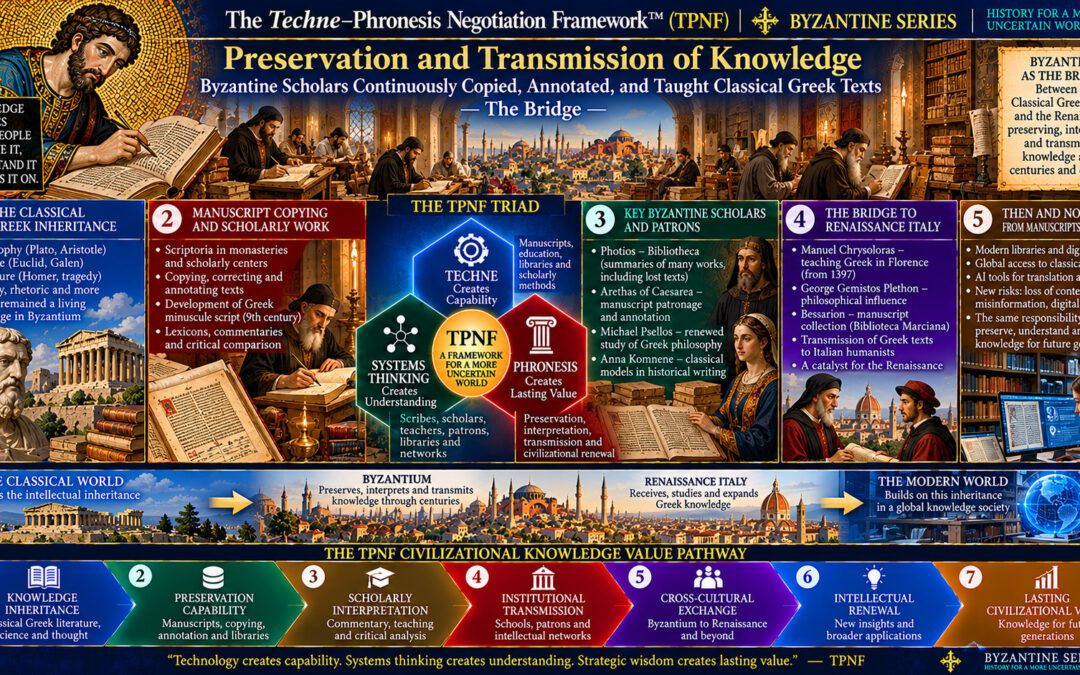
The Byzantine Empire’s contribution to world civilization extended beyond preserving ancient Greek manuscripts.
By copying, annotating, interpreting and teaching classical texts, Byzantine scholars maintained an intellectual inheritance that might otherwise have suffered far greater losses.
Their achievement demonstrates that knowledge preservation is an active institutional process, not merely the passive storage of information.
Through the Techne–Phronesis Negotiation Framework™ (TPNF), Byzantium emerges as a bridge connecting ancient intellectual achievements with later civilizations.
Technology Creates Capability. Systems Thinking Creates Understanding. Strategic Wisdom Creates Lasting Value.
Purpose of the Essay
This eleventh essay in the TPNF Byzantine Series examines how knowledge survived through scholarly activity, educational institutions and manuscript transmission.
It explores the contribution of Byzantine intellectuals to the preservation of classical Greek philosophy, science and literature.
It also investigates the strategic importance of transmitting knowledge across institutional, geographical and political boundaries.
Abstract
Byzantine civilization inherited a substantial body of classical Greek literature and scientific thought.
Its scholars preserved texts through manuscript copying, commentary, education and intellectual exchange.
Figures including Photios, Arethas of Caesarea and Michael Psellos contributed to the continuation of Greek learning.
Later scholars such as Manuel Chrysoloras and Bessarion helped transmit Greek intellectual traditions to Renaissance Italy.
TPNF interprets these developments as a system of knowledge continuity linking technical capabilities, institutions and strategic choices.
Introduction: The Fragility of Civilizational Knowledge
Civilizations accumulate knowledge over generations.
However, intellectual achievements do not automatically survive political instability, warfare or institutional collapse.
Manuscripts deteriorate.
Libraries disappear.
Languages become unfamiliar.
Educational traditions may weaken.
Knowledge survives only when people and institutions continue to reproduce, understand and transmit it.
The Byzantine Empire provides an important historical example.
Despite political crises and territorial losses, Greek scholarly traditions continued across many centuries.
This continuity was uneven and selective, but its historical consequences were substantial.
The Classical Greek Intellectual Inheritance
Byzantine scholars inherited philosophical, literary, mathematical and scientific traditions developed in antiquity.
Works associated with Homer, Plato, Aristotle, Euclid, Hippocrates, Galen and other ancient authors remained subjects of study.
Greek continued as a major language of administration, theology, education and scholarship.
This linguistic continuity facilitated direct engagement with classical texts.
Nevertheless, not all ancient works survived.
Many disappeared through material deterioration, changing educational priorities or interruptions in transmission.
The surviving classical corpus therefore reflects both deliberate preservation and historical contingency.
Manuscript Copying: The Technology of Intellectual Survival
Before printing, texts depended upon handwritten reproduction.
Scribes copied manuscripts onto parchment and, increasingly, paper.
This activity required literacy, specialized training, materials and sustained labor.
Errors could enter manuscripts during copying.
Scholars therefore compared readings, corrected passages and added explanatory notes.
The widespread adoption of Greek minuscule script from the ninth century improved the efficiency of book production.
Copying became an essential technology of intellectual continuity.
The manuscript was simultaneously an information-storage medium, a teaching instrument and a mechanism for transmitting civilization across generations.
Photios: Scholarship as Intellectual Organization
Photios, the ninth-century patriarch of Constantinople, exemplifies Byzantine scholarly engagement with inherited literature.
His Bibliotheca, also known as the Myriobiblon, contains summaries and evaluations of numerous works.
Some texts discussed by Photios have subsequently disappeared.
His observations consequently preserve valuable evidence of otherwise lost literature.
Photios also contributed to lexical scholarship and intellectual debate.
His achievement demonstrates that preservation involves selection, classification and interpretation.
Knowledge becomes more useful when scholars organize it into accessible intellectual structures.
Arethas of Caesarea: The Importance of Scholarly Patronage
Arethas of Caesarea, active around the late ninth and early tenth centuries, was an important scholar and manuscript patron.
He commissioned or owned manuscripts containing classical and Christian writings.
His annotations and scholarly interests contributed to the transmission of ancient philosophical literature.
The survival of particular texts depended upon individuals willing to invest resources in their reproduction.
Arethas therefore illustrates a strategic dimension of preservation:
Intellectual continuity requires financial support, informed priorities and material infrastructure.
Education and the Continuity of Interpretation
Byzantine education maintained traditions of grammar, rhetoric, philosophy and textual interpretation.
Schools and scholarly circles transmitted knowledge through teaching and commentary.
Michael Psellos, an influential eleventh-century intellectual, demonstrated renewed engagement with Greek philosophical traditions.
Anna Komnene’s Alexiad reveals the continued importance of classical literary models in Byzantine historical writing.
Educational institutions did more than preserve written documents.
They maintained the skills necessary to understand them.
Without trained readers, manuscripts could survive physically while their intellectual contents became inaccessible.
The Bridge to Renaissance Italy
From the late fourteenth century onward, Byzantine scholars played an important role in the expansion of Greek studies in Italy.
Manuel Chrysoloras began teaching Greek in Florence in 1397.
His instruction helped Italian humanists engage directly with ancient Greek texts.
Other scholars, including George Gemistos Plethon and Bessarion, participated in intellectual exchanges connecting Byzantine and Italian scholarly communities.
Bessarion’s manuscript collection became an important foundation of Venice’s Biblioteca Marciana.
The fall of Constantinople in 1453 intensified the movement of scholars and manuscripts, but the transmission had begun decades earlier.
Byzantium was a major bridge, although not the only route through which classical knowledge reached later civilizations.
Arabic, Syriac and Latin scholarly traditions also played essential roles.
Techne: Technology Creates Capability
The first TPNF dimension states:
Technology Creates Capability.
In Byzantine knowledge preservation, techne included writing materials, manuscript production, book organization and scholarly techniques.
Copying reproduced information.
Annotation clarified meaning.
Lexicons supported linguistic understanding.
Teaching methods enabled successive generations to interpret inherited texts.
These capabilities made preservation possible.
However, technical reproduction alone could not guarantee intellectual continuity.
Systems Thinking: Knowledge as an Ecosystem
The second TPNF dimension states:
Systems Thinking Creates Understanding.
Knowledge transmission depended upon interconnected actors and institutions.
Scribes produced manuscripts.
Scholars interpreted their contents.
Teachers developed intellectual competence.
Patrons financed copying.
Libraries preserved collections.
Diplomatic and commercial networks facilitated circulation.
The effectiveness of the system depended upon these relationships.
A manuscript without readers had limited intellectual utility.
A scholar without access to texts faced significant constraints.
A library without continuing institutional support remained vulnerable.
Civilizational knowledge survives through coordinated systems of production, interpretation, preservation and transmission.
Then and Now: From Manuscripts to Digital Knowledge
Contemporary societies possess technologies that Byzantine scholars could scarcely have imagined.
Digital libraries preserve enormous collections.
Cloud infrastructure enables remote access.
Artificial intelligence can assist translation, classification and information retrieval.
Yet technological abundance does not automatically guarantee reliable knowledge.
Digital records may become inaccessible.
Information can be distorted.
Software and storage systems may become obsolete.
Artificial intelligence may reproduce errors or generate misleading interpretations.
The historical comparison is functional rather than technological.
Byzantine scholars maintained intellectual continuity through manuscripts and teaching.
Modern institutions confront comparable responsibilities using radically different technologies.
Phronesis: Strategic Wisdom and Civilizational Responsibility
The third TPNF dimension states:
Strategic Wisdom Creates Lasting Value.
Knowledge preservation requires decisions about what to protect, how to interpret it and whom to educate.
These choices involve resources, priorities and responsibility.
Byzantine scholars did not preserve all inherited knowledge equally.
Their intellectual selections reflected the cultural, religious and institutional conditions of their time.
This reminds contemporary societies that preservation is never entirely neutral.
Strategic wisdom requires protecting intellectual diversity, maintaining scholarly standards and ensuring that knowledge remains accessible to future generations.
The TPNF Civilizational Knowledge Value Pathway
The Byzantine experience suggests the following progression:
Knowledge Inheritance → Preservation Capability → Scholarly Interpretation → Institutional Transmission → Cross-Cultural Exchange → Intellectual Renewal → Lasting Civilizational Value
Inherited knowledge provides the foundation.
Preservation protects intellectual resources.
Interpretation sustains understanding.
Institutions enable continuity.
Exchange expands access.
Renewal creates opportunities for further intellectual development.
Lasting value emerges when knowledge remains useful across generations.
This pathway represents a contemporary TPNF interpretation rather than a historical Byzantine doctrine.
Strategic Implications
The Byzantine experience offers important lessons for modern knowledge governance.
First, preserving information is insufficient without preserving the capacity to interpret it.
Second, educational institutions are essential components of civilizational resilience.
Third, knowledge requires sustainable funding and institutional stewardship.
Fourth, intellectual exchange can preserve achievements when political structures become vulnerable.
Finally, technological innovation should strengthen the reliability and accessibility of accumulated knowledge.
The Byzantine Empire served as a major bridge between classical Greek intellectual traditions and later civilizations.
Its scholars copied, studied, annotated and taught texts that remain fundamental to philosophy, science and literature.
Their contribution was neither complete nor exclusive.
Nevertheless, it demonstrates the extraordinary importance of institutions that maintain intellectual continuity through periods of uncertainty.
TPNF captures the underlying relationship:
Technology Creates Capability. Systems Thinking Creates Understanding. Strategic Wisdom Creates Lasting Value.
Civilizations achieve lasting intellectual influence when they preserve knowledge while maintaining the human and institutional capabilities necessary to understand and transmit it.
Key Takeaways
- Byzantine scholars contributed substantially to preserving classical Greek literature and science.
- Manuscript copying was a critical technology of intellectual continuity.
- Annotation and teaching preserved understanding alongside written information.
- Photios and Arethas exemplify different dimensions of scholarly preservation.
- Byzantine scholars helped expand Greek studies in Renaissance Italy.
- Knowledge transmission depended upon interconnected institutions and professional expertise.
- Lasting civilizational value requires preservation, interpretation and intellectual renewal.
Author’s Reflection
The Byzantine preservation of classical Greek knowledge reveals a fundamental characteristic of civilization.
Human progress depends not only upon discovering new knowledge but also upon preventing accumulated understanding from disappearing.
The Byzantine scholars who copied manuscripts, corrected texts and taught successive generations participated in an extraordinary historical undertaking.
They connected intellectual achievements separated by centuries.
Their work reminds us that knowledge preservation is an act of responsibility toward future generations.
In an age of artificial intelligence and expanding digital information, this responsibility becomes even more important.
A civilization’s intellectual strength depends not simply upon how much knowledge it possesses, but upon its capacity to preserve, understand, critically evaluate and transmit that knowledge.
Nikolaos Chatzis
Research References
1. Reynolds, L. D., and Wilson, N. G. Scribes and Scholars: A Guide to the Transmission of Greek and Latin Literature. Oxford University Press. A foundational account of manuscript preservation, education and classical textual transmission.
2. Tarrant, Richard (2018). Transmission of Greek and Latin Literature. Oxford Bibliographies. Explains the importance of copying, commentary, quotations and manuscript evidence.
3. Dickey, Eleanor (2007). Ancient Greek Scholarship. Oxford University Press. Examines scholia, commentaries, lexicons and grammatical traditions transmitted into the Byzantine period.
4. Photios, Patriarch of Constantinople. Lexicon. Manuscript evidence preserved in the Cambridge Medieval Manuscripts Catalogue.
5. Hobbs, Christopher (2019). Manuel Chrysoloras. Oxford Bibliographies. Documents Chrysoloras’s teaching in Florence and his contribution to Italian humanism.
6. Paché, Gilles A. (2026). Guardians of Knowledge: Byzantine Networks and the Transmission of Manuscripts to Renaissance Italy. Advances in Historical Studies, 15, 136–154. Examines the institutional and logistical networks supporting manuscript circulation.
7. De Melo, Wolfgang David Cirilo, and Scullion, Scott, eds. (2026). The Oxford Handbook of Greek and Latin Textual Criticism. Oxford University Press. A contemporary reference on textual transmission, copying errors and critical reconstruction.
Source: Open Sources Analysis, Relative Data Analysis by Nikos Chatzis
© Nikolaos Chatzis. All Rights Reserved.
The Techne–Phronesis Negotiation Framework™
An Integrative Theory of Strategic Negotiation, Complex Adaptive Systems and Practical Wisdom
Technology Creates Capability • Systems Thinking Creates Understanding • Strategic Wisdom Creates Lasting Value.
Negotiation.gr | Strategic Wisdom for the Technological Age