Negotiation.gr | Strategic Wisdom for the Technological Age
“Strategic resilience emerges when technical capability (techne) is
continuously guided by practical wisdom (phronesis) through adaptive
negotiation across interconnected systems.”
Central Idea (Thesis)
Byzantine automata demonstrate how mechanical technology can serve purposes extending beyond practical production.
Moving imperial thrones, roaring mechanical lions and singing artificial birds transformed engineering into political spectacle. Meanwhile, scientific instruments and practical mechanisms supported measurement, calculation and everyday activities.
These applications reveal three distinct sources of technological value: functionality, knowledge and influence.
Through the Techne–Phronesis Negotiation Framework™ (TPNF), the Byzantine experience suggests a fundamental proposition:
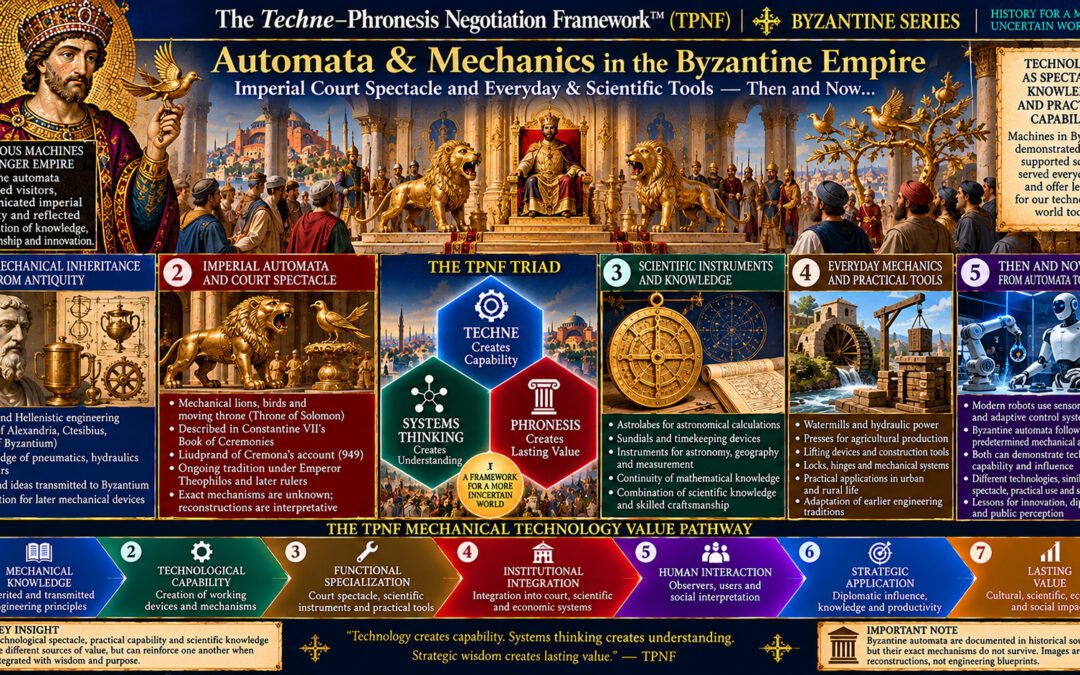
Mechanical technology creates capability; Systems Thinking integrates that capability into practical and institutional environments; strategic wisdom determines whether technological innovation produces lasting social, scientific or political value.
Purpose of the Essay
This tenth essay in the TPNF Byzantine Series examines mechanical technologies through three interconnected dimensions: imperial spectacle, scientific instrumentation and practical applications.
It investigates the relationship between inherited engineering knowledge, Byzantine craftsmanship and political communication.
It also explores functional parallels with contemporary robotics, automation and technologically mediated demonstrations of power.
Abstract
Byzantium inherited mechanical traditions from the Greek and Roman worlds.
Its imperial court employed spectacular automata, including moving animal figures and an elevating throne, to impress visitors and communicate authority.
Other mechanical technologies supported timekeeping, astronomical observation, music and practical work.
Although surviving evidence varies considerably, these examples demonstrate the diversity of mechanical knowledge in Byzantine society.
TPNF interprets them through technological capability, institutional integration and strategic purpose.
Introduction: When Machines Become Political Instruments
Modern technologies frequently perform functions beyond their immediate engineering purpose.
Robots can demonstrate industrial capability.
Artificial intelligence systems may symbolize national technological ambition.
Space missions communicate scientific achievement and geopolitical prestige.
The Byzantine imperial court understood an earlier version of this relationship.
Mechanical devices could impress foreign ambassadors and reinforce the extraordinary status of the emperor.
Their importance was not limited to what the machines physically accomplished.
It also concerned what observers believed those machines represented.
The Mechanical Inheritance of Antiquity
Byzantine engineering developed within traditions inherited from the Hellenistic and Roman worlds.
Earlier figures such as Ctesibius, Philo of Byzantium and Hero of Alexandria had described pneumatic, hydraulic and mechanical devices.
Their works explored principles involving air pressure, water movement, valves, gears and controlled mechanical action.
Byzantine scholars and craftsmen encountered elements of this technical inheritance through manuscripts, instruments and practical traditions.
However, the survival of ancient texts does not establish that every described machine was reproduced in Byzantium.
The historical challenge is to distinguish transmitted knowledge from documented construction.
This distinction is essential for evaluating technological capability accurately.
The Imperial Throne of Solomon
One of the most remarkable Byzantine mechanical displays appeared in the imperial palace at Constantinople.
The tenth-century diplomat Liudprand of Cremona described an audience in 949 during which mechanical lions roared and artificial birds produced sounds.
The emperor’s throne appeared to rise dramatically above its original position.
Liudprand interpreted the movement as probably involving machinery comparable to lifting equipment.
The display was associated with the ceremonial Throne of Solomon.
Its biblical symbolism reinforced the emperor’s representation as a ruler possessing exceptional wisdom and authority.
The surviving descriptions establish the theatrical effect, but not the exact mechanical design.
No complete original mechanism survives.
Mechanical Lions, Singing Birds and Controlled Spectacle
The Book of Ceremonies, compiled under Constantine VII, provides additional evidence of coordinated mechanical performances.
Lions roared.
Birds sang.
Mechanical animals moved during carefully organized diplomatic receptions.
The devices operated within a prescribed sequence involving greetings, gifts and ceremonial gestures.
Their significance therefore depended upon timing and institutional coordination.
The machines were not independent political actors.
They formed part of a larger ceremonial system.
The technology created sensory effects; court organization transformed those effects into political communication.
Emperor Theophilos and Imperial Mechanical Culture
Byzantine historical traditions also associate elaborate mechanical displays with Emperor Theophilos, who ruled from 829 to 842.
Accounts describe luxurious palace installations, mechanical birds and impressive musical instruments.
These traditions suggest that mechanical spectacle had become associated with imperial magnificence before Constantine VII.
Nevertheless, individual descriptions differ, and the chronology of particular devices remains uncertain.
Theophilos should therefore be understood as an important figure in the history of Byzantine court technology, not as the conclusively identified inventor of every imperial automaton.
Scientific Instruments: Measurement and Knowledge
Mechanical ingenuity was not restricted to palace entertainment.
Byzantine scholars used and studied instruments associated with astronomy, geometry and time measurement.
Astrolabes enabled calculations concerning celestial positions and astronomical relationships.
Sundials and other timekeeping devices supported the organization of time.
Such instruments combined mathematical principles with specialized craftsmanship.
They also demonstrate a different technological objective.
Unlike imperial automata, scientific instruments primarily supported observation and calculation.
Their value depended upon accuracy and informed use rather than theatrical surprise.
Everyday Mechanics and Practical Utility
Practical Byzantine life also depended upon mechanical technologies.
Watermills converted flowing water into rotational power.
Presses supported agricultural processing.
Lifting equipment and construction mechanisms enabled the movement of heavy materials.
Locks, hinges and related devices supported ordinary building functions.
These technologies generally continued and adapted earlier engineering traditions.
Their documentation is uneven, and they should not all be classified as automata.
An automaton produces a predetermined mechanical performance; a mill or press primarily performs useful work.
Nevertheless, both demonstrate the application of mechanical knowledge to human objectives.
Techne: Technology Creates Capability
The first TPNF dimension states:
Technology Creates Capability.
Automata generated controlled movement and sound.
Scientific instruments enabled measurement.
Practical mechanisms transformed human or natural energy into useful work.
Each application expanded the range of achievable activities.
However, technical capability did not determine strategic importance.
A mechanical bird and a watermill could employ related engineering principles while serving fundamentally different purposes.
Technology created possibilities.
Human institutions selected their uses.
Systems Thinking: Technology Within Institutional Environments
The second TPNF dimension states:
Systems Thinking Creates Understanding.
The imperial automata depended upon more than individual mechanisms.
Craftsmen constructed and maintained devices.
Court officials organized ceremonial sequences.
Architectural settings shaped the audience’s experience.
Diplomatic protocols determined when mechanical performances occurred.
Imperial symbolism supplied political meaning.
These elements formed an integrated system.
A technically impressive machine operating outside the appropriate setting might have produced little diplomatic influence.
Conversely, effective ceremonial coordination could magnify the perceived importance of relatively limited mechanical capabilities.
Technological influence emerges from the interaction between engineering performance, institutional organization and human interpretation.
Then and Now: From Automata to Robotics
Modern robotics differs fundamentally from Byzantine mechanical spectacle.
Contemporary robots may incorporate electronic sensors, computer processors, software and adaptive control systems.
Some systems perform industrial, medical or logistical tasks.
Others demonstrate technological leadership during exhibitions and diplomatic events.
The historical parallel concerns function rather than technological descent.
Byzantine automata followed predetermined mechanical arrangements.
Modern robots may respond dynamically to environmental information.
Yet both can influence how observers perceive the capabilities of their creators.
The distinction between actual performance and communicated technological power remains strategically important.
Phronesis: Strategic Wisdom and Technological Purpose
The third TPNF dimension states:
Strategic Wisdom Creates Lasting Value.
Mechanical innovation may serve entertainment, scientific inquiry, productive work or political influence.
These objectives are not automatically equivalent.
A spectacular demonstration may strengthen prestige without improving public welfare.
A relatively simple practical mechanism may generate substantial economic benefits.
Scientific instruments may create long-term intellectual value through more accurate understanding.
Strategic wisdom therefore requires evaluating technology according to its intended purpose, actual effectiveness and wider consequences.
The central question is not whether a machine is impressive.
It is whether its capabilities produce meaningful and sustainable value.
The TPNF Byzantine Mechanical Value Pathway
The historical experience suggests the following analytical progression:
Mechanical Knowledge → Technological Capability → Functional Specialization → Institutional Integration → Human Interaction → Strategic Application → Lasting Value
Mechanical knowledge enables construction.
Technological capability creates operational possibilities.
Specialization adapts devices to particular tasks.
Institutional integration connects machines with organizations.
Human interaction determines their practical or symbolic effects.
Strategic application converts capability into influence or utility.
Lasting value depends upon sustained usefulness, knowledge or institutional benefit.
This pathway is a contemporary TPNF interpretation, not a Byzantine engineering doctrine.
Strategic Implications
The Byzantine experience suggests several lessons for contemporary technology strategy.
First, technological demonstrations should be distinguished from operational capability.
Second, institutional context influences how technologies are perceived.
Third, scientific instruments and practical mechanisms may generate greater long-term value than spectacular displays.
Fourth, technological prestige can support diplomacy but cannot substitute for genuine productive strength.
Finally, strategic assessment should examine the relationship between engineering capability, institutional purpose and measurable outcomes.
Byzantine automata and mechanical technologies reveal a civilization capable of integrating inherited engineering knowledge with political ceremony, scientific inquiry and practical activity.
The imperial throne and mechanical animals demonstrate technology’s symbolic power.
Scientific instruments and everyday mechanisms illustrate its intellectual and productive functions.
TPNF captures the enduring relationship:
Technology Creates Capability. Systems Thinking Creates Understanding. Strategic Wisdom Creates Lasting Value.
The Byzantine experience demonstrates that technological sophistication becomes strategically meaningful when mechanical capability is connected with purposeful institutional action.
Key Takeaways
- Byzantine automata combined engineering with imperial spectacle.
- Mechanical lions, singing birds and an elevating throne are documented in tenth-century sources.
- Their exact mechanisms remain uncertain.
- Scientific instruments supported measurement and astronomical knowledge.
- Practical mechanical devices served construction and production.
- Modern robotics offers functional comparisons, not direct technological equivalence.
- Strategic value depends upon the purpose and integration of technological capability.
Author’s Reflection
The Byzantine automata offer a fascinating example of technology’s capacity to influence human perception.
Their designers understood that machines could communicate authority as well as perform physical actions.
Yet the same civilization also employed mechanical knowledge for scientific and practical purposes.
This contrast remains relevant in the technological age.
Modern societies frequently celebrate spectacular demonstrations of artificial intelligence and robotics.
However, technological prestige should not be confused with lasting technological value.
The enduring lesson is that the significance of a machine lies not only in what it can do, but in how wisely its capabilities are integrated into human institutions and purposes.
Nikolaos Chatzis
Research References
1. Constantine VII Porphyrogennetos. The Book of Ceremonies (De Cerimoniis), Book II, Chapter 15. Primary evidence describing mechanical lions, singing birds and their integration into imperial diplomatic receptions. English translation by Ann Moffatt and Maxeme Tall, Australian Association for Byzantine Studies, 2012. Discussed in the Oxford Handbook of Byzantine Studies.
2. Liudprand of Cremona. Antapodosis, Book VI, Chapter 5. Eyewitness account of the imperial reception of 949, including the moving throne and mechanical animals. Historical passage and references.
3. Brett, Gerard (1954). “The Automata in the Byzantine ‘Throne of Solomon’.” Speculum, 29, 477–487. A foundational scholarly examination of the palace automata and their historical interpretation.
4. Woodrow, Zoe Antonia (2001). Imperial Ideology in Middle Byzantine Court Culture: The Evidence of Constantine Porphyrogenitus’s De Cerimoniis. Durham University. Read the doctoral thesis. Examines court ritual as an expression of imperial authority.
5. Featherstone, Jeffrey Michael. “The Emperor and the Court.” In The Oxford Handbook of Byzantine Studies. Examines ceremonial procedures, foreign diplomatic receptions and mechanical displays at the imperial court.
6. Lazos, Christos (2005). Μηχανική και Τεχνολογία στο Βυζάντιο: Αστρονομία και Όργανα Μέτρησης του Χρόνου. Athens: Aiolos. A Greek-language study of Byzantine engineering, astronomy, astrolabes and time-measuring instruments. Bibliographic record.
Historical qualification: The existence of Byzantine court automata is documented, but their precise mechanical operation cannot be reconstructed with certainty. The essay’s comparison with robotics concerns technological functions and strategic communication, not direct technological ancestry
Source: Open Sources Analysis, Relative Data Analysis by Nikos Chatzis
© Nikolaos Chatzis. All Rights Reserved.
The Techne–Phronesis Negotiation Framework™
An Integrative Theory of Strategic Negotiation, Complex Adaptive Systems and Practical Wisdom
Technology Creates Capability • Systems Thinking Creates Understanding • Strategic Wisdom Creates Lasting Value.
Negotiation.gr | Strategic Wisdom for the Technological Age