Negotiation.gr | Strategic Wisdom for the Technological Age
“Strategic resilience emerges when technical capability (techne) is
continuously guided by practical wisdom (phronesis) through adaptive
negotiation across interconnected systems.”
Central Idea (Thesis)
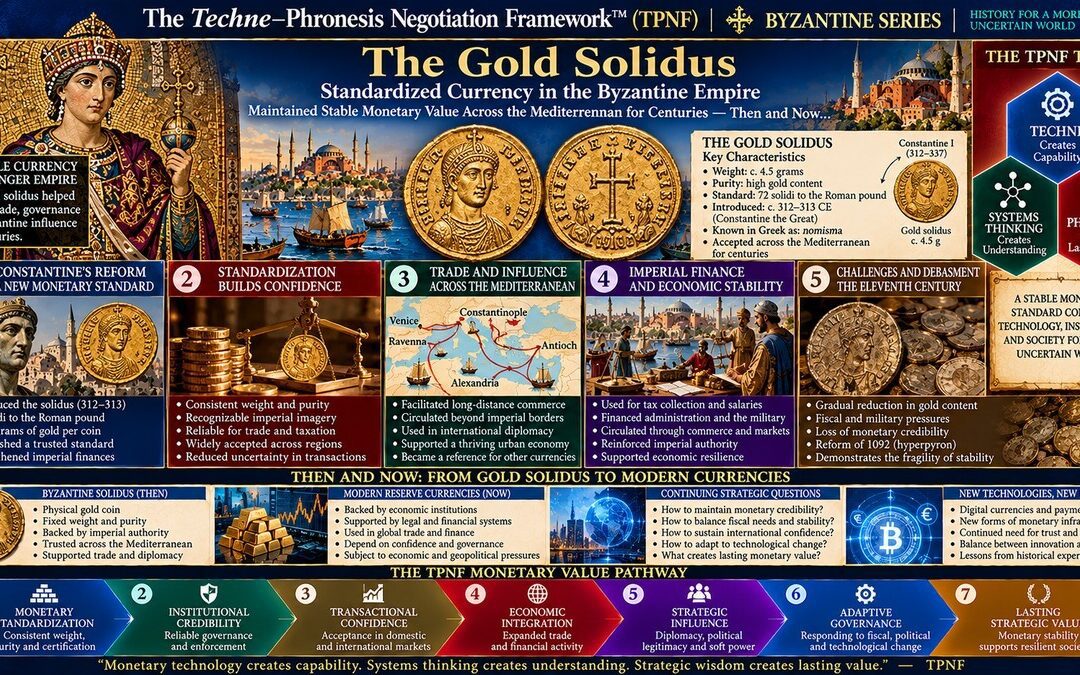
The Byzantine gold solidus represents one of history’s most enduring examples of monetary standardization.
For approximately seven centuries, its remarkable consistency in weight and gold purity supported commerce, imperial finance and international confidence.
Its strategic importance extended beyond the physical characteristics of a gold coin.
The solidus connected technical standards, imperial institutions, fiscal capacity and commercial networks into a monetary system whose influence reached far beyond Byzantine territory.
Through the Techne–Phronesis Negotiation Framework™ (TPNF), this experience suggests a fundamental proposition:
Monetary technology creates transactional capability; Systems Thinking transforms standardized currency into economic confidence; strategic wisdom determines whether monetary credibility produces lasting institutional and geopolitical value.
Purpose of the Essay
This eighth essay in the TPNF Byzantine Series examines the gold solidus as an instrument of monetary stability, economic integration and imperial influence.
It investigates its origins, technical characteristics, institutional foundations, international circulation and eventual debasement.
The essay also considers functional parallels with modern reserve currencies, central banking and digital monetary systems.
Abstract
Introduced under Constantine the Great in the early fourth century, the gold solidus became the foundation of Byzantine monetary organization.
Its standard weight of approximately 4.5 grams and consistently high gold content supported its reputation across commercial and political boundaries.
Known in Byzantine Greek as the nomisma, it facilitated taxation, government expenditure and international transactions.
However, its stability eventually weakened during the eleventh century, when debasement undermined the long-established monetary standard.
TPNF interprets this history through technological standardization, institutional coordination and strategic monetary governance.
Introduction: Money as an Institutional Technology
Money is frequently understood as an instrument of exchange.
Yet reliable currency performs a more complex function.
It allows individuals, businesses and governments to coordinate economic activity through a commonly accepted standard.
The value of money depends not only upon its material composition but also upon confidence in the institutions responsible for issuing it.
The Byzantine Empire developed one of the most durable monetary standards of the premodern world.
Its gold solidus became widely recognized across the Mediterranean and beyond.
The central question is therefore not simply why the coin contained gold.
It is how a standardized monetary instrument became a foundation of economic coordination and imperial credibility.
Constantine’s Reform: Establishing the Gold Solidus
The solidus emerged during the monetary reforms of Constantine the Great, with its introduction generally dated to 312–313.
It replaced the heavier Roman gold aureus as the principal gold denomination.
The new standard established 72 solidi to the Roman pound of gold.
Each coin consequently weighed approximately 4.5 grams.
This standardization provided a recognizable basis for monetary transactions.
The coin’s high gold purity strengthened its acceptability.
Constantine’s reform did not resolve every monetary problem inherited from the late Roman Empire.
Lower-value coinage continued to experience difficulties.
Nevertheless, the solidus established a durable foundation for the empire’s high-value monetary transactions.
Standardization: The Engineering of Monetary Confidence
The solidus illustrates an important relationship between technical precision and economic trust.
Its weight and purity could be examined through established methods.
A recognizable standard reduced uncertainty concerning the metallic content of individual coins.
Imperial mints supplied coins bearing official images and inscriptions.
These features communicated both monetary specifications and issuing authority.
The system combined material value with institutional certification.
Its effectiveness depended upon consistent production and the credibility of imperial administration.
The strategic innovation was not simply the creation of a gold coin, but the sustained institutional enforcement of a recognizable monetary standard.
The Nomisma: A Currency Beyond Imperial Borders
In Byzantine usage, the gold coin was commonly known as the nomisma.
Its consistent characteristics supported acceptance beyond the empire’s political boundaries.
Merchants, rulers and commercial intermediaries could recognize its established gold standard.
This facilitated transactions across regions with different political authorities and monetary traditions.
The solidus also influenced other monetary systems, including early coinage traditions in territories formerly connected with the Eastern Roman Empire.
Its international importance should not be confused with a modern global reserve currency.
Premodern monetary circulation differed fundamentally from contemporary banking and foreign-exchange systems.
Nevertheless, the comparison reveals a shared principle:
A widely trusted monetary standard can extend economic influence beyond the territory of its issuing authority.
Imperial Finance and Monetary Circulation
The Byzantine state played a central role in the monetary ecosystem.
Taxes provided government revenue.
Military expenditures, administrative salaries and other payments returned currency to economic circulation.
Imperial mints produced standardized coins.
Merchants and households employed currency in commercial and financial transactions.
The interaction among these activities supported monetary demand.
The solidus was therefore not an isolated technological achievement.
Its credibility depended upon the broader fiscal and institutional organization of the empire.
A stable coin required more than sufficient gold.
It required institutions capable of maintaining standards while financing public obligations.
Gold, Imperial Authority and Political Legitimacy
Byzantine coins also communicated political authority.
Imperial portraits, religious symbols and inscriptions connected currency with the legitimacy of the ruler.
A coin could therefore function simultaneously as money and political communication.
Its circulation distributed recognizable representations of imperial power.
This symbolic function complemented its economic utility.
However, political imagery alone could not guarantee monetary confidence.
The material standard had to remain credible.
The Byzantine experience demonstrates how technical reliability and political authority can reinforce one another.
Techne: Technology Creates Capability
The first TPNF dimension states:
Technology Creates Capability.
The solidus established a reproducible monetary instrument.
Its standardized weight and high gold purity facilitated recognition, valuation and exchange.
Minting techniques transformed precious metal into an officially certified medium of payment.
These capabilities supported taxation, commerce and public expenditure.
Yet standardization alone could not guarantee permanent success.
The effectiveness of the currency depended upon the institutions responsible for its production and circulation.
Systems Thinking: The Byzantine Monetary Ecosystem
The second TPNF dimension states:
Systems Thinking Creates Understanding.
The solidus operated within an interconnected monetary ecosystem.
Gold supplies supported minting.
Imperial institutions established production standards.
Taxation generated monetary demand.
Government expenditure circulated coins.
Commercial networks distributed them across regions.
Political authority reinforced recognition.
Confidence connected these components.
A failure in one part could affect the wider system.
Insufficient fiscal resources might create pressure to alter monetary standards.
Loss of confidence could weaken commercial acceptance.
The strategic value of currency therefore depended upon the coordination of material resources, fiscal policy and institutional credibility.
The Eleventh-Century Debasement: The Limits of Monetary Stability
The solidus did not maintain its original characteristics indefinitely.
During the eleventh century, the gold content of Byzantine coinage declined significantly.
The process accelerated under successive emperors.
Economic historians have examined the relationship between debasement, military expenditure, fiscal pressures and changing monetary conditions.
The precise causes and relative importance of these factors remain debated.
What is clear is that the long-established standard weakened.
The deterioration of gold purity undermined a defining characteristic of the traditional nomisma.
Emperor Alexios I Komnenos introduced a major monetary reform in 1092, establishing the gold hyperpyron.
The episode illustrates an important distinction:
Monetary credibility may require centuries to establish, yet institutional and fiscal pressures can erode it within a comparatively short period.
Then and Now: Monetary Standards and Digital Finance
Modern monetary systems operate through institutions and technologies fundamentally different from Byzantine gold coinage.
Most contemporary currencies are not convertible into a fixed quantity of gold.
Their credibility depends upon monetary institutions, economic conditions, legal frameworks and public confidence.
Central banks influence monetary conditions through policy instruments unavailable to Byzantine rulers.
Digital payment networks allow transactions without transferring physical coins.
Emerging digital monetary technologies introduce additional questions concerning verification, governance and systemic resilience.
The historical comparison is therefore functional.
Both ancient and modern monetary systems require reliable standards, institutional coordination and mechanisms supporting confidence.
Technological sophistication does not eliminate the need for responsible governance.
Phronesis: Strategic Wisdom and Monetary Governance
The third TPNF dimension states:
Strategic Wisdom Creates Lasting Value.
Monetary authorities must balance competing objectives.
Governments require resources to meet public obligations.
Businesses and households need confidence in the currency used for transactions.
International partners value predictability.
Short-term fiscal measures may conflict with long-term monetary credibility.
The Byzantine experience demonstrates that monetary stability cannot be separated from institutional choices.
Strategic wisdom requires recognizing the consequences of undermining a trusted monetary standard.
The objective is not simply preserving an unchanged technical specification.
It is sustaining a monetary system capable of supporting economic activity under changing circumstances.
The TPNF Byzantine Monetary Value Pathway
The historical experience suggests the following analytical progression:
Monetary Standardization → Institutional Certification → Transactional Confidence → Economic Integration → International Acceptance → Adaptive Monetary Governance → Lasting Strategic Value
Standardization establishes recognizable characteristics.
Institutional certification supports authenticity.
Confidence facilitates transactions.
Economic integration connects markets and fiscal institutions.
International acceptance extends monetary influence.
Adaptive governance responds to changing conditions.
Lasting strategic value emerges when credibility remains compatible with economic sustainability.
This pathway is a contemporary TPNF interpretation, not a historical Byzantine doctrine.
Strategic Implications
The solidus offers several lessons for contemporary monetary governance.
First, technical standards become strategically valuable when institutions enforce them consistently.
Second, monetary credibility depends upon broader economic and fiscal systems.
Third, international acceptance can expand the influence of an issuing authority.
Fourth, monetary stability must be distinguished from stable purchasing power or universal prosperity.
Finally, governments should evaluate the long-term credibility costs of short-term financial decisions.
The Byzantine gold solidus demonstrates how monetary standardization can become a durable source of economic and political influence.
Its centuries of relative stability reflected more than the intrinsic value of gold.
They depended upon technical precision, imperial institutions, fiscal organization and international confidence.
Its eventual debasement revealed the vulnerability of even exceptionally durable monetary systems.
TPNF captures the enduring relationship:
Technology Creates Capability. Systems Thinking Creates Understanding. Strategic Wisdom Creates Lasting Value.
The Byzantine experience demonstrates that the greatest strategic achievement of a currency is not simply its material value, but the sustained confidence it generates.
Key Takeaways
- The solidus established a gold standard of approximately 4.5 grams.
- Its weight and purity remained remarkably consistent for centuries.
- Monetary credibility supported trade and imperial finance.
- International circulation extended Byzantine economic influence.
- Standardization required institutional enforcement.
- Eleventh-century debasement demonstrated the vulnerability of monetary confidence.
- Modern monetary systems face comparable challenges of trust and governance.
Author’s Reflection
The gold solidus reveals a fundamental dimension of technological civilization.
A relatively small object became an instrument connecting economic activity, institutional authority and international relationships.
Its remarkable durability did not arise from gold alone.
It reflected the ability of successive generations to preserve a trusted monetary standard.
The subsequent debasement illustrates the fragility of that achievement.
Modern societies possess monetary technologies of extraordinary sophistication.
Yet their currencies remain dependent upon confidence, institutional responsibility and strategic judgement.
The enduring lesson is that monetary power cannot be sustained through technology or authority alone. It requires institutions capable of protecting credibility across generations.
Nikolaos Chatzis
Research References
1. American Numismatic Society. Rome: A Thousand Years of Monetary History. Explains Constantine’s monetary reforms and the establishment of the 72-to-the-pound gold solidus.
2. The Metropolitan Museum of Art. Gold Solidus of Constantine I (313–315 CE). A documented surviving specimen weighing approximately 4.47 grams.
3. The Metropolitan Museum of Art. Solidus of Heraclius, Heraclius Constantine and Heraclonas (638–641). Illustrates the relationship between coinage, imperial legitimacy, taxation and military expenditure.
4. “Trans-Saharan Gold Trade and Byzantine Coinage.” The Antiquaries Journal, Cambridge University Press. Examines the standardization of Byzantine gold coinage and its exceptional stability in weight and purity until the eleventh century. Read the research.
5. Kaplanis, Costas (2003). “The Debasement of the ‘Dollar of the Middle Ages.’” The Journal of Economic History, 63(3), 768–801. An important economic analysis linking eleventh-century monetary debasement to fiscal and military pressures. Read the scholarly article.
6. Banaji, Jairus. “Precious Metal Coinages and Monetary Expansion in Late Antiquity.” In Exploring the Economy of Late Antiquity, Cambridge University Press. Analyzes the solidus as a foundation of late antique monetary systems and commercial circulation.
7. The Metropolitan Museum of Art. Wearing Coins in Late Antiquity. Discusses the solidus’s standardized weight, state control over coin production and circulation alongside other denominations.
Source: Open Sources Analysis, Relative Data Analysis by Nikos Chatzis
© Nikolaos Chatzis. All Rights Reserved.
The Techne–Phronesis Negotiation Framework™
An Integrative Theory of Strategic Negotiation, Complex Adaptive Systems and Practical Wisdom
Technology Creates Capability • Systems Thinking Creates Understanding • Strategic Wisdom Creates Lasting Value.
Negotiation.gr | Strategic Wisdom for the Technological Age