Negotiation.gr | Strategic Wisdom for the Technological Age
“Strategic resilience emerges when technical capability (techne) is
continuously guided by practical wisdom (phronesis) through adaptive
negotiation across interconnected systems.”
Central Idea (Thesis)
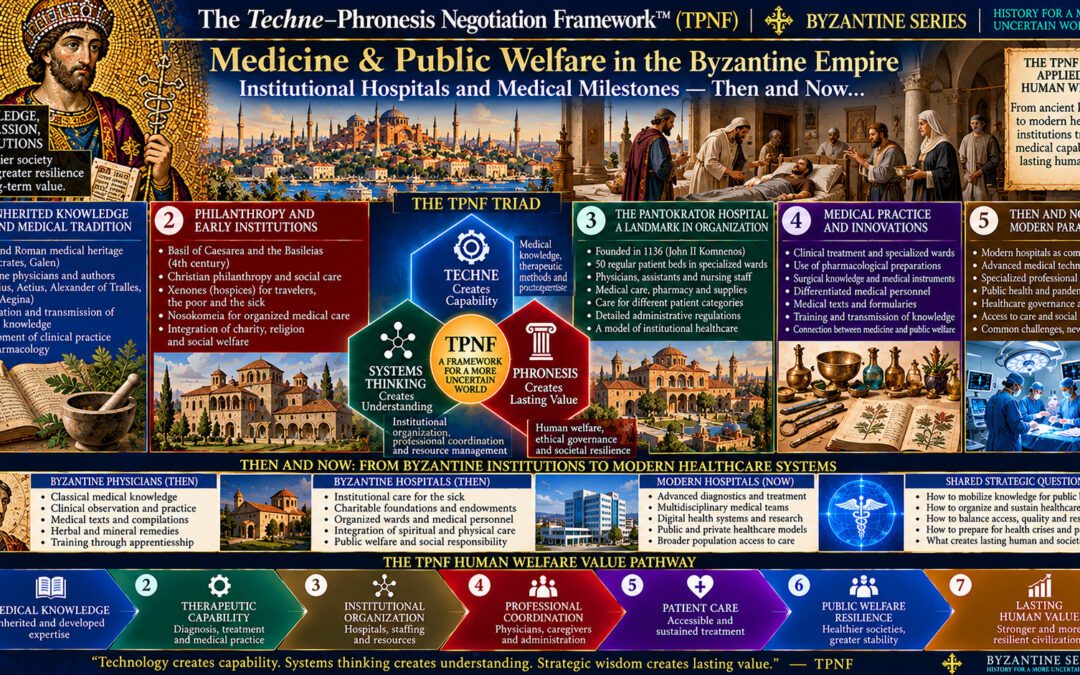
The Byzantine Empire made a significant contribution to the institutional development of medicine by connecting inherited medical knowledge, professional care, religious philanthropy and organized public welfare.
Its most important achievement was not the invention of medicine or the world’s first hospital.
It was the development of institutions capable of bringing physicians, caregivers, medicines, facilities and financial resources together to serve vulnerable populations.
Through the Techne–Phronesis Negotiation Framework™ (TPNF), this experience suggests a fundamental proposition:
Medical knowledge creates therapeutic capability; Systems Thinking transforms specialized capabilities into organized healthcare; strategic wisdom determines whether healthcare institutions produce lasting human and civilizational value.
Purpose of the Essay
This ninth essay in the TPNF Byzantine Series examines the development of hospitals, medical practice and public welfare in the Byzantine Empire.
It focuses on the relationship between scientific knowledge, philanthropy, institutional organization and healthcare delivery.
The essay also explores functional parallels with contemporary hospitals, medical education, healthcare governance and public-health resilience.
Abstract
Byzantine medicine preserved and developed important elements of Greek and Roman medical knowledge.
From the fourth century onward, charitable institutions increasingly provided shelter, nursing and, in certain cases, professional medical treatment.
The Basileias of Caesarea and the Pantokrator Hospital in Constantinople illustrate different stages of institutional development.
By the twelfth century, some Byzantine hospitals possessed specialized wards, salaried physicians, organized staffing and formal administrative arrangements.
TPNF interprets these achievements as examples of technological knowledge becoming socially valuable through institutional coordination.
Introduction: Medicine as a Civilizational Capability
Medical knowledge has accompanied human civilization for thousands of years.
Yet possessing medical knowledge is not equivalent to providing organized healthcare.
A physician may understand disease without having access to appropriate facilities, medicines or trained assistants.
A society may possess skilled practitioners while leaving vulnerable populations without systematic care.
The Byzantine Empire confronted this fundamental problem.
Its contribution emerged from connecting established medical traditions with institutions capable of providing continuing assistance.
This transformation deserves attention because it concerns a central question of strategic governance:
How can specialized knowledge become an accessible and sustainable public capability?
Greek Medical Knowledge and Byzantine Continuity
Byzantine physicians inherited the medical traditions of Hippocrates, Galen and other classical authorities.
Medical education and practice continued to draw upon observation, established therapeutic methods and written medical knowledge.
Important Byzantine medical authors included Oribasius, Aetius of Amida, Alexander of Tralles and Paul of Aegina.
Their compilations preserved extensive information concerning diseases, pharmacology, surgery and therapeutic practice.
These works also transmitted medical knowledge to subsequent generations and other intellectual traditions.
However, Byzantine medicine remained constrained by the scientific understanding of its period.
Its achievements should not be equated with modern evidence-based medicine.
Its significance lies partly in the preservation, organization and transmission of knowledge.
The Basileias: Philanthropy Becomes Institutional Care
During the fourth century, Basil of Caesarea established a major charitable complex in Cappadocia.
Known as the Basileias, it provided assistance to vulnerable people, including the poor and sick.
The institution reflected the growing importance of Christian philanthropy in late Roman society.
Its significance extended beyond individual acts of charity.
Organized facilities and continuing support created a more durable form of assistance.
The Basileias is frequently discussed in the history of hospitals, although the precise extent and organization of its medical services remain subjects of historical interpretation.
It nevertheless demonstrates an important institutional development:
Public welfare increasingly required organized resources rather than occasional personal generosity.
Xenones and Nosokomeia: From Hospitality to Medical Treatment
Byzantine sources describe several categories of charitable institutions.
Xenones could provide hospitality and, in certain circumstances, medical care.
Nosokomeia were associated more directly with caring for the sick.
Other establishments supported elderly people, orphans and those experiencing poverty.
Their functions were not identical, and terminology changed across periods.
Some institutions primarily provided shelter and food.
Others employed physicians and developed more elaborate arrangements for treatment.
The Byzantine contribution therefore involved institutional diversity rather than a single universal hospital model.
The Pantokrator Hospital: A Landmark in Medical Organization
One of the best-documented examples is the hospital associated with the Monastery of Christ Pantokrator in Constantinople.
Its foundation charter, or typikon, dates to 1136, during the reign of John II Komnenos.
The charter describes a hospital with fifty regular patient beds organized into five wards.
Its provisions included medical personnel, assistants, nursing arrangements, medicines and administrative responsibilities.
Different wards accommodated different categories of patients, including women and individuals requiring specialized treatment.
The institution also provided for patients seeking treatment without admission.
The detailed regulations reveal considerable attention to staffing, patient care and resource allocation.
However, the charter records intended organization; it cannot establish that every provision was consistently implemented.
The Pantokrator remains an exceptional historical source for understanding Byzantine healthcare institutions.
Medical Milestones: Specialization, Pharmacy and Training
The Byzantine medical tradition produced developments of lasting historical interest.
Medical compilations organized therapeutic knowledge.
Hospitals employed practitioners with differentiated responsibilities.
Pharmaceutical preparations formed an important component of treatment.
The Pantokrator charter refers to specialized medical personnel and pharmacy-related functions.
Some Byzantine institutions also supported practical medical instruction.
These developments should not be described as the invention of modern medical specialization.
Rather, they represent earlier forms of organized professional differentiation.
Their significance lies in recognizing that effective treatment requires coordinated expertise.
Healthcare as an Institutional Ecosystem
A functioning hospital depends upon more than physicians.
Patients require accommodation, food, hygiene, medicines and continuing attention.
Medical personnel need equipment, assistance and reliable supplies.
Administrators must coordinate staffing and resources.
Financial support must sustain operations.
Byzantine hospital foundations connected these requirements through combinations of imperial patronage, ecclesiastical organization and endowed resources.
Their institutional arrangements transformed separate activities into organized care.
This represents an important transition from individual medical capability toward collective healthcare capacity.
Techne: Technology Creates Capability
The first TPNF dimension states:
Technology Creates Capability.
In medicine, techne includes clinical knowledge, therapeutic methods, instruments, pharmaceutical preparation and practical expertise.
Byzantine physicians possessed capabilities inherited from earlier medical traditions and developed through continuing practice.
These capabilities enabled diagnosis, treatment and patient support within the limits of contemporary knowledge.
However, medical expertise alone could not guarantee accessible healthcare.
Its practical value depended upon institutions capable of mobilizing and sustaining it.
Systems Thinking: Understanding Healthcare Interdependence
The second TPNF dimension states:
Systems Thinking Creates Understanding.
The Pantokrator Hospital illustrates healthcare as an interconnected system.
Physicians provided medical expertise.
Assistants and caregivers supported treatment.
Pharmaceutical personnel prepared medicines.
Administrative structures organized resources.
Institutional patrons provided financial support.
Patients remained the central purpose of the system.
A shortage of medicines could undermine medical treatment.
Insufficient staffing could reduce the effectiveness of available facilities.
Financial instability could threaten the institution itself.
Healthcare effectiveness depends upon the relationships among medical knowledge, professional personnel, organizational resources and patient needs.
Then and Now: Hospitals as Knowledge-Intensive Systems
Contemporary hospitals employ technologies unavailable to Byzantine physicians.
Medical imaging, laboratory diagnostics, advanced surgery, pharmaceuticals and digital information systems have transformed healthcare.
Modern hospitals also operate within complex regulatory, financial and professional environments.
Yet the underlying organizational challenge remains recognizable.
Specialized knowledge must be coordinated.
Resources must reach patients.
Institutions must maintain continuity under pressure.
Healthcare professionals must cooperate across different disciplines.
The historical parallel is functional rather than technological.
Byzantine institutions reveal early forms of organized medical service; contemporary hospitals operate through fundamentally different scientific and technological capabilities.
Phronesis: Strategic Wisdom and Public Welfare
The third TPNF dimension states:
Strategic Wisdom Creates Lasting Value.
Healthcare governance requires decisions involving competing priorities.
Institutions must balance treatment capacity, staffing, financial sustainability and access to care.
Resources are limited, while human needs may be extensive.
Byzantine charitable foundations illustrate the attempt to connect institutional resources with social responsibility.
Their limitations also demonstrate that philanthropic intentions do not automatically guarantee effective services.
Strategic wisdom requires both ethical purpose and organizational competence.
The objective is not merely to establish hospitals.
It is to sustain institutions that deliver meaningful care to those who need it.
The TPNF Byzantine Healthcare Value Pathway
The historical experience suggests the following analytical progression:
Medical Knowledge → Therapeutic Capability → Institutional Organization → Professional Coordination → Patient Care → Public Welfare Resilience → Lasting Human Value
Medical knowledge provides the intellectual foundation.
Therapeutic capability enables intervention.
Institutional organization mobilizes resources.
Professional coordination connects specialized functions.
Patient care translates capability into service.
Resilience supports continuity.
Lasting human value emerges when institutions remain capable of meeting social needs.
This pathway is a contemporary TPNF interpretation, not a Byzantine medical doctrine.
Strategic Implications
The Byzantine experience suggests several lessons for contemporary healthcare governance.
First, medical knowledge creates greater social value when supported by effective institutions.
Second, healthcare depends upon coordinated professional and administrative systems.
Third, medical specialization must be integrated around patient needs.
Fourth, sustainable financing and institutional maintenance are essential.
Finally, public welfare requires strategic decisions connecting technical capability with ethical responsibility.
Byzantine medicine contributed to the institutional history of healthcare by connecting medical knowledge with organized philanthropy and professional treatment.
The Basileias and Pantokrator Hospital illustrate different stages of this development.
Their importance lies not in claims of modern scientific equivalence, but in the organization of human and material resources around medical care.
TPNF captures the enduring relationship:
Technology Creates Capability. Systems Thinking Creates Understanding. Strategic Wisdom Creates Lasting Value.
The Byzantine experience demonstrates that medical progress becomes a civilizational achievement when knowledge is transformed into sustainable institutions serving human welfare.
Key Takeaways
- Byzantine medicine preserved and transmitted classical medical knowledge.
- Charitable foundations helped institutionalize assistance to vulnerable populations.
- The Basileias illustrates the connection between philanthropy and organized welfare.
- The Pantokrator Hospital provides detailed evidence of structured medical care.
- Healthcare required professional coordination, medicines and institutional resources.
- Modern hospitals face comparable organizational challenges despite radically different technologies.
- Lasting healthcare value depends upon ethical purpose and sustainable governance.
Author’s Reflection
The history of Byzantine medicine reveals a dimension of technological civilization that cannot be measured through engineering achievements alone.
Medical knowledge acquires its greatest significance when societies organize institutions capable of using it for human benefit.
The Byzantine experience demonstrates how scientific inheritance, professional expertise and philanthropy could become interconnected.
Modern medicine possesses capabilities beyond the imagination of Byzantine physicians.
Yet the challenge of connecting those capabilities with accessible, coordinated and sustainable care remains fundamental.
The ultimate measure of medical progress is not simply what a society knows about disease, but how effectively and responsibly it transforms that knowledge into human welfare.
Nikolaos Chatzis
Research References
The following sources support the historical foundations of the essay and distinguish documented Byzantine practices from modern interpretations.
1. Miller, Timothy S. (1997). The Birth of the Hospital in the Byzantine Empire. Johns Hopkins University Press. A foundational study of Byzantine medical institutions and their development.
2. Miller, Timothy S. (1999). “Byzantine Physicians and Their Hospitals.” Medicina nei Secoli, 11(2), 323–335. Examines professional medical care and hospital-based practice in Constantinople.
3. The Pantokrator Monastery Typikon (1136). Foundation charter of John II Komnenos, documenting hospital staffing, wards, supplies and administration. Discussed in Piroska and the Pantokrator: Dynastic Memory, Healing and Salvation in Komnenian Constantinople.
4. Bouras-Vallianatos, Petros (2020). “Cross-cultural Transfer of Medical Knowledge in the Medieval Mediterranean.” A study of pharmaceutical knowledge transfer and the Pantokrator Hospital’s medical preparations.
5. Van Minnen, Peter (1995). “Medical Care in Late Antiquity.” Clio Medica, 27, 153–169. Important evidence concerning the development of late antique hospitals, including institutions outside direct ecclesiastical administration.
6. Bennett, David. Medicine and Pharmacy in Byzantine Hospitals: A Study of the Extant Formularies. A specialized investigation of Byzantine medical institutions and pharmaceutical practice.
7. Seintova, Zoi (2026). Medical Care and Philanthropy in Byzantium: The Xenon of the Monastery of the Pantokrator. National and Kapodistrian University of Athens. A recent Greek academic study of hospital organization and Byzantine philanthropy.
Historical qualification: The Pantokrator charter provides unusually detailed evidence of a planned healthcare institution, but should not be treated as proof that all Byzantine hospitals operated at the same level or that every prescribed arrangement was continuously maintained.
Source: Open Sources Analysis, Relative Data Analysis by Nikos Chatzis
© Nikolaos Chatzis. All Rights Reserved.
The Techne–Phronesis Negotiation Framework™
An Integrative Theory of Strategic Negotiation, Complex Adaptive Systems and Practical Wisdom
Technology Creates Capability • Systems Thinking Creates Understanding • Strategic Wisdom Creates Lasting Value.
Negotiation.gr | Strategic Wisdom for the Technological Age