Negotiation.gr | Strategic Wisdom for the Technological Age
“Strategic resilience emerges when technical capability (techne) is
continuously guided by practical wisdom (phronesis) through adaptive
negotiation across interconnected systems.”
Central Idea (Thesis)
Greek Fire represents one of the most remarkable technological achievements of Byzantine military history.
Its strategic significance, however, cannot be explained solely through the destructive properties of an incendiary substance.
Its effectiveness depended upon naval platforms, specialized delivery mechanisms, trained personnel, protected knowledge and the wider Byzantine defense system.
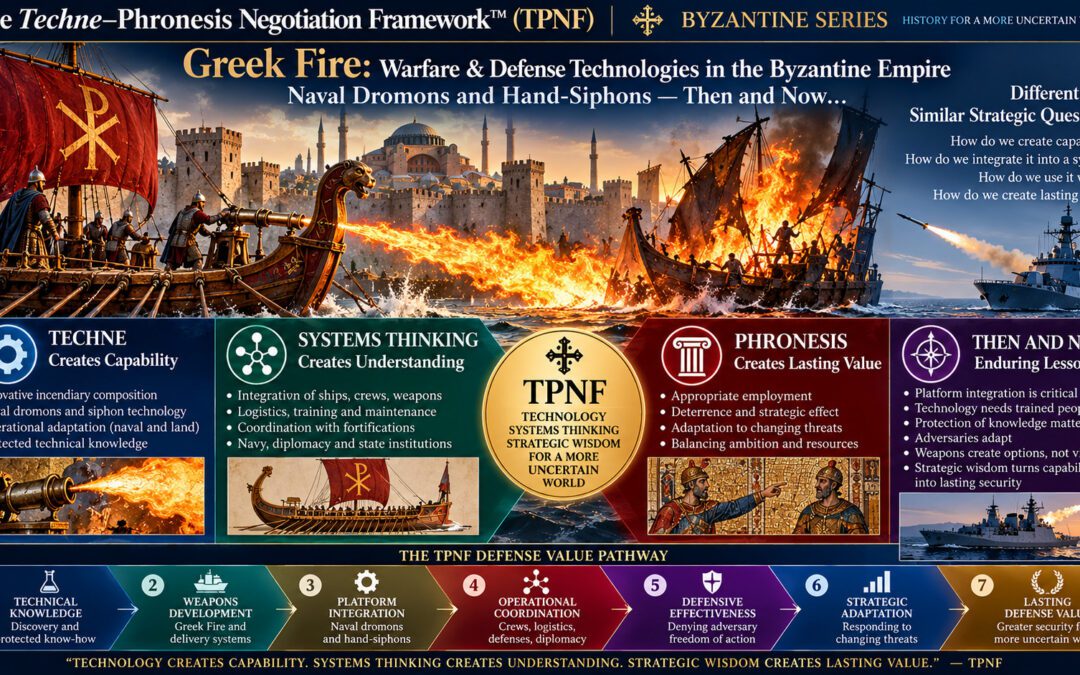
Through the Techne–Phronesis Negotiation Framework™ (TPNF), Greek Fire illustrates a fundamental proposition:
A military invention creates capability; integration into an operational ecosystem creates effectiveness; strategic wisdom determines whether that effectiveness produces lasting defense value.
This distinction remains relevant to contemporary defense technologies.
Purpose of the Essay
This second essay in the TPNF Byzantine Series examines Greek Fire as a historical case of military technological innovation and strategic integration.
It focuses on naval dromons, ship-mounted siphons and portable hand-siphons, investigating how these technologies contributed to Byzantine defensive capabilities.
The essay also identifies conceptual parallels with modern military innovation, without treating medieval incendiary weapons as direct technological predecessors of contemporary systems.
Abstract
Developed during the seventh century, Greek Fire became a distinctive Byzantine incendiary weapon, particularly associated with naval warfare.
Tradition attributes its development to Kallinikos, an engineer from the eastern Mediterranean.
Its exact composition remains uncertain.
The Byzantine military employed specialized delivery systems, including siphons mounted aboard warships and portable devices associated with land warfare.
Greek Fire contributed to important defensive successes, including the protection of Constantinople against Arab attacks.
Yet its effectiveness depended upon operational circumstances and institutional capabilities.
TPNF interprets this history through technological capability, Systems Thinking and strategic wisdom.
Introduction: Technology and Byzantine Survival
The Byzantine Empire occupied a strategically demanding geopolitical environment.
Its capital, Constantinople, controlled important maritime connections between the Black Sea and the Mediterranean.
Protecting these approaches required fortifications, naval forces, logistical resources and effective political leadership.
Greek Fire emerged within this broader defensive ecosystem.
Unlike ordinary incendiary weapons, Byzantine liquid fire was described as continuing to burn on water.
Its reputation created both physical danger and psychological pressure.
Nevertheless, its strategic importance depended upon how Byzantine forces employed it.
The historical question is therefore not simply what Greek Fire contained, but how the empire converted technical knowledge into organized defensive power.
Greek Fire: Historical Origins and Uncertainty
Greek Fire is generally associated with Byzantine developments during the later seventh century.
Historical accounts connect its introduction with Kallinikos, traditionally identified as an engineer from Heliopolis in Syria.
Its employment against Arab naval forces became an important element of Byzantine military history.
However, historians continue to debate its precise origins and technical characteristics.
The original formula has not survived in a form permitting reliable reconstruction.
Petroleum-based substances are frequently discussed as likely components, but proposed ingredients and operating mechanisms remain uncertain.
This uncertainty matters.
Historical interpretation must distinguish documented military employment from speculative technological reconstruction.
For TPNF, Greek Fire provides an early example of the relationship between protected technical knowledge and strategic advantage.
Naval Dromons: Technology Integrated into Platforms
The Byzantine dromon was an important warship within the empire’s naval forces.
Its operational significance emerged from the combination of vessel design, propulsion, crews, weapons and maritime organization.
Greek Fire could be projected through siphons mounted near the bow of suitably equipped vessels.
This transformed the ship from a transportation and combat platform into a specialized delivery system for an unusual incendiary weapon.
However, the dromon’s effectiveness required coordinated operation.
Navigation, maneuvering, crew discipline and the positioning of the vessel influenced combat outcomes.
The weapon’s limited practical reach also meant that approaching an adversary could involve considerable danger.
Greek Fire therefore illustrates a principle familiar in modern defense engineering:
A weapon becomes operationally meaningful when its capabilities are successfully integrated into a functioning platform.
Hand-Siphons: Extending Technological Applications
Byzantine military sources also describe portable fire-projecting devices known as cheirosiphones, or hand-siphons.
These are associated particularly with tenth-century military writings and siege warfare.
Their exact construction and battlefield performance remain uncertain.
Nevertheless, their appearance suggests an effort to adapt incendiary technology beyond ship-mounted systems.
The strategic significance lies in the attempted transfer of an established capability into additional operational environments.
Naval warfare and siege defense presented different requirements.
A technology effective aboard a warship could not automatically achieve equivalent results on land.
Adaptation required attention to equipment, personnel, mobility and tactical circumstances.
For TPNF, hand-siphons illustrate the distinction between technological invention and technological diversification.
Techne: Creating Military Capability
The first TPNF dimension states:
Technology Creates Capability.
Greek Fire offered Byzantine forces an unusual means of attacking hostile vessels and potentially disrupting siege operations.
Its effectiveness derived from the interaction of incendiary materials and specialized delivery technologies.
However, the weapon was not universally decisive.
Weather, maritime conditions, engagement distances and enemy responses influenced its usefulness.
Technological superiority therefore existed within operational limits.
This historical reality challenges interpretations of Greek Fire as an invincible weapon.
The important achievement was the creation of an additional military capability that could alter the tactical choices available to Byzantine commanders.
Systems Thinking: The Greek Fire Defense Ecosystem
The second TPNF dimension states:
Systems Thinking Creates Understanding.
Greek Fire depended upon a network of interconnected capabilities.
Technical knowledge had to be preserved.
Materials and equipment had to be available.
Warships required maintenance.
Crews needed training.
Commanders had to coordinate naval operations with broader defensive objectives.
Constantinople’s fortifications and maritime geography also influenced how naval capabilities contributed to the capital’s protection.
These relationships created a defense ecosystem.
Its strategic value exceeded the properties of any single weapon.
A sophisticated incendiary system without trained operators or suitable naval platforms would have possessed limited military usefulness.
Conversely, effective coordination could magnify the value of an otherwise specialized capability.
The strategic value of Greek Fire emerged from the system that enabled its employment, not merely from the substance itself.
Knowledge Protection and Strategic Advantage
The composition and preparation of Greek Fire were reportedly protected as important imperial secrets.
Such secrecy may have helped preserve Byzantine technological advantages.
However, secrecy also creates strategic trade-offs.
Restricting access to knowledge can protect sensitive capabilities while making their transmission and improvement dependent upon specialized personnel.
The historical record does not establish precisely how these trade-offs affected Greek Fire’s eventual decline.
Nevertheless, the broader principle remains relevant.
Modern defense organizations confront comparable tensions involving classified software, advanced materials, military sensors and proprietary technologies.
Protection must be balanced against institutional learning, maintenance and adaptability.
Technological knowledge creates lasting value only when organizations can preserve and employ it effectively.
Then and Now: Functional Parallels with Modern Defense Technology
Greek Fire should not be equated technically with modern missiles, drones or directed-energy systems.
Their scientific foundations, operational ranges and destructive mechanisms differ fundamentally.
However, important functional parallels exist.
Modern naval weapons also require integration with platforms, trained personnel, command systems and logistical support.
Unmanned systems depend upon communications, intelligence and institutional coordination.
Advanced defense technologies frequently involve protected knowledge and specialized industrial capabilities.
In each case, the acquisition of a weapon represents only one component of military effectiveness.
The enduring analytical connection is therefore systemic rather than technological.
Different generations of military technology confront the same strategic requirement: transforming technical capability into coordinated operational value.
Phronesis: Strategic Wisdom Beyond Technological Superiority
The third TPNF dimension states:
Strategic Wisdom Creates Lasting Value.
Ancient Greek phronesis concerns practical judgement about appropriate action under particular circumstances.
Applied retrospectively as a modern analytical lens, it helps distinguish technological achievement from strategic success.
Greek Fire could contribute to defensive victories.
Yet no single military technology could guarantee Byzantine survival.
Political leadership, diplomacy, economic resources and institutional adaptability remained essential.
The Byzantine Empire ultimately experienced territorial losses, internal conflicts and military defeat despite its historical technological achievements.
Strategic wisdom therefore requires decision-makers to evaluate capabilities within the broader political environment.
The decisive question is not simply whether a weapon works.
It is whether employing that weapon advances sustainable strategic objectives.
The TPNF Greek Fire Defense Value Pathway
The historical case suggests the following analytical progression:
Technical Knowledge → Weapons Development → Platform Integration → Operational Coordination → Defensive Effectiveness → Strategic Adaptation → Lasting Defense Value
Each stage introduces additional requirements.
Technical knowledge must become a usable weapon.
Weapons must be integrated into appropriate platforms.
Operational systems must coordinate their employment.
Defensive effectiveness must contribute to achievable strategic objectives.
Finally, institutions must adapt as threats and technologies evolve.
This pathway provides a conceptual model for examining both Byzantine and contemporary defense innovation.
It does not imply that successful progression is inevitable.
Strategic Implications for Contemporary Defense
Greek Fire offers several lessons for modern military organizations.
First, technological innovation must be evaluated within the operational systems that support it.
Second, platform integration can be as important as the invention itself.
Third, technological secrecy must coexist with institutional continuity.
Fourth, adversaries adapt, reducing the permanence of technological advantages.
Finally, defense value must be assessed through sustainable security outcomes rather than technological prestige.
These lessons apply to modern naval warfare, unmanned systems, electronic warfare and advanced military modernization.
Greek Fire illustrates the technological ingenuity of Byzantine civilization.
Naval dromons and portable hand-siphons demonstrate efforts to integrate and adapt incendiary capabilities across different operational environments.
However, the historical significance of Greek Fire extends beyond its technical characteristics.
Its value depended upon institutional knowledge, naval organization, operational coordination and strategic circumstances.
TPNF expresses the governing relationship:
Technology Creates Capability. Systems Thinking Creates Understanding. Strategic Wisdom Creates Lasting Value.
Greek Fire’s enduring lesson is that military innovation becomes strategically significant only when institutions can transform technological potential into effective and sustainable defense capabilities.
Key Takeaways
- Greek Fire was a distinctive Byzantine incendiary weapon whose exact composition remains uncertain.
- Naval dromons integrated weapons technology with maritime operational capabilities.
- Hand-siphons illustrate attempts to adapt incendiary technology to additional military environments.
- Protected knowledge contributed to technological advantage but required institutional continuity.
- Operational effectiveness depended upon platforms, crews, logistics and coordination.
- Technological superiority did not guarantee Byzantine strategic success.
- Modern defense systems exhibit comparable requirements for integration and governance.
Author’s Reflection
Greek Fire represents more than a fascinating episode in medieval military history.
It reveals how technological ingenuity can become a strategic resource when supported by capable institutions.
Yet its history also demonstrates that technological advantages are conditional and temporary.
The Byzantine Empire could develop exceptional military capabilities without escaping the fundamental uncertainties of geopolitical competition.
Modern societies face a similar challenge with increasingly sophisticated defense technologies.
The technologies have changed dramatically.
The need for coordination, adaptability and responsible judgement has not.
The lasting lesson of Greek Fire is not that civilizations survive through superior weapons, but that technological power acquires strategic meaning only through the wisdom of its application.
Nikolaos Chatzis
Research References
- Haldon, John, and Maurice Byrne (1977). “A Possible Solution to the Problem of Greek Fire.” Byzantinische Zeitschrift, 70(1), 91–99. A technical and historical investigation into the possible composition and delivery mechanisms of Byzantine Greek Fire.
https://doi.org/10.1515/byzs.1977.70.1.91 - Pryor, John H., and Elizabeth M. Jeffreys (2006). The Age of the Dromon: The Byzantine Navy ca. 500–1204. Leiden: Brill. A major scholarly study of Byzantine naval organization, warship development, naval tactics and incendiary weapons.
https://doi.org/10.1163/9789047409939 - Haldon, John (1999). Warfare, State and Society in the Byzantine World, 565–1204. London: UCL Press. Examines the relationship between Byzantine military institutions, resources, administration and geopolitical pressures.
- Theophanes the Confessor. The Chronicle of Theophanes Confessor: Byzantine and Near Eastern History, AD 284–813. Translated by Cyril Mango and Roger Scott, with Geoffrey Greatrex. Oxford: Clarendon Press, 1997. A principal narrative source for early Byzantine history, including traditions surrounding Greek Fire and Arab–Byzantine warfare.
- Leo VI, Emperor of Byzantium. The Taktika of Leo VI. Edited and translated by George T. Dennis. Washington, DC: Dumbarton Oaks, 2010. A primary Byzantine military treatise relevant to naval organization, military doctrine and the employment of specialized weapons.
- Cartwright, Mark (2017). “Greek Fire: The Byzantines’ Secret Weapon.” World History Encyclopedia, November 14, 2017. An accessible historical overview of Greek Fire, its naval employment, possible composition and strategic significance.
https://www.worldhistory.org/Greek_Fire/ - Exploring Byzantium — Greek Fire. Educational historical resource examining Byzantine incendiary technology, the traditional attribution to Kallinikos and the weapon’s employment in naval warfare.
https://www.exploringbyzantium.gr/EKBMM/Page?id=29&lang=en&level=1&name=ypomeleti&sub=493
Analytical Note: The Techne–Phronesis Negotiation Framework™ (TPNF), its three-dimensional analytical structure and the proposed Greek Fire Defense Value Pathway are contemporary theoretical interpretations developed by Nikolaos Chatzis. They should not be understood as doctrines explicitly formulated by Byzantine military authorities.
Source: Open Sources Analysis, Relative Data Analysis by Nikos Chatzis
© Nikolaos Chatzis. All Rights Reserved.
The Techne–Phronesis Negotiation Framework™
An Integrative Theory of Strategic Negotiation, Complex Adaptive Systems and Practical Wisdom
Technology Creates Capability • Systems Thinking Creates Understanding • Strategic Wisdom Creates Lasting Value.
Negotiation.gr | Strategic Wisdom for the Technological Age