Negotiation.gr | Strategic Wisdom for the Technological Age
“Strategic resilience emerges when technical capability (techne) is
continuously guided by practical wisdom (phronesis) through adaptive
negotiation across interconnected systems.”
Central Idea (Thesis)
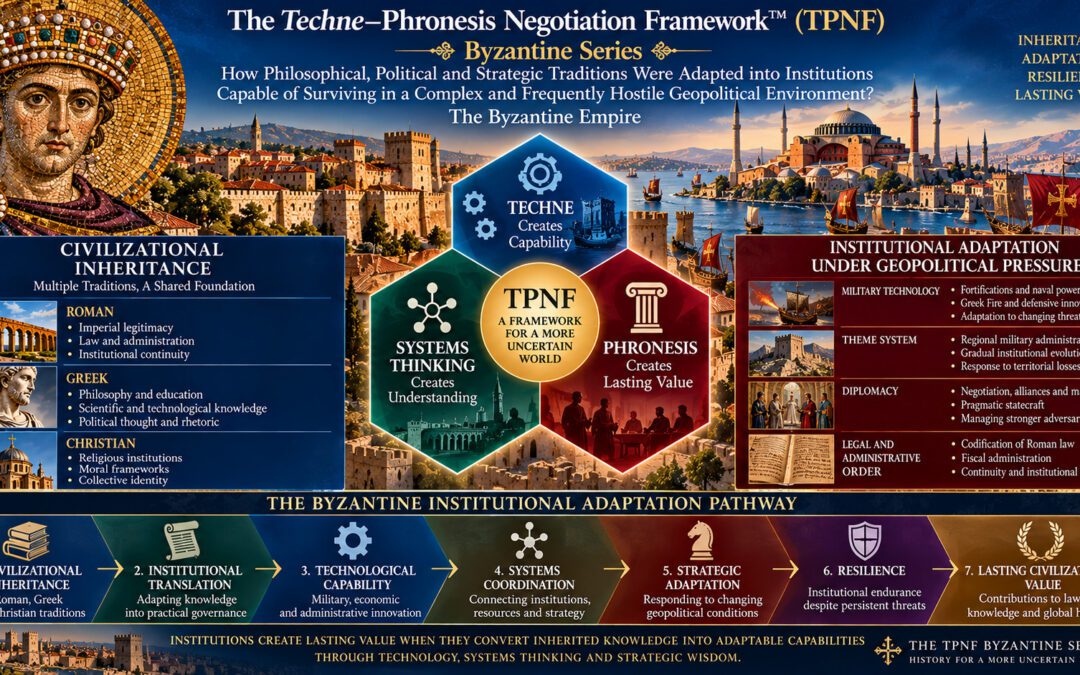
The Byzantine Empire demonstrates that civilizational endurance depends not merely on inherited knowledge, military strength or geographical advantages, but on the capacity to transform these resources into adaptable institutions.
Emerging from the Eastern Roman Empire, Byzantium integrated Roman law and administration, Greek intellectual traditions and Christianity into an evolving political civilization.
Through the Techne–Phronesis Negotiation Framework™ (TPNF), its historical experience suggests a fundamental proposition:
Civilizational inheritance creates strategic potential; institutional adaptation converts that potential into resilience; strategic wisdom determines whether resilience can be sustained.
Byzantium offers an exceptional historical case for examining this relationship.
Purpose of the Essay
This essay inaugurates a TPNF research series examining Byzantine civilization through technology, Systems Thinking and strategic wisdom.
Its purpose is to investigate how inherited philosophical, political and strategic traditions contributed to institutional adaptation under persistent geopolitical pressure.
It also explores what Byzantine experience can teach contemporary societies confronting technological disruption, geopolitical rivalry and institutional uncertainty.
Abstract
For more than a millennium after Constantinople became an imperial capital in 330 CE, the Eastern Roman state underwent repeated transformations.
Its rulers confronted territorial losses, fiscal crises, religious controversies, military invasions and shifting international relationships.
Yet Byzantine institutions demonstrated substantial capacities for adaptation.
Legal administration, military reorganization, diplomacy, religious institutions and technological innovation contributed to imperial resilience.
TPNF interprets this experience through three interconnected dimensions: technological capability, systemic understanding and practical wisdom.
The resulting lesson concerns institutional adaptability rather than any claim of Byzantine invincibility.
Introduction: The Civilization That Adapted
The Byzantine Empire was not a static continuation of ancient Rome.
Its inhabitants called themselves Romans, while their state increasingly operated within a predominantly Greek-speaking and Christian cultural environment.
Constantinople occupied a strategically important position connecting the Black Sea, Mediterranean and surrounding continental regions.
Geography created opportunities for trade, defense and diplomacy.
However, geography alone could not guarantee survival.
The empire’s institutions repeatedly faced pressures requiring reorganization.
The Byzantine experience therefore raises a question central to TPNF:
How can a civilization preserve its identity while continuously changing the institutions through which that identity operates?
Civilizational Inheritance: Roman, Greek and Christian Foundations
Byzantine political civilization combined three major historical inheritances.
Roman traditions contributed imperial legitimacy, legal concepts, administrative structures and ideas of public authority.
Greek intellectual culture contributed language, philosophical education, rhetoric and scientific knowledge.
Christianity contributed religious institutions, moral frameworks and powerful forms of collective identity.
These inheritances were not always harmonious.
Theological disputes, political rivalries and competing interpretations of imperial authority generated persistent tensions.
Nevertheless, their interaction produced an evolving institutional order.
The significance of this combination was not simply cultural preservation.
It was the capacity to employ inherited traditions within changing political and strategic circumstances.
Roman Law and Administrative Continuity
The Byzantine state maintained extensive administrative responsibilities.
It collected taxes, regulated economic activity, administered justice and supported military organizations.
Under Emperor Justinian I, the sixth-century codification of Roman law created an influential legal inheritance.
The Corpus Juris Civilis was not a complete solution to Byzantine political problems.
However, it demonstrated the importance of organizing accumulated legal knowledge into an authoritative institutional framework.
Administrative continuity enabled the state to preserve important functions despite changes in rulers and territorial boundaries.
For TPNF, this illustrates a central principle:
Institutions create strategic value when they convert accumulated knowledge into repeatable capacities for collective action.
Greek Philosophy and the Question of Practical Wisdom
Greek philosophical traditions remained influential within Byzantine education and intellectual life.
Aristotle’s distinction between technical skill and practical wisdom provides a useful analytical lens.
Techne concerns the capacity to produce or accomplish something.
Phronesis concerns appropriate judgement in particular circumstances.
The Byzantine state did not explicitly operate according to the modern TPNF framework.
Nevertheless, its history presents numerous examples of the tension between possessing capabilities and judging how to employ them.
Military force could defend territory, but diplomacy might sometimes achieve comparable objectives at lower cost.
Political centralization could strengthen coordination while creating succession vulnerabilities.
Religious unity could support legitimacy while doctrinal conflict weakened political cohesion.
These tensions make Byzantine history especially relevant to strategic analysis.
Techne: Technology as an Instrument of Survival
The first TPNF dimension states:
Technology Creates Capability.
Byzantine civilization developed, preserved and adapted numerous technical capabilities.
Its military technologies included fortified defensive systems, naval vessels, siege equipment and incendiary weapons.
Greek Fire became one of the most recognizable examples of Byzantine military technology.
Its exact composition remains uncertain, but its deployment illustrates the relationship between technical knowledge and naval warfare.
Constantinople’s defensive walls provide another example.
Their effectiveness depended not only on engineering but also on maintenance, manpower, logistics and the strategic circumstances of each siege.
Technology expanded defensive options.
Yet technological superiority was never permanent.
Adversaries adapted, and changing military conditions eventually reduced the effectiveness of established defensive advantages.
Systems Thinking: Institutions as an Integrated Ecosystem
The second TPNF dimension states:
Systems Thinking Creates Understanding.
Byzantine resilience depended upon interactions among multiple institutions.
Taxation supported armies.
Agricultural production sustained populations and military forces.
Fortifications protected economic and administrative centers.
Diplomacy influenced the number and timing of external threats.
Religious institutions shaped legitimacy and social relationships.
Education preserved specialized knowledge.
These components formed an interconnected political ecosystem.
Their effectiveness depended upon coordination.
A powerful army without adequate fiscal resources could become unsustainable.
Strong fortifications without external support could become isolated.
Diplomatic achievements without credible military capacity might prove temporary.
Byzantine endurance therefore cannot be attributed to a single institution or technological invention.
The Theme System: Adaptation Under Pressure
The seventh century brought profound territorial and military challenges.
Following major losses in the eastern Mediterranean, Byzantine military and provincial administration evolved substantially.
The development of the themes, or themata, reflected changing relationships among regional military forces, territory and administration.
Historical scholarship emphasizes that this process was gradual rather than one universally coordinated reform.
The theme system nevertheless illustrates institutional adaptation to altered geopolitical conditions.
Instead of preserving earlier arrangements unchanged, Byzantine authorities developed new forms of military and administrative organization.
For TPNF, the lesson concerns the strategic importance of institutional flexibility.
When environmental conditions change, preserving institutional purpose may require transforming institutional structure.
Diplomacy: Negotiation as Strategic Capability
Byzantine diplomacy became a sophisticated instrument of statecraft.
Imperial authorities employed negotiation, ceremonial prestige, alliances, marriage diplomacy, religious influence and material incentives.
These instruments complemented military power.
Byzantine rulers sometimes negotiated with adversaries whose immediate military strength exceeded their own.
This distinction between political ideology and practical conduct is especially significant.
Imperial rhetoric emphasized Roman legitimacy and hierarchical status.
Actual diplomacy frequently required accommodation, compromise and recognition of unfavorable power relationships.
TPNF identifies here a fundamental strategic principle:
Political identity may define strategic aspirations, but practical wisdom must determine feasible action.
Diplomacy was therefore not merely a substitute for warfare.
It was a capability for managing complexity.
Phronesis: Strategic Wisdom Under Uncertainty
The third TPNF dimension states:
Strategic Wisdom Creates Lasting Value.
Byzantine decision-makers repeatedly confronted uncertainty.
They could not control neighboring powers, economic conditions, dynastic conflicts or technological developments.
Successful decisions often required balancing competing objectives.
Territorial ambitions had to be weighed against fiscal resources.
Military confrontation had to be evaluated alongside diplomatic alternatives.
Religious authority had to coexist with political realities.
Not every Byzantine decision reflected wisdom.
Imperial overextension, internal conflict and strategic miscalculations periodically undermined resilience.
The importance of phronesis lies precisely in recognizing these limitations.
Practical wisdom requires continuous reassessment rather than confidence derived from historical prestige.
The Limits of Byzantine Resilience
The empire’s longevity should not obscure its failures.
The Fourth Crusade’s conquest of Constantinople in 1204 fragmented imperial authority.
Although Byzantine rule returned to the city in 1261, the restored empire possessed substantially reduced resources.
Its final centuries combined intellectual and artistic achievements with growing geopolitical vulnerability.
In 1453, Ottoman forces captured Constantinople.
Byzantine institutions had demonstrated extraordinary adaptability, but adaptation could not indefinitely compensate for structural weaknesses and unfavorable power relationships.
This outcome provides an essential qualification.
Resilience extends strategic possibilities; it does not guarantee survival.
The TPNF Byzantine Institutional Adaptation Pathway
The Byzantine experience suggests a proposed analytical sequence:
Civilizational Inheritance → Institutional Translation → Technological Capability → Systems Coordination → Strategic Adaptation → Resilience → Lasting Civilizational Value
Each stage identifies a distinct requirement.
Inherited knowledge must be interpreted.
Institutions must translate that knowledge into practical functions.
Technology must create usable capabilities.
Systems must coordinate resources and decisions.
Strategic adaptation must respond to changing conditions.
Resilience emerges when institutions can continue performing essential functions under pressure.
Lasting value may survive even when the original political state disappears.
Byzantine contributions to law, art, theology, architecture and learning demonstrate this distinction.
Strategic Implications for Modern Technological Civilization
Contemporary societies confront challenges different from those faced by Byzantium.
Artificial intelligence, robotics, cybersecurity and digital infrastructure create capabilities unimaginable to medieval rulers.
Nevertheless, the institutional challenge remains recognizable.
Technological development can outpace organizational adaptation.
Governments may acquire sophisticated systems without adequate governance structures.
Critical infrastructure may become vulnerable through excessive interdependence.
Geopolitical competition may encourage technological investment without sufficient strategic coordination.
The Byzantine experience suggests that institutions must evolve alongside capabilities.
It also demonstrates that historical identity alone cannot compensate for institutional weakness.
For TPNF, technological modernization should therefore be assessed through adaptability, resilience and long-term value creation.
The Byzantine Empire transformed Roman, Greek and Christian inheritances into an evolving political and institutional civilization.
Its longevity reflected neither uninterrupted success nor permanent technological superiority.
Rather, its institutions repeatedly adapted to changing geopolitical realities.
TPNF provides a contemporary analytical interpretation of this historical experience:
Technology Creates Capability. Systems Thinking Creates Understanding. Strategic Wisdom Creates Lasting Value.
Byzantium’s most enduring strategic lesson is that civilizational inheritance becomes meaningful when institutions can translate it into effective action under changing conditions.
Key Takeaways
- Byzantine civilization combined Roman, Greek and Christian inheritances.
- Institutional adaptation contributed to imperial endurance.
- Military technology required administrative, logistical and strategic support.
- The theme system illustrates gradual organizational transformation.
- Diplomacy complemented military power in managing geopolitical complexity.
- Political ideology did not always determine practical diplomatic behavior.
- Resilience depends upon coordination, adaptability and judgement.
- The empire’s fall demonstrates the limits of institutional resilience.
Author’s Reflection
The Byzantine Empire offers an extraordinary historical laboratory for examining the relationship between civilization, technology and strategy.
Its significance extends beyond the preservation of ancient knowledge.
Byzantine institutions repeatedly transformed inherited traditions into practical responses to new challenges.
Yet their achievements also reveal the limits of adaptation.
No civilization can rely indefinitely upon historical prestige, military technology or institutional continuity.
For contemporary technological societies, the lesson is especially important.
Artificial intelligence and other emerging technologies will create unprecedented capabilities.
Their lasting value will depend upon institutions capable of understanding, governing and adapting to their consequences.
Civilizations do not endure merely because they inherit greatness. They create lasting value when they possess the wisdom to transform inheritance into responsible action.
Nikolaos Chatzis
Selected Historical References
These sources provide a historical foundation for the essay’s interpretation. The TPNF pathways and propositions are contemporary analytical applications, not concepts attributed to Byzantine historical actors.
-
The Metropolitan Museum of Art: Byzantium (ca. 330–1453) — imperial continuity, cultural transformation, the Fourth Crusade and the empire’s final centuries.
The Metropolitan Museum of Art -
Nicolas Drocourt: Byzantine Diplomacy (2018) — the distinction between imperial ideology and adaptable diplomatic practice.
Wiley Online Library -
Christos Malatras: Civil Authority in the Byzantine Provinces (7th–9th Centuries) — the gradual evolution of provincial administration and the theme system.
Studia Ceranea -
Meredith L. D. Riedel: Administration, Byzantine — the breadth and functions of Byzantine government.
Wiley Online Library -
Byzantine and Christian Museum, Athens: The Palaiologan Period: The Final Flowering of Byzantium — political decline alongside cultural and intellectual vitality.
Source: Open Sources Analysis, Relative Data Analysis by Nikos Chatzis
© Nikolaos Chatzis. All Rights Reserved.
The Techne–Phronesis Negotiation Framework™
An Integrative Theory of Strategic Negotiation, Complex Adaptive Systems and Practical Wisdom
Technology Creates Capability • Systems Thinking Creates Understanding • Strategic Wisdom Creates Lasting Value.
Negotiation.gr | Strategic Wisdom for the Technological Age