Negotiation.gr | Strategic Wisdom for the Technological Age
“Strategic resilience emerges when technical capability (techne) is
continuously guided by practical wisdom (phronesis) through adaptive
negotiation across interconnected systems.”
Central Idea — Thesis
On September 21, 2026, a tanker transiting the Strait of Hormuz was struck by an unidentified projectile.
Two crew members suffered minor injuries. The vessel remained operational and continued toward its destination. Responsibility for the incident had not been established.
As an isolated military event, the attack was limited.
Strategically, however, its significance is much larger.
It occurred in one of the world’s most important energy chokepoints, within an already contested maritime environment, just as world leaders were gathering around the United Nations General Assembly and diplomatic attention was turning toward possible de-escalation of the wider Middle Eastern conflict.
The Techne–Phronesis Negotiation Framework™ (TPNF) identifies an important strategic condition:
When military escalation and diplomatic engagement occur simultaneously, uncertainty itself becomes a strategic force capable of influencing markets, maritime behavior, political decisions and the negotiating environment.
TPNF describes this condition as Escalation–Diplomacy Convergence™.
Purpose of the Essay
This TPNF essay examines why a single unattributed attack against a commercial tanker can acquire strategic significance far beyond the physical damage it causes.
The central question is:
How does a relatively limited event inside a critical geopolitical chokepoint alter strategic calculations when military escalation and diplomatic negotiations coexist?
Abstract
UK Maritime Trade Operations reported on September 21 that military authorities had informed it of a tanker struck by an unknown projectile while making an inbound transit through the Strait of Hormuz. Two crew members suffered minor injuries. The ship remained under its own power, and no environmental impact was reported.
The incident occurred within a much wider deterioration of maritime security. The International Maritime Organization reported on September 16 that it had verified 80 attacks on merchant vessels in and around Hormuz since the current Middle Eastern conflict began on February 28, resulting in at least 22 seafarer deaths.
Meanwhile, world leaders gathering around the UN General Assembly confront the possibility of renewed diplomacy alongside continued military escalation.
TPNF interprets this environment through Escalation–Diplomacy Convergence™, Strategic Chokepoint Uncertainty™, Maritime Risk Transmission™ and Adaptive Energy Logistics™.
1. One Tanker, a Global Chokepoint
The immediate facts appear straightforward.
A tanker was struck.
Two sailors were injured.
The vessel continued sailing.
Yet location transforms significance.
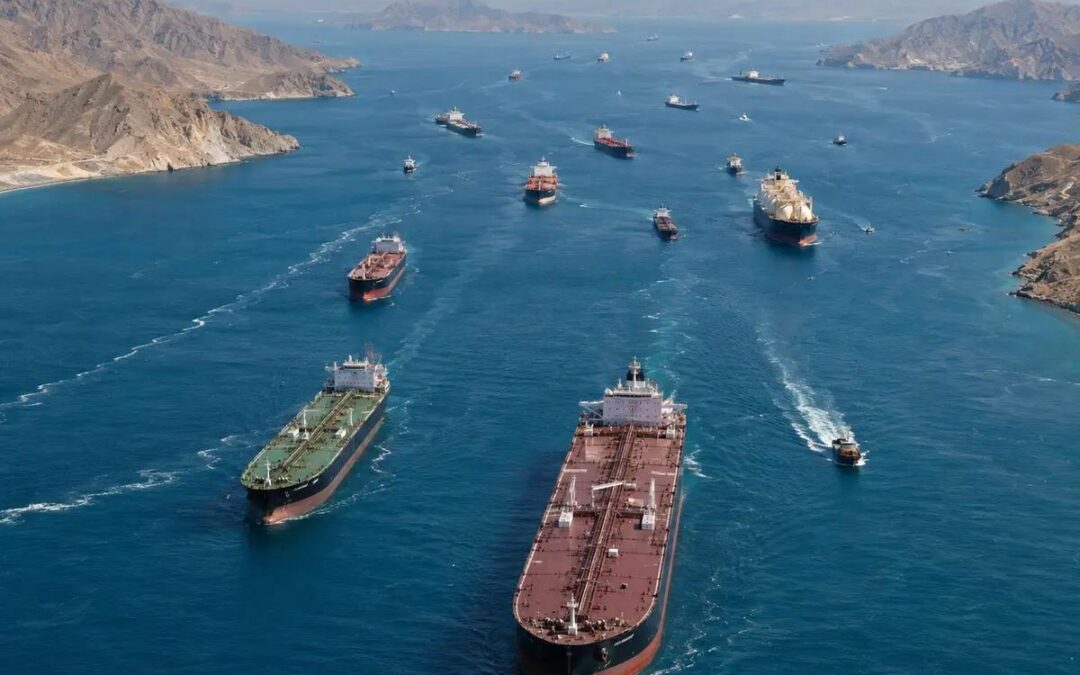
Before the current conflict, approximately one-fifth of global oil consumption moved through the Strait of Hormuz. The narrow maritime corridor connects the enormous hydrocarbon resources of the Persian Gulf with global markets.
The strategic equation is therefore:
Local Incident → Maritime Risk → Shipping Behavior → Energy Flows → Prices → Inflation → Economic Expectations → Political Pressure.
A projectile can cause limited physical damage while generating consequences across systems thousands of kilometers away.
2. Strategic Chokepoint Uncertainty™
TPNF describes this phenomenon as Strategic Chokepoint Uncertainty™:
the amplification of strategic uncertainty when military incidents occur within geographic corridors whose continued functioning is disproportionately important to global economic or security systems.
An attack in open ocean and an identical attack inside Hormuz do not carry equal systemic significance.
The difference is not the weapon.
It is the surrounding ecosystem.
Geography amplifies consequence.
3. Attribution Matters
The projectile remains unidentified.
That uncertainty must be preserved analytically.
Attribution in contemporary warfare is strategically important because retaliation requires decisions about responsibility.
Who launched the weapon?
Was the tanker deliberately targeted?
Was the strike accidental?
Was it connected with a wider military operation?
Was it intended to influence shipping behavior?
Without reliable answers, decision-makers operate within an Attribution–Response Dilemma™.
Act too quickly and retaliation against the wrong actor can accelerate escalation.
Wait too long and deterrence may weaken.
Technological capability therefore does not eliminate uncertainty.
Sometimes it accelerates the speed at which leaders must make decisions despite uncertainty.
4. Hormuz Is Already Under Pressure
The September 21 incident did not occur within normal maritime conditions.
Reuters reported that only 17 commodity vessels crossed Hormuz during the weekend, compared with 37 the previous weekend and approximately 125 vessels daily before the war.
Some tankers continue operating with transponders switched off.
Saudi Arabia and other Gulf producers are simultaneously attempting to maintain exports through increasingly complex logistical arrangements.
The strategic significance of another attack therefore depends partly upon accumulation.
One incident rarely transforms a system.
Repeated incidents change behavior.
5. From Physical Damage to Behavioral Disruption
This distinction is fundamental.
A tanker does not need to sink for an attack to create strategic consequences.
Shipowners may avoid the region.
Insurance costs can rise.
Crews face additional risk.
Military escorts may become necessary.
Shipping schedules change.
Tankers may demand higher freight rates.
The strategic effect therefore shifts from physical destruction toward behavioral disruption.
TPNF calls this Maritime Risk Transmission™:
the process through which security threats affecting maritime transportation are converted into changes in commercial behavior, logistics, costs, supply chains and ultimately economic outcomes.
6. The Energy Ecosystem Is Adapting
Yet the system is not simply collapsing.
It is adapting.
Gulf producers have increasingly used ship-to-ship transfers in the Gulf of Oman to maintain exports while reducing the exposure of individual tankers repeatedly traversing Hormuz.
Around 2.5 million barrels per day are expected to move through these transfers during September, compared with 1.4 million barrels per day in August.
But adaptation has a price.
Reuters reported benchmark freight costs for a VLCC carrying Gulf crude to China rising above $30 per barrel.
This is Adaptive Energy Logistics™:
the capacity of an energy ecosystem to reorganize transportation, routing and operational structures to preserve essential flows under conditions of geopolitical disruption.
Resilience exists.
But resilience is becoming expensive.
7. The Resilience–Efficiency Tradeoff™
This produces another important TPNF lesson.
Efficient systems optimize costs under normal conditions.
Resilient systems maintain functionality under abnormal conditions.
The two objectives do not always coincide.
Ship-to-ship transfers, military escorts, alternative routes and additional tankers can preserve energy flows.
But they increase cost and complexity.
TPNF therefore identifies the Resilience–Efficiency Tradeoff™:
the strategic tension between optimizing a system for economic efficiency during stability and maintaining sufficient redundancy and adaptability to function during disruption.
The cheapest energy network is not necessarily the most strategically resilient.
8. Diplomacy and Escalation Now Coexist
The timing of the tanker incident adds another dimension.
As leaders gather around the UN General Assembly, Gulf governments are calling increasingly for diplomatic engagement with Iran.
Qatar has advocated a regional security framework.
The UAE has called for a different regional approach emphasizing dialogue.
Saudi Arabia has explored mechanisms for reducing confrontation with Tehran.
At the same time, military incidents continue.
Diplomacy and warfare therefore no longer represent separate sequential phases.
They coexist.
9. Escalation–Diplomacy Convergence™
TPNF defines Escalation–Diplomacy Convergence™ as:
the simultaneous interaction of military escalation and diplomatic engagement in which developments in either domain continuously alter the bargaining environment of the other.
A tanker attack can harden negotiating positions.
A diplomatic opening can restrain military responses.
A new military strike can increase urgency for negotiation.
A successful diplomatic meeting can alter market expectations.
The relationship becomes recursive:
Escalation → Diplomatic Pressure → Negotiation → Strategic Signaling → Military Calculation → Further Escalation or De-escalation.
Negotiation therefore occurs inside the conflict rather than after it.
10. The UN General Assembly as a Strategic Network
The UN General Assembly cannot independently solve the Hormuz crisis.
But it performs another function.
It concentrates political actors within the same diplomatic environment.
Formal speeches receive public attention.
But strategically important interactions often occur through bilateral meetings, intermediaries, informal discussions and back channels.
The diplomatic ecosystem therefore creates Relational Strategic Optionality™.
Actors that cannot negotiate directly may communicate through others.
Saudi Arabia can engage China.
Qatar can maintain channels between Washington and Tehran.
European governments can explore diplomatic alternatives.
The value lies in maintaining pathways through which escalation might eventually be converted into negotiation.
11. The Global Consequence of Local Insecurity
The Strait of Hormuz demonstrates a defining characteristic of contemporary technological civilization.
Economic systems are geographically distributed but strategically interconnected.
Oil produced in the Gulf powers factories in Asia.
Tankers crossing Hormuz influence fuel prices in Europe.
Shipping insurance affects transportation costs.
Transportation costs influence inflation.
Inflation affects interest rates.
Interest rates influence households and businesses.
TPNF already describes this as Geopolitical–Economic Transmission™.
Hormuz is one of the clearest places where that transmission becomes visible.
Strategic Implications
The September 21 tanker incident demonstrates that physical damage alone is an inadequate measure of strategic effect.
Strategic Chokepoint Uncertainty™ amplifies the significance of incidents occurring within critical geographic corridors.
The Attribution–Response Dilemma™ complicates deterrence when responsibility remains uncertain.
Maritime Risk Transmission™ converts military insecurity into commercial and economic consequences.
Adaptive Energy Logistics™ demonstrates that complex systems can reorganize under pressure—but at substantial cost.
And Escalation–Diplomacy Convergence™ explains why military action and diplomatic negotiation increasingly occur simultaneously rather than sequentially.
The September 21 tanker incident may ultimately prove to be a relatively limited event.
But that is precisely why it is strategically revealing.
Two sailors were injured.
The tanker remained operational.
No major environmental damage was reported.
Yet the incident occurred inside a maritime corridor upon which a substantial part of the global energy system depends.
Its importance therefore cannot be measured by physical damage alone.
Techne creates ships, weapons, surveillance systems and energy infrastructure.
Systems Thinking reveals the connections between maritime security, energy markets, diplomacy and global economics.
Phronesis becomes essential when leaders must decide how to respond before responsibility and consequences are completely understood.
As world leaders gather around the United Nations, the central strategic challenge is therefore not merely stopping another projectile.
It is preventing individual incidents from being converted through interconnected systems into cascading escalation.
Because in the Strait of Hormuz:
A small military event can generate a large strategic consequence when geography, uncertainty and global interdependence amplify its effects.
Key Takeaways
- A tanker was struck by an unidentified projectile in Hormuz on September 21.
- Two crew members suffered minor injuries and the vessel continued under its own power.
- Attribution remains unresolved.
- Strategic Chokepoint Uncertainty™ amplifies localized incidents.
- Attribution–Response Dilemma™ complicates deterrence and retaliation.
- Maritime Risk Transmission™ converts security threats into economic consequences.
- Gulf producers are developing Adaptive Energy Logistics™.
- Resilience is preserving flows but increasing costs.
- Escalation–Diplomacy Convergence™ explains simultaneous conflict and negotiation.
- The UN General Assembly creates additional diplomatic pathways for managing escalation.
Author’s Reflection
The tanker struck on September 21 did not sink.
That fact could make the incident appear strategically minor.
But strategic analysis cannot stop at visible damage.
The important question is what the event changes elsewhere.
Does another shipowner reconsider entering Hormuz?
Does an insurer raise premiums?
Does another government request naval protection?
Does an oil producer reorganize exports?
Does a negotiator arrive in New York with greater urgency?
Does a military commander become more cautious—or more aggressive?
The strategic consequence of an event increasingly resides in the connections through which its effects travel.
That may be one of the defining realities of contemporary technological civilization.
The world has built extraordinary networks capable of moving energy, information, capital and goods with remarkable efficiency.
Those same connections can transmit fear, disruption and geopolitical pressure with equally remarkable speed.
The challenge for strategic leadership is therefore not simply to manage individual crises.
It is to understand how crises propagate through systems—and to intervene before uncertainty becomes escalation and escalation becomes systemic disruption.
Technology creates connectivity. Connectivity transmits consequence. Systems Thinking reveals the transmission pathways. Strategic wisdom determines whether those pathways carry escalation—or create opportunities for de-escalation.
Nikos Chatzis
Source: Open Sources Analysis, Relative Data Analysis by Nikos Chatzis
© Nikolaos Chatzis. All Rights Reserved.
The Techne–Phronesis Negotiation Framework™
An Integrative Theory of Strategic Negotiation, Complex Adaptive Systems and Practical Wisdom
Technology Creates Capability • Systems Thinking Creates Understanding • Strategic Wisdom Creates Lasting Value.
Negotiation.gr | Strategic Wisdom for the Technological Age