Negotiation.gr | Strategic Wisdom for the Technological Age
“Strategic resilience emerges when technical capability (techne) is
continuously guided by practical wisdom (phronesis) through adaptive
negotiation across interconnected systems.”
Central Idea — Thesis
China’s economic stability cannot be understood only through the size of its domestic economy, industrial capacity or technological development.
It must also be understood through China’s position inside global supply chains.
For decades, Chinese factories, suppliers, logistics networks, foreign investors, ports, technology companies and international markets have formed extensive cross-border production relationships. These relationships have supported trade and manufacturing, but their deeper strategic significance lies in the capabilities accumulated through continuous interaction with the global economy.
From the perspective of the Techne–Phronesis Negotiation Framework™ (TPNF), global supply-chain cooperation can therefore create long-term value through:
Connectivity → Exchange → Specialization → Learning → Capability Accumulation → Diversification → Adaptation → Economic Resilience → Lasting Strategic Value™.
The central proposition is not that interdependence automatically guarantees stability.
It is that well-diversified and strategically managed interdependence can increase the capacity of an economy to absorb disruption, adapt and continue creating value.
Purpose of the Essay
This TPNF essay explains how global supply-chain cooperation can contribute to China’s economic stability through long-term value creation.
It examines trade, foreign investment, intermediate goods, logistics, industrial learning, market diversification and international production networks as interconnected components of economic resilience.
The deeper TPNF question is:
How can participation in global supply chains be converted from economic connectivity into lasting strategic capability?
Abstract
China remains deeply embedded in global trade and production networks despite increasing geopolitical tensions, tariffs, export controls and efforts by several economies to reduce selected dependencies.
China’s 2026 Government Work Report simultaneously emphasizes stronger industrial and supply-chain resilience, expansion of trade in intermediate goods, encouragement of foreign investment, greater imports, cross-border investment and more rational international distribution of industrial and supply chains.
This apparent tension reveals an important strategic reality.
Resilience and openness are not necessarily opposites.
TPNF introduces the concept of Cooperative Supply Chain Resilience™: the capacity of an economy to preserve and regenerate productive capability through diversified, adaptive and mutually beneficial relationships across interconnected domestic and international production ecosystems.
China’s challenge is therefore not simply to become independent of global supply chains.
It is to make its position within them more resilient.
1. From the World’s Factory to a Global Production Ecosystem
China’s integration into global supply chains transformed its economy.
Foreign companies invested in Chinese manufacturing.
Chinese suppliers entered international production networks.
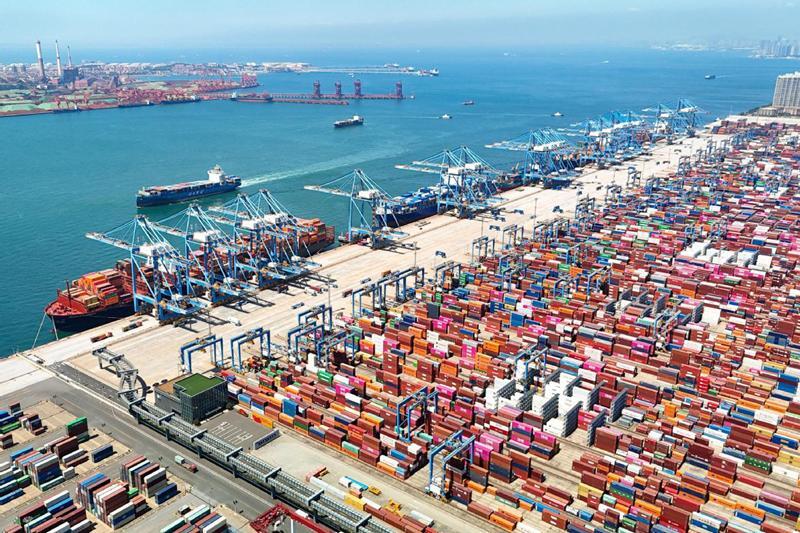
Ports and logistics infrastructure expanded.
Manufacturing clusters developed.
Technology and managerial knowledge circulated.
Chinese companies gradually moved into increasingly sophisticated areas of production.
This process demonstrates that supply chains do more than move products.
They move:
capital;
knowledge;
standards;
technology;
skills;
components;
information;
market signals.
A supply chain is therefore not simply a logistical arrangement.
It is a value-creation network.
2. Why Supply Chains Can Support Economic Stability
Economic stability depends partly on an economy’s ability to continue producing, trading and adapting when conditions change.
Global supply-chain cooperation can contribute through several mechanisms.
International customers create demand.
Foreign suppliers provide specialized inputs.
Investment provides capital.
International partnerships provide knowledge.
Logistics networks connect producers with markets.
Multiple trading partners reduce dependence on any single market.
This produces an important TPNF architecture:
External Connectivity → Economic Opportunity → Capability Accumulation → Adaptive Capacity → Economic Resilience.
Connectivity therefore has potential strategic value beyond immediate trade revenues.
3. Intermediate Goods Reveal the Deeper Relationship
One of the most important characteristics of modern global trade is the movement of intermediate goods.
A product may be designed in one country, incorporate components from several others, be assembled somewhere else and finally sold globally.
China’s 2026 Government Work Report specifically calls for expanding trade in intermediate goods while facilitating cross-border commerce.
This matters because intermediate-goods trade reveals the depth of economic integration.
Countries are not merely selling finished products to one another.
Their production systems increasingly participate in one another.
The relationship becomes:
Supplier → Manufacturer → Logistics Network → Distributor → Market.
Disrupting one node can therefore affect many others.
Interdependence creates vulnerability—but it can also create incentives for stability and cooperation.
4. Supply Chains as Learning Systems
Perhaps the greatest long-term benefit is less visible.
Global supply chains create learning.
A supplier working with demanding international customers must meet technical standards.
Manufacturers learn quality-control processes.
Engineers encounter new production methods.
Companies acquire managerial knowledge.
Workers develop skills.
Logistics providers improve coordination.
Over time:
Production Participation → Experience → Learning → Capability Accumulation.
This creates what TPNF can describe as Supply Chain Learning Capital™:
the cumulative technological, organizational and human knowledge generated through sustained participation in interconnected production networks.
That knowledge can remain even when individual commercial relationships change.
5. Foreign Investment Becomes Ecosystem Participation
Foreign direct investment should similarly not be understood only as money entering China.
A foreign factory interacts with local workers.
It purchases from suppliers.
It trains engineers.
It establishes quality requirements.
It interacts with logistics companies.
It may conduct R&D.
It connects local production to international markets.
China reported a 19.1% increase in newly established foreign-funded enterprises in 2025, even though the broader investment environment remains challenging. Its 2026 policy agenda encourages foreign enterprises to reinvest and expand localized production.
The deeper value of investment can therefore become ecosystem integration.
6. Diversification Creates Adaptive Capacity
Supply-chain resilience does not mean eliminating dependency.
Modern economies cannot efficiently produce everything themselves.
The more realistic objective is managing dependency.
This requires diversification.
Multiple suppliers.
Multiple transportation routes.
Multiple export markets.
Alternative technologies.
Flexible production locations.
China’s exports to non-U.S. markets grew 10.4% in 2025, illustrating continued market diversification as trade tensions intensified.
The strategic architecture becomes:
Diversification → Reduced Concentration Risk → Greater Optionality → Adaptive Capacity.
TPNF can describe this as Supply Chain Optionality™.
The more viable alternatives an economic system retains, the greater its ability to respond when one pathway becomes constrained.
7. Cooperation and Self-Reliance Are Not Necessarily Opposites
China simultaneously promotes international economic cooperation and greater technological self-reliance.
At first glance, these strategies appear contradictory.
They need not be.
Strategic resilience can involve strengthening domestic capabilities in critical areas while maintaining extensive international cooperation elsewhere.
The objective becomes neither absolute dependency nor absolute autarky.
It becomes Selective Strategic Interdependence™:
maintaining international economic relationships where cooperation creates mutual value while strengthening domestic or diversified alternatives where excessive concentration creates strategic vulnerability.
This is much closer to the reality of contemporary technological competition.
8. Supply Chains Become Geopolitical Systems
Global supply chains are no longer purely economic structures.
Semiconductors demonstrate this clearly.
So do critical minerals, batteries, pharmaceuticals, energy technologies and telecommunications equipment.
Governments increasingly ask:
Who controls critical technologies?
Where are essential components manufactured?
Which transportation corridors are vulnerable?
Can production continue during geopolitical disruption?
Economic efficiency therefore interacts increasingly with national security.
This changes the strategic equation:
Efficiency + Resilience + Security + Adaptability.
A supply chain optimized only for cost may become fragile.
A supply chain optimized only for security may become inefficient.
Strategic wisdom lies in negotiating the balance.
9. The Stability Paradox
China’s global integration creates what we might call the Supply Chain Stability Paradox™.
The more integrated an economy becomes, the more opportunities it gains from global specialization and cooperation.
But greater integration can also expose it to external shocks.
The same network can therefore create:
Value AND Vulnerability.
The solution is not necessarily disconnection.
It is resilience.
That requires redundancy, diversification, technological capability, inventories where appropriate, alternative routes, strong domestic suppliers and international partnerships.
Economic stability emerges from the capacity to adapt when the network changes.
10. Global Cooperation as Ecosystem Strategy
China’s Belt and Road relationships, international investment, logistics corridors, overseas industrial projects and trade agreements can also be understood through this ecosystem perspective.
The 2026 Government Work Report calls for stronger infrastructure connectivity, greater alignment of rules and standards, improved China-Europe and China-Central Asia rail links and further development of the New International Land-Sea Trade Corridor.
Physical infrastructure matters.
But so do standards, customs procedures, financing, information and institutional relationships.
This produces:
Infrastructure Connectivity + Institutional Connectivity + Commercial Connectivity = Ecosystem Connectivity.
And ecosystem connectivity can generate cumulative strategic value.
11. Cooperation Must Produce Mutual Value
There is, however, an essential qualification.
Supply-chain relationships cannot remain stable indefinitely if the benefits are perceived as overwhelmingly one-sided.
This is particularly relevant today.
The European Union is pressing China over a rapidly widening trade imbalance; the EU’s goods deficit with China reached €360.6 billion in 2025 and widened further during the first half of 2026.
This demonstrates an important TPNF principle:
Economic interdependence becomes more sustainable when participants perceive sufficient mutual strategic value to preserve the relationship.
Long-term supply-chain stability therefore requires negotiation.
Market access matters.
Reciprocity matters.
Standards matter.
Trust matters.
Distribution of benefits matters.
Cooperation itself must continuously be maintained.
12. From Supply-Chain Cooperation to Lasting Strategic Value™
The complete TPNF architecture can now be constructed:
Global Supply Chain Cooperation
↓
Trade and Investment Connectivity
↓
Knowledge and Technology Exchange
↓
Specialization and Industrial Learning
↓
Capability Accumulation
↓
Market and Supplier Diversification
↓
Adaptive Capacity
↓
Cooperative Supply Chain Resilience™
↓
Economic Stability
↓
Strategic Future Value™
↓
Lasting Strategic Value™
This reveals why supply chains should not be evaluated only through annual trade statistics.
Their deeper strategic value lies in the capabilities accumulated through decades of interaction.
Strategic Implications
For China, economic resilience does not necessarily require retreating from globalization. It requires making international connectivity more adaptive, diversified and sustainable.
For China’s partners, complete decoupling can also create costs because modern production systems contain deeply interconnected capabilities.
For companies, supply-chain strategy increasingly requires balancing efficiency with resilience and optionality.
For policymakers, economic security increasingly depends upon understanding entire ecosystems rather than individual companies or products.
And for TPNF, the case demonstrates that cooperation itself can become a strategic capability when repeated interaction creates knowledge, trust, alternatives and adaptive capacity.
Global supply chains helped transform China into a central manufacturing and trading economy.
Their next strategic role may be different.
The challenge is no longer simply participation.
It is resilience.
China must continuously negotiate the relationship between openness and security, efficiency and redundancy, international cooperation and domestic capability.
The fundamental equation is therefore not:
Globalization = Stability.
Nor is it:
Self-Sufficiency = Security.
A more sophisticated architecture is:
Strategic Interdependence → Diversification → Learning → Adaptation → Resilience → Long-Term Value Creation.
From the perspective of the Techne–Phronesis Negotiation Framework™, the deepest economic advantage of global supply-chain cooperation may therefore lie not merely in what China can produce and export today.
It lies in the capabilities, relationships, knowledge and strategic options that continued cooperation can create for tomorrow.
Key Takeaways
- Global supply chains contribute to economic stability when connectivity generates learning, diversification and adaptive capability.
- Cooperative Supply Chain Resilience™ describes resilience created through diversified domestic and international production relationships rather than isolation.
- Supply Chain Learning Capital™ captures the cumulative knowledge generated through long-term participation in global production networks.
- Interdependence creates both value and vulnerability; resilience depends upon intelligently managing that tension.
- Sustainable supply-chain cooperation ultimately requires mutual value creation rather than simply maximizing one participant’s short-term advantage.
Author’s Reflection
The history of China’s economic rise demonstrates something fundamental about strategy.
Capability is rarely created alone.
Factories interact with suppliers.
Companies interact with markets.
Engineers interact with technologies.
Economies interact with economies.
And through repeated interaction, knowledge accumulates.
But the technological age is making these relationships more complex.
Supply chains are becoming economic systems, technological systems, digital systems and geopolitical systems simultaneously.
Techne creates productive capability.
Systems Thinking reveals the networks connecting production, technology, logistics, markets and institutions.
Phronesis asks how interdependence should be managed so that cooperation creates sustainable rather than fragile value.
The strategic challenge for China—and ultimately for every major economy—is therefore not simply deciding between globalization and self-reliance.
It is learning how to remain connected without becoming strategically fragile.
That may be one of the defining economic negotiations of the technological age.
Nikos Chatzis
Source: Open Sources Analysis, Relative Data Analysis by Nikos Chatzis
© Nikolaos Chatzis. All Rights Reserved.
The Techne–Phronesis Negotiation Framework™
An Integrative Theory of Strategic Negotiation, Complex Adaptive Systems and Practical Wisdom
Technology Creates Capability • Systems Thinking Creates Understanding • Strategic Wisdom Creates Lasting Value.
Negotiation.gr | Strategic Wisdom for the Technological Age