Negotiation.gr | Strategic Wisdom for the Technological Age
“Strategic resilience emerges when technical capability (techne) is
continuously guided by practical wisdom (phronesis) through adaptive
negotiation across interconnected systems.”
Central Idea — Thesis
The future of air warfare may not be defined simply by one generation of fighter aircraft replacing another.
Instead, it may increasingly be shaped by the ability of existing advanced combat aircraft to become orchestrators of wider combat ecosystems combining crewed fighters, stealth unmanned combat aerial vehicles (UCAVs), artificial intelligence, electronic warfare, advanced weapons, sensors and resilient networks.
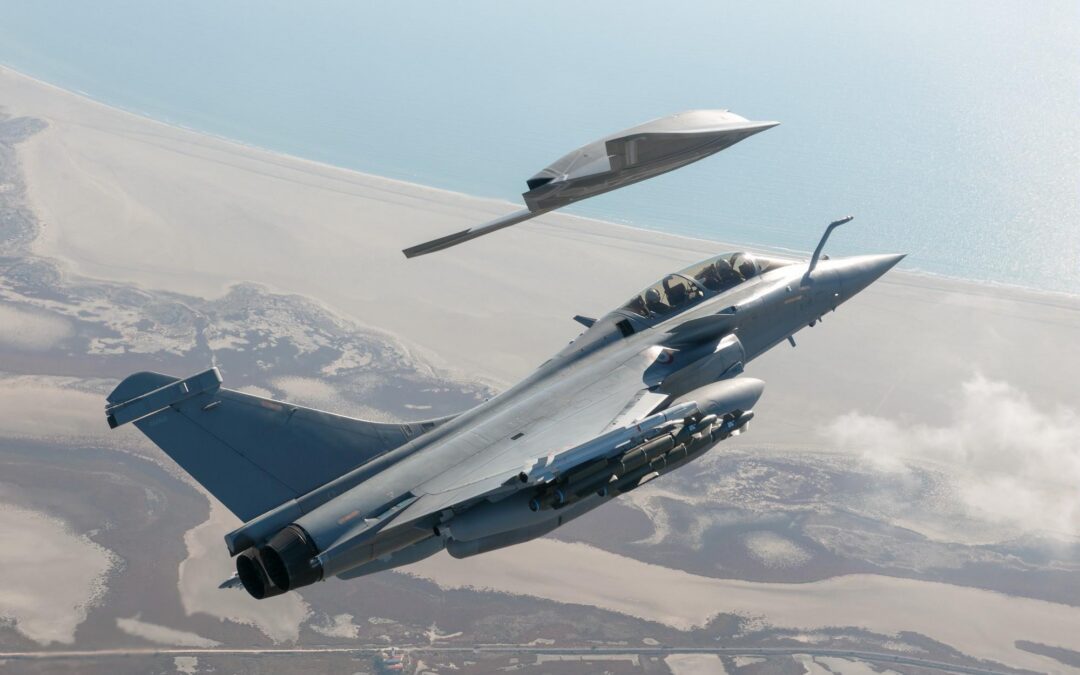
France’s development of the Rafale F5 alongside a new stealth UCAV illustrates this transition.
The strategic question therefore changes from:
Is a 4.5-generation fighter technologically inferior to a 5th- or 6th-generation aircraft?
to:
What combat ecosystem can the aircraft command, coordinate and exploit?
Through the Techne–Phronesis Negotiation Framework™ (TPNF), the Rafale F5–UCAV combination suggests an emerging principle:
Platform Capability → Collaborative Capability → Distributed Combat Capability → Ecosystem Orchestration → Adaptive Air Power.
The future value of the 4.5-generation fighter may therefore depend less on transforming the aircraft itself into a stealth platform and more on transforming its role within the combat ecosystem.
Purpose of the Essay
This essay examines the development of a stealth UCAV designed to operate alongside the future Rafale F5 and asks what this tells us about the continuing strategic relevance of advanced 4.5-generation fighters.
The purpose is not to argue that 4.5-generation aircraft become equivalent to purpose-designed stealth fighters.
They do not.
Rather, the objective is to examine whether collaborative combat can allow highly evolved non-stealth fighters to generate new forms of strategic value by combining their capabilities with unmanned, stealthy and increasingly autonomous systems.
Abstract
France is developing the Rafale F5 together with a stealth combat drone derived from experience accumulated through the European nEUROn demonstrator.
The UCAV is intended to complement the Rafale in collaborative combat. French official sources describe capabilities including stealth, autonomous control with a human in the loop, internal payloads, resilient connectivity, advanced sensors and integration with artificial intelligence. Its expected roles include supporting first-entry operations, air-to-air and air-to-surface combat, and suppression of enemy air defenses.
This development raises a wider strategic question.
If advanced crewed fighters can increasingly command and collaborate with stealth unmanned systems, future air power may no longer be adequately measured by the characteristics of the crewed platform alone.
TPNF therefore proposes the concept of Distributed Stealth Advantage™: the ability of a combat formation to distribute low-observability, sensing, electronic-warfare and strike functions across interconnected crewed and uncrewed platforms rather than requiring every platform to possess identical characteristics.
1. Rafale F5: Evolution Rather Than Replacement
Rafale was designed around continuous technological evolution through successive standards.
The F5 standard represents a major step in that philosophy.
France plans improvements including a new radar, electronic-warfare system, optronic sensors, greater connectivity, advanced weapons and integration with the future ASN4G nuclear missile.
But perhaps its most strategically interesting feature is not located inside the Rafale itself.
It will operate alongside a new stealth UCAV.
This changes the analytical unit.
Instead of evaluating:
Rafale F5
we increasingly need to evaluate:
Rafale F5 + UCAV + Sensors + Weapons + Networks + AI + Supporting Platforms.
The fighter is becoming one component of a larger combat architecture.
2. The Stealth UCAV Changes the Tactical Equation
The UCAV is being developed from knowledge accumulated through the nEUROn programme, whose demonstrator first flew in 2012.
Dassault describes the future system as stealthy, versatile, autonomously controlled with a human in the loop and equipped with internal payload capacity.
French defence authorities envisage the drone supporting demanding missions in highly contested environments.
This is significant because a non-stealth crewed fighter does not necessarily have to perform every dangerous function itself.
A stealth UCAV could operate ahead of the crewed aircraft, contributing to reconnaissance, electronic warfare, suppression of air defenses or strike operations.
The result is not that the Rafale itself becomes stealthy.
The result is that stealth becomes a capability distributed within the formation.
3. Distributed Stealth Advantage™
This distinction is strategically important.
Stealth has traditionally been understood principally as a platform characteristic.
An aircraft possesses a particular radar signature.
But collaborative combat allows us to think differently.
TPNF defines Distributed Stealth Advantage™ as:
the strategic advantage created when low-observability capabilities are positioned within a networked combat formation so that stealth platforms can perform the missions requiring deeper penetration while other platforms contribute complementary sensing, command, electronic-warfare, weapons or decision-making capabilities.
This does not eliminate the advantages of a fully stealthy crewed fighter.
It creates another architecture for employing stealth.
Crewed Fighter
↓
Stealth UCAV
↓
Distributed Sensors
↓
Electronic Warfare
↓
Networked Weapons
↓
Collaborative Decision-Making
↓
Integrated Combat Effect
The relevant measure increasingly becomes the performance of the system.
4. From Loyal Wingman to Collaborative Combat Partner
The popular expression “loyal wingman” can be useful, but it may also oversimplify the transformation.
The UCAV should not necessarily be imagined merely as a robotic aircraft flying beside a fighter.
Its value could emerge from performing complementary tasks.
It may move ahead of the crewed aircraft.
It may expose itself to greater risk.
It may contribute sensor information.
It may support suppression of enemy air defenses.
It may carry weapons internally.
It may complicate an adversary’s detection and targeting problem.
The relationship is therefore better understood as Manned-Unmanned Collaborative Combat.
The crewed fighter supplies capabilities that may include human judgment, mission command, advanced sensors and weapons.
The UCAV contributes another combination of survivability, persistence, sensing, payload and acceptable operational risk.
The strategic effect emerges from their interaction.
5. Human Judgment Remains Central
Autonomy does not automatically mean removing humans from decision-making.
Dassault explicitly describes autonomous control with a human in the loop.
This is highly relevant to TPNF.
Future air combat will occur at speeds and levels of complexity that make AI increasingly valuable for processing information, identifying patterns, prioritizing threats and coordinating multiple systems.
But greater automation also increases the importance of deciding:
What should be delegated?
What should remain under human control?
When should force be used?
How should uncertain information be interpreted?
What level of machine autonomy is strategically and ethically acceptable?
Here the distinction between Techne and Phronesis becomes particularly important.
Technology expands the capacity to act.
Strategic wisdom determines how that capacity should be used.
6. The 4.5-Generation Fighter Is Not Automatically Obsolete
The emergence of stealth fighters has sometimes encouraged a linear interpretation of military aviation:
4th Generation → 4.5 Generation → 5th Generation → 6th Generation.
This can imply that each generation simply replaces the previous one.
Reality is more complex.
Aircraft operate within force structures, budgets, industrial ecosystems, alliances, weapons inventories and operational doctrines.
An advanced 4.5-generation fighter equipped with powerful sensors, electronic warfare, long-range weapons and connectivity can remain strategically relevant if it is effectively integrated into a wider combat system.
The Rafale F5 represents this evolutionary approach.
Its future relevance will depend not merely on the physical characteristics of the aircraft, but on what other capabilities it can access and coordinate.
7. From Platform Superiority to Ecosystem Superiority
This leads to a deeper transformation.
Traditional air-power comparisons often focus on individual platforms:
speed;
range;
radar;
weapons;
stealth;
maneuverability.
Those variables remain important.
But networked warfare introduces another level of analysis.
Imagine an aircraft connected with stealth UCAVs, airborne early-warning systems, satellites, ground sensors, electronic-warfare platforms and long-range weapons.
The aircraft’s effective capability is no longer limited to what it carries internally.
It can potentially access the capabilities of the ecosystem.
TPNF describes this as Combat Ecosystem Amplification™:
the increase in effective combat capability generated when a platform can access, coordinate and exploit complementary capabilities distributed across a networked operational ecosystem.
8. The Fighter Pilot Becomes an Ecosystem Orchestrator
This transformation also changes the human role.
The future fighter pilot may increasingly move beyond controlling only one aircraft.
The pilot could become a decision-maker positioned within a network of crewed and autonomous systems.
This does not mean manually flying several drones simultaneously.
Automation should absorb much of the mechanical coordination.
The human role moves upward:
Flying → Managing → Prioritizing → Coordinating → Deciding → Orchestrating.
The fighter cockpit therefore evolves toward a node of Human–Machine Strategic Collaboration™.
The quality of human-machine interaction may become almost as important as traditional aircraft performance.
9. The Limits of the Model
However, collaborative combat does not magically solve the disadvantages of 4.5-generation aircraft.
A Rafale remains physically different from a purpose-designed low-observable aircraft.
Communications can be disrupted.
Data links can be attacked.
Electronic warfare can interfere with coordination.
Autonomous systems can make mistakes.
UCAVs require maintenance, logistics and secure software.
More interconnected systems can also create more dependencies.
This creates what TPNF can call the Collaborative Combat Dependency Paradox™:
the more combat power depends upon interconnected systems, the more strategically important the resilience of those connections becomes.
Connectivity creates capability.
Dependency creates vulnerability.
Future air-power architectures must manage both.
10. Future Air Warfare Becomes an Ecosystem Competition
The Rafale F5–UCAV combination therefore points toward something larger than the modernization of one French fighter.
Future air warfare may increasingly become competition between combat ecosystems.
The decisive advantage may belong to the force that can most effectively integrate:
crewed aircraft;
stealth UCAVs;
autonomous systems;
electronic warfare;
airborne and space-based sensors;
long-range weapons;
AI;
command networks;
human judgment.
This does not make individual aircraft irrelevant.
It changes how their strategic value should be measured.
Strategic Implications
The first implication is that 4.5-generation fighters may remain strategically relevant much longer than simplistic generational comparisons suggest.
Second, stealth can increasingly become a distributed capability within a combat formation, although this does not make a non-stealth fighter equivalent to a stealth aircraft.
Third, UCAVs can allow crewed fighters to delegate some of the highest-risk functions while preserving human judgment within the mission architecture.
Fourth, resilient connectivity becomes a fundamental combat capability because collaborative warfare depends upon the ability of distributed systems to continue exchanging information under attack.
Finally, the future fighter may increasingly derive its value from the ecosystem it can orchestrate, rather than solely from the capabilities physically contained within the aircraft.
The Rafale F5 and its future stealth UCAV illustrate an important transformation in military aviation.
The question is no longer simply whether a 4.5-generation aircraft can compete with a 5th-generation fighter.
That comparison remains relevant—but it is incomplete.
The more important question increasingly becomes:
What combination of capabilities can each aircraft bring into the battle, access through the network and orchestrate during combat?
The future of air warfare therefore points toward:
Platform → Network → Collaborative Formation → Combat Ecosystem → Adaptive Air Power.
In this environment, the continuing strategic relevance of 4.5-generation fighters will depend upon their ability to evolve from powerful individual platforms into intelligent nodes within distributed combat systems.
The Rafale F5 will remain a crewed fighter.
Its UCAV will remain a distinct platform.
But together, supported by sensors, weapons, networks and human-machine collaboration, they may create something strategically different from either aircraft operating alone.
The future of air superiority may therefore be determined not only by who possesses the most advanced fighter, but by who can build, protect and orchestrate the most adaptive combat ecosystem.
Key Takeaways
- The Rafale F5–UCAV architecture demonstrates the transition from platform-centric toward collaborative air warfare.
- Distributed Stealth Advantage™ describes how stealth capability can complement non-stealth platforms across a networked formation without making those platforms themselves stealthy.
- Advanced 4.5-generation fighters can remain strategically relevant when integrated with UCAVs, AI, advanced weapons, sensors and resilient networks.
- Combat Ecosystem Amplification™ shifts evaluation from the capability of an individual fighter toward the combined capability accessible through the operational ecosystem.
- Human judgment remains essential as pilots increasingly evolve from aircraft operators toward orchestrators of human-machine combat systems.
Author’s Reflection
The Rafale F5 case challenges us to reconsider what technological generations actually mean.
Technology rarely evolves through clean replacement.
Older technological architectures can acquire new strategic value when they are intelligently integrated with emerging capabilities.
The decisive question is therefore not simply:
How advanced is the platform?
It is:
How effectively can the platform participate in, contribute to and orchestrate an evolving technological ecosystem?
This is precisely where the Techne–Phronesis Negotiation Framework™ becomes useful.
Techne creates the fighter, the stealth UCAV, the sensors, artificial intelligence and weapons.
Systems Thinking reveals how those capabilities interact.
Phronesis determines how they should be combined and employed under uncertainty.
And strategic negotiation continuously aligns technology, humans, organizations and operational requirements as the environment evolves.
The Rafale F5 may therefore illustrate a wider principle of technological civilization:
A mature technology does not necessarily lose strategic value when a newer technology appears. Its future value depends upon whether it can be intelligently recombined with the capabilities that come next.
Nikos Chatzis
Source: Open Sources Analysis, Relative Data Analysis by Nikos Chatzis
© Nikolaos Chatzis. All Rights Reserved.
The Techne–Phronesis Negotiation Framework™
An Integrative Theory of Strategic Negotiation, Complex Adaptive Systems and Practical Wisdom
Technology Creates Capability • Systems Thinking Creates Understanding • Strategic Wisdom Creates Lasting Value.
Negotiation.gr | Strategic Wisdom for the Technological Age