Negotiation.gr | Strategic Wisdom for the Technological Age
“Strategic resilience emerges when technical capability (techne) is
continuously guided by practical wisdom (phronesis) through adaptive
negotiation across interconnected systems.”
Central Idea — Thesis
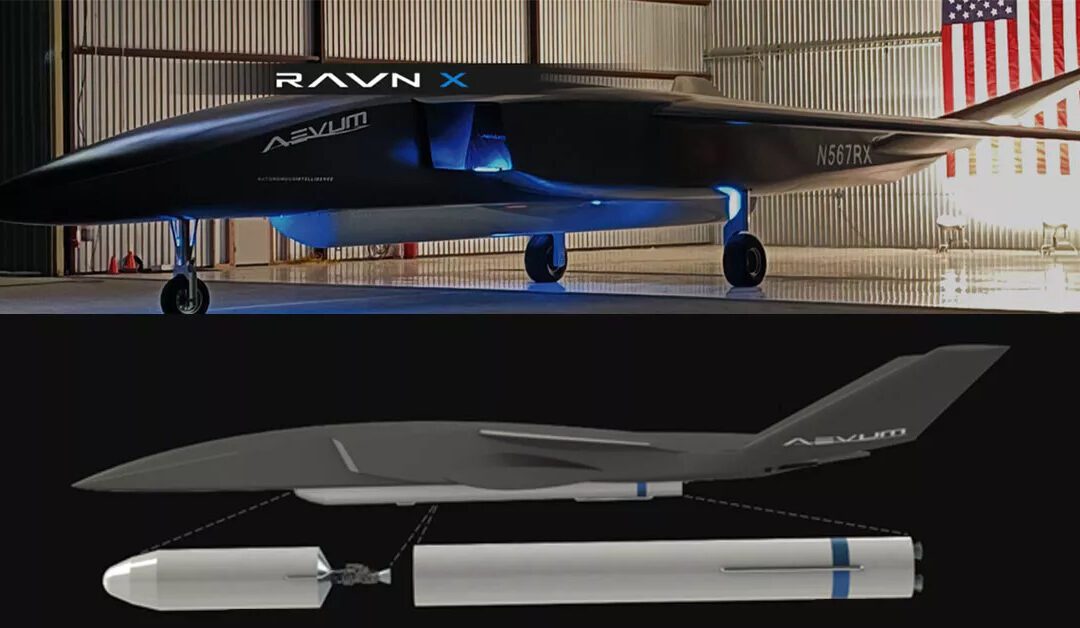
A mysterious black aircraft emerging from a hangar at Long Beach Airport initially looked like something belonging to the world of classified military aviation.
It had no visible cockpit. Its sleek black airframe was roughly comparable in size to the Cold War-era A-5 Vigilante. Aviation photographers had rarely, if ever, seen anything similar at the airport.
The aircraft was subsequently identified as RAVN X, an autonomous aircraft developed by Aevum around an ambitious concept: using a reusable unmanned aircraft as part of a system capable of rapidly placing payloads into orbit.
Its reappearance raises a question much larger than the aircraft itself.
What happens when access to space begins acquiring the operational characteristics of military aviation?
Through the Techne–Phronesis Negotiation Framework™ (TPNF), RAVN X illustrates an emerging transformation:
Space Launch → Responsive Space Access → Distributed Launch Infrastructure → Orbital Capability Regeneration → Space Resilience → Strategic Space Power.
Modern space warfare may increasingly depend not only upon what capabilities a military possesses in orbit, but upon how quickly those capabilities can be restored, replaced or reconfigured during conflict.
Purpose of the Essay
This essay examines RAVN X as a technological concept within the wider evolution of modern space warfare.
The central question is not whether this particular aircraft will ultimately become operational.
It is:
What strategic value would an autonomous, mobile and rapidly responsive space-launch architecture create in a contested space environment?
Abstract
RAVN X first appeared publicly in 2020 as Aevum’s proposed autonomous launch aircraft. On September 6, 2026, The War Zone identified a mysterious black aircraft recently seen outside a Long Beach Airport hangar as the RAVN X airframe.
Its current operational status remains uncertain.
But the concept remains strategically significant.
Aevum currently describes RAVN X as an autonomous aircraft capable of functioning as mobile launch infrastructure, while its ERV-A rocket is intended to provide rapid orbital access.
This reflects a wider military transformation. The U.S. Space Force is actively developing Tactically Responsive Space capabilities designed to place systems into orbit on operationally relevant timelines.
TPNF therefore introduces Responsive Orbital Regeneration™:
the capacity to rapidly restore, replace, augment or reposition space capability in response to operational disruption or emerging strategic requirements.
In modern space warfare, launch speed may increasingly become part of combat power.
1. The Mysterious Aircraft at Long Beach
The story began almost cinematically.
Aviation photographer Ricky Schol saw an unusually large black aircraft emerging from a hangar at Long Beach Airport.
At first glance, he thought it might be an F-117.
Closer inspection revealed something stranger: there was no cockpit.
The aircraft was identified as RAVN X, carrying the registration N567RX associated with Aevum.
But caution is necessary.
The aircraft appeared to be the mockup previously displayed publicly. Observers reported that it moved slightly but heard no engines and saw no exhaust.
Its appearance therefore does not establish that an operational RAVN X has suddenly entered flight testing.
Strategically, however, the concept deserves attention.
2. RAVN X Changes the Launch Architecture
Traditional orbital launch depends heavily upon specialized infrastructure.
Rockets are assembled.
Payloads are integrated.
Launch pads are prepared.
Range availability must be coordinated.
Weather conditions matter.
Launch windows matter.
RAVN X proposes something different.
Aevum currently describes the aircraft as autonomous and capable of operating as a mobile launch pad and range, while also functioning as an edge-AI flight-test platform and heavy-cargo aircraft.
Paired with an orbital launch vehicle, the concept seeks to make access to orbit more responsive and geographically flexible.
The strategic transition is:
Fixed Launch Infrastructure → Mobile Launch Architecture.
That distinction becomes extremely important during conflict.
3. Space Is No Longer a Sanctuary
For decades, space systems operated in an environment largely separated from direct conventional warfare.
That assumption has disappeared.
Satellites support:
communications;
navigation;
missile warning;
intelligence;
surveillance;
reconnaissance;
targeting;
weather;
command and control.
Modern military operations increasingly depend upon them.
Consequently, space assets have become strategically valuable targets.
Electronic warfare can disrupt them.
Cyber operations can attack their supporting networks.
Anti-satellite systems can threaten spacecraft.
Directed-energy systems may interfere with sensors.
Orbital systems can potentially approach other spacecraft.
Space therefore increasingly behaves like a contested operational domain.
4. From Satellite Protection to Space Resilience
The traditional response might be to protect individual satellites.
But perfect protection is impossible.
This changes the strategic objective.
Instead of asking:
How do we prevent every satellite from being attacked?
militaries increasingly ask:
How do we preserve space capability even after parts of the architecture are disrupted?
This leads toward:
distributed constellations;
redundancy;
commercial integration;
rapid replacement;
proliferated satellites;
responsive launch.
The goal becomes resilience rather than invulnerability.
5. Responsive Orbital Regeneration™
This is where RAVN X becomes theoretically important.
Imagine a conflict in which several strategically important satellites are disabled.
The critical question becomes:
How quickly can replacement capability reach orbit?
Months may be operationally unacceptable.
Weeks may be too slow.
Days may still create a dangerous capability gap.
TPNF therefore defines Responsive Orbital Regeneration™ as:
the capacity of a space ecosystem to rapidly restore, replace, augment or reconfigure orbital capabilities following disruption, loss or changing operational requirements.
The architecture becomes:
Orbital Capability
↓
Attack or Disruption
↓
Capability Loss
↓
Rapid Mission Decision
↓
Responsive Launch
↓
Replacement / Augmentation
↓
Restored Orbital Capability
↓
Strategic Resilience
This transforms launch infrastructure into part of the military regeneration system.
6. The U.S. Space Force Is Already Testing the Principle
This is not purely theoretical.
The U.S. Space Force’s Tactically Responsive Space programme is explicitly developing the ability to respond rapidly to operational space requirements.
In June 2026, its VICTUS HAZE mission demonstrated launch after a notice requiring readiness for a previously unknown orbit with only 24 hours’ notice.
The mission then moved into realistic rendezvous and proximity-operation threat-response scenarios.
The strategic significance is profound.
Space launch is moving from a predominantly scheduled logistical process toward something resembling operational responsiveness.
7. Launch Tempo Becomes Strategic Power
Traditional space power emphasizes the capabilities already in orbit.
Modern space power may require another variable:
regeneration speed.
Consider two competing powers.
Both lose comparable satellite capability.
One requires six months to replace it.
The other requires days.
Their initial losses may be identical.
Their strategic consequences are not.
This creates Orbital Regeneration Advantage™:
the strategic advantage gained when one actor can restore or expand orbital capability faster than an adversary can degrade it.
Space warfare consequently becomes partly a competition between:
Destruction Rate ↔ Regeneration Rate.
That resembles other forms of industrial warfare.
8. Mobility Creates Uncertainty
A mobile launch architecture could create another advantage.
Fixed spaceports are geographically known.
Their infrastructure can be monitored.
Launch preparations can potentially be observed.
An aircraft-based system operating from multiple suitable airfields could theoretically distribute launch capability.
This creates Launch Infrastructure Dispersion™.
Dispersion can complicate adversary planning because the launch system is no longer concentrated exclusively around a limited number of fixed facilities.
The strategic asset becomes not merely the rocket.
It becomes the network of locations from which the launch architecture can potentially operate.
9. Autonomy Adds Another Layer
RAVN X also reflects the convergence between aviation, artificial intelligence, autonomy and space operations.
Aevum describes the current RAVN X architecture as incorporating edge AI and autonomous operations.
This connects several technological domains:
Autonomous Aviation + AI + Rocket Technology + Space Infrastructure + Digital Command Systems.
The result illustrates Technology Convergence.
The aircraft itself is therefore less important than the technological combinations it represents.
Modern strategic capability increasingly emerges between technologies rather than inside one technology alone.
10. Commercial Space and Military Space Converge
The boundary between commercial space activity and national-security space capability is becoming increasingly interconnected.
Commercial companies are no longer merely contractors supplying equipment to governments. They increasingly provide launch services, satellite communications, Earth observation, data processing, space-domain awareness and other capabilities that can become integrated directly into military space architectures.
The U.S. Space Force increasingly describes this model as a hybrid space architecture, combining government-owned capabilities with commercial, allied and partner capabilities.
This transformation is strategically important because modern military space power no longer depends exclusively upon capabilities developed, owned and operated by the state. It increasingly depends upon the ability to access, integrate and orchestrate capabilities distributed across a much wider technological and industrial ecosystem.
This creates a Strategic Space Ecosystem™.
Military space power increasingly depends upon the ability to orchestrate:
government;
commercial industry;
launch providers;
satellite manufacturers;
software companies;
AI developers;
allies;
ground infrastructure.
Space superiority therefore becomes partly an ecosystem problem.
11. Space Warfare Becomes a Regeneration Competition
This leads to a broader TPNF proposition.
Modern warfare increasingly attacks systems rather than isolated platforms.
Space warfare will likely follow the same logic.
Destroying one satellite matters less if another can rapidly replace its function.
Disrupting one communications node matters less if traffic can reroute.
Attacking one launch facility matters less if launch capability is distributed.
The decisive question becomes:
Can the ecosystem continue generating capability under attack?
This is Strategic Capability Regeneration™ applied to space warfare.
12. RAVN X as Strategic Optionality
RAVN X should therefore not be judged only by whether its original commercial promises are ultimately achieved.
Its concept illustrates Strategic Optionality™.
An autonomous aircraft potentially capable of supporting space launch, heavy cargo, flight testing and mobile launch operations creates several possible future applications.
Some may succeed.
Others may not.
But the underlying architecture explores a strategic direction:
making aerospace infrastructure more mobile, autonomous and responsive.
That direction is highly relevant to future military space operations.
Strategic Implications
First, responsive launch is becoming part of space resilience.
Second, future military space power may increasingly depend upon regeneration capacity rather than simply the number of satellites initially deployed.
Third, autonomous aircraft could potentially extend space-launch infrastructure beyond traditional fixed launch sites.
Fourth, commercial aerospace innovation is becoming increasingly integrated with national-security space architectures.
Finally, modern space warfare should be understood as an ecosystem competition involving satellites, launch systems, communications, AI, industrial capacity, commercial partners and human decision-making.
The mysterious black aircraft emerging at Long Beach Airport may ultimately prove more interesting as a symbol than as an operational aircraft.
RAVN X represents an important strategic idea.
Space access need not remain exclusively tied to slow, predictable and geographically concentrated launch architectures.
It can potentially become:
mobile;
autonomous;
distributed;
responsive.
That possibility changes how we think about space warfare.
The future strategic question may not simply be:
Who has the most capable satellites?
It may increasingly become:
Who can regenerate space capability fastest after those satellites are disrupted?
Through TPNF, modern space warfare therefore follows an emerging architecture:
Space Technology → Orbital Capability → Contestation → Disruption → Responsive Orbital Regeneration™ → Ecosystem Adaptation → Space Resilience → Sustainable Strategic Power.
RAVN X may or may not ultimately fulfill its ambitious technological vision.
But the strategic logic it represents is already becoming real.
The future of military space power may belong not to the actor capable of preventing every loss.
It may belong to the ecosystem capable of recovering from loss faster than an adversary can exploit it.
Key Takeaways
- RAVN X represents the concept of autonomous, mobile and potentially responsive space-launch infrastructure.
- Its current operational status remains uncertain; the Long Beach appearance should not be interpreted as evidence of an operational launch aircraft.
- Responsive Orbital Regeneration™ may become a critical component of future space resilience.
- Orbital Regeneration Advantage™ emerges when replacement capability can be generated faster than an adversary can degrade it.
- Modern space warfare is increasingly becoming an ecosystem competition involving launch, satellites, AI, commercial industry, communications and adaptive regeneration.
Author’s Reflection
RAVN X illustrates something larger than an unusual aircraft.
It illustrates how technological convergence can change strategic assumptions.
An aircraft becomes a launch platform.
A runway becomes part of space infrastructure.
Autonomy changes aerospace operations.
Commercial innovation becomes part of military resilience.
And space launch begins moving from strategic logistics toward operational capability.
This is exactly where Techne and Phronesis must interact.
Techne asks whether we can create autonomous systems capable of providing increasingly responsive access to orbit.
Phronesis asks how such capability changes deterrence, escalation, resilience and the stability of the space ecosystem.
Perhaps the deepest lesson is therefore simple.
In future space warfare, losing capability may not determine defeat.
Failing to regenerate capability may.
Nikos Chatzis
Source: Open Sources Analysis, Relative Data Analysis by Nikos Chatzis
© Nikolaos Chatzis. All Rights Reserved.
The Techne–Phronesis Negotiation Framework™
An Integrative Theory of Strategic Negotiation, Complex Adaptive Systems and Practical Wisdom
Technology Creates Capability • Systems Thinking Creates Understanding • Strategic Wisdom Creates Lasting Value.
Negotiation.gr | Strategic Wisdom for the Technological Age