Negotiation.gr | Strategic Wisdom for the Technological Age
“Strategic resilience emerges when technical capability (techne) is
continuously guided by practical wisdom (phronesis) through adaptive
negotiation across interconnected systems.”
Central Idea — Thesis
China’s approval of a two-year commercial satellite Internet of Things trial for Zhejiang Geespace Technology should not be understood simply as another regulatory authorization in the country’s expanding commercial-space industry.
Its deeper strategic significance lies in the progressive construction of an integrated space–air–ground technological ecosystem in which satellites provide the persistent connectivity layer connecting vehicles, machines, ships, infrastructure, drones, logistics systems and eventually intelligent autonomous platforms.
Through the Techne–Phronesis Negotiation Framework™ (TPNF), the development illustrates a fundamental transformation of technological power: competitive advantage increasingly belongs not to the actor possessing an isolated technology, but to the actor capable of integrating multiple technologies into an adaptive ecosystem that continuously creates capability and value.
Purpose of the Essay
This essay examines China’s decision to authorize Zhejiang Geespace Technology to conduct commercial satellite-IoT trials and explores its broader significance for commercial space, intelligent mobility, industrial digitalization, 6G development and technological competition.
Using TPNF, it argues that satellite IoT should be interpreted not merely as communications infrastructure but as an emerging connectivity architecture connecting physical assets with digital intelligence.
Abstract
China’s Ministry of Industry and Information Technology has approved a two-year commercial trial of satellite Internet of Things services by Zhejiang Geespace Technology. The Geely-backed company operates a low-Earth-orbit satellite constellation intended to connect vehicles, maritime operations, industrial machinery, energy infrastructure and other assets beyond reliable terrestrial-network coverage.
The development reflects China’s broader transition from deploying technological assets toward orchestrating interconnected technological ecosystems. Satellite IoT provides a connective layer capable of integrating terrestrial networks, intelligent machines, autonomous vehicles, industrial sensors and future 6G non-terrestrial networks.
TPNF suggests that the strategic significance therefore lies not primarily in satellites themselves but in connectivity, integration and ecosystem orchestration.
1. From Experimental Satellites to Commercial Infrastructure
China’s commercial-space industry is entering another stage of development.
The Ministry of Industry and Information Technology has authorized Geespace to conduct satellite-IoT commercial trials for two years using its low-Earth-orbit constellation.
The regulatory decision matters because it moves private satellite operators further into China’s formal telecommunications framework.
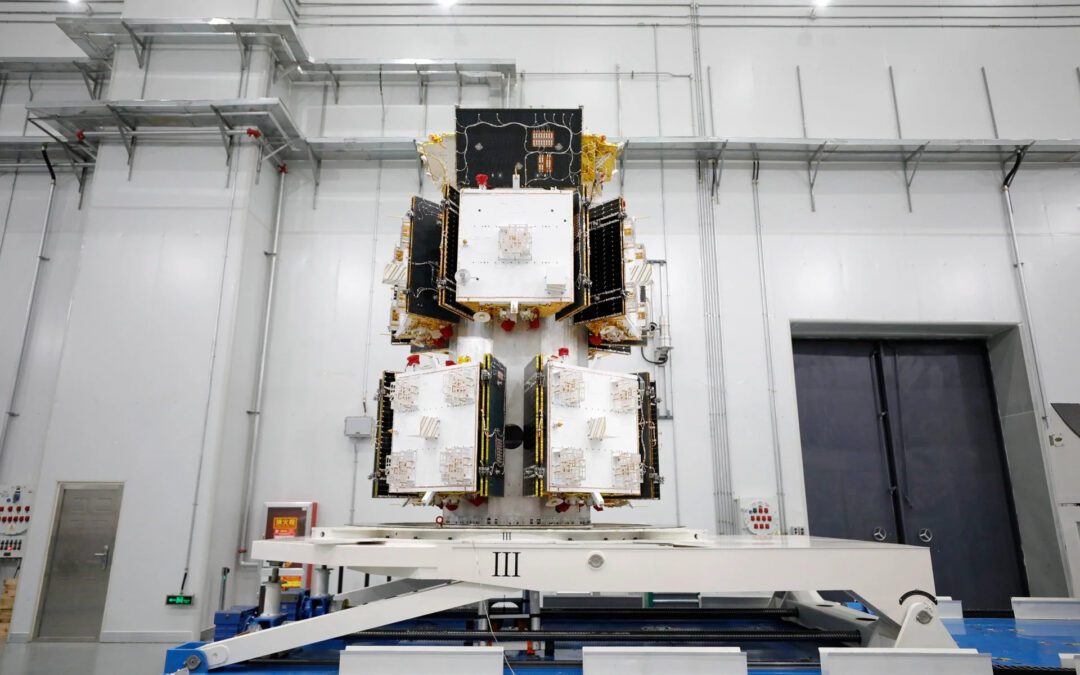
Geespace has already completed the first phase of its constellation deployment. Its network comprises 64 satellites operating in low Earth orbit and is designed to provide wide-area connectivity beyond the limitations of terrestrial communications networks.
But satellite IoT differs fundamentally from conventional satellite broadband.
Its objective is not primarily to provide people with high-speed internet.
Its purpose is to keep things connected.
Vehicles.
Ships.
Industrial machinery.
Sensors.
Energy installations.
Water infrastructure.
Logistics assets.
Agricultural systems.
And increasingly autonomous machines.
This changes the strategic meaning of satellite connectivity.
2. The Internet of Things Is Becoming the Internet of Everywhere
Traditional IoT architectures depend heavily on terrestrial connectivity.
That creates an obvious limitation.
Mobile networks work extremely well where infrastructure exists, but many economically important activities occur far beyond dense telecommunications coverage: oceans, deserts, mountains, agricultural regions, remote energy installations and transnational transportation corridors.
Satellite IoT addresses this geographic discontinuity.
A connected machine no longer necessarily disappears from the digital ecosystem when it leaves terrestrial-network coverage.
This produces what might be called Persistent Strategic Connectivity™.
Connectivity becomes increasingly independent of geography.
A fishing vessel can transmit operational information offshore.
Construction machinery can remain digitally visible in remote locations.
Energy infrastructure can continuously report status.
Logistics assets can be monitored across long-distance transportation networks.
Vehicles can maintain emergency or operational communications outside conventional cellular coverage.
The strategic transformation is therefore straightforward:
Disconnected Asset → Connected Asset → Data-Producing Asset → Intelligent Asset → Ecosystem Participant.
Connectivity becomes the foundation upon which higher layers of technological value can be constructed.
3. Geely Reveals Why the Development Matters
Geespace’s relationship with Geely makes this development particularly interesting.
This is not simply a satellite company developing communications technology independently from other industries.
It exists inside a much broader mobility ecosystem.
Geespace says it has already delivered satellite communications terminals for mass-produced vehicles, while satellite connectivity is being explored for applications including intelligent vehicles and robotaxis.
That reveals the emerging architecture.
Consider an autonomous vehicle.
It requires positioning.
Connectivity.
Mapping.
Sensors.
Artificial intelligence.
Cloud infrastructure.
Data processing.
Remote monitoring.
Software updates.
Emergency communications.
Increasingly, these technologies cannot be understood independently.
The vehicle becomes a node inside a technological network.
Satellite connectivity provides another layer of resilience to that network.
The strategic asset is consequently no longer merely the automobile or the satellite.
It is the ecosystem connecting them.
4. From Product Competition to Ecosystem Competition
This development reinforces one of the central propositions emerging from TPNF analysis:
Modern strategic competition is increasingly competition among technological ecosystems rather than individual products.
A company may build an excellent satellite.
Another may build an excellent vehicle.
Another may produce advanced AI.
Another may operate telecommunications infrastructure.
But the actor capable of connecting these capabilities can create substantially greater strategic value.
The emerging architecture can be represented as:
Satellites → Connectivity → Sensors → Data → AI → Autonomous Systems → Services → Ecosystem Value.
Each technological layer strengthens the usefulness of the others.
This is the logic of Cumulative Capability™.
Capability does not merely accumulate numerically.
It compounds through integration.
A satellite becomes more valuable when connected to millions of machines.
Those machines become more valuable when they generate data.
The data becomes more valuable when processed through AI.
AI becomes more valuable when it can influence physical systems.
And physical systems become more valuable when they remain continuously connected.
The resulting ecosystem can create strategic advantages greater than the sum of its components.
5. Satellite IoT and China’s Industrial System
The applications approved for the commercial trial demonstrate that this is not simply a consumer telecommunications initiative.
Potential applications include intelligent transportation, marine fisheries, energy and water infrastructure.
Geespace itself identifies broader applications including construction machinery, logistics, emergency communications and agriculture.
These are fundamental components of an industrial economy.
Satellite IoT therefore contributes to the digitalization of physical infrastructure.
The strategic value lies in converting previously isolated assets into continuously observable components of larger operational systems.
This enables better:
Monitoring → Prediction → Coordination → Optimization → Automation.
Once industrial assets continuously generate usable data, artificial intelligence can increasingly interpret operational conditions and support decision-making.
Satellite IoT therefore becomes part of the infrastructure of industrial intelligence.
6. The Drone and Low-Altitude Economy Dimension
One application deserves particular attention: low-altitude mobility.
Geespace explicitly identifies drones and eVTOL aircraft among potential beneficiaries of satellite-enabled connectivity.
The reason is structural.
Future autonomous aerial systems operating across long distances cannot rely exclusively on conventional terrestrial networks.
They require resilient communications, identity management, positioning, operational monitoring and potentially continuous data exchange.
Geespace describes satellite connectivity as supporting cross-regional communication, aircraft identity authentication, flight-status monitoring and operational management for drones and eVTOLs.
This creates another emerging architecture:
Satellite Network + UAS + AI + Navigation + Digital Identity + Airspace Management.
Satellite IoT could therefore become part of the connective infrastructure supporting the future low-altitude economy.
7. The Road Toward 6G
The development becomes even more strategically significant when viewed through the evolution toward 6G.
Future communications architectures increasingly envisage integration between terrestrial and non-terrestrial networks.
Instead of satellites operating as separate communications systems, they become components of a broader network architecture.
Geespace says it intends to continue IoT NTN experimentation and contribute to commercialization of 6G satellite communications technologies. Industry analysis likewise identifies terrestrial-satellite integration as an important direction in China’s communications development.
The strategic objective can therefore be understood as:
Terrestrial Networks + LEO Satellites + IoT + Edge Computing + AI = Ubiquitous Intelligent Connectivity.
That is considerably more consequential than satellite internet alone.
It represents movement toward a world in which connectivity becomes embedded throughout the physical environment.
8. The TPNF Perspective: Techne Creates Capability
Satellite IoT represents a powerful expression of Techne.
Engineering makes satellites smaller and more affordable.
Launch systems deploy constellations.
Telecommunications technologies connect devices.
Sensors generate data.
AI extracts intelligence.
Autonomous systems act upon that intelligence.
Yet technological capability alone does not guarantee sustainable strategic value.
This is where Phronesis becomes essential.
A satellite-enabled intelligent ecosystem also creates questions concerning cybersecurity, privacy, data sovereignty, orbital congestion, standards, infrastructure dependency, regulation and resilience.
The same connectivity that increases efficiency can increase systemic vulnerability.
The same data that improves decision-making can create surveillance capability.
The same ecosystem integration that generates competitive advantage can produce technological dependence.
Strategic wisdom therefore requires asking not simply:
What can this technology do?
But:
What kind of technological ecosystem should society build around it?
9. China Is Negotiating the Architecture of Technological Civilization
China’s satellite-IoT strategy should consequently be interpreted within a much larger transformation.
Space infrastructure is becoming connected to terrestrial infrastructure.
Vehicles are becoming computing platforms.
Industrial machinery is becoming data-generating infrastructure.
Drones are becoming components of logistics and mobility networks.
Artificial intelligence increasingly coordinates these systems.
The boundaries separating industries begin to disappear.
Automotive becomes telecommunications.
Telecommunications becomes space.
Space becomes IoT.
IoT becomes AI.
AI becomes mobility.
Mobility becomes infrastructure.
This is Technology Convergence™ in practice.
And technological convergence changes strategic competition because states and companies are no longer competing within clearly separated industries.
They increasingly compete over the architecture connecting industries together.
Strategic Implications
China’s Geespace authorization produces several broader strategic implications.
First, commercial space is evolving from launch and constellation deployment toward service commercialization.
Second, satellite IoT extends digital connectivity into previously disconnected physical environments.
Third, integration between satellite networks and intelligent vehicles demonstrates the increasing convergence of aerospace, automotive and telecommunications industries.
Fourth, satellite connectivity may become strategically important for autonomous drones, eVTOLs and the emerging low-altitude economy.
Fifth, satellite IoT represents an intermediate step toward integrated terrestrial–non-terrestrial 6G architectures.
Most importantly, the competitive unit is changing.
The decisive strategic asset may no longer be the satellite constellation itself.
It may be the ecosystem of connected machines, data, intelligence and services built upon it.
China’s authorization of Zhejiang Geespace Technology’s two-year satellite-IoT commercial trial may appear to be a specialized telecommunications decision.
It is considerably more than that.
The decision represents another step toward an environment in which satellites, vehicles, ships, industrial machinery, infrastructure, drones and intelligent systems participate within continuously connected technological ecosystems.
Through the TPNF lens, its importance lies in the progression:
Technology → Connectivity → Capability → Integration → Intelligence → Ecosystem Value.
China is not simply placing satellites into orbit.
It is progressively building connective infrastructure through which physical and digital systems can interact.
The strategic competition of the coming decade may therefore not be determined by which country possesses the largest number of satellites, vehicles, drones or AI models independently.
It may be determined by who can connect them most effectively into resilient, intelligent and value-creating ecosystems.
That is where Techne meets Phronesis.
And increasingly, that is where technological power becomes strategic power.
Key Takeaways
- Satellite IoT transforms connectivity from geographically limited infrastructure into Persistent Strategic Connectivity™.
- Geespace illustrates the convergence of commercial space, intelligent mobility, IoT and autonomous systems.
- The emerging competitive unit is the technological ecosystem rather than the isolated product.
- Satellite IoT can become important infrastructure for drones, eVTOLs and China’s low-altitude economy.
- TPNF suggests that technological leadership ultimately depends on converting connectivity into sustainable ecosystem value through strategic wisdom.
Author’s Reflection
The most important aspect of China’s satellite-IoT development may not be found in space at all.
It is found in the relationships being created on Earth.
A satellite becomes strategically significant when it connects a vehicle, vessel, drone, machine or piece of critical infrastructure. That connection generates data. Data generates understanding. Understanding enables better decisions. And increasingly, AI transforms those decisions into autonomous action.
This is why contemporary technological strategy should focus less on individual inventions and increasingly on connections among capabilities.
The satellite is important.
The IoT device is important.
Artificial intelligence is important.
But the lasting strategic advantage emerges from the architecture connecting them.
Nikos Chatzis
Source: Open Sources Analysis, Relative Data Analysis by Nikos Chatzis
© Nikolaos Chatzis. All Rights Reserved.
The Techne–Phronesis Negotiation Framework™
An Integrative Theory of Strategic Negotiation, Complex Adaptive Systems and Practical Wisdom
Technology Creates Capability • Systems Thinking Creates Understanding • Strategic Wisdom Creates Lasting Value.
Negotiation.gr | Strategic Wisdom for the Technological Age