Negotiation.gr | Strategic Wisdom for the Technological Age
“Strategic resilience emerges when technical capability (techne) is
continuously guided by practical wisdom (phronesis) through adaptive
negotiation across interconnected systems.”
Central Idea
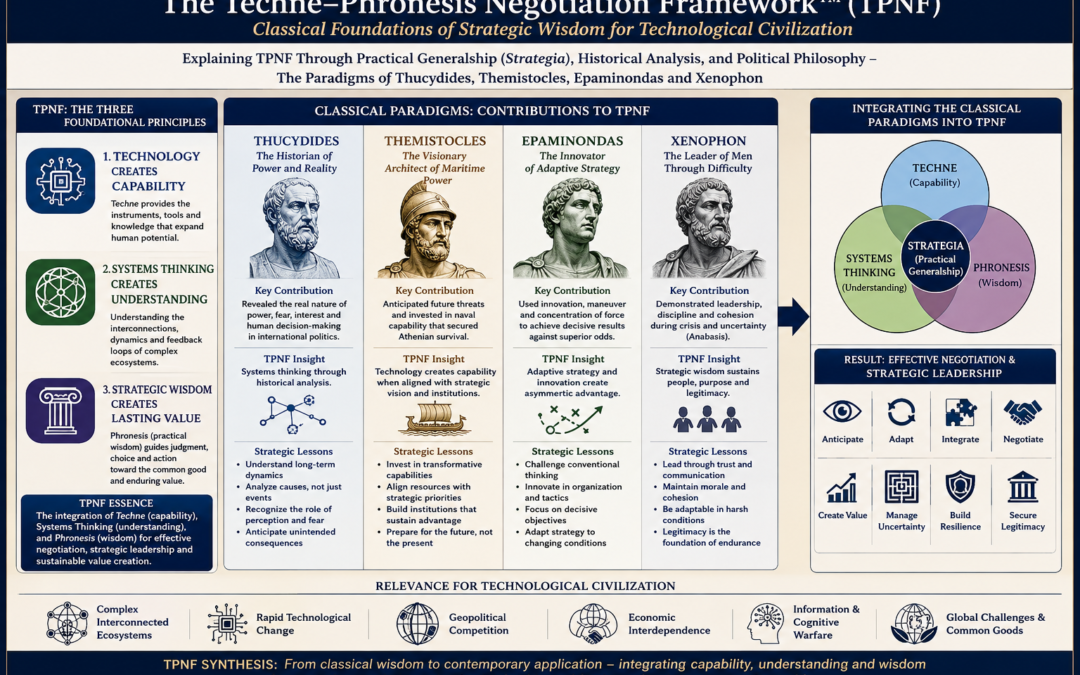
The Techne–Phronesis Negotiation Framework™ (TPNF) is best understood not merely as a contemporary strategic framework but as the modern continuation of a long intellectual tradition that combines Techne (technical mastery), Phronesis (practical wisdom), Strategia (practical generalship), historical analysis, and political philosophy. The works and actions of Thucydides, Themistocles, Epaminondas, and Xenophon illustrate enduring strategic principles that remain highly relevant for navigating the complexities of technological civilization.
Purpose of the Essay
This essay explores the philosophical and historical foundations of TPNF by examining four influential figures from classical Greece. It argues that their contributions to leadership, strategy, diplomacy, military command, and political judgment provide timeless insights that can be reinterpreted through TPNF to address the interconnected technological, geopolitical, and institutional challenges of the twenty-first century.
Abstract
Contemporary strategic frameworks often emphasize technology, economics, or management while overlooking the deeper intellectual traditions that shaped strategic thought over millennia. Classical Greece produced a remarkable body of practical and philosophical knowledge on leadership, war, diplomacy, governance, and human decision-making. The ideas associated with Thucydides, Themistocles, Epaminondas, and Xenophon continue to influence military academies, diplomatic studies, and political philosophy.
The Techne–Phronesis Negotiation Framework™ (TPNF) reconnects this classical heritage with the realities of technological civilization. Rather than treating history as a source of anecdotes, TPNF interprets historical experience as a laboratory of strategic adaptation, demonstrating how technical capability, systems understanding, strategic negotiation, and practical wisdom remain essential for creating lasting value in an interconnected world.
Introduction
Why Classical Strategy Still Matters
Technological change has transformed the instruments of power.
Human judgment has not changed at the same pace.
Artificial intelligence, autonomous systems, digital finance, and cyber capabilities have altered the strategic environment, yet leaders continue to confront familiar questions:
- How should power be exercised?
- How should alliances be managed?
- How should uncertainty be addressed?
- How should limited resources be allocated?
- How should conflicts be prevented—or, if necessary, concluded?
These questions were explored by the great strategists of classical Greece.
Their relevance lies not in the technologies they employed but in the enduring logic of strategic decision-making.
Main Discussion
1. Themistocles: Strategic Vision and Technological Foresight
Themistocles recognized that Athens’ future security depended on maritime power.
His support for expanding the Athenian fleet transformed naval capability into strategic influence.
Through the TPNF lens, this illustrates the first foundational principle:
Technology Creates Capability.
Ships alone did not guarantee success.
Their strategic value emerged because political leadership, resource allocation, institutional support, and long-term vision were aligned around a coherent objective.
Themistocles demonstrates that technological investment becomes transformative only when integrated into a broader strategic ecosystem.
2. Thucydides: Systems Thinking and Strategic Analysis
Thucydides’ account of the Peloponnesian War remains one of history’s most influential analyses of power, fear, interest, leadership, and institutional decision-making.
Rather than presenting isolated events, he examined how political, military, economic, psychological, and diplomatic factors interacted over time.
This reflects the second principle of TPNF:
Systems Thinking Creates Understanding.
Thucydides encourages leaders to analyze relationships, feedback loops, unintended consequences, and long-term dynamics rather than focusing exclusively on immediate tactical events.
3. Epaminondas: Innovation and Adaptive Strategy
Epaminondas transformed military practice through organizational innovation, tactical creativity, and disciplined execution.
His victory at Leuctra demonstrated that established power structures could be challenged through adaptive thinking rather than numerical superiority alone.
Within TPNF, Epaminondas represents strategic adaptation.
His example illustrates that innovation often emerges from questioning inherited assumptions and redesigning systems rather than simply improving existing methods.
4. Xenophon: Leadership Through Practical Wisdom
Xenophon’s Anabasis provides one of history’s most remarkable studies of leadership under uncertainty.
Following the collapse of the Persian expedition, he helped organize, motivate, and guide the Greek forces through hostile territory.
His leadership relied on:
- communication
- trust
- discipline
- adaptability
- ethical authority
- practical judgment
These qualities exemplify the third principle of TPNF:
Strategic Wisdom Creates Lasting Value.
Xenophon reminds us that effective leadership depends not only on planning but also on maintaining legitimacy and cohesion under difficult conditions.
5. Strategia as an Integrative Practice
The Greek concept of Strategia extended beyond battlefield command.
It required integrating:
- political judgment
- diplomacy
- logistics
- intelligence
- economics
- coalition management
- public confidence
- ethical responsibility
Similarly, TPNF understands strategy as the orchestration of interconnected technological, institutional, and geopolitical ecosystems.
6. Historical Analysis as a Strategic Laboratory
History should not be viewed merely as a chronological record.
Within TPNF, historical analysis functions as a strategic laboratory where leaders examine recurring mechanisms such as:
- alliance formation
- institutional adaptation
- technological change
- strategic deception
- resilience
- negotiation
- leadership under uncertainty
Historical comparison enables better anticipation of future strategic challenges without assuming that historical outcomes will necessarily repeat.
7. Political Philosophy and the Governance of Technological Civilization
Political philosophy provides the normative foundation for strategic action.
Technological capability alone cannot determine how power ought to be exercised.
The examples of Thucydides, Themistocles, Epaminondas, and Xenophon suggest that enduring leadership requires balancing:
- capability with responsibility
- innovation with prudence
- competition with cooperation
- ambition with legitimacy
The TPNF extends this tradition into the contemporary context of technological civilization.
Strategic Implications
The TPNF perspective offers several important conclusions.
First, classical strategic thought remains relevant because it addresses enduring patterns of leadership and decision-making.
Second, technological capability requires political judgment and institutional support to generate sustainable value.
Third, systems thinking enables leaders to understand the interconnected dynamics of modern technological ecosystems.
Fourth, strategic negotiation continues the classical tradition of coordinating diverse interests in pursuit of common objectives.
Finally, practical wisdom remains indispensable for governing increasingly complex technological societies.
The strategic challenges confronting contemporary civilization differ greatly in their technological expression from those faced in classical Greece. Yet the underlying questions of leadership, adaptation, governance, and judgment remain strikingly familiar. The examples of Thucydides, Themistocles, Epaminondas, and Xenophon demonstrate that enduring strategic success depends not merely on superior capabilities but on the ability to integrate knowledge, institutions, alliances, and practical wisdom into coherent action.
The Techne–Phronesis Negotiation Framework™ (TPNF) builds upon this intellectual heritage by combining technological capability, systems thinking, strategic negotiation, and practical wisdom into an integrative framework for understanding technological civilization. Rather than replacing classical strategic thought, TPNF extends its relevance to the interconnected ecosystems that define the twenty-first century.
Key Takeaways
- TPNF draws upon a long tradition of classical strategic thought while addressing contemporary technological challenges.
- Themistocles illustrates how technological investment becomes strategic capability through visionary leadership.
- Thucydides demonstrates the enduring importance of systems thinking and historical analysis.
- Epaminondas highlights innovation and adaptive strategy as sources of strategic advantage.
- Xenophon exemplifies leadership grounded in trust, resilience, and practical wisdom.
- Strategic value emerges through the integration of technology, governance, negotiation, and ethical judgment.
Author’s Reflection
Technological civilization changes the instruments through which strategy is practiced, but it does not eliminate the need for sound judgment. The enduring examples of Thucydides, Themistocles, Epaminondas, and Xenophon remind us that leadership ultimately depends upon the intelligent integration of capability, understanding, courage, and practical wisdom. The Techne–Phronesis Negotiation Framework™ (TPNF) seeks to continue this tradition by connecting the strategic heritage of classical Greece with the complex adaptive ecosystems of the modern world, demonstrating that lasting value is created when innovation is guided by wisdom and strategic purpose.
Author: Nikos Chatzis
Source: Open Sources Analysis, Relative Data Analysis by Nikos Chatzis
© Nikolaos Chatzis. All Rights Reserved.
The Techne–Phronesis Negotiation Framework™
An Integrative Theory of Strategic Negotiation, Complex Adaptive Systems and Practical Wisdom
Technology Creates Capability • Systems Thinking Creates Understanding • Strategic Wisdom Creates Lasting Value.
Negotiation.gr | Strategic Wisdom for the Technological Age