
Negotiation.gr | Strategic Wisdom for the Technological Age
“Strategic resilience emerges when technical capability (techne) is
continuously guided by practical wisdom (phronesis) through adaptive
negotiation across interconnected systems.”
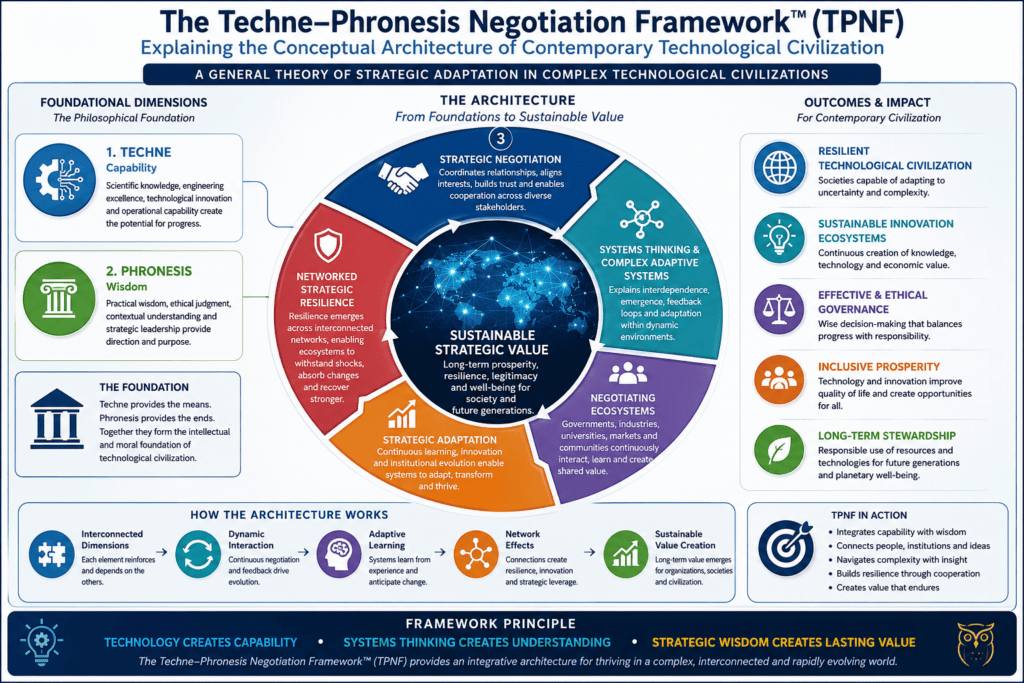
Explaining the Conceptual Architecture of Contemporary Technological Civilization by Nikos Chatzis / Goal Consulting
Central Idea
Contemporary technological civilization is increasingly characterized by interconnected technological, institutional, economic, and geopolitical ecosystems whose resilience depends upon continuous adaptation rather than static equilibrium. The Techne–Phronesis Negotiation Framework™ (TPNF) proposes a conceptual architecture explaining how technical capability (techne), practical wisdom (phronesis), strategic negotiation, systems thinking, and complex adaptive systems interact to generate negotiating ecosystems, strategic adaptation, and networked strategic resilience. Together these interconnected concepts provide an integrative theoretical architecture for understanding how individuals, organizations, governments, and civilizations create sustainable strategic value in an era of accelerating technological transformation.
Purpose of the Essay
The purpose of this essay is to present the conceptual architecture of the Techne–Phronesis Negotiation Framework™ as an integrative theory for understanding contemporary technological civilization. Rather than examining isolated technological, organizational, or geopolitical phenomena, the framework explains how interconnected concepts collectively describe the processes through which capability becomes governance, governance becomes adaptation, and adaptation becomes resilient civilization. The essay establishes the theoretical relationships among the principal concepts developed throughout the TPNF and positions them within a coherent interdisciplinary architecture.
Abstract
Technological civilization has entered a period in which innovation, digital infrastructure, artificial intelligence, geopolitical competition, institutional transformation, and global interdependence increasingly interact within complex adaptive systems. Traditional disciplinary perspectives often explain these developments separately, limiting their ability to interpret the interconnected dynamics that characterize contemporary strategic environments.
The Techne–Phronesis Negotiation Framework™ (TPNF) proposes a conceptual architecture integrating classical philosophy with systems thinking, strategic management, technological innovation, organizational learning, and geopolitical analysis. The framework explains how technical capability (techne), practical wisdom (phronesis), strategic negotiation, and systems thinking collectively generate adaptive ecosystems capable of creating resilience, innovation, and sustainable strategic value. Rather than functioning as isolated concepts, these elements form an integrated architecture describing the evolution of contemporary technological civilization.
Introduction
The twenty-first century is increasingly defined by interconnected technological systems.
Artificial intelligence influences governance.
Digital infrastructure shapes economic development.
Supply chains determine geopolitical resilience.
Innovation ecosystems generate competitiveness.
Institutions continuously adapt to technological disruption.
These developments reveal that contemporary civilization functions as a complex adaptive system.
Understanding such complexity requires an integrative theoretical architecture capable of connecting technological capability, institutional governance, strategic adaptation, and human judgment.
The TPNF proposes such an architecture.
TECHNOLOGICAL CIVILIZATION
│┌────────────────┴────────────────┐
│Techne Phronesis
(Capability) (Strategic Wisdom)
└──────────────┬──────────────────┘
│
Strategic Negotiation
│
Systems Thinking
│
Complex Adaptive Systems
│
Negotiating Ecosystems
│
Strategic Adaptation
│
Networked Strategic Resilience
│
Sustainable Strategic Value
© Nikolaos Chatzis.
The Conceptual Architecture of the TPNF
The framework is organized as a progressive conceptual architecture.
At its philosophical foundation lie Techne and Phronesis.
Techne represents scientific knowledge, engineering capability, technological innovation, and operational excellence.
Phronesis represents practical wisdom, ethical judgment, contextual understanding, and strategic leadership.
Together they establish the intellectual foundations of technological civilization.
Strategic Negotiation: The Coordinating Mechanism
The interaction between capability and wisdom occurs through Strategic Negotiation.
Negotiation extends beyond formal bargaining.
It coordinates relationships.
It aligns interests.
It facilitates institutional learning.
It enables cooperation across governments, industries, universities, financial institutions, and international organizations.
Strategic negotiation therefore functions as the dynamic coordinating mechanism of technological civilization.
Systems Thinking and Complex Adaptive Systems
Negotiation occurs within environments characterized by complexity.
Systems Thinking explains interdependence.
Complex Adaptive Systems explain emergence.
Feedback.
Learning.
Adaptation.
Innovation.
These perspectives demonstrate that contemporary technological civilization continuously evolves through interconnected interactions rather than centralized control.
Negotiating Ecosystems
The interaction of technology, governance, institutions, markets, research, and society produces Negotiating Ecosystems.
Within these ecosystems:
Governments negotiate regulation.
Industries negotiate innovation.
Universities negotiate knowledge.
International organizations negotiate standards.
Financial institutions negotiate investment.
Civil society negotiates legitimacy.
Negotiation therefore becomes a continuous systemic process rather than a discrete event.
Strategic Adaptation
Continuous negotiation generates Strategic Adaptation.
Organizations learn.
Institutions evolve.
Technologies mature.
Policies adjust.
Markets transform.
Adaptation becomes the defining capability of resilient technological civilization.
The TPNF therefore places adaptation at the center of long-term strategic success.
Networked Strategic Resilience
Strategic adaptation ultimately produces Networked Strategic Resilience.
Resilience no longer belongs exclusively to individual organizations.
It emerges across interconnected technological ecosystems.
Knowledge networks.
Digital infrastructure.
Supply chains.
Research institutions.
Innovation ecosystems.
International partnerships.
Their resilience collectively determines societal stability.
Sustainable Strategic Value
The culmination of the conceptual architecture is Sustainable Strategic Value.
Technology creates capability.
Wisdom provides direction.
Negotiation coordinates relationships.
Systems thinking explains complexity.
Adaptation enables evolution.
Resilience sustains continuity.
Together these dimensions generate long-term economic prosperity, institutional legitimacy, technological leadership, and societal well-being.
Strategic Implications
Governments should strengthen adaptive governance capable of integrating technology with institutional learning.
Businesses should prioritize collaborative innovation ecosystems.
Universities should educate interdisciplinary leaders combining engineering, philosophy, management, and public policy.
International organizations should facilitate resilient global cooperation.
Strategic leaders should recognize that sustainable advantage increasingly depends upon the architecture of relationships rather than isolated capabilities.
The Techne–Phronesis Negotiation Framework™ (TPNF) proposes an integrative conceptual architecture for understanding contemporary technological civilization.
Rather than treating technology, governance, negotiation, adaptation, and resilience as independent concepts, the framework explains their continuous interaction within complex adaptive systems.
Its central proposition is straightforward.
Technical capability creates possibility.
Practical wisdom provides purpose.
Strategic negotiation coordinates relationships.
Systems thinking explains complexity.
Strategic adaptation enables evolution.
Networked Strategic Resilience sustains civilization.
Together they generate Sustainable Strategic Value.
The future of technological civilization will therefore depend not simply upon accelerating innovation, but upon strengthening the conceptual architecture through which societies wisely govern complexity and continuously adapt to change.
Source: Open Sources Analysis, Relative Data Analysis by Nikos Chatzis
© Nikolaos Chatzis. All Rights Reserved.
The Techne–Phronesis Negotiation Framework™
An Integrative Theory of Strategic Negotiation, Complex Adaptive Systems & Practical Wisdom
Technology Creates Capability • Systems Thinking Creates Understanding • Strategic Wisdom Creates Lasting Value.
Negotiation.gr | Strategic Wisdom for the Technological Age