Negotiation.gr | Strategic Wisdom for the Technological Age
“Strategic resilience emerges when technical capability (techne) is
continuously guided by practical wisdom (phronesis) through adaptive
negotiation across interconnected systems.”
The “Red Flag of the East,” India’s Strategic Autonomy, and the Challenge of Interoperability
Central Idea (Thesis)
The participation of American F-35A Lightning II fighters in India’s multinational Exercise Tarang Shakti 2026 represents more than a milestone in military aviation cooperation. It illustrates the growing strategic importance of multinational interoperability, technological learning, defence diplomacy, and national strategic autonomy.
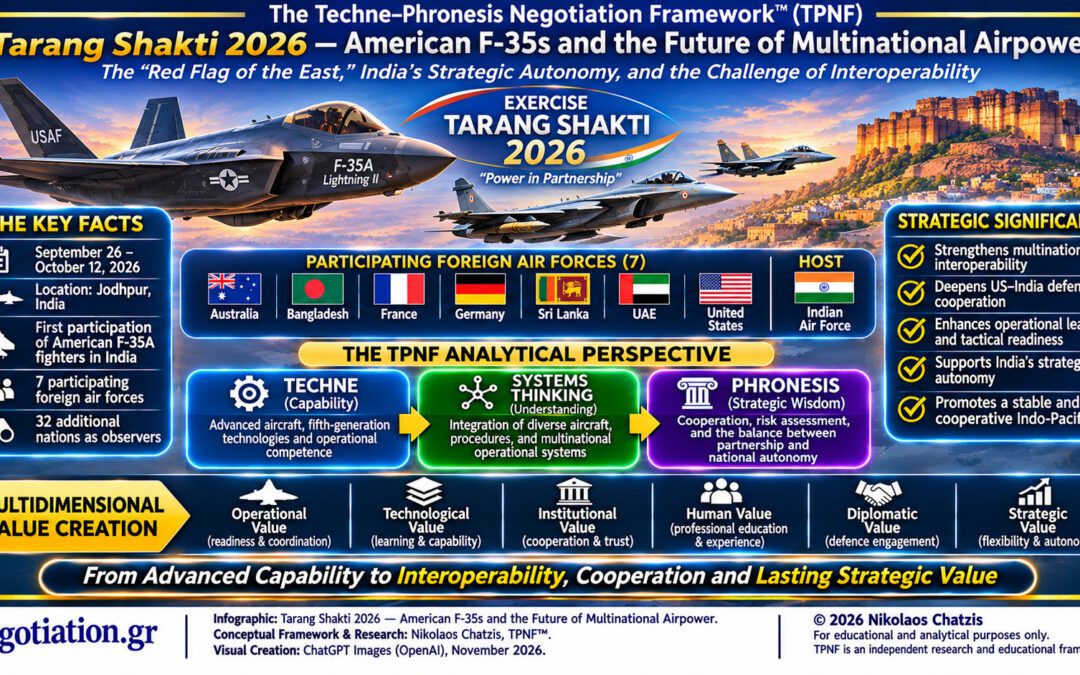
Through the Techne–Phronesis Negotiation Framework™ (TPNF), the exercise can be examined through three interconnected dimensions: Techne (Capability), Systems Thinking (Understanding), and Phronesis (Strategic Wisdom).
The central challenge is transforming diverse national airpower capabilities into effective cooperation without compromising the independent strategic interests of participating countries.
Purpose
This TPNF essay evaluates Tarang Shakti 2026 through the TPNF analytical perspective, examining fifth-generation aviation, multinational training, operational interoperability, and India’s evolving geopolitical position.
It also considers how complex exercises can generate technological, institutional, educational, and strategic value beyond their immediate military objectives.
Abstract
Between September 26 and October 12, 2026, the Indian Air Force hosted the second edition of Exercise Tarang Shakti at Jodhpur.
Seven foreign countries participated, alongside representatives from 32 observer nations.
Six American F-35A fighters made their first deployment to India for a major military exercise.
The event provided opportunities for joint mission planning, tactical learning, and cooperation among air forces operating different aircraft and doctrines.
TPNF offers a complementary framework for understanding how such exercises connect military capabilities with institutional relationships and responsible strategic decision-making.
1. Tarang Shakti: The “Red Flag of the East”
The American Red Flag exercises are internationally recognized for providing demanding, realistic combat-training environments.
Tarang Shakti has attracted comparisons with Red Flag because of its multinational participation and emphasis on complex air operations.
However, the Indian exercise has its own strategic identity.
Its official 2026 theme was “Power in Partnership.”
The participating foreign countries were Australia, Bangladesh, France, Germany, Sri Lanka, the United Arab Emirates, and the United States.
Their aircraft and personnel operated alongside the Indian Air Force, creating opportunities to examine different operational procedures and technological capabilities.
The presence of 32 observer nations expanded the exercise’s diplomatic significance.
Tarang Shakti therefore combined operational training with international defence engagement.
2. The Historic Participation of American F-35s
Six US Air Force F-35A Lightning II fighters arrived in India on September 26.
The aircraft belonged to the 13th Fighter Squadron, based at Misawa Air Base in Japan.
More than 200 American personnel supported the deployment.
Although F-35 aircraft had previously appeared at Indian aviation exhibitions, this marked their first participation in a major exercise conducted on Indian soil.
The distinction is significant.
An exhibition demonstrates the presence of advanced technology.
An operational exercise provides opportunities to examine how different aircraft and organizations cooperate in realistic training environments.
The American deployment also demonstrated the ability to project fifth-generation aviation capabilities into the Indian operational environment.
3. Techne: Fifth-Generation Aviation Capability
Within TPNF, Techne represents practical knowledge, technological capability, and operational competence.
The F-35 incorporates stealth characteristics, advanced sensors, integrated avionics, and sophisticated information-processing capabilities.
Its significance extends beyond individual aircraft performance.
Modern combat aviation increasingly depends upon acquiring, processing, and distributing information effectively.
For the Indian Air Force, operating alongside F-35s provided opportunities to observe aspects of fifth-generation aircraft integration.
However, participation in a multinational exercise does not imply unrestricted access to classified systems or sensitive operational data.
The technological learning available to partners depends upon security restrictions, exercise design, and agreed procedures.
Techne therefore provides the foundation for cooperation, but does not automatically guarantee interoperability.
4. Systems Thinking: Multinational Airpower as an Ecosystem
Modern air operations involve interconnected aircraft, communications networks, surveillance systems, air traffic coordination, logistics, and command structures.
A multinational exercise introduces additional complexity.
Participating countries may operate different aircraft, weapons, communication systems, and operational doctrines.
India’s aviation inventory illustrates this diversity.
Its air force operates Russian-origin Su-30MKI fighters, French Rafales, indigenous Tejas aircraft, and other platforms.
Integrating such capabilities into multinational scenarios requires coordination across technical and organizational boundaries.
Systems Thinking helps identify these dependencies.
Within TPNF, effective multinational airpower emerges from the interaction of capabilities rather than the simple accumulation of advanced aircraft.
5. Phronesis: Strategic Wisdom and National Autonomy
India maintains relationships with multiple international powers while seeking to preserve freedom of strategic decision-making.
Its defence partnerships include cooperation with the United States, France, Russia, and other countries.
This creates both opportunities and challenges.
Participation in multinational exercises strengthens professional relationships without necessarily establishing binding military alliances.
Phronesis emphasizes the importance of understanding these distinctions.
India must evaluate how international cooperation contributes to national security while preserving its independent strategic choices.
The United States similarly must consider how defence cooperation advances shared interests without assuming complete geopolitical alignment.
Strategic wisdom requires recognizing that cooperation and autonomy can coexist.
6. The Geopolitical Dimension: China and the Indo-Pacific
Tarang Shakti occurred within a broader regional environment characterized by military modernization and strategic competition.
China continues developing advanced combat aircraft and expanding its military capabilities.
India faces important security challenges along its northern borders and within the wider Indo-Pacific.
American participation therefore carries geopolitical significance.
However, the exercise should not automatically be interpreted as the formation of an anti-China military alliance.
Participating countries possess different regional priorities and strategic relationships.
For India, multinational cooperation can strengthen preparedness while supporting its broader policy of strategic autonomy.
TPNF encourages distinguishing demonstrated operational objectives from speculative geopolitical interpretations.
7. France, Germany, and European Defence Engagement
European participation adds another dimension.
France maintains substantial defence cooperation with India, including the Rafale fighter relationship.
Germany’s involvement reflects expanding European interest in Indo-Pacific security and international military cooperation.
Operating within a common exercise environment enables participating air forces to exchange professional experience.
These interactions may improve communication, mission planning, and understanding of different operational approaches.
However, European participation does not necessarily indicate identical strategic objectives.
TPNF interprets such cooperation as a network of overlapping interests rather than a single unified geopolitical position.
8. India’s Indigenous Aerospace Development
Tarang Shakti also highlighted India’s ambitions to strengthen its domestic aerospace industry.
The Indian Ministry of Defence emphasized indigenous platforms, including the Tejas light combat aircraft and Prachand light combat helicopter.
These systems represent important components of India’s defence self-reliance strategy.
Multinational exercises provide opportunities to evaluate how domestically developed platforms interact with foreign aircraft.
This can support operational learning and inform future technological development.
However, indigenous production and international cooperation should not be treated as opposing objectives.
Domestic capability may strengthen a country’s bargaining position while cooperation provides access to complementary knowledge and experience.
9. The Importance of Operational Learning
Large-scale military exercises are valuable because they expose participants to unfamiliar procedures and operating conditions.
Pilots encounter different tactical approaches.
Mission planners evaluate coordination challenges.
Maintenance and support personnel gain experience operating alongside foreign organizations.
Such activities may reveal limitations that remain less visible during national training.
The strategic objective should extend beyond completing scheduled missions.
Institutions must identify lessons, evaluate their significance, and incorporate validated improvements into future training and doctrine.
Within TPNF, operational learning connects technological capability with institutional adaptability.
10. From Interoperability to Strategic Value
Interoperability is frequently understood as the ability of different military forces to operate together.
However, effective interoperability requires more than compatible equipment.
It also depends upon common procedures, communication, mutual understanding, and appropriate command relationships.
Tarang Shakti provided an environment for examining these requirements.
Its potential value extends across several dimensions.
Operational value: Improved coordination and professional readiness.
Technological value: Greater understanding of different aircraft capabilities.
Institutional value: Stronger military relationships and organizational learning.
Diplomatic value: Expanded opportunities for defence engagement.
Strategic value: Greater flexibility in responding to future security challenges.
These benefits require subsequent evaluation rather than automatic assumption.
11. The TPNF Multinational Airpower Pathway
TPNF proposes the following analytical progression:
National Capabilities → Multinational Interaction → Systems Understanding → Operational Learning → Institutional Adaptation → Strategic Cooperation → Long-Term Value Creation
Each stage depends upon the effectiveness of the preceding relationships.
National capabilities enable participation.
Multinational interaction creates opportunities for learning.
Systems understanding identifies operational dependencies.
Institutional adaptation transforms lessons into improved practices.
Strategic cooperation may then generate broader value.
The pathway is a TPNF conceptual model, not an official Indian Air Force doctrine.
12. Aviation Education and Professional Adaptability
Tarang Shakti also demonstrates why military aviation education must extend beyond aircraft operation.
Pilots and instructors increasingly require knowledge of different technologies, multinational procedures, and complex operational environments.
They must understand how national platforms interact with foreign systems while recognizing technological and institutional limitations.
Such competencies cannot be developed exclusively through classroom instruction.
Realistic exercises provide opportunities to test assumptions and improve professional judgment.
TPNF offers a complementary educational perspective connecting technical proficiency with systems understanding and responsible decision-making.
Strategic Lessons for Leaders
- Evaluate multinational exercises through operational learning, not aircraft numbers alone.
- Treat interoperability as a technological and institutional challenge.
- Preserve national strategic autonomy while developing international cooperation.
- Connect indigenous defence capabilities with external learning opportunities.
- Recognize the geopolitical significance of military cooperation without exaggerating its implications.
- Convert exercise experience into measurable improvements in readiness and professional education.
Exercise Tarang Shakti 2026 represents an important development in India’s multinational aviation cooperation.
The first participation of American F-35 fighters in an Indian military exercise attracted particular attention.
Yet the exercise’s broader significance lies in the interaction among technological capabilities, operational procedures, national interests, and institutional relationships.
Through TPNF, Tarang Shakti demonstrates that advanced aircraft create greater potential value when integrated into effective systems of cooperation and learning.
The ultimate strategic challenge is transforming multinational interaction into lasting operational capability while preserving responsible national decision-making.
Key Takeaways
Tarang Shakti 2026 brought together India and seven participating foreign air forces.
American F-35A fighters participated in an exercise on Indian soil for the first time.
The exercise emphasized multinational interoperability, operational learning, and defence cooperation.
India’s strategic autonomy remains an important consideration.
TPNF connects technological capability, systems integration, and strategic wisdom in evaluating long-term value.
Author’s Reflection
Military aviation exercises are often evaluated through the number and sophistication of participating aircraft.
However, their deeper strategic importance concerns the knowledge, relationships, and institutional capabilities they help develop.
The participation of American F-35 fighters in India demonstrates how technological excellence can create opportunities for multinational cooperation.
Yet effective cooperation requires understanding different systems, respecting national priorities, and exercising responsible judgment.
For TPNF, the enduring value of such exercises lies not simply in demonstrating military power, but in strengthening the capacity of institutions and professionals to operate effectively within complex strategic environments.
Nikolaos Chatzis
Research References
The following sources distinguish confirmed exercise details from the broader TPNF strategic interpretation.
-
Indian Ministry of Defence, October 10, 2026: Official account of Tarang Shakti’s participating countries, objectives, and strategic significance.
pib.gov.in
-
Indian Ministry of Defence, October 12, 2026: Final exercise statement emphasizing international cooperation, indigenous aerospace capabilities, and operational learning.
pib.gov.in
-
Air & Space Forces Magazine, September 28, 2026: Confirms six American F-35A fighters, their squadron, and the significance of their first Indian exercise deployment.
Air & Space Forces Magazine
-
The War Zone, November 11, 2026: Retrospective analysis of the exercise and its international aviation significance.
TWZ
Source: Open Sources Analysis, Relative Data Analysis by Nikos Chatzis
© Nikolaos Chatzis. All Rights Reserved.
The Techne–Phronesis Negotiation Framework™
An Integrative Theory of Strategic Negotiation, Complex Adaptive Systems and Practical Wisdom
Technology Creates Capability • Systems Thinking Creates Understanding • Strategic Wisdom Creates Lasting Value.
Negotiation.gr | Strategic Wisdom for the Technological Age