Negotiation.gr | Strategic Wisdom for the Technological Age
“Strategic resilience emerges when technical capability (techne) is
continuously guided by practical wisdom (phronesis) through adaptive
negotiation across interconnected systems.”
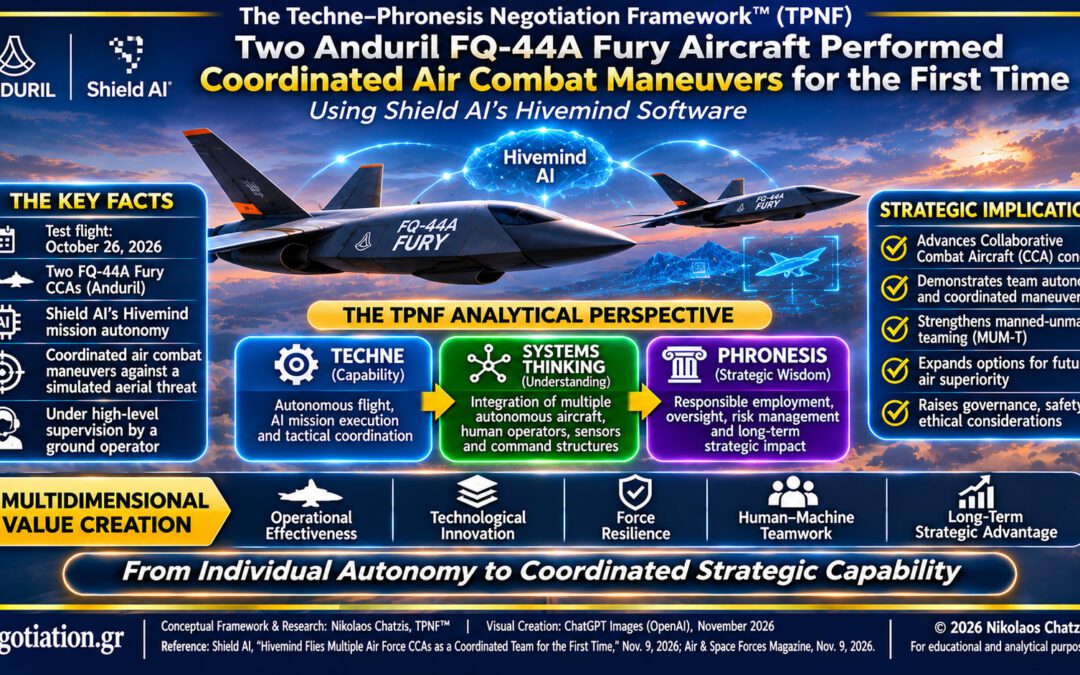
Two Anduril FQ-44A Fury Aircraft Perform Coordinated Air Combat Maneuvers Using Shield AI’s Hivemind Software
TPNF Research Essay | Artificial Intelligence, Collaborative Combat Aircraft and Strategic Aviation | November 10, 2026
Central Idea (Thesis)
The first coordinated air combat maneuvers performed by two Anduril FQ-44A Fury aircraft using Shield AI’s Hivemind software represent an important transition from individual aircraft autonomy toward collaborative, AI-enabled military aviation.
Through the Techne–Phronesis Negotiation Framework™ (TPNF), this development can be evaluated across three interconnected dimensions: Techne (Capability), Systems Thinking (Understanding), and Phronesis (Strategic Wisdom).
The central strategic challenge is not simply developing autonomous aircraft, but integrating them into reliable, accountable, and adaptable military aviation ecosystems capable of generating sustainable operational value.
Purpose
This TPNF essay examines the October 26, 2026, flight demonstration involving two Anduril FQ-44A Fury Collaborative Combat Aircraft (CCA) and Shield AI’s Hivemind mission-autonomy software.
It evaluates the technological achievement, implications for human–machine cooperation, operational challenges, and potential consequences for future air superiority.
Abstract
Artificial intelligence is transforming military aviation by enabling increasingly autonomous aircraft to execute complex missions under human supervision.
On November 9, 2026, Shield AI announced that two Anduril FQ-44A Fury aircraft had performed coordinated beyond-visual-range air combat maneuvers during an October 26 demonstration.
The aircraft operated against a simulated aerial threat, receiving high-level instructions from a ground operator.
The achievement demonstrates progress in collaborative mission autonomy, although it does not establish operational combat readiness.
TPNF provides a framework for examining how technological autonomy may evolve into coordinated strategic capability.
1. The October 26 Flight Demonstration
The demonstration took place at the Nevada Test and Training Range.
Two Anduril-built FQ-44A Fury aircraft flew in formation and executed coordinated beyond-visual-range air combat maneuvers using Shield AI’s Hivemind software.
Rather than manually controlling each aircraft, a ground operator provided high-level instructions.
Hivemind translated those instructions into coordinated aircraft behavior.
The demonstration followed an October 8 test at Edwards Air Force Base, during which an F-22 Raptor pilot directed a single Fury aircraft using Hivemind.
Together, these tests illustrate an important progression: from one autonomous aircraft responding to human instructions toward multiple aircraft coordinating tactical activities.
However, the October 26 engagement involved a virtual adversary. Live weapons employment remains a separate developmental challenge.
2. Understanding Collaborative Combat Aircraft
Collaborative Combat Aircraft are uncrewed military aircraft intended to operate alongside crewed platforms and other autonomous systems.
Their potential missions include reconnaissance, electronic warfare, defensive support, and combat operations.
The United States Air Force is developing CCAs to increase operational flexibility and expand combat capacity.
Unlike conventional remotely piloted aircraft, future CCAs are expected to perform certain functions autonomously under human direction.
This distinction is essential.
Remote control requires continuous human involvement in specific aircraft movements.
Mission autonomy allows software to translate broader objectives into operational actions within defined limits.
The strategic ambition is to enable human commanders to supervise coordinated aircraft formations without individually controlling every maneuver.
3. Techne: Autonomous Flight and Tactical Coordination
Within TPNF, Techne represents technological capability and practical competence.
The FQ-44A demonstration illustrates the development of autonomous flight control, mission execution, and coordinated aircraft behavior.
Hivemind operates as mission-autonomy software, interpreting human instructions and generating appropriate aircraft actions.
Coordinated maneuvering requires reliable interactions among aircraft control systems, sensors, communications, and mission software.
These technologies must operate within demanding aviation environments.
The achievement is therefore more significant than simply demonstrating two aircraft flying simultaneously.
It concerns their ability to perform complementary tactical actions.
Nevertheless, technological performance during controlled testing must not be confused with proven effectiveness against sophisticated operational threats.
4. Systems Thinking: From Aircraft to Combat Ecosystems
Modern military aviation increasingly depends upon interconnected platforms and information systems.
Crewed fighters, autonomous aircraft, sensors, communications networks, command structures, and supporting infrastructure form a complex operational ecosystem.
The effectiveness of individual aircraft depends partly upon their integration within this environment.
For example, autonomous aircraft may possess advanced maneuvering capabilities but remain vulnerable to communication disruptions or unreliable information.
Systems Thinking emphasizes these dependencies.
Within TPNF, the strategic value of the FQ-44A extends beyond its individual performance.
The central question becomes how multiple autonomous aircraft can cooperate with human operators and other military systems while maintaining operational coherence.
5. Phronesis: Responsible Human Judgment
Phronesis represents practical wisdom and responsible strategic judgment.
Its importance increases as military technologies acquire greater autonomy.
Autonomous aircraft may process information and execute maneuvers rapidly, but decisions concerning mission objectives, acceptable risks, and the use of force require appropriate human responsibility.
The October demonstration illustrates a human-directed autonomy model.
A ground operator established high-level directions while the software coordinated aircraft behavior.
However, successful coordination does not resolve every question concerning human oversight.
Future systems must address accountability, unexpected behavior, escalation risks, and compliance with applicable international humanitarian law.
Technological autonomy should strengthen human decision-making rather than obscure responsibility for military action.
6. Human–Machine Teaming and the Future Fighter Pilot
Traditional fighter operations depend upon pilots controlling aircraft while maintaining situational awareness.
Collaborative autonomy introduces a different operational relationship.
A future fighter pilot may supervise several autonomous aircraft while simultaneously managing the crewed aircraft’s mission.
This creates opportunities to distribute tasks and expand operational capacity.
However, it also creates cognitive challenges.
Human operators must understand what autonomous systems are doing, recognize unexpected behavior, and intervene when necessary.
Effective interfaces and appropriate levels of automation become critical.
The objective is not simply reducing pilot workload.
It is ensuring that automation improves overall mission effectiveness without overwhelming human supervision.
7. Beyond-Visual-Range Air Combat
Beyond-visual-range air combat involves engagements in which opposing aircraft may not be directly visible to one another.
Such operations depend upon situational awareness, sensor information, communications, and coordinated decision-making.
The October demonstration involved simulated BVR counter-air tactics.
Its significance lies in showing that mission-autonomy software can coordinate aircraft during an air-combat scenario.
However, the demonstration did not establish performance against operational electronic warfare, contested communications, or an adaptive enemy force.
These remain important areas for future evaluation.
TPNF emphasizes that technological demonstrations should be assessed according to the conditions under which their results were obtained.
8. Software-Defined Military Aviation
An important dimension of the CCA program concerns software architecture.
Shield AI highlighted the United States Air Force’s Autonomy Government Reference Architecture (A-GRA).
This approach seeks to separate mission-autonomy software from aircraft-specific functions through standardized interfaces.
Such separation may enable software improvements without requiring complete redesigns of individual aircraft.
It may also encourage competition among technology providers and facilitate future integration.
From a TPNF perspective, this represents an important connection between technological capability and ecosystem adaptability.
The strategic value of military aircraft may increasingly depend upon their capacity to incorporate validated software improvements throughout their operational lives.
9. Accelerating Technological Learning
Shield AI describes a development process involving repeated testing, evaluation, and software refinement.
Flight-test data contributes to subsequent software releases.
This creates the possibility of shortening certain technological learning cycles.
However, rapid development must remain compatible with rigorous verification and safety assessment.
A software update may improve performance while introducing unexpected interactions with other systems.
Therefore, accelerated innovation requires disciplined testing and configuration management.
TPNF interprets this challenge as a relationship between Techne, Systems Thinking, and Phronesis.
Technical innovation creates possibilities.
Systems understanding identifies dependencies.
Strategic wisdom determines whether improvements are sufficiently reliable for broader employment.
10. Strategic Implications for Air Superiority
Collaborative autonomous aircraft could influence future concepts of air superiority.
Potential advantages include increased operational capacity, distributed sensing, greater mission flexibility, and reduced exposure of human crews to certain risks.
Autonomous aircraft may also provide additional options for operating in contested environments.
Nevertheless, these advantages remain conditional.
Operational effectiveness depends upon survivability, communications resilience, logistical support, affordability, and integration with existing forces.
Adversaries may develop countermeasures specifically intended to disrupt autonomous coordination.
Consequently, the strategic significance of CCAs cannot be measured exclusively through aircraft numbers or technological sophistication.
It must be evaluated through the performance of the wider combat ecosystem.
11. Multidimensional Value Creation
The FQ-44A demonstration offers an opportunity to examine several dimensions of potential value.
Operational value: More flexible coordination among aircraft.
Technological value: Advances in mission-autonomy software and aircraft integration.
Institutional value: Improved cooperation among military organizations and technology developers.
Human value: New professional competencies in supervising autonomous systems.
Strategic value: Potential improvements in adaptability, resilience, and operational options.
These benefits are not automatic.
They depend upon successful integration, appropriate governance, and demonstrated effectiveness.
Within TPNF, multidimensional value creation requires balancing technological opportunities against operational risks and institutional responsibilities.
12. The TPNF Strategic Adaptation Pathway
The development can be examined through a proposed seven-stage pathway:
Individual Autonomy → Collaborative Coordination → Human–Machine Integration → Systems Validation → Operational Adaptation → Responsible Employment → Sustainable Strategic Value
Each stage introduces additional requirements.
Individual autonomy establishes technological capability.
Collaboration introduces interactions among aircraft.
Human–machine integration requires effective supervision.
Systems validation tests reliability.
Operational adaptation incorporates lessons into doctrine, training, and procedures.
Responsible employment establishes appropriate limits and accountability.
Long-term strategic value emerges only when these elements function together.
13. Implications for Aviation Education
The emergence of collaborative autonomous aircraft also raises important educational questions.
Future military aviation professionals will require knowledge extending beyond conventional aircraft operation.
Pilots, instructors, engineers, and commanders must understand autonomous systems, software limitations, communications dependencies, and human–machine interaction.
Training must preserve established operational competencies while incorporating technological literacy and systems-level reasoning.
TPNF offers a complementary educational perspective for examining these requirements.
The objective is to prepare professionals capable of evaluating emerging technologies rather than merely operating them.
Strategic Lessons for Leaders
- Distinguish successful demonstrations from validated operational capabilities.
- Evaluate autonomous aircraft as components of interconnected combat ecosystems.
- Preserve meaningful human supervision and accountability.
- Develop resilient communications and reliable software integration.
- Connect rapid innovation with disciplined testing and risk governance.
- Invest in the education of professionals responsible for autonomous systems.
- Measure long-term strategic value through operational evidence.
The coordinated maneuvers of two Anduril FQ-44A Fury aircraft using Shield AI’s Hivemind software represent an important milestone in autonomous military aviation.
The achievement demonstrates progress from individual aircraft autonomy toward collaborative mission execution.
However, technological coordination alone does not guarantee operational effectiveness or strategic advantage.
Through TPNF, the development highlights the importance of integrating technical capability, systems understanding, and responsible judgment.
The future of autonomous air combat will depend not simply upon intelligent aircraft, but upon the capacity of human institutions to integrate, supervise, and adapt these technologies responsibly.
Key Takeaways
The October 26 demonstration involved two autonomous aircraft conducting coordinated maneuvers against a simulated threat.
Hivemind translated high-level human instructions into collaborative aircraft behavior.
The achievement supports the development of human-directed autonomous aviation.
Operational combat effectiveness remains unproven by this demonstration.
TPNF connects autonomous capability with systems integration, responsible governance, and sustainable strategic value.
Author’s Reflection
The evolution of military aviation increasingly challenges the traditional relationship between aircraft, pilots, and technological systems.
Artificial intelligence creates new possibilities for coordinating aircraft and expanding operational capabilities.
Yet the strategic significance of these developments extends beyond automation itself.
The essential question concerns how technological intelligence can be integrated with human understanding and responsible judgment.
For TPNF, the transition from individual autonomy to coordinated strategic capability illustrates a broader principle: technological innovation becomes strategically meaningful when it strengthens the effectiveness, adaptability, and responsibility of the systems within which it operates.
The future of airpower will be shaped not only by what autonomous aircraft can accomplish, but also by the wisdom governing their employment.
Nikolaos Chatzis
Primary Research Sources
The flight-test details and technical distinctions are supported by two principal sources:
-
Shield AI, November 9, 2026: Hivemind Flies Multiple Air Force CCAs as a Coordinated Team for the First Time. The company’s primary announcement describes the October 8 and October 26 demonstrations, human-directed mission autonomy, and A-GRA.
Shield
-
Air & Space Forces Magazine, November 9, 2026: In First, Two CCAs Fly Air Combat Maneuvers Using Autonomy Software. Independent reporting identifies the two FQ-44A aircraft, Nevada test location, simulated threat, and plans for more complex demonstrations.
Source: Open Sources Analysis, Relative Data Analysis by Nikos Chatzis
© Nikolaos Chatzis. All Rights Reserved.
The Techne–Phronesis Negotiation Framework™
An Integrative Theory of Strategic Negotiation, Complex Adaptive Systems and Practical Wisdom
Technology Creates Capability • Systems Thinking Creates Understanding • Strategic Wisdom Creates Lasting Value.
Negotiation.gr | Strategic Wisdom for the Technological Age