Negotiation.gr | Strategic Wisdom for the Technological Age
“Strategic resilience emerges when technical capability (techne) is
continuously guided by practical wisdom (phronesis) through adaptive
negotiation across interconnected systems.”
Central Idea — Thesis
Two apparently separate geopolitical developments reveal a deeper transformation of international power.
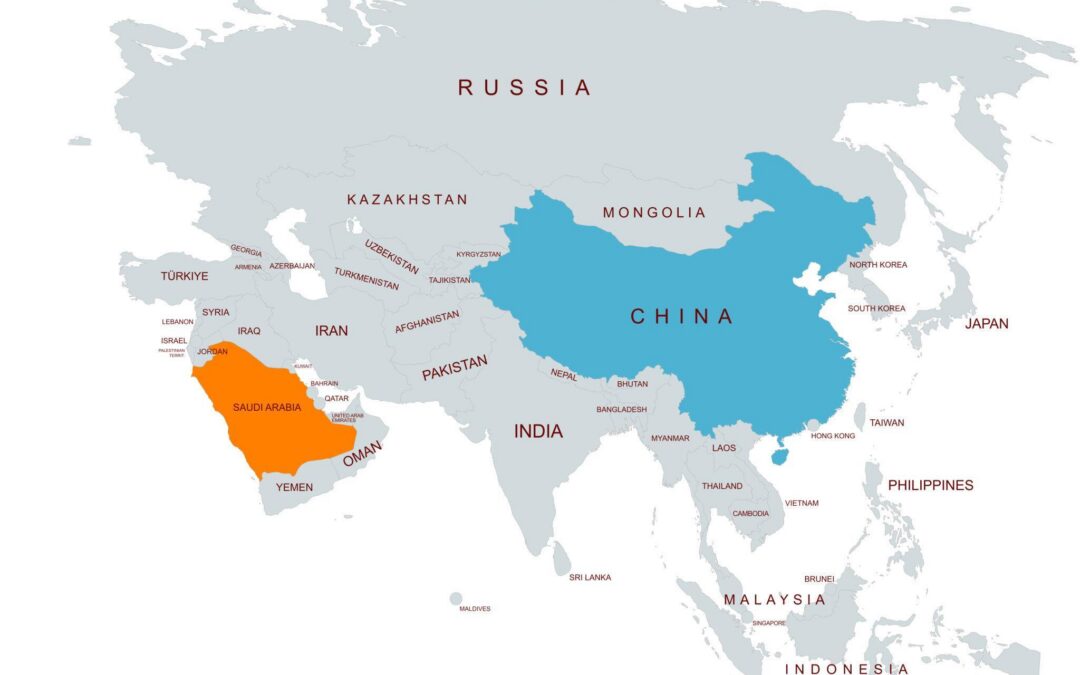
Saudi Arabia has turned to China seeking help in restraining Yemen’s Houthis through Beijing’s relationship with Iran.
At approximately the same time, tensions between President Donald Trump and NATO allies are forcing European governments to reconsider the degree of their strategic dependence on the United States.
The comparison should not be exaggerated: China is not replacing the United States as Europe’s security provider, nor does Saudi Arabia’s appeal to Beijing mean that Riyadh has abandoned Washington.
But the simultaneous developments illuminate something more important.
Power in an interconnected geopolitical system increasingly depends not only upon military capability, but upon the ability to maintain relationships across competing actors and mobilize those relationships when crises emerge.
The Techne–Phronesis Negotiation Framework™ (TPNF) describes this emerging capability as Strategic Relational Optionality™:
the capacity of a state to preserve multiple usable relationships across competing geopolitical networks so that alternative channels of influence remain available during crisis.
Purpose of the Essay
This TPNF essay examines China’s intervention with Iran over the Houthis and the continuing tensions within NATO as two contrasting cases of geopolitical ecosystem management.
The central question is:
Can the ability to preserve relationships with competing actors itself become a source of strategic power?
Abstract
Saudi Arabia appealed to China after Houthi advances along Yemen’s Red Sea coast increased risks around Bab el-Mandeb and Saudi energy exports. Beijing subsequently privately urged Tehran to use its influence over the Houthis.
China occupies an unusual position because it maintains important relationships with Iran while simultaneously developing substantial economic relations with Saudi Arabia and the other Gulf states.
Across another geopolitical ecosystem, President Trump’s pressure on NATO is encouraging European allies to increase defense expenditure but is also generating uncertainty about American reliability and encouraging some governments to diversify defense procurement.
TPNF interprets these developments through Strategic Relational Optionality™, Alliance Trust Capital™, and the Pressure–Dependency Paradox™.
1. Why Saudi Arabia Turned to China
Saudi Arabia faces a difficult strategic environment.
Houthi advances toward strategically important areas along Yemen’s Red Sea coast have increased concern about Bab el-Mandeb.
The danger becomes particularly significant while disruption around the Strait of Hormuz already threatens another major Middle Eastern energy route.
Riyadh therefore turned toward an actor with an unusual relationship with Tehran:
China.
Beijing is Iran’s largest trading partner and principal oil customer.
But China simultaneously maintains major commercial relationships with Saudi Arabia and other Gulf states.
That creates something military power alone cannot provide:
access across competing geopolitical networks.
2. China’s Strategic Relational Optionality™
China’s position does not mean that Beijing controls Tehran or the Houthis.
Reuters reports that China did not threaten Iran with economic consequences, and it remains uncertain whether Tehran will act upon Beijing’s concerns.
This limitation is important.
Influence is not control.
But China’s relationships create diplomatic options unavailable to actors whose geopolitical connections are restricted by rigid alignment.
TPNF defines this as Strategic Relational Optionality™.
The strategic asset is not neutrality.
It is usable connectivity.
China can communicate with Iran.
It can communicate with Saudi Arabia.
It trades with both.
It depends upon regional energy.
And both sides have economic reasons to maintain relations with Beijing.
3. The 2023 Precedent
This is not the first time China has occupied the space between Iran and Saudi Arabia.
In 2023, Beijing helped broker the agreement restoring diplomatic relations between Tehran and Riyadh.
The current situation is substantially more difficult because it involves an active regional war and the Houthis, whose decision-making cannot simply be reduced to Iranian command.
Nevertheless, Saudi Arabia’s decision to approach Beijing indicates that China’s previous diplomatic positioning has created Relational Strategic Capital™.
Relationships accumulated during periods of stability can become capabilities during periods of crisis.
4. China’s Economic Vulnerability Creates Diplomatic Motivation
China’s involvement should not be interpreted as altruism.
Approximately half of China’s oil imports originate in the Middle East.
Instability around both Hormuz and Bab el-Mandeb threatens energy flows and international commerce.
Beijing therefore has powerful reasons to prevent further escalation.
This demonstrates an important TPNF principle:
Interdependence can generate vulnerability, but vulnerability can also generate incentives for strategic stabilization.
China’s dependence on Middle Eastern energy increases its exposure.
Yet that same exposure encourages Beijing to preserve functioning relationships across the region.
5. Meanwhile, a Different Ecosystem Is Under Stress
Across the Atlantic, another geopolitical ecosystem is experiencing a different dynamic.
President Trump has repeatedly pressured NATO members over defense spending and criticized European governments that did not fully support U.S. policy toward Iran.
The Pentagon is conducting a review of American force posture in Europe.
Yet more than 81,000 U.S. military personnel remain on the continent, and Washington continues investing heavily in strategically important European bases.
This reveals a paradox.
Political relations are under pressure.
Operational interdependence remains extensive.
The United States still relies upon European geography, infrastructure and allies to project military power toward regions including the Middle East.
6. Alliance Trust Capital™
Military alliances depend upon weapons, forces and infrastructure.
But they also depend upon expectations.
Will allies respond?
Will commitments survive political change?
Will technology remain available?
Will forces remain deployed?
TPNF describes the accumulated confidence behind these expectations as Alliance Trust Capital™:
the stock of strategic confidence created when alliance commitments are repeatedly demonstrated to be credible, predictable and mutually beneficial.
Trust accumulated over decades can absorb disagreements.
But it is not unlimited.
Persistent uncertainty can gradually consume it.
7. The Pressure–Dependency Paradox™
Trump’s pressure has produced measurable effects.
European NATO members have substantially increased defense expenditure.
Most allies have accepted significantly higher long-term spending objectives.
From one perspective, pressure therefore generated burden-sharing.
But another consequence is emerging.
Reuters identified at least eight NATO countries exploring ways to reduce dependence on American weapons and technology.
This creates the Pressure–Dependency Paradox™:
Pressure applied to make partners contribute more can simultaneously encourage those partners to reduce the very dependencies that previously strengthened the relationship.
The immediate outcome may strengthen European military capability.
The longer-term outcome may produce a more autonomous European defense-industrial ecosystem.
8. Two Different Forms of Strategic Power
The contrast with China is striking.
China is attempting to activate relationships.
The United States is attempting to renegotiate obligations inside an established alliance.
These strategies are not directly equivalent, and NATO remains incomparably deeper institutionally and militarily than China’s relationships with Middle Eastern states.
Nevertheless, they demonstrate different mechanisms of influence.
One emphasizes relational access.
The other emphasizes alliance conditionality and burden-sharing.
Their long-term effects depend on whether each approach expands or reduces strategic options.
9. The Geopolitical Ecosystem Conversion Gap™
Possessing relationships does not guarantee influence.
China may ask Iran to restrain the Houthis and discover that Tehran cannot—or will not—produce the desired result.
Likewise, possessing an alliance does not guarantee unlimited political alignment.
European governments may remain NATO members while declining to support particular American operations.
This creates a geopolitical extension of an existing TPNF concept:
Geopolitical Ecosystem Conversion Gap™:
the difference between the relationships and capabilities formally available within a geopolitical network and the influence or coordinated action that can actually be generated from them during crisis.
China’s challenge is converting economic relationships into political influence.
America’s challenge is converting alliance structures into sustained political and strategic cohesion.
10. From Alliances to Multi-Layered Networks
The emerging international system may therefore become increasingly networked.
States can maintain security alliances with one power while trading extensively with another.
Saudi Arabia can depend significantly upon U.S. military cooperation while asking China to influence Iran.
European NATO states can rely upon American deterrence while simultaneously developing greater European defense autonomy.
China can maintain strategic relations with Iran while expanding commercial relations with Gulf Arab states.
This does not mean alliances are disappearing.
It means strategic relationships are becoming multi-layered.
11. The Strategic Value of Being Connected
The emerging lesson is remarkably consistent with broader TPNF ecosystem theory.
Possessing capabilities matters.
But connecting capabilities matters too.
China’s economic relationship with Iran becomes strategically relevant because Saudi Arabia believes Beijing may be able to activate it.
NATO’s enormous military capability remains strategically powerful because decades of interoperability connect national forces into a functioning system.
The strategic question is therefore not simply:
Who possesses the greatest power?
It is increasingly:
Who can mobilize the greatest combination of relationships and capabilities when circumstances change?
Strategic Implications
First, Saudi Arabia’s appeal to China demonstrates Beijing’s growing diplomatic relevance in Middle Eastern crisis management without proving Chinese dominance over regional actors.
Second, Strategic Relational Optionality™ can become a source of geopolitical power when states maintain usable channels across competing networks.
Third, China’s energy dependence creates both vulnerability and incentives for stabilization.
Fourth, NATO remains militarily integrated, but political uncertainty can erode Alliance Trust Capital™.
Fifth, the Pressure–Dependency Paradox™ suggests that demanding greater allied responsibility can strengthen partners while simultaneously encouraging strategic autonomy.
Finally, both cases demonstrate the Geopolitical Ecosystem Conversion Gap™: relationships become strategically valuable only when they can be converted into effective influence and coordinated action.
The geopolitical significance of these developments extends beyond China, Iran, Saudi Arabia, the Houthis, Trump or NATO.
They reveal a changing architecture of power.
Military capability remains fundamental.
Economic capability matters enormously.
Technology increasingly shapes both.
But relationships determine how capabilities can be combined.
China’s attempt to influence Iran demonstrates the potential strategic value of maintaining connections across rival geopolitical networks.
Tensions within NATO demonstrate the importance—and fragility—of trust inside even the world’s most institutionalized military alliance.
Techne creates capability.
Systems Thinking reveals interdependence.
Ecosystem Orchestration™ connects actors and resources.
Phronesis determines whether those relationships are managed wisely enough to create sustainable strategic outcomes.
The emerging geopolitical competition may therefore not be decided solely by which power possesses the strongest military.
It may increasingly depend upon which geopolitical ecosystem preserves the greatest capacity to connect, mobilize, adapt and cooperate when the international system enters crisis.
Key Takeaways
- Saudi Arabia asked China to use its relationship with Iran regarding the Houthi escalation.
- China’s position demonstrates Strategic Relational Optionality™, but influence should not be confused with control.
- Economic interdependence can create incentives for geopolitical stabilization.
- NATO remains operationally integrated despite significant political tensions.
- Alliance Trust Capital™ is a strategic capability that can accumulate—and erode—over time.
- The Pressure–Dependency Paradox™ explains how pressure for burden-sharing can simultaneously encourage greater allied autonomy.
- Geopolitical Ecosystem Conversion Gap™ measures the difference between possessing relationships and successfully converting them into influence.
- Strategic power increasingly depends upon the capacity to mobilize interconnected relationships and capabilities.
Author’s Reflection
For much of history, strategic power was visualized through armies, ships, territory and economic resources.
Those capabilities remain essential.
But perhaps another map must now be placed beside the traditional map of power:
the map of relationships.
Who can speak with whom?
Who is trusted?
Who depends upon whom?
Which relationships remain usable during crisis?
And which connections can actually mobilize other capabilities?
Saudi Arabia’s request to China is important precisely because Beijing maintains a relationship with an actor Riyadh struggles to influence directly.
NATO’s current difficulties demonstrate the opposite side of the same principle: extraordinary military integration cannot make political trust irrelevant.
The technological age therefore does not eliminate diplomacy.
It makes the architecture of relationships even more important.
Because the strategic value of a geopolitical ecosystem ultimately depends not only upon who belongs to it, but upon what its relationships make possible when the system is under pressure.
Nikos Chatzis
Source: Open Sources Analysis, Relative Data Analysis by Nikos Chatzis
© Nikolaos Chatzis. All Rights Reserved.
The Techne–Phronesis Negotiation Framework™
An Integrative Theory of Strategic Negotiation, Complex Adaptive Systems and Practical Wisdom
Technology Creates Capability • Systems Thinking Creates Understanding • Strategic Wisdom Creates Lasting Value.
Negotiation.gr | Strategic Wisdom for the Technological Age