Negotiation.gr | Strategic Wisdom for the Technological Age
“Strategic resilience emerges when technical capability (techne) is
continuously guided by practical wisdom (phronesis) through adaptive
negotiation across interconnected systems.”
Central Idea — Thesis
The 2026 World Humanoid Robot Games in Beijing represent much more than an extraordinary technological spectacle. They reveal an important transition in robotics: from demonstrating what humanoid machines can perform under controlled conditions toward discovering whether they can operate autonomously, reliably and economically within the unpredictable physical environments of everyday life.
Through the Techne–Phronesis Negotiation Framework™ (TPNF), the decisive question is therefore not whether robots can run faster, jump higher or become physically stronger than humans.
It is whether artificial intelligence can successfully migrate from the digital world into the physical world.
The next great technological transformation may emerge when AI acquires not merely intelligence, but a capable physical presence.
Purpose of the Essay
This essay examines the five-day 2026 World Humanoid Robot Games as a real-world testing laboratory for humanoid robotics.
Using TPNF, it explores the convergence of artificial intelligence, robotics, sensors, autonomous decision-making, manufacturing and human–machine collaboration, while asking a larger question:
Are we approaching the transition from the Information Age toward the age of Physical AI?
Abstract
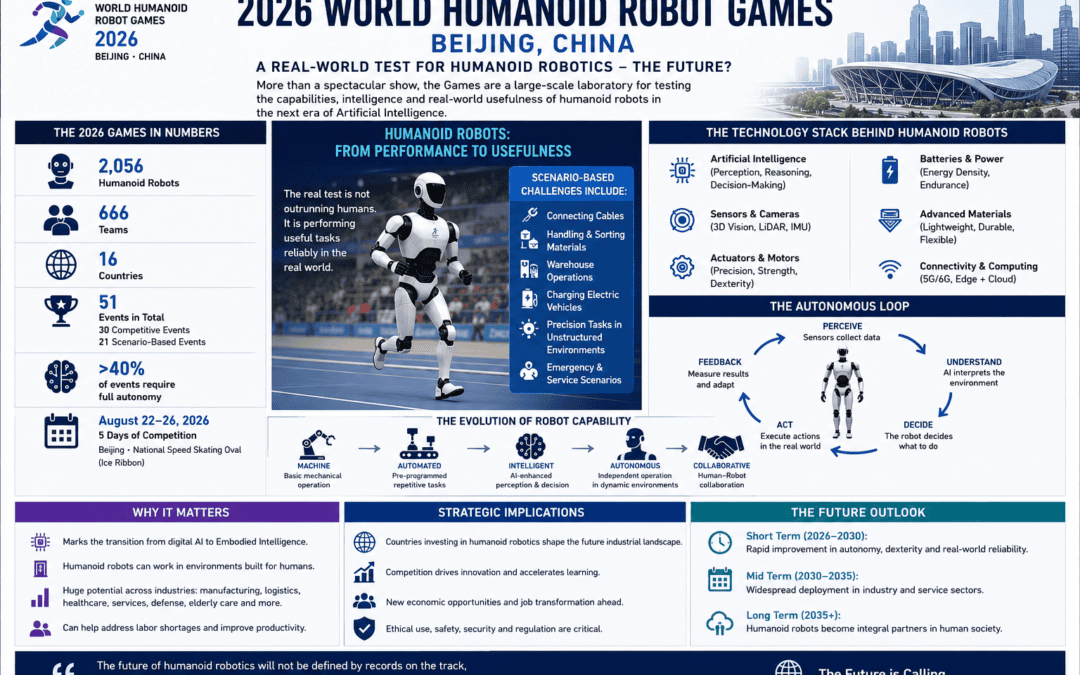
More than 2,000 humanoid robots from 666 teams representing 16 countries are participating in the second World Humanoid Robot Games in Beijing.
Some performances are spectacular. Humanoid robots have already surpassed human records in running and jumping.
But the strategically important competitions are considerably less glamorous.
Robots must connect cables, handle materials, perform warehouse operations, charge electric vehicles and undertake precision tasks in environments designed to reproduce real-world imperfections.
China is therefore using competition as something resembling a massive technological laboratory.
TPNF interprets the Games as evidence of a broader transition from robotic performance toward autonomous usefulness. If AI successfully acquires reliable physical agency, the consequences could extend across manufacturing, logistics, healthcare, emergency response, services, defence and everyday human life.
1. Beyond the Robot Olympics
The images emerging from Beijing are remarkable.
Humanoid machines sprint.
They compete in martial arts.
They play football and tennis.
They dance.
Some already exceed human athletic performance.
But these events can obscure the deeper significance of the Games.
The 2026 competition contains 51 events, including 21 scenario-based challenges specifically designed to test practical robotic capabilities.
Robots must operate in environments resembling factories, restaurants, offices and emergency situations.
The transition is important:
Demonstration → Competition → Testing → Learning → Application.
The Games are becoming an accelerated experimentation environment in which engineers can discover not simply what works—but, perhaps more importantly, what fails.
2. Why Plugging in a Cable May Matter More Than Running 100 Metres
A humanoid robot running faster than the human world record generates headlines.
A robot reliably connecting an imperfectly positioned cable could ultimately generate considerably more economic value.
This apparent contradiction captures the central challenge facing humanoid robotics.
Human environments are messy.
Objects are rarely positioned perfectly.
Floors differ.
Lighting changes.
People move unpredictably.
Doors resist.
Packages vary.
Tools slip.
Humans handle these variations almost unconsciously.
Robots struggle.
Connecting a cable requires perception, spatial reasoning, fine motor control, force adjustment and continuous feedback.
The task appears trivial because humans have spent millions of years developing the biological architecture required to perform it.
For robotics, it represents an extraordinary engineering challenge.
The future of humanoids may therefore depend less upon spectacular superhuman abilities than upon reliable performance of ordinary human tasks.
3. From Artificial Intelligence to Embodied Intelligence
The AI revolution has largely occurred inside computers.
Large language models process language.
AI systems generate images.
Algorithms analyze financial markets.
Software agents increasingly execute digital tasks.
Humanoid robotics introduces another frontier:
Embodied Intelligence™.
Intelligence must interact directly with physical reality.
The architecture becomes:
Perception → Understanding → Decision → Physical Action → Feedback → Adaptation.
A humanoid must perceive its environment through cameras and sensors.
AI must interpret what those sensors observe.
The system must decide what action is appropriate.
Motors and actuators must execute that decision.
Sensors then measure the result.
The robot adapts.
This continuous loop represents something fundamentally different from generating an answer on a computer screen.
AI becomes physically consequential.
4. Why the Human Form?
An obvious question remains.
Why build robots that resemble humans?
Factories have used robots for decades without giving them arms, legs and human proportions.
The answer may be found in the environment.
Civilization was constructed for human bodies.
Doors.
Stairs.
Tools.
Vehicles.
Shelves.
Factories.
Warehouses.
Kitchens.
Hospitals.
Homes.
Instead of redesigning the entire physical environment around machines, humanoid robots attempt to create machines capable of operating inside environments already designed around humans.
The human form therefore becomes an interface with existing civilization.
If successful, humanoids could potentially enter enormous numbers of workplaces without requiring complete redesign of physical infrastructure.
5. China Is Building More Than Robots
The Games should also be understood within China’s wider industrial strategy.
China already possesses enormous manufacturing depth in batteries, electric motors, electronics, sensors, drones, electric vehicles and increasingly artificial intelligence.
Humanoid robotics combines many of these capabilities.
The technological stack includes:
AI + Semiconductors + Sensors + Batteries + Actuators + Motors + Advanced Materials + Manufacturing + Data.
Humanoid robots consequently represent a powerful example of Technology Convergence™.
No single technological breakthrough creates the humanoid revolution.
It emerges through integration.
This is precisely where China’s manufacturing ecosystem may provide strategic advantages.
The country can potentially connect research, component suppliers, manufacturing capacity, domestic demand, government support and enormous volumes of experimentation.
Reuters notes that China’s robot competitions have evolved during the past decade from relatively modest academic contests into major strategic showcases, supported by a maturing industrial supply chain and government policy.
6. Competition as an Innovation Laboratory
The World Humanoid Robot Games reveal another interesting strategic mechanism.
Competition itself becomes an instrument of technological development.
Teams confront identical problems.
Different technological architectures compete.
Failures become observable.
Performance becomes measurable.
Engineers obtain data.
Systems improve.
The Games therefore create something resembling a Competitive Learning Ecosystem™.
Rather than innovation occurring entirely behind closed laboratory doors, technological learning occurs through repeated comparison.
This can accelerate development because failure becomes productive.
A robot falling while running provides engineering information.
A robot unable to grasp an object reveals deficiencies in perception or control.
A robot failing to connect a cable exposes weaknesses in dexterity.
Every failure generates data.
And data feeds the next generation of AI and robotic systems.
7. Autonomy Is the Real Test
The most strategically important word surrounding the 2026 Games may therefore be autonomy.
More than 40% of the contests require robots to operate fully autonomously.
This matters because remotely controlled robots remain extensions of human operators.
Autonomous robots become something different.
They become decision-making technological agents.
The progression is profound:
Machine → Automated Machine → Intelligent Machine → Autonomous Agent.
At that point, the economic implications expand dramatically.
One human might supervise multiple robots.
Robots could potentially operate continuously.
Machines could enter hazardous environments.
Labour shortages could be mitigated.
Manufacturing could become more flexible.
Logistics systems could become increasingly autonomous.
But autonomy simultaneously creates questions about safety, accountability, cybersecurity and human control.
8. The TPNF Perspective: Techne Meets Phronesis
Humanoid robotics represents Techne in an extraordinarily visible form.
Engineering creates mechanical capability.
AI creates intelligence.
Sensors create perception.
Actuators create physical agency.
But technological civilization cannot stop at the question:
Can we build it?
Phronesis requires another question:
How should we use it?
Humanoid robots could create enormous productivity.
They could also disrupt labour markets.
They could assist elderly populations.
They could increase surveillance.
They could perform dangerous industrial tasks.
They could become military systems.
They could expand human capability.
They could create new technological dependencies.
Strategic wisdom therefore requires evaluating not simply technological capability, but long-term systemic consequences.
9. From Automation to Human–Robot Ecosystems
The most plausible future may not involve robots simply replacing humans.
It may involve new forms of Human–Robot Collaboration™.
Humans possess contextual understanding, creativity, empathy, ethical judgment and strategic reasoning.
Machines increasingly possess precision, endurance, computational power and repeatability.
Combining these strengths could create new operating architectures.
A warehouse worker may supervise autonomous humanoids.
A surgeon may collaborate with robotic systems.
Emergency teams may deploy robots into dangerous environments before humans enter.
Factories may combine human judgment with robotic execution.
The strategic question therefore becomes less:
Humans or robots?
and increasingly:
How should humans and intelligent machines collaborate?
10. The Future?
Humanoid robots remain imperfect.
That fact should not be hidden by spectacular demonstrations.
Robots still fall.
Dexterous manipulation remains difficult.
Battery life remains constrained.
Reliability must improve.
Costs must decline.
AI still struggles with unpredictable physical environments.
But technological revolutions rarely arrive fully mature.
The important question is the direction of development.
The Games demonstrate rapid improvement and an increasingly explicit shift toward practical applications. Beijing’s official description emphasizes that scenario competitions are moving into factories, hotels and model homes specifically to transform robots from demonstration systems into useful real-world tools.
That transition deserves attention.
Strategic Implications
Humanoid robotics could become one of the defining technology-convergence industries of the next decade.
For companies, competitive advantage may increasingly depend upon integrating AI, hardware, data and manufacturing.
For governments, robotics could influence industrial competitiveness, labour productivity and technological sovereignty.
For workers, the challenge will increasingly involve learning how to collaborate with intelligent machines.
For strategists, humanoid robotics demonstrates that AI is moving beyond information processing toward physical agency.
And for society, the central challenge will be ensuring that technological capability creates sustainable human value.
The 2026 World Humanoid Robot Games may be remembered for robots running faster than humans.
But history may eventually regard something much less spectacular as more important.
A robot successfully connecting a cable.
Picking up an irregular object.
Operating autonomously inside a factory.
Responding safely to an unexpected obstacle.
These seemingly ordinary actions represent the bridge between technological demonstration and economic transformation.
Through the TPNF lens, the progression becomes:
Artificial Intelligence → Embodied Intelligence → Autonomous Capability → Human–Robot Collaboration → Ecosystem Value.
The future of humanoid robotics will therefore not be determined by whether robots can defeat humans in sporting events.
It will be determined by whether they can reliably participate in human civilization.
The future?
It may already be learning how to walk among us.
Key Takeaways
- The real breakthrough in humanoid robotics is shifting from spectacular performance toward reliable autonomous usefulness.
- Humanoid robots represent the convergence of AI with physical agency—Embodied Intelligence™.
- China’s manufacturing ecosystem may provide powerful advantages in scaling humanoid robotics.
- The World Humanoid Robot Games function as a Competitive Learning Ecosystem™ where failures generate valuable technological data.
- The central strategic challenge is not humans versus robots, but designing productive and responsible Human–Robot Collaboration™.
Author’s Reflection
What fascinates me most about the Beijing Games is not the possibility that a robot can eventually run faster than a human.
Machines have exceeded human physical capabilities for centuries.
Cars move faster than humans. Cranes lift more. Computers calculate faster.
The genuinely transformative moment will arrive when intelligent machines can enter the ordinary complexity of human environments and operate there with reliability, adaptability and judgment.
That would represent something different.
Artificial intelligence would no longer merely analyze our world.
It would begin physically participating in it.
For TPNF, that makes humanoid robotics an extraordinary laboratory of technological civilization.
Techne will determine what these machines become capable of doing.
But Phronesis must help humanity determine what we want them to become.
Nikos Chatzis
Source: Open Sources Analysis, Relative Data Analysis by Nikos Chatzis
© Nikolaos Chatzis. All Rights Reserved.
The Techne–Phronesis Negotiation Framework™
An Integrative Theory of Strategic Negotiation, Complex Adaptive Systems and Practical Wisdom
Technology Creates Capability • Systems Thinking Creates Understanding • Strategic Wisdom Creates Lasting Value.
Negotiation.gr | Strategic Wisdom for the Technological Age