Negotiation.gr | Strategic Wisdom for the Technological Age
“Strategic resilience emerges when technical capability (techne) is
continuously guided by practical wisdom (phronesis) through adaptive
negotiation across interconnected systems.”
Central Idea
The contemporary Middle East demonstrates that possessing superior military capability does not automatically translate into political control over a strategic ecosystem.
President Donald Trump is attempting to influence several interconnected regional fronts involving Iran, Israel, Gaza, the Strait of Hormuz, Yemen, Saudi Arabia and maritime trade. Yet Israeli Prime Minister Benjamin Netanyahu’s rejection of the U.S.-backed Gaza plan, continuing Houthi attacks on shipping, and separate U.S. military enforcement actions against vessels linked to trade with Iran demonstrate how difficult it is for Washington to transform military and diplomatic power into Strategic Ecosystem Coherence™.
Through the Techne–Phronesis Negotiation Framework™ (TPNF), the central problem becomes:
Power provides influence, but influence becomes sustainable only when the interests and actions of interconnected actors can be strategically coordinated.
Purpose of the Essay
This essay examines the emerging divergence between U.S. and Israeli objectives alongside continuing maritime escalation involving the Houthis and the United States.
It argues that the Middle East should increasingly be understood not as a collection of separate conflicts but as a Negotiating–Security Ecosystem in which actions on one front alter bargaining positions across several others.
Abstract
The Middle Eastern strategic environment remains highly unstable despite continuing diplomatic efforts.
Netanyahu has rejected the U.S.-backed 15-point Gaza framework and insists that Israel will not withdraw until Hamas is completely disarmed. At the same time, Houthi forces continue attacks against maritime traffic, while the United States is independently enforcing its blockade on Iranian ports through military action against vessels.
These developments reveal a fundamental strategic difficulty: Washington may possess overwhelming military capability, but it cannot automatically control the strategic choices of allies, adversaries, proxies and commercial actors.
TPNF interprets this as a problem of Strategic Ecosystem Governance.
1. The Middle East Is Not a Single Negotiation
Traditional diplomatic analysis frequently separates conflicts into individual files:
Gaza
Iran
Hormuz
Yemen
Red Sea
Saudi security
This separation is becoming increasingly artificial.
An Israeli decision regarding Gaza can influence Houthi calculations.
Houthi attacks can influence Saudi security.
Maritime attacks influence insurance and shipping.
Shipping disruption affects energy prices.
Energy prices create political pressure internationally.
Iranian negotiations influence the Strait of Hormuz.
The strategic environment therefore operates as an interconnected ecosystem.
TPNF consequently asks not merely:
What happens in Gaza?
but:
How does what happens in Gaza change the behavior of actors elsewhere in the regional ecosystem?
2. Netanyahu and the Limits of American Influence
Israel remains one of America’s closest strategic partners.
Yet alliance does not mean identical strategic interests.
Netanyahu’s rejection of Trump’s Gaza framework illustrates this distinction.
Trump has incentives to demonstrate that American power can produce agreements, reduce regional instability and constrain the economic consequences of continuing war.
Netanyahu operates under a different combination of military, political, security and domestic pressures.
The resulting problem is important:
An ally can simultaneously increase a great power’s regional capability and constrain its diplomatic flexibility.
This is the Alliance Influence Paradox™.
Strong alliances generate strategic leverage, but independent allied decisions can also reduce the leading power’s freedom of maneuver.
3. Military Capability Is Not Strategic Control
The United States possesses extraordinary military capability in the region.
But TPNF distinguishes between:
Capability
and
Strategic Control.
Military forces can destroy targets.
Naval forces can enforce blockades.
Air power can deter or punish.
But military capability alone cannot guarantee that Israel, Iran, the Houthis, Saudi Arabia or other regional actors will behave according to Washington’s preferred political outcome.
This reinforces the foundational TPNF distinction:
Techne determines what can be done. Phronesis helps determine how capability can produce sustainable strategic outcomes.
4. Two Maritime Fronts
The latest shipping incidents make the ecosystem problem particularly visible.
Near Bab el-Mandeb, a Houthi missile attack on the Egyptian-owned cargo vessel Tihamah killed four crew members. Two rescuers were subsequently killed when another attack struck during rescue operations.
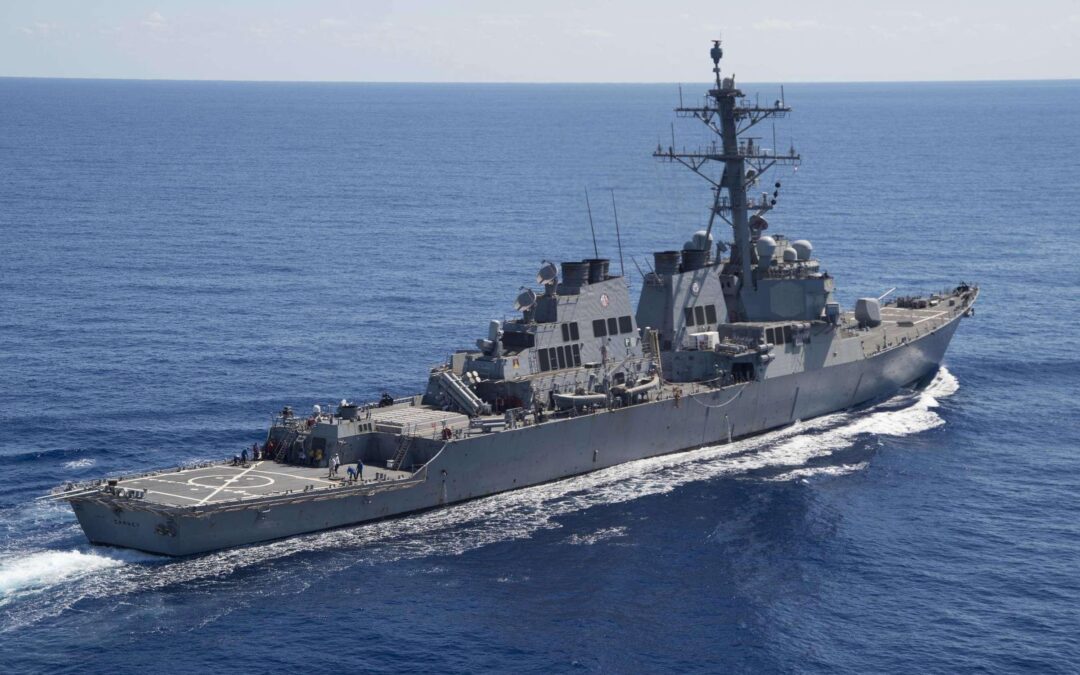
Separately, U.S. forces disabled the Panama-flagged Vela Nova in the Gulf of Oman, saying the vessel had violated the naval blockade on Iranian ports.
The incidents are operationally separate.
Strategically, however, they interact.
The result is simultaneous coercion affecting shipping at two critical maritime gateways:
Bab el-Mandeb
and
Strait of Hormuz / Gulf of Oman.
This transforms maritime geography into negotiating leverage.
5. Maritime Chokepoints as Negotiating Platforms
A chokepoint is not merely geography.
It is a strategic platform connecting:
Energy + Trade + Shipping + Insurance + Military Power + Diplomacy + Global Markets.
Disruption at Bab el-Mandeb affects Red Sea traffic and access toward the Suez Canal.
Instability around Hormuz threatens one of the world’s most strategically important energy corridors.
When military actors operate around both simultaneously, regional conflict becomes a problem for the wider global economy.
TPNF describes this as Peripheral Impact.
A missile launched in Yemen can eventually affect a shipping company’s routing decision in Europe or Asia.
Local military action therefore generates global economic consequences.
6. The Houthis as an Asymmetric Ecosystem Actor
The Houthis demonstrate another characteristic of contemporary strategic competition.
Strategic influence is no longer proportional to conventional national power.
Relatively inexpensive missiles and drones can threaten commercial vessels worth tens or hundreds of millions of dollars and force naval powers to deploy sophisticated defensive capabilities.
This produces an asymmetric equation:
Low-Cost Disruption → High-Cost Strategic Response.
The objective need not be complete control of maritime territory.
Creating sufficient uncertainty may already alter shipping behavior.
In technological civilization, therefore, disruption itself becomes capability.
7. Iran and Distributed Strategic Pressure
Iran’s regional position must also be understood through networks.
Tehran possesses conventional military capabilities, but its wider strategic influence has historically involved relationships with non-state and regional actors.
This creates forms of distributed pressure.
Instead of strategic competition occurring only between Washington and Tehran, pressure can emerge through multiple geographic nodes.
The resulting architecture resembles:
Iran
↓
Regional Networks
↓
Multiple Pressure Points
↓
Shipping / Energy / Security
↓
Global Economic Effects
This makes negotiations extraordinarily difficult because an agreement on one front may not automatically stabilize another.
8. Trump’s Strategic Coordination Problem
President Trump’s challenge therefore extends beyond negotiating with Iran.
Washington must simultaneously manage:
- Iran negotiations,
- Israeli strategic preferences,
- Gaza diplomacy,
- maritime security,
- Houthi escalation,
- Gulf partners,
- global energy consequences.
These objectives may conflict.
Increasing pressure on Iran may strengthen negotiating leverage but also increase incentives for asymmetric retaliation.
Supporting Israel may reinforce alliance credibility while limiting Washington’s ability to act as a diplomatic broker.
Military enforcement may demonstrate resolve while increasing escalation risks.
This is a classic TPNF problem of Multidimensional Strategic Optimization™.
There may be no decision maximizing every objective simultaneously.
Strategy requires prioritization.
9. Strategic Ecosystem Coherence™
The situation suggests an important TPNF concept:
Strategic Ecosystem Coherence™
Strategic Ecosystem Coherence is the capacity of a leading actor to align military capability, diplomatic objectives, alliance relationships, economic instruments and negotiating strategy sufficiently to produce a sustainable political outcome.
The key word is sufficiently.
Perfect alignment is unrealistic.
But without minimum coherence, one policy instrument can undermine another.
Diplomacy may seek de-escalation while military operations increase pressure.
An ally may pursue objectives inconsistent with the wider negotiating strategy.
Regional actors may exploit these contradictions.
Strategic power therefore depends partly upon the ability to orchestrate complexity.
10. From Deterrence to Ecosystem Governance
Classical deterrence asks:
How do we convince an adversary not to act?
The contemporary Middle East requires a broader question:
How do we influence an ecosystem containing allies, adversaries, proxies, commercial actors and competing political objectives?
This is Strategic Ecosystem Governance.
It requires:
Military Capability
Diplomatic Leverage
Economic Instruments
Alliance Management
Systems Understanding
Strategic Negotiation
Military superiority remains essential.
But it becomes one instrument inside a larger architecture.
11. Phronesis and the Limits of Coercion
The danger is assuming that greater coercive capability automatically creates greater control.
Sometimes it does.
Sometimes pressure produces adaptation, resistance or escalation.
TPNF therefore places Phronesis at the highest level of strategic decision-making.
The question is not simply:
Can the United States strike another vessel?
or:
Can Israel continue military operations?
The strategic question is:
Does each additional action move the ecosystem closer to the desired political outcome?
That distinction separates tactical effectiveness from strategic wisdom.
Strategic Implications
Several conclusions emerge.
First, Netanyahu’s divergence from Trump’s Gaza approach demonstrates that alliances require continuous strategic negotiation.
Second, simultaneous Houthi and U.S. maritime actions illustrate how separate military operations can combine into wider ecosystem instability.
Third, Bab el-Mandeb and Hormuz increasingly operate as geopolitical negotiating platforms rather than merely shipping routes.
Fourth, asymmetric actors can generate strategic effects far exceeding their conventional capabilities.
Fifth, American regional power depends increasingly upon coordinating allies and military instruments with diplomatic objectives.
Finally, sustainable influence requires Strategic Ecosystem Coherence, not merely superior military capability.
The contemporary Middle East reveals a fundamental characteristic of twenty-first-century strategy.
Power is increasingly exercised inside interconnected ecosystems that no single actor completely controls.
Netanyahu can influence Trump’s diplomatic options.
Iran can influence maritime risk.
The Houthis can affect international shipping.
U.S. naval power can enforce pressure but also alter negotiating dynamics.
Commercial vessels, energy markets and global supply chains then transmit the consequences far beyond the region.
The TPNF sequence becomes:
Military Capability
↓
Alliance Relationships
↓
Negotiating Ecosystems
↓
Maritime Chokepoints
↓
Geoeconomic Effects
↓
Strategic Ecosystem Governance
↓
Phronesis
The central lesson is therefore:
The decisive measure of geopolitical power is not simply the ability to compel individual actors, but the ability to orchestrate interconnected actors toward a strategically coherent outcome.
America remains extraordinarily powerful in the Middle East.
The harder question is whether that power can be converted into sufficient ecosystem coherence to produce a durable political settlement.
Key Takeaways
- Netanyahu’s position illustrates the Alliance Influence Paradox™.
- Military capability does not automatically produce strategic control.
- Gaza, Iran, Yemen, Hormuz and Red Sea security form an interconnected negotiating ecosystem.
- Maritime chokepoints function as strategic and geoeconomic platforms.
- Asymmetric actors can impose disproportionate costs through relatively inexpensive technologies.
- Separate Houthi and U.S. maritime actions can collectively increase systemic instability.
- Trump’s central challenge is one of multidimensional strategic coordination.
- Strategic influence increasingly requires Strategic Ecosystem Coherence™.
- Tactical success should always be evaluated against the desired political outcome.
- Phronesis remains essential for transforming capability into lasting strategic value.
Author’s Reflection
The contemporary Middle East demonstrates that geopolitical power should never be confused with complete geopolitical control.
The United States possesses extraordinary military, economic and diplomatic capabilities. Israel possesses substantial military and technological power. Iran and the Houthis possess very different forms of asymmetric leverage.
Yet all operate inside the same interconnected regional ecosystem.
The Techne–Phronesis Negotiation Framework™ (TPNF) suggests that successful strategy therefore requires more than superior capability. It requires understanding how military actions, alliances, negotiations, maritime corridors, economic pressures and domestic politics interact.
The strategic leader must ultimately orchestrate these relationships toward a coherent political purpose.
Technology creates capability.
Systems Thinking reveals interconnected consequences.
Strategic negotiation coordinates competing interests.
Phronesis determines whether tactical actions actually serve long-term objectives.
In an increasingly interconnected geopolitical environment, this capacity for Strategic Ecosystem Coherence may become one of the defining measures of genuine strategic leadership.
Nikos Chatzis
Source: Open Sources Analysis, Relative Data Analysis by Nikos Chatzis
© Nikolaos Chatzis. All Rights Reserved.
The Techne–Phronesis Negotiation Framework™
An Integrative Theory of Strategic Negotiation, Complex Adaptive Systems and Practical Wisdom
Technology Creates Capability • Systems Thinking Creates Understanding • Strategic Wisdom Creates Lasting Value.
Negotiation.gr | Strategic Wisdom for the Technological Age