Negotiation.gr | Strategic Wisdom for the Technological Age
Central Thesis
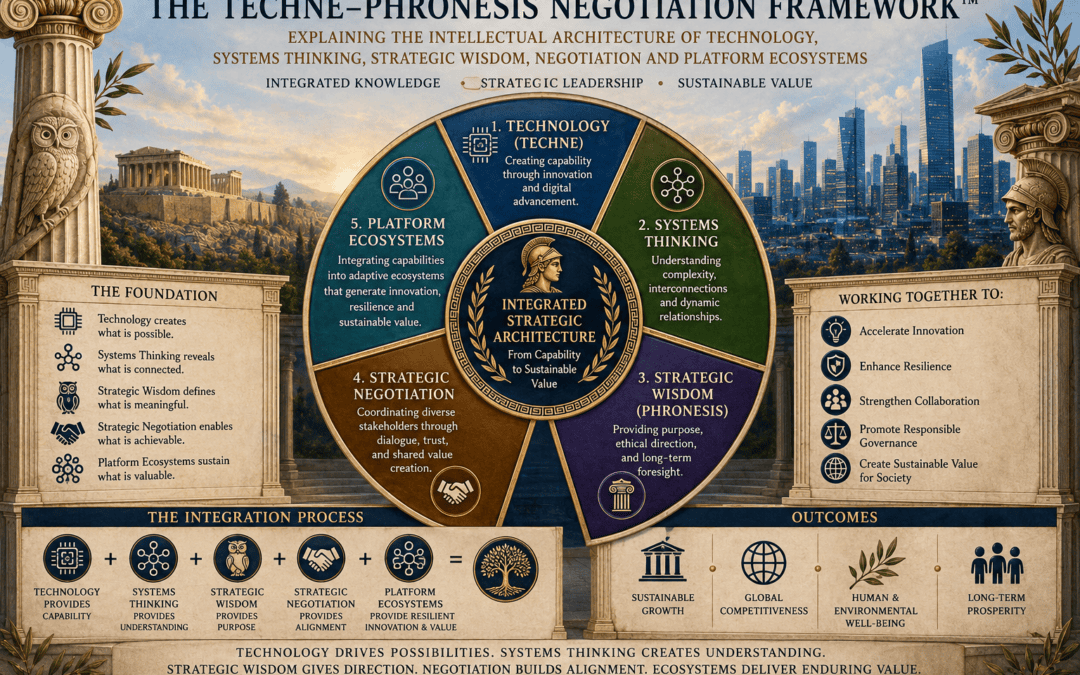
The Techne–Phronesis Negotiation Framework™ is an integrated intellectual architecture that explains how Technology, Systems Thinking, Strategic Wisdom, Strategic Negotiation, and Platform Ecosystems interact to govern technological civilization. Rather than functioning as independent concepts, these five dimensions form a unified strategic system that transforms technological capability into resilient innovation, collaborative leadership, and sustainable value creation.
Abstract
Technological civilization has introduced unprecedented complexity into economic development, innovation, leadership, and international cooperation. Artificial Intelligence, software, robotics, drones, digital platforms, cloud computing, advanced manufacturing, and globally interconnected innovation networks increasingly require strategic approaches that extend beyond traditional management theories. The Techne–Phronesis Negotiation Framework™ proposes an integrated intellectual architecture that combines Technology (Techne), Systems Thinking, Strategic Wisdom (Phronesis), Strategic Negotiation, and Platform Ecosystems into a coherent strategic perspective. This essay explains how these five complementary dimensions interact to guide technological leadership, ecosystem governance, resilient innovation, and sustainable value creation in the Human–Technology Revolution.
Introduction
Every mature strategic framework requires an underlying intellectual architecture.
Individual concepts may explain specific aspects of reality.
A coherent intellectual architecture explains how those concepts relate to one another.
The Techne–Phronesis Negotiation Framework™ was developed to provide such an integrated perspective.
Rather than treating technology, leadership, negotiation, and innovation as separate disciplines, the framework explains how they continuously interact within technological civilization.
Technology (Techne): Creating Capability
Technology represents the foundation of modern innovation.
Artificial Intelligence, software, robotics, cloud computing, advanced manufacturing, digital platforms, and autonomous systems continuously expand human capability.
Technology determines what becomes technically possible.
However, capability alone does not determine strategic success.
Technology requires direction, coordination, and responsible governance.
Systems Thinking: Understanding Complexity
Technological civilization functions through interconnected systems.
Organizations interact with governments.
Universities collaborate with industry.
Research institutions exchange knowledge with startups.
Investors finance innovation.
Citizens participate through digital platforms.
Systems Thinking enables leaders to understand these relationships rather than examining isolated events.
Understanding complexity becomes an essential strategic capability.
Strategic Wisdom (Phronesis): Providing Purpose
Technology expands capability.
Strategic Wisdom determines purpose.
Drawing upon the classical concept of Phronesis, the framework emphasizes practical judgment, ethical responsibility, long-term thinking, and societal benefit.
Strategic Wisdom aligns innovation with sustainable development and human flourishing.
It transforms technological possibility into meaningful progress.
Strategic Negotiation: Coordinating Human Capability
Technological ecosystems involve diverse stakeholders with different objectives.
Governments pursue public interests.
Companies seek competitiveness.
Universities generate knowledge.
Investors support innovation.
International organizations establish standards.
Strategic Negotiation aligns these diverse interests through dialogue, cooperation, trust, and shared value creation.
Negotiation therefore becomes the mechanism through which complex ecosystems achieve coordinated action.
Platform Ecosystems: Integrating Strategic Capability
Platform Ecosystems represent the environment in which the previous four dimensions interact.
Technology creates capability.
Systems Thinking explains relationships.
Strategic Wisdom establishes direction.
Strategic Negotiation creates alignment.
Platform Ecosystems integrate these complementary capabilities into adaptive networks that continuously generate innovation, resilience, learning, and sustainable value.
They transform individual excellence into collective strategic performance.
The Integrated Intellectual Architecture
The strength of the framework lies not in its individual components but in their integration.
Technology without Systems Thinking lacks understanding.
Systems Thinking without Strategic Wisdom lacks direction.
Strategic Wisdom without Negotiation lacks implementation.
Negotiation without Platform Ecosystems lacks scalable coordination.
Platform Ecosystems without Technology cannot innovate.
Together, these five dimensions function as one integrated strategic architecture for technological civilization.
Leadership in Technological Civilization
Leadership increasingly requires orchestrating ecosystems rather than managing isolated organizations.
Strategic leaders cultivate innovation, strengthen interdisciplinary collaboration, encourage responsible governance, and build resilient partnerships across sectors and nations.
Their objective extends beyond organizational performance to the long-term health of technological ecosystems.
Leadership therefore becomes ecosystem stewardship.
Sustainable Value Creation
The ultimate purpose of the intellectual architecture is sustainable value creation.
Economic competitiveness.
Technological progress.
Human development.
Environmental responsibility.
Institutional resilience.
These objectives become mutually reinforcing when guided by integrated strategic leadership.
Technology serves humanity most effectively when capability, understanding, wisdom, negotiation, and ecosystem collaboration operate together.
The Human–Technology Revolution requires strategic frameworks capable of explaining complexity rather than simplifying it.
The Techne–Phronesis Negotiation Framework™ provides such an intellectual architecture by integrating Technology, Systems Thinking, Strategic Wisdom, Strategic Negotiation, and Platform Ecosystems into one coherent strategic system.
Technology creates capability.
Systems Thinking creates understanding.
Strategic Wisdom creates purpose.
Strategic Negotiation creates alignment.
Platform Ecosystems create resilient innovation and sustainable value.
Together, these five dimensions provide an integrated framework for understanding, governing, and leading technological civilization in the twenty-first century.
Source: Open Sources Analysis, Relative Data Analysis by Nikos Chatzis
© Nikolaos Chatzis. The Techne–Phronesis Negotiation Framework™
Technology Creates Capability • Systems Thinking Creates Understanding • Strategic Wisdom Creates Lasting Value.
Negotiation.gr | Strategic Wisdom for the Technological Age