Negotiation.gr | Strategic Wisdom for the Technological Age
Central Thesis
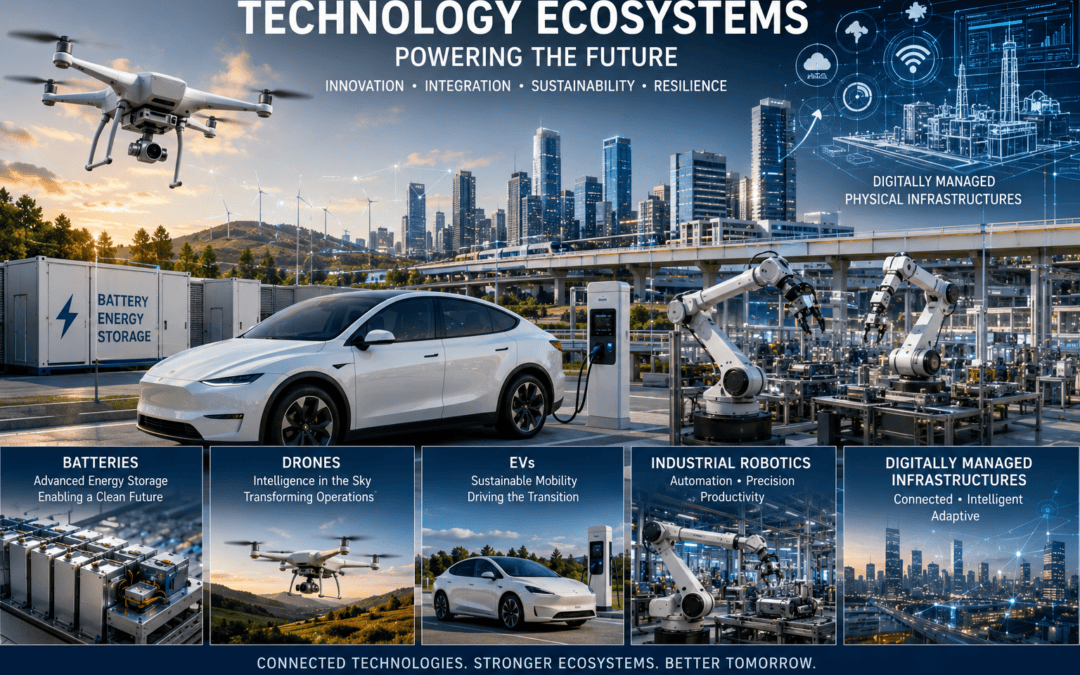
Technological breakthroughs rarely emerge in isolation. Batteries, drones, EVs, industrial robotics, and digitally managed physical infrastructures evolve through interconnected technology ecosystems that integrate research, industry, software, data, investment, regulation, and human expertise. The Techne–Phronesis Negotiation Framework™ explains how Technology, Systems Thinking, Strategic Wisdom, Strategic Negotiation, and Platform Ecosystems transform these coordinated capabilities into resilient innovation and sustainable value creation.
Abstract
Technological progress increasingly results from the interaction of interconnected innovation ecosystems rather than isolated discoveries. Batteries, drones, Electric Vehicles (EVs), industrial robotics, Artificial Intelligence, cloud computing, and digitally managed physical infrastructures are evolving simultaneously through collaboration among universities, research institutions, technology companies, governments, investors, and users. These technologies reinforce one another, accelerating innovation across multiple industries and creating new forms of economic and societal value. This essay argues that The Techne–Phronesis Negotiation Framework™ explains how Technology (Techne), Systems Thinking, Strategic Wisdom (Phronesis), Strategic Negotiation, and Platform Ecosystems provide the strategic foundations for understanding and governing these rapidly evolving technology ecosystems.
Introduction
The Human–Technology Revolution is transforming how innovation emerges.
Historically, technological breakthroughs were often associated with individual inventions or organizations.
Today, innovation increasingly develops through technology ecosystems where diverse participants contribute complementary expertise, infrastructure, investment, and knowledge.
Batteries improve electric mobility.
Artificial Intelligence enhances robotics.
Cloud platforms coordinate industrial operations.
Digital twins optimize infrastructure.
Sensors and connected devices enable real-time decision-making.
Each technological advance strengthens the broader ecosystem.
Technology Ecosystems as Engines of Innovation
Technology ecosystems bring together organizations that would be unable to achieve the same level of innovation independently.
Universities generate scientific discoveries.
Research laboratories develop new technologies.
Companies commercialize innovation.
Governments establish enabling policies and standards.
Investors finance growth.
Users provide continuous feedback that drives improvement.
Innovation therefore becomes a collective achievement rather than an isolated event.
Converging Technologies
Modern technological leadership increasingly depends upon convergence.
Advanced batteries improve EV performance and energy storage.
Artificial Intelligence enhances autonomous drones and industrial robots.
Cloud computing connects distributed operations.
Digital twins simulate physical systems.
The Internet of Things provides real-time operational awareness.
Together, these technologies create intelligent infrastructures capable of continuous adaptation, optimization, and resilience.
Digitally Managed Physical Infrastructure
Infrastructure itself is becoming intelligent.
Transportation systems.
Energy grids.
Manufacturing facilities.
Ports.
Airports.
Logistics networks.
Urban environments.
Increasingly, these assets are monitored, coordinated, and optimized through digital platforms integrating sensors, software, AI, and predictive analytics.
Physical infrastructure is evolving into cyber-physical infrastructure, creating new opportunities for efficiency, resilience, and sustainability.
Systems Thinking Explains Technological Evolution
Understanding these developments requires Systems Thinking.
Technologies do not evolve independently.
Progress in one domain often accelerates innovation in another.
Battery technology influences EV adoption.
Artificial Intelligence improves robotics.
Digital connectivity strengthens logistics.
Cloud computing enables global collaboration.
Systems Thinking reveals these relationships, enabling leaders to govern technological complexity rather than reacting to isolated developments.
The Techne–Phronesis Negotiation Framework™
The framework explains how technology ecosystems generate long-term strategic value.
Technology (Techne) creates technical capability.
Systems Thinking reveals interdependence across technologies, industries, and institutions.
Strategic Wisdom (Phronesis) aligns innovation with long-term human, economic, and environmental objectives.
Strategic Negotiation coordinates collaboration among governments, industries, universities, investors, regulators, and international partners.
Platform Ecosystems integrate these capabilities into adaptive innovation environments that continuously generate resilience, learning, and sustainable value.
Together, these five dimensions explain the strategic dynamics of modern technology ecosystems.
Leadership in Technology Ecosystems
Leadership increasingly requires orchestrating collaboration rather than managing isolated organizations.
Strategic leaders cultivate interdisciplinary partnerships, encourage knowledge exchange, strengthen innovation capabilities, and support responsible technological governance.
Their success depends upon the resilience and adaptability of the ecosystems they help create.
Leadership therefore evolves from organizational management toward ecosystem stewardship.
Sustainable Value Creation
Technology ecosystems generate value beyond commercial success.
They improve productivity.
Enhance environmental sustainability.
Increase infrastructure resilience.
Expand scientific knowledge.
Strengthen economic competitiveness.
Improve quality of life.
Long-term prosperity therefore emerges from continuous collaboration, responsible innovation, and adaptive ecosystem governance.
The evolution of batteries, drones, EVs, industrial robotics, and digitally managed physical infrastructure demonstrates that technological leadership increasingly depends upon ecosystems rather than isolated organizations.
The Techne–Phronesis Negotiation Framework™ explains this transformation by integrating Technology, Systems Thinking, Strategic Wisdom, Strategic Negotiation, and Platform Ecosystems into a coherent strategic perspective.
Technology creates capability.
Systems Thinking creates understanding.
Strategic Wisdom creates direction.
Strategic Negotiation creates alignment.
Platform Ecosystems transform coordinated capabilities into resilient innovation and sustainable value.
Together, these principles provide a comprehensive framework for understanding how technology ecosystems are shaping the industries, economies, and societies of the future.
Source: Open Sources Analysis, Relative Data Analysis by Nikos Chatzis
© Nikolaos Chatzis. The Techne–Phronesis Negotiation Framework™
Technology Creates Capability • Systems Thinking Creates Understanding • Strategic Wisdom Creates Lasting Value.
Negotiation.gr | Strategic Wisdom for the Technological Age