Negotiation.gr | Strategic Wisdom for the Technological Age
Central Thesis
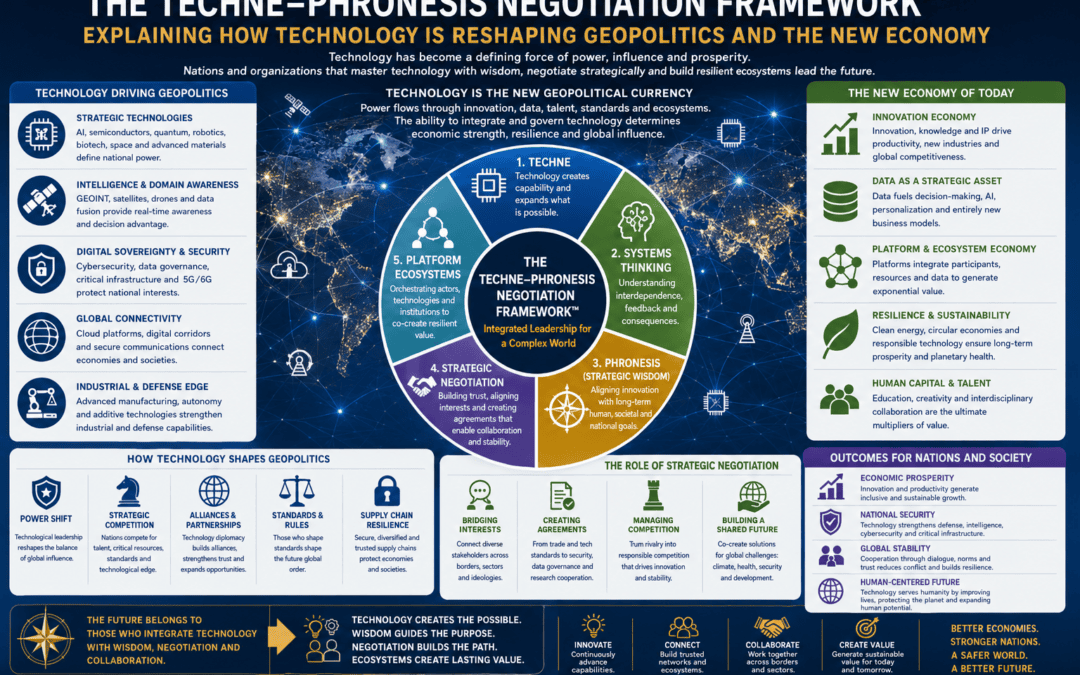
Technology has become one of the defining forces shaping geopolitical influence and economic competitiveness. Nations increasingly compete not only through territory, population, or industrial capacity, but through their ability to develop, govern, and integrate advanced technologies into resilient platform ecosystems. The Techne–Phronesis Negotiation Framework™ explains how Technology, Systems Thinking, Strategic Wisdom, Strategic Negotiation, and Platform Ecosystems together shape leadership in the emerging geopolitical and economic landscape.
Abstract
Technological innovation has become one of the principal forces shaping international relations, economic competitiveness, and strategic leadership. Artificial Intelligence, semiconductors, drones, robotics, cloud computing, Geospatial Intelligence (GEOINT), advanced communications, and digital platforms increasingly influence how nations create prosperity, protect national interests, and exercise global influence. Economic power is progressively determined by the capacity to innovate, coordinate ecosystems, govern critical technologies, and transform knowledge into sustainable value. This essay argues that The Techne–Phronesis Negotiation Framework™ provides an integrated perspective for understanding this transformation by combining Technology (Techne), Systems Thinking, Strategic Wisdom (Phronesis), Strategic Negotiation, and Platform Ecosystems into a unified model for technological leadership in the twenty-first century.
Introduction
Throughout history, geopolitical influence has evolved alongside technological progress.
Maritime power shaped global trade.
Industrialization transformed military and economic capabilities.
The Information Age accelerated globalization through digital communications.
Today, technological civilization is redefining geopolitical influence once again.
Nations increasingly compete through innovation ecosystems, digital infrastructures, Artificial Intelligence, semiconductor capabilities, advanced manufacturing, autonomous systems, and data-driven platforms.
Technology has become a strategic dimension of both national security and economic development.
Technology as a Strategic Source of National Power
Modern geopolitical influence extends beyond traditional measures of military strength and economic size.
Technological capability increasingly determines national resilience, industrial competitiveness, innovation capacity, and strategic autonomy.
Countries investing in advanced technologies strengthen their ability to create new industries, attract talent, develop resilient supply chains, and respond to emerging global challenges.
Technology therefore becomes an essential component of national power.
The New Economy
The global economy is increasingly organized around data, knowledge, digital platforms, and interconnected ecosystems.
Economic leadership depends upon:
- innovation,
- continuous learning,
- technological capability,
- ecosystem collaboration,
- resilient supply chains,
- responsible governance.
Value is increasingly generated through the intelligent integration of these capabilities rather than through isolated production alone.
The economy itself is becoming increasingly ecosystem-driven.
Systems Thinking Explains Geopolitical Complexity
Technological competition does not occur in isolation.
Technology influences diplomacy.
Supply chains affect national resilience.
Research collaboration accelerates innovation.
Economic policy shapes industrial capability.
International partnerships strengthen ecosystem development.
Systems Thinking enables leaders to understand these relationships and anticipate the broader consequences of strategic decisions.
It transforms complexity into strategic understanding.
The Techne–Phronesis Negotiation Framework™
The framework explains technological leadership through five complementary dimensions.
Technology (Techne) expands capability.
Systems Thinking reveals interdependence.
Strategic Wisdom (Phronesis) aligns innovation with long-term national and societal objectives.
Strategic Negotiation coordinates governments, industries, universities, investors, and international partners.
Platform Ecosystems integrate these capabilities into adaptive environments that continuously generate innovation, resilience, and sustainable value.
Together, these dimensions provide an integrated approach to technological strategy.
Technology Diplomacy and Collaborative Leadership
Technological leadership increasingly depends upon cooperation as well as competition.
International standards.
Research partnerships.
Cross-border investment.
Technology alliances.
Public–private collaboration.
Academic cooperation.
Strategic Negotiation enables nations and institutions to coordinate these relationships while protecting long-term strategic interests.
Leadership therefore increasingly emphasizes ecosystem governance rather than isolated national action.
The Future of Geopolitics and the New Economy
The future will increasingly belong to societies capable of integrating technology with human judgment.
Competitive advantage will emerge through:
- resilient innovation ecosystems,
- responsible technological governance,
- interdisciplinary collaboration,
- adaptive leadership,
- continuous learning,
- sustainable value creation.
Technological leadership will increasingly define geopolitical influence and economic prosperity.
The Human–Technology Revolution is transforming the foundations of geopolitics and the global economy.
Technology no longer functions merely as an instrument supporting national development.
It increasingly shapes economic resilience, international influence, strategic autonomy, and long-term competitiveness.
The Techne–Phronesis Negotiation Framework™ explains this transformation by integrating Technology, Systems Thinking, Strategic Wisdom, Strategic Negotiation, and Platform Ecosystems into a coherent perspective for understanding technological civilization.
Technology creates capability.
Systems Thinking creates understanding.
Strategic Wisdom creates direction.
Strategic Negotiation creates alignment.
Platform Ecosystems create resilient innovation and sustainable value.
Together, these principles provide a strategic framework for understanding how technology is reshaping geopolitics and the new economy of the twenty-first century.
Source: Open Sources Analysis, Relative Data Analysis by Nikos Chatzis
© Nikolaos Chatzis. The Techne–Phronesis Negotiation Framework™
Technology Creates Capability • Systems Thinking Creates Understanding • Strategic Wisdom Creates Lasting Value.
Negotiation.gr | Strategic Wisdom for the Technological Age