Negotiation.gr | Strategic Wisdom for the Technological Age
Abstract
The rapid convergence of Artificial Intelligence, drones, robotics, autonomous systems, Geospatial Intelligence (GEOINT), advanced manufacturing, and digital infrastructure is transforming the foundations of economic development, national security, and technological competitiveness. Yet technological capability alone cannot explain why some nations and organizations consistently outperform others. Their advantage increasingly arises from coordinated leadership capable of integrating technology, knowledge, institutions, industry, and society into resilient ecosystems. This essay applies The Techne–Phronesis Negotiation Framework™ to demonstrate that coordinated leadership represents the critical link connecting technological capability, Systems Thinking, Strategic Wisdom, and collaborative negotiation. Sustainable competitive advantage emerges not from isolated innovation but from the continuous orchestration of interconnected technology ecosystems.
Introduction
Technological civilization is reshaping the way societies innovate, compete, and cooperate.
Artificial Intelligence accelerates decision-making.
Drone ecosystems expand operational capability.
Robotics transform production.
Geospatial Intelligence improves situational awareness.
Cloud computing enables global collaboration.
Despite these advances, technology itself remains only one component of a much larger system.
The true challenge of the twenty-first century is coordinating these capabilities across governments, research institutions, universities, industries, investors, and citizens to create resilient ecosystems capable of continuous innovation.
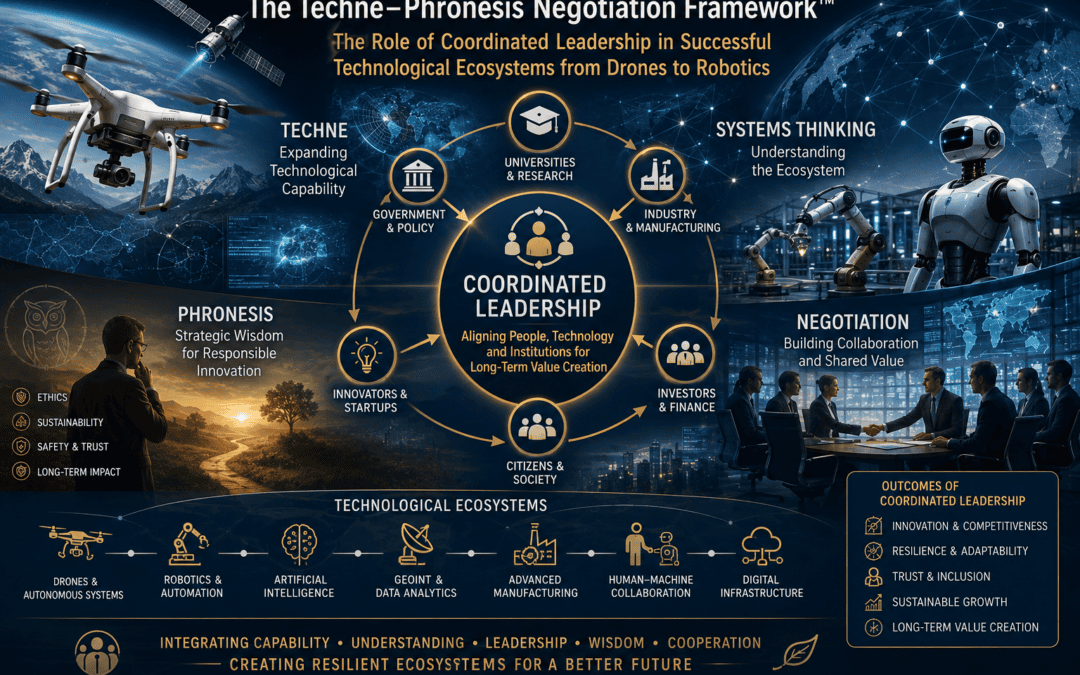
The Techne–Phronesis Negotiation Framework™ provides an integrated model for understanding this transformation.
Techne: Expanding Technological Capability
The Greek concept of techne represents humanity’s capacity to transform knowledge into practical capability.
Today’s technological breakthroughs—including Artificial Intelligence, drones, robotics, advanced sensors, autonomous systems, and digital infrastructure—dramatically expand what organizations and societies can accomplish.
However, technological capability alone rarely creates lasting competitive advantage.
Innovation reaches its full potential only when it becomes part of an interconnected ecosystem.
Systems Thinking: Understanding the Ecosystem
Technology ecosystems consist of far more than machines.
They include researchers, engineers, universities, startups, established industries, governments, regulators, investors, educators, and citizens.
Systems Thinking reveals how these participants interact through feedback loops, knowledge exchange, collaboration, adaptation, and shared objectives.
Rather than optimizing individual organizations, Systems Thinking focuses on optimizing the relationships among them.
This systemic perspective enables leaders to recognize opportunities that remain invisible when technologies are viewed in isolation.
Coordinated Leadership: The Strategic Integrator
The Human–Technology Revolution requires a new understanding of leadership.
Traditional leadership often emphasizes authority within individual organizations.
Coordinated leadership emphasizes integration across entire ecosystems.
Its primary responsibility is not controlling technology but aligning diverse capabilities toward shared strategic objectives.
Coordinated leaders connect universities with industry, research with commercialization, public institutions with private investment, and technological innovation with societal needs.
They become architects of ecosystems rather than managers of isolated organizations.
Negotiation: Building Collaborative Ecosystems
Every successful technology ecosystem depends upon continuous negotiation.
Governments negotiate regulatory frameworks.
Industries negotiate partnerships.
Universities negotiate research collaboration.
Investors negotiate long-term commitments.
International partners negotiate standards and interoperability.
Negotiation therefore functions as the operational mechanism through which coordinated leadership transforms diversity into cooperation.
Rather than resolving conflicts alone, negotiation becomes a process of creating shared value.
From Drones to Robotics: An Ecosystem Perspective
Drone ecosystems illustrate the importance of coordinated leadership.
Engineers design autonomous platforms.
Manufacturers build reliable systems.
Software developers create intelligent applications.
Geospatial specialists provide operational awareness.
Governments establish regulatory environments.
Universities educate future innovators.
Industry develops commercial markets.
The same ecosystem logic increasingly applies to robotics, Artificial Intelligence, advanced manufacturing, healthcare technologies, and smart infrastructure.
Success depends not upon any single participant but upon the quality of coordination among them.
Strategic Wisdom: Directing Technological Civilization
Ancient Greek philosophy reminds us that practical wisdom—phronesis—guides action toward the common good.
Within technological ecosystems, Strategic Wisdom determines:
- long-term priorities,
- ethical governance,
- responsible innovation,
- sustainable development,
- international cooperation.
Technology creates capability.
Systems Thinking creates understanding.
Coordinated leadership transforms understanding into collective action.
Strategic Wisdom ensures that this action generates enduring value.
Building Resilient Technology Ecosystems
The most resilient technology ecosystems share several characteristics:
- collaborative leadership,
- interdisciplinary cooperation,
- continuous learning,
- trusted institutions,
- adaptive governance,
- investment in human capital,
- openness to innovation,
- strategic foresight.
These characteristics enable ecosystems to respond effectively to technological disruption while maintaining long-term competitiveness.
The future of technological civilization will depend less on the speed of technological invention than on the quality of leadership coordinating increasingly complex ecosystems.
The Techne–Phronesis Negotiation Framework™ demonstrates that sustainable strategic advantage emerges when technological capability, Systems Thinking, coordinated leadership, Strategic Wisdom, and negotiation function as an integrated whole.
Technology creates capability.
Systems Thinking creates understanding.
Coordinated Leadership creates alignment.
Strategic Wisdom creates direction.
Negotiation creates cooperation.
Together, these principles transform innovation into resilient ecosystems capable of generating lasting economic, societal, and geopolitical value.
In the Human–Technology Revolution, the most successful leaders will not simply manage organizations. They will coordinate ecosystems, cultivate trust, and guide technological progress toward the long-term flourishing of humanity.
Source: Open Sources Analysis, Relative Data Analysis by Nikos Chatzis
© Nikolaos Chatzis. The Techne–Phronesis Negotiation Framework™
Technology Creates Capability • Systems Thinking Creates Understanding • Strategic Wisdom Creates Lasting Value.
Negotiation.gr | Strategic Wisdom for the Technological Age