Negotiation.gr | Strategic Wisdom for the Technological Age
Abstract
The global drone industry has become one of the clearest demonstrations of how interconnected technology ecosystems create sustainable competitive advantage. China’s emergence as the dominant force in commercial drone manufacturing is not the consequence of a single technological breakthrough but the result of an integrated ecosystem combining advanced manufacturing, engineering talent, research institutions, vertically integrated supply chains, industrial clusters, continuous innovation, and long-term strategic planning. DJI represents the most successful expression of this ecosystem. This essay applies The Techne–Phronesis Negotiation Framework™ to explain how China’s revolutionary supply chains transform technological capability into global industrial leadership. It argues that future competitiveness will increasingly depend not upon isolated technological inventions but upon the ability to build resilient ecosystems that continuously generate innovation, adaptability, and long-term value.
Introduction
Technological leadership in the twenty-first century is increasingly determined by the strength of ecosystems rather than by individual products.
Artificial Intelligence, robotics, autonomous systems, advanced manufacturing, cloud computing, and drone technologies evolve through interconnected networks of suppliers, universities, research laboratories, industrial clusters, investors, governments, and global markets.
China’s commercial drone industry provides one of the most compelling examples of this transformation.
DJI has emerged as the world’s leading commercial drone manufacturer not simply because it produces outstanding aircraft, but because it operates within one of the world’s most integrated technology and manufacturing ecosystems. China’s concentration of suppliers, engineering expertise, advanced production capabilities, and continuous innovation has enabled rapid product development, cost efficiency, and large-scale manufacturing that competitors have found difficult to match.
Techne: Manufacturing Capability at Scale
The first pillar of The Techne–Phronesis Negotiation Framework™ is techne.
In the modern technological economy, techne represents the capacity to transform knowledge into industrial capability.
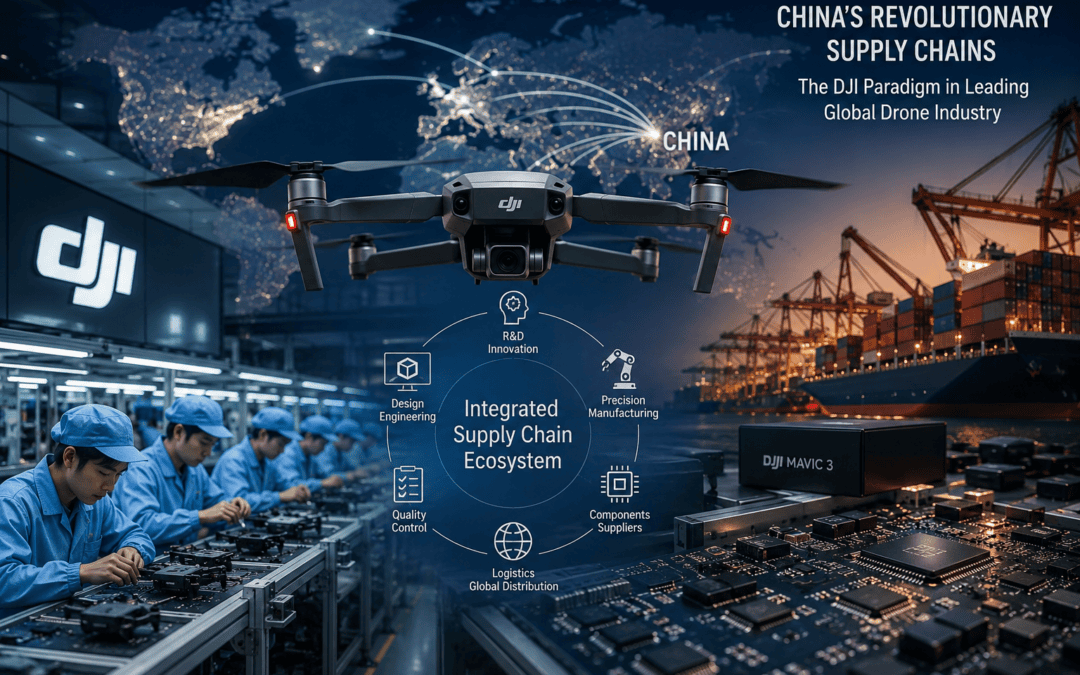
China’s drone sector illustrates this principle through highly integrated manufacturing networks that connect component suppliers, electronics producers, software developers, battery manufacturers, optics companies, precision machining, and logistics providers into a unified production ecosystem.
Rather than relying upon fragmented international supply chains, DJI has historically benefited from a dense manufacturing environment that supports rapid prototyping, design iteration, and scalable production. This integration has contributed significantly to its global competitiveness.
Systems Thinking: Understanding the Ecosystem
Technological leadership does not emerge from manufacturing alone.
It depends upon understanding the relationships among innovation, education, finance, regulation, production, and global markets.
Systems Thinking explains why China’s drone ecosystem has achieved remarkable resilience.
Universities educate engineers.
Research institutions generate innovation.
Suppliers collaborate closely with manufacturers.
Industrial clusters accelerate product development.
Digital platforms connect customers worldwide.
Each participant strengthens the performance of the entire ecosystem.
Competitive advantage therefore emerges from systemic integration rather than isolated technological excellence.
DJI as an Ecosystem Paradigm
DJI demonstrates how ecosystem thinking can become a strategic asset.
Its competitive position has been reinforced by integrating hardware, software, flight control systems, imaging technologies, manufacturing, and user experience into a coherent platform. Analysts frequently point to this high degree of vertical integration and ecosystem coordination as a major source of the company’s sustained leadership.
Phronesis: Strategic Wisdom in Industrial Development
Technology alone cannot explain long-term industrial success.
Strategic Wisdom determines how technological capability should be coordinated, continuously improved, and aligned with long-term objectives.
Within The Techne–Phronesis Negotiation Framework™, phronesis represents the ability to balance innovation, resilience, competitiveness, and adaptation.
For organizations and governments alike, wisdom requires anticipating future technological transitions rather than merely responding to current market conditions.
Negotiation Across Technology Ecosystems
Modern supply chains depend upon continuous negotiation.
Manufacturers coordinate suppliers.
Universities cooperate with industry.
Governments establish regulatory environments.i
Investors finance innovation.
International markets create demand.
Negotiation therefore becomes the mechanism through which technology ecosystems remain adaptive, collaborative, and resilient.
Lessons for the Global Drone Industry
China’s experience demonstrates several broader lessons.
First, sustainable technological leadership depends upon ecosystem integration rather than individual inventions.
Second, resilient supply chains create strategic flexibility during periods of geopolitical uncertainty.
Third, investment in engineering talent, manufacturing capability, and innovation networks generates cumulative competitive advantages that become increasingly difficult to replicate.
Finally, future competitiveness will depend upon connecting technology, knowledge, institutions, and human capital into adaptive ecosystems capable of continuous learning.
China’s leadership in the commercial drone industry illustrates the growing importance of technology ecosystems in shaping global competitiveness. DJI represents not merely a successful manufacturer but a paradigm demonstrating how integrated supply chains, engineering excellence, innovation ecosystems, and strategic coordination can generate enduring industrial leadership.
The Techne–Phronesis Negotiation Framework™ explains this transformation through four interconnected principles.
Technology creates capability.
Systems Thinking creates understanding.
Strategic Wisdom creates long-term direction.
Negotiation transforms interconnected capabilities into resilient ecosystems capable of creating sustainable economic, industrial, and strategic value.
The future of technological civilization will belong not only to those who invent breakthrough technologies, but to those who build ecosystems capable of continuously transforming innovation into lasting competitive advantage.
Source: Open Sources Analysis, Relative Data Analysis by Nikos Chatzis
© Nikolaos Chatzis. The Techne–Phronesis Negotiation Framework™
Technology Creates Capability • Systems Thinking Creates Understanding • Strategic Wisdom Creates Lasting Value.
Negotiation.gr | Strategic Wisdom for the Technological Age