Negotiation.gr | Strategic Wisdom for the Technological Age
Abstract
The accelerating convergence of drones, Artificial Intelligence, Geospatial Intelligence (GEOINT), robotics, cloud computing, and digital infrastructure is redefining how nations, organizations, and industries operate. Technological superiority alone, however, no longer guarantees strategic advantage. The ability to integrate technological capability, geospatial awareness, Systems Thinking, and practical wisdom has become the defining characteristic of effective leadership in technological civilization. This essay applies The Techne–Phronesis Negotiation Framework™ to demonstrate how drones, GEOINT, and Systems Thinking interact to create resilient technology ecosystems that enable strategic leadership, collaborative innovation, and sustainable value creation.
Introduction
Humanity is entering an era in which technological capability expands faster than traditional models of governance and leadership.
Drones operate autonomously.
Artificial Intelligence analyzes massive datasets.
Satellites continuously observe the Earth’s surface.
Digital networks connect governments, industries, universities, and societies in real time.
These developments represent far more than technological progress.
They represent the emergence of interconnected technology ecosystems requiring new methods of leadership.
The Techne–Phronesis Negotiation Framework™ provides a multidisciplinary approach for governing these ecosystems by integrating technological capability, systemic understanding, strategic wisdom, and collaborative negotiation.
Drones: Expanding Human Capability
Drones represent one of the most visible expressions of modern techne.
They extend human reach into environments that are dangerous, remote, or inaccessible.
Their applications include:
- disaster response,
- environmental monitoring,
- precision agriculture,
- infrastructure inspection,
- logistics,
- public safety,
- defense and security.
Supported by Artificial Intelligence and advanced communications, drones transform data into operational capability.
Yet capability alone remains insufficient.
Technology must operate within broader systems that generate understanding and responsible action.
GEOINT: Creating Situational Awareness
Geospatial Intelligence provides the spatial dimension of decision-making.
By integrating satellite imagery, remote sensing, mapping technologies, geographic information systems, and Artificial Intelligence, GEOINT transforms raw geographic information into actionable knowledge.
Within modern technology ecosystems, GEOINT enables leaders to:
- understand operational environments,
- identify emerging risks,
- optimize resource allocation,
- strengthen resilience,
- improve strategic planning.
Geography therefore becomes dynamic intelligence rather than static location.
Systems Thinking: Connecting the Ecosystem
Drones generate data.
GEOINT provides context.
Artificial Intelligence accelerates analysis.
Cloud computing enables collaboration.
Institutions establish governance.
People make decisions.
Systems Thinking connects these components into a coherent ecosystem.
Rather than examining technologies independently, Systems Thinking explains how their interactions generate capabilities that no individual technology can achieve alone.
It emphasizes:
- interdependence,
- feedback loops,
- resilience,
- adaptation,
- collaboration,
- continuous learning.
In technological civilization, competitive advantage increasingly emerges from ecosystem integration rather than isolated innovation.
Thought Evolution Diagram:
TECHNE
Technology
Capability
│
▼
GEOINT
Situational Awareness
│
▼
SYSTEMS THINKING
Understanding Complexity
│
▼
PHRONESIS
Strategic Wisdom
│
▼
NEGOTIATION
Collaborative Integration
│
▼
STRATEGIC LEADERSHIP => Proper Decision-Making
│
▼
LASTING VALUE => Long-Term Cooperation
The Techne–Phronesis Negotiation Framework™ in Practice
The Techne–Phronesis Negotiation Framework™ proposes that technological leadership develops through four interconnected dimensions.
Techne represents technological capability.
Drones, Artificial Intelligence, robotics, cloud computing, and GEOINT continuously expand humanity’s operational possibilities.
Systems Thinking transforms individual technologies into coherent ecosystems.
It enables leaders to understand how technologies, institutions, people, and policies influence one another.
Phronesis provides practical wisdom.
It aligns innovation with ethics, long-term vision, societal resilience, and responsible governance.
Negotiation becomes the mechanism through which governments, industry, universities, researchers, investors, and civil society coordinate their different interests into collaborative technology ecosystems capable of creating sustainable value.
Together, these dimensions transform technological progress into strategic capability.
Strategic Leadership in Technological Civilization
The Industrial Revolution rewarded leaders who optimized production.
The Information Age rewarded leaders who managed knowledge.
The Human–Technology Revolution requires leaders capable of orchestrating interconnected technology ecosystems.
Strategic Leadership increasingly depends upon the ability to integrate:
- technological literacy,
- Systems Thinking,
- geospatial awareness,
- interdisciplinary collaboration,
- ethical judgment,
- negotiation,
- adaptive governance.
Leadership is no longer defined by controlling organizations.
It is defined by connecting capabilities across entire ecosystems.
From Technology to Strategic Advantage
Technology alone rarely produces lasting competitive advantage.
Organizations that simply acquire advanced technologies often discover that innovation remains fragmented.
Strategic advantage emerges when technology is integrated into resilient ecosystems supported by:
- skilled people,
- trusted institutions,
- effective governance,
- continuous learning,
- collaborative partnerships,
- adaptive leadership.
The Techne–Phronesis Negotiation Framework™ explains how these elements interact to transform technical capability into long-term strategic value.
Drones, GEOINT, and Human Decision-Making
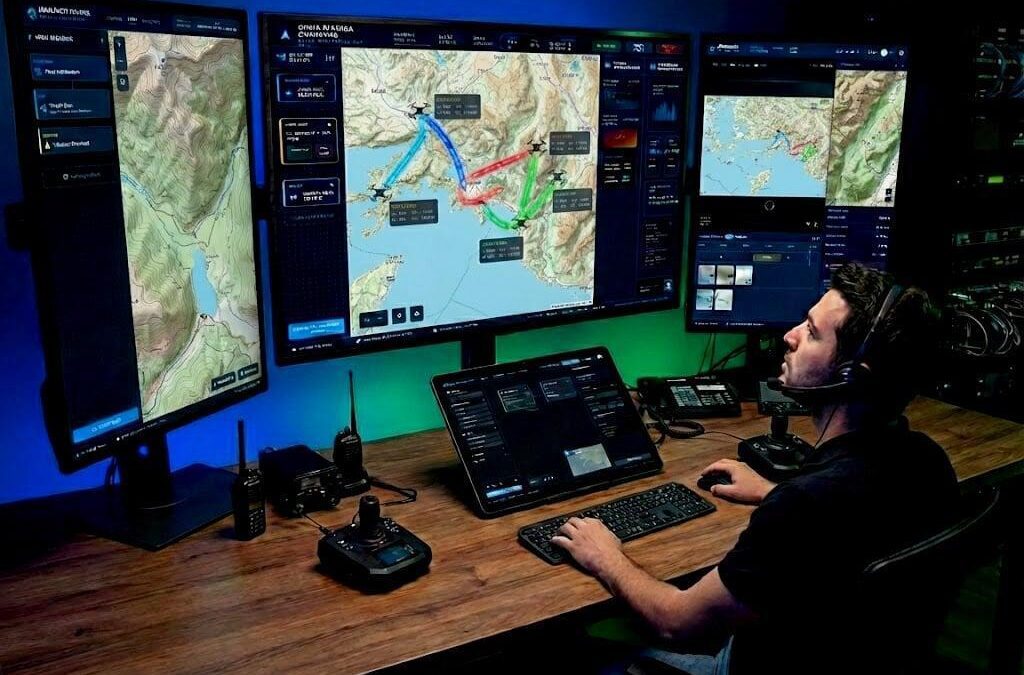
Modern drone ecosystems illustrate this transformation.
Drones collect information.
GEOINT interprets the operational environment.
Artificial Intelligence accelerates analysis.
Systems Thinking connects information across the ecosystem.
Human leaders evaluate strategic priorities.
Negotiation aligns stakeholders.
Phronesis determines responsible action.
This sequence demonstrates that technology supports leadership—it does not replace it.
The ultimate responsibility for judgment remains human.
Building Resilient Technology Ecosystems
Future competitiveness will increasingly depend upon resilient ecosystems rather than isolated technological achievements.
Successful ecosystems require:
- technological capability,
- trusted partnerships,
- knowledge exchange,
- educational excellence,
- international cooperation,
- responsible innovation,
- strategic leadership.
Governments, universities, research institutions, startups, established industries, and citizens each contribute unique capabilities.
Negotiation transforms these diverse contributions into collaborative value creation.
Looking Toward the Future
The future of technological civilization will increasingly integrate:
- Artificial Intelligence,
- autonomous drones,
- robotics,
- Geospatial Intelligence,
- quantum technologies,
- advanced communications,
- digital twins,
- cloud computing.
The societies that prosper will not necessarily be those possessing the largest number of technologies.
They will be those capable of governing technological complexity through Systems Thinking, Strategic Wisdom, and collaborative negotiation.
The greatest strategic advantage will therefore arise from leadership rather than technology alone.
The Human–Technology Revolution is transforming how societies innovate, compete, cooperate, and govern. Drones, GEOINT, Artificial Intelligence, and Systems Thinking are no longer isolated disciplines but interconnected components of increasingly complex technology ecosystems.
The Techne–Phronesis Negotiation Framework™ provides a comprehensive model for understanding this transformation. It demonstrates that technology creates capability, Systems Thinking creates understanding, Strategic Wisdom provides direction, and negotiation converts shared understanding into collaborative action and sustainable value.
Strategic Leadership in the twenty-first century is therefore defined not by the possession of advanced technologies alone, but by the wisdom to integrate them responsibly, the vision to connect them across resilient ecosystems, and the ability to negotiate partnerships that transform innovation into enduring human progress.
The future belongs to leaders who recognize that technological excellence is only the beginning. Lasting success depends upon the intelligent integration of capability, understanding, wisdom, and cooperation in service of humanity.
Source: Open Sources Analysis, Relative Data Analysis by Nikos Chatzis
© Nikolaos Chatzis. The Techne–Phronesis Negotiation Framework™
Technology Creates Capability • Systems Thinking Creates Understanding • Strategic Wisdom Creates Lasting Value.
Negotiation.gr | Strategic Wisdom for the Technological Age