Negotiation.gr | Strategic Wisdom for the Technological Age
Abstract
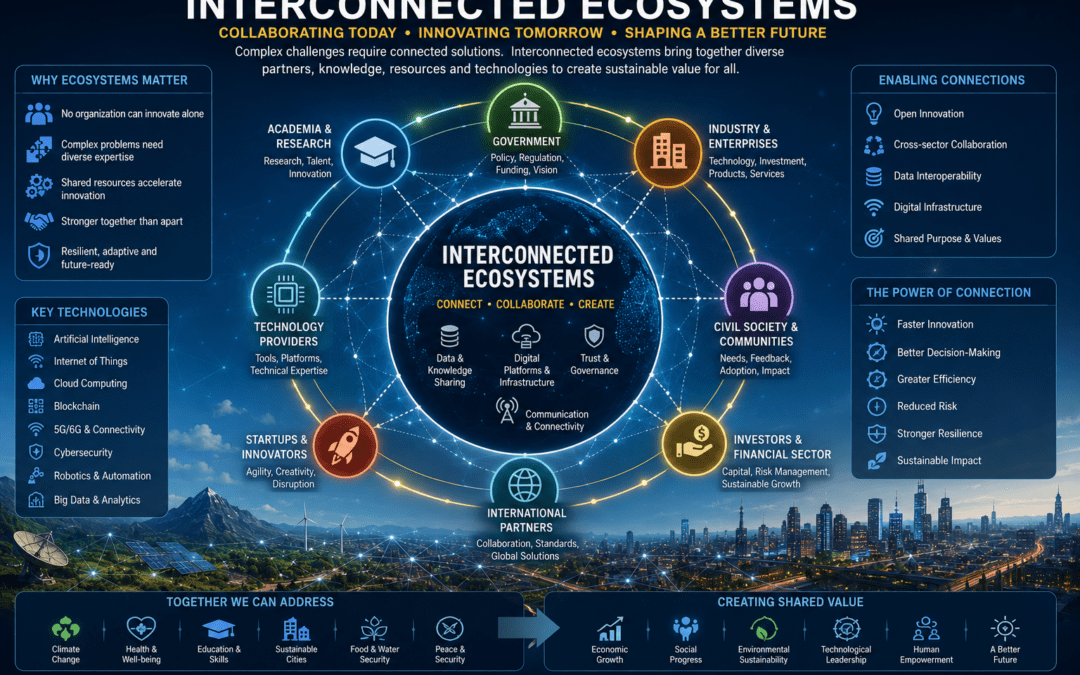
The remarkable technological achievements of the twenty-first century are transforming economies, industries, governments, and international relations at an unprecedented pace. Artificial Intelligence, autonomous systems, biotechnology, geospatial intelligence, quantum computing, advanced communications, and digital infrastructure are reshaping the foundations of modern society. Contrary to the traditional perception that breakthrough innovations emerge from isolated inventors or individual organizations, today’s technological revolutions increasingly originate within interconnected innovation ecosystems that unite governments, universities, research institutions, private companies, investors, regulatory authorities, and international partners.
This essay argues that interconnected ecosystems have become the principal engine of technological progress. Their ability to facilitate collaboration, knowledge exchange, strategic partnerships, and multidisciplinary innovation enables societies to solve increasingly complex challenges while creating sustainable economic, societal, and geopolitical value.
Introduction
Throughout history, technological revolutions have transformed civilizations.
The Industrial Revolution mechanized production.
The Information Revolution digitized communication.
Today, the world is entering the era of interconnected technological ecosystems.
Artificial Intelligence, robotics, geospatial intelligence, autonomous systems, cloud computing, biotechnology, quantum technologies, and digital infrastructure are evolving simultaneously.
These technologies no longer develop independently.
Instead, they interact continuously within collaborative ecosystems where knowledge, expertise, capital, research, regulation, and innovation converge.
The future of technology therefore depends not only upon invention but also upon connection.
From Individual Innovation to Collaborative Innovation
Historically, innovation was often associated with exceptional individuals or individual companies.
Modern technological development follows a different model.
Breakthrough innovations increasingly emerge from networks that combine multiple areas of expertise.
Universities contribute scientific research.
Technology companies commercialize discoveries.
Governments establish supportive policies.
Investors provide financial resources.
Research institutions generate new knowledge.
Startups accelerate experimentation.
International partnerships facilitate global collaboration.
Innovation has become an ecosystem activity.
Technology Ecosystems as Innovation Platforms
Technology ecosystems represent interconnected environments where organizations collaborate to generate continuous innovation.
Successful ecosystems integrate:
- research and development,
- entrepreneurship,
- education,
- investment,
- digital infrastructure,
- regulatory governance,
- international cooperation.
Rather than competing independently, participants contribute complementary capabilities that strengthen the ecosystem as a whole.
The value generated collectively often exceeds the contributions of individual participants.
Artificial Intelligence as an Ecosystem Technology
Artificial Intelligence illustrates the importance of interconnected ecosystems.
Successful AI development requires:
- advanced algorithms,
- large datasets,
- cloud computing,
- semiconductor technologies,
- skilled researchers,
- cybersecurity,
- ethical governance,
- regulatory frameworks.
No single organization possesses all these capabilities.
Artificial Intelligence therefore advances through collaboration among universities, technology companies, governments, cloud providers, and research laboratories.
Its success depends upon ecosystem integration rather than isolated innovation.
The Drone Industry: A Practical Example
The global drone industry demonstrates how interconnected ecosystems accelerate technological progress.
Modern drone ecosystems combine:
- Artificial Intelligence,
- geospatial intelligence,
- satellite navigation,
- cloud computing,
- telecommunications,
- cybersecurity,
- advanced manufacturing,
- aviation regulation,
- digital mapping,
- autonomous navigation.
Each component contributes to the overall capability of the system.
The economic value increasingly originates not from the aircraft itself but from the ecosystem supporting it.
Training, data analytics, software platforms, maintenance, regulation, and international partnerships have become essential elements of the modern drone economy.
Knowledge Sharing and Collective Intelligence
Innovation ecosystems transform individual knowledge into collective intelligence.
Researchers exchange scientific discoveries.
Engineers solve practical challenges.
Entrepreneurs identify market opportunities.
Governments establish regulatory certainty.
Investors accelerate commercialization.
The continuous circulation of knowledge reduces duplication, accelerates learning, and increases innovation speed.
Knowledge sharing therefore becomes a strategic competitive advantage.
Technology Diplomacy and International Cooperation
The complexity of emerging technologies increasingly requires international collaboration.
Technology diplomacy promotes cooperation through:
- scientific partnerships,
- research exchanges,
- international standards,
- technology transfer,
- regulatory dialogue,
- collaborative innovation initiatives.
Interconnected ecosystems extend beyond national borders.
Global technological progress increasingly depends upon international trust and cooperation.
Ecosystem Governance
Successful ecosystems do not emerge spontaneously.
They require governance.
Effective governance establishes:
- shared vision,
- stakeholder alignment,
- transparent communication,
- responsible innovation,
- ethical principles,
- risk management,
- long-term strategic direction.
Governance transforms collaboration into sustained innovation.
Without governance, ecosystems become fragmented.
Strategic Negotiation as the Connecting Mechanism
Complex ecosystems inevitably involve diverse interests.
Universities pursue scientific discovery.
Companies seek competitive advantage.
Governments promote national security.
Investors seek financial returns.
Society demands responsible innovation.
Strategic negotiation aligns these interests.
Rather than merely resolving conflicts, negotiation creates shared value through collaboration, coalition building, and long-term relationship management.
The Technology Ecosystem 3D Negotiator therefore becomes an essential participant within modern innovation ecosystems.
Geopolitical Implications
Technology ecosystems increasingly shape geopolitical influence.
Countries compete not only through military capability or economic output but through their capacity to develop resilient innovation ecosystems.
Artificial Intelligence, semiconductors, cybersecurity, quantum technologies, biotechnology, and autonomous systems have become strategic assets.
National competitiveness increasingly depends upon ecosystem quality rather than individual technological achievements.
The geography of power is gradually becoming the geography of innovation.
Looking Toward the Future
The coming decades will witness increasing integration among:
- Artificial Intelligence,
- robotics,
- quantum technologies,
- geospatial intelligence,
- biotechnology,
- digital infrastructure,
- autonomous mobility,
- advanced communications.
These technologies will evolve simultaneously within increasingly interconnected ecosystems.
Organizations capable of building collaborative networks rather than isolated capabilities will enjoy substantial competitive advantages.
Innovation itself will become increasingly systemic.
The revolutionary technologies defining the twenty-first century are not created in isolation. They emerge from interconnected ecosystems that unite science, industry, government, entrepreneurship, investment, and international cooperation into collaborative environments of continuous innovation.
These ecosystems generate value by integrating diverse knowledge, accelerating technological development, and enabling societies to address increasingly complex global challenges. Their effectiveness depends upon strategic leadership, ecosystem governance, technology diplomacy, and collaborative negotiation capable of aligning multiple stakeholders around shared objectives.
As technological complexity continues to increase, the ability to build and govern interconnected ecosystems will become one of the defining strategic capabilities of governments, organizations, and societies. The future will belong not simply to those who invent new technologies, but to those who successfully connect the people, institutions, and ideas that transform innovation into lasting economic, societal, and geopolitical progress.
Source: Open Sources Analysis, Relative Data Analysis by Nikos Chatzis
© Nikolaos Chatzis. The Techne–Phronesis Negotiation Framework™
Technology Creates Capability • Systems Thinking Creates Understanding • Strategic Wisdom Creates Lasting Value.
Negotiation.gr | Strategic Wisdom for the Technological Age