Negotiation.gr | Strategic Wisdom for the Technological Age
“Strategic resilience emerges when technical capability (techne) is
continuously guided by practical wisdom (phronesis) through adaptive
negotiation across interconnected systems.”
Autonomous Aviation, Airspace Integration, Aviation Safety, and Strategic Wisdom | 4 November 2026
Central Idea (Thesis)
The successful integration of autonomous drones into civil airspace depends not merely on technological sophistication, but on the ability to coordinate technological capabilities, regulatory institutions, human expertise, and complex aviation ecosystems.
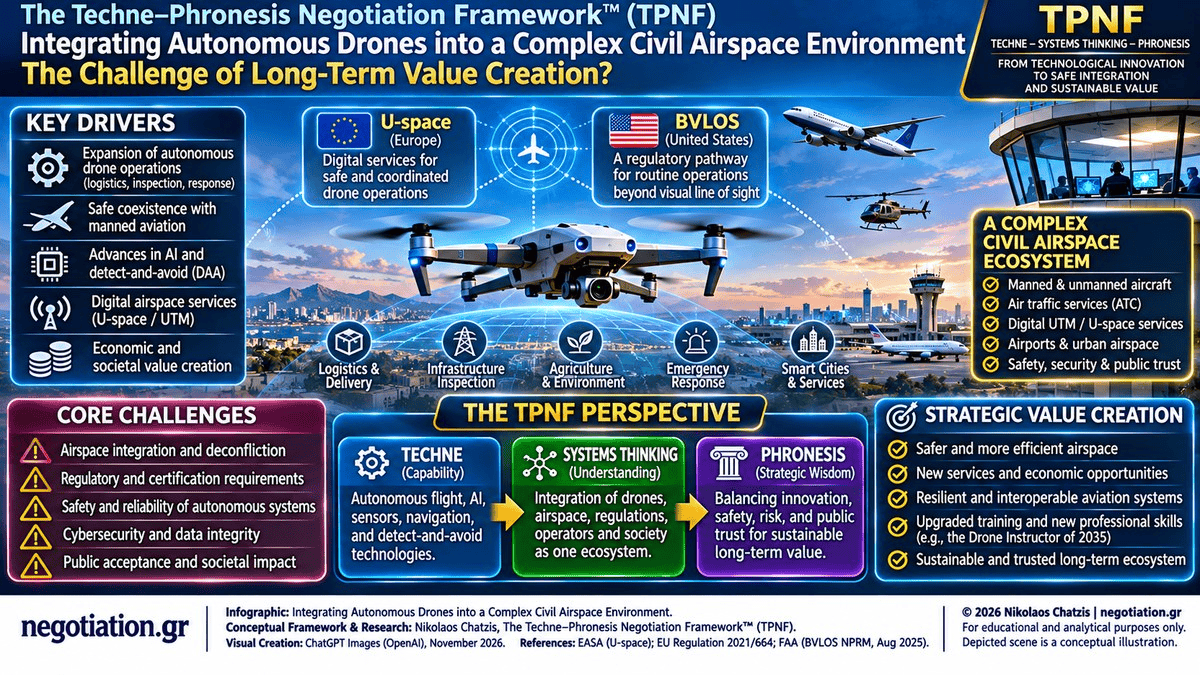
Through the Techne–Phronesis Negotiation Framework™ (TPNF), autonomous aviation becomes a strategic challenge involving three interconnected dimensions: Techne, Systems Thinking, and Phronesis.
Long-term value emerges when technological innovation improves aviation services while preserving safety, public trust, and institutional resilience.
Purpose
This TPNF essay examines the technological, regulatory, operational, and educational challenges associated with integrating autonomous unmanned aircraft into civil airspace.
It applies TPNF to explain how aviation organizations can transform autonomous capabilities into sustainable economic, operational, and societal value.
Abstract
Autonomous drones are transforming aviation through applications in logistics, infrastructure inspection, agriculture, emergency response, and environmental monitoring.
However, integrating them into airspace shared with conventional aircraft presents complex challenges.
Europe’s U-space framework and American efforts to establish routine Beyond Visual Line of Sight (BVLOS) operations demonstrate the importance of coordinated regulation and technological development.
TPNF suggests that successful integration requires more than advanced aircraft. It demands interoperable systems, qualified personnel, risk-based regulation, and strategic judgment.
1. The Transformation of Civil Aviation
Civil aviation has historically developed around aircraft operated by onboard pilots, supported by air traffic control, established procedures, and internationally recognized safety standards.
Autonomous drones introduce a different operational model.
Aircraft may execute substantial flight functions automatically, while remote personnel supervise operations and intervene when necessary.
Future systems may coordinate multiple aircraft through increasingly sophisticated digital infrastructures.
However, autonomy exists along a spectrum.
Automated flight does not necessarily imply independent decision-making, and remotely piloted aircraft should not automatically be classified as fully autonomous.
This distinction is essential for regulatory oversight.
The central challenge is integrating different levels of automation into an aviation environment already characterized by complex interactions.
2. Civil Airspace as a Complex Operational Ecosystem
Civil airspace accommodates commercial airliners, general aviation aircraft, helicopters, emergency services, military flights, and recreational aviation.
These aircraft differ in performance, equipment, operating altitude, and communication capabilities.
Introducing large numbers of drones creates additional complexity.
An autonomous aircraft must navigate while respecting airspace restrictions, detecting potential conflicts, responding to unexpected conditions, and maintaining operational safety.
The problem becomes particularly challenging near airports, urban areas, and emergency operations.
A technically capable drone may nevertheless become a safety risk if it cannot interact effectively with the surrounding aviation system.
TPNF principle: An autonomous aircraft cannot be evaluated independently of the airspace ecosystem in which it operates.
3. Techne: Creating Autonomous Aviation Capability
Within TPNF, Techne represents technological knowledge, engineering competence, and practical operational capability.
Autonomous drone operations depend upon navigation systems, onboard sensors, reliable communications, flight-control software, and automated decision-support technologies.
Detect-and-avoid capabilities are particularly important.
These systems seek to identify potential collision hazards and support appropriate avoidance responses.
Artificial intelligence may improve perception and decision support, but its performance must be evaluated under realistic operating conditions.
Cybersecurity, software reliability, and navigation resilience are equally important.
A sophisticated autonomous aircraft remains vulnerable if its supporting systems cannot perform safely during failures or disruptions.
Consequently, technological capability must be demonstrated through systematic testing, verification, and operational evidence.
4. Europe’s U-space Regulatory Framework
The European Union has established U-space as a regulatory framework supporting unmanned aircraft operations in designated airspace.
Commission Implementing Regulation (EU) 2021/664 provides the foundation for this system.
U-space is designed to support safe, efficient, and coordinated drone operations through digital services.
Four mandatory services form its core: network identification, geo-awareness, UAS flight authorization, and traffic information.
These services help operators understand airspace restrictions, identify relevant traffic, and obtain authorization for operations.
However, U-space does not automatically authorize every drone mission.
Operators must continue complying with applicable aviation regulations and operational requirements.
The framework illustrates how technological innovation requires supporting institutional infrastructure.
5. The American BVLOS Challenge
In the United States, the Federal Aviation Administration has pursued a regulatory pathway for routine Beyond Visual Line of Sight operations.
In August 2025, the FAA published a proposed rule addressing scalable BVLOS operations and supporting unmanned aircraft traffic management services.
The proposal recognizes that requiring continuous direct visual observation can limit commercial applications.
However, removing this limitation creates additional requirements concerning aircraft performance, operational risk, communications, and airspace coordination.
As of this essay’s preparation, the 2025 proposal provides an important regulatory reference; its provisions should not be treated automatically as finalized operating requirements.
The American experience demonstrates the challenge of balancing innovation with aviation safety.
6. Systems Thinking: Integrating Manned and Unmanned Aviation
Systems Thinking represents the second dimension of TPNF.
The successful integration of autonomous drones requires coordination among multiple participants.
These include aviation authorities, air navigation service providers, drone operators, aircraft manufacturers, technology developers, airports, and emergency organizations.
Each participant possesses different responsibilities and operational requirements.
A drone’s onboard automation must interact with external information systems and established airspace procedures.
Information must remain reliable, timely, and interoperable.
Failures can propagate across organizational boundaries.
For example, inaccurate traffic information may compromise an otherwise reliable autonomous flight system.
Therefore, the effectiveness of autonomous aviation depends upon the combined performance of aircraft, digital infrastructure, institutions, and people.
7. Phronesis: Strategic Wisdom and Aviation Safety
Phronesis represents practical wisdom and responsible judgment under uncertainty.
In autonomous aviation, it requires balancing technological opportunity against operational risk.
Aviation authorities must decide when evidence is sufficient to authorize new activities.
Manufacturers must determine which automated functions are dependable enough for operational deployment.
Operators must recognize when environmental conditions or system limitations require intervention or cancellation.
The objective is not to eliminate human judgment.
Rather, it is to redefine its role within increasingly automated systems.
Strategic wisdom also requires acknowledging that regulatory caution and technological innovation are not necessarily opposing forces.
Appropriate safety requirements can strengthen public confidence and support sustainable market development.
TPNF principle: Autonomy creates lasting value when technological freedom is accompanied by accountable human and institutional judgment.
8. Human Expertise and the Drone Instructor of 2035
Autonomous aviation will transform the educational requirements of pilots, operators, and instructors.
Traditional flight training emphasizes aircraft control, navigation, meteorology, operational procedures, and decision-making.
These competencies remain important.
However, future drone professionals will increasingly need to understand automation supervision, system limitations, digital airspace services, cybersecurity, and operational risk assessment.
An instructor must explain not only how a drone operates, but also how its technology interacts with the wider aviation ecosystem.
This creates an important educational opportunity.
Training institutions can integrate technical instruction with systems analysis and scenario-based strategic decision-making.
TPNF offers a complementary framework for developing these competencies.
The future instructor should prepare participants to understand technological evolution, not merely operate today’s equipment.
9. The Economic and Societal Value Challenge
Autonomous drones may generate substantial benefits through faster inspections, improved access to remote areas, reduced exposure to hazardous environments, and more efficient logistical services.
Yet technological feasibility does not guarantee commercial sustainability.
Operators must consider certification, insurance, maintenance, infrastructure, workforce training, and regulatory compliance.
Communities may raise concerns about noise, privacy, security, and environmental consequences.
Business models that overlook these factors may struggle despite technical success.
Long-term value therefore requires alignment among technological performance, economic viability, regulatory legitimacy, and public acceptance.
The strongest autonomous aviation ecosystems will be those capable of sustaining this alignment.
10. The TPNF Strategic Value Pathway
The integration of autonomous drones can be represented through the following sequence:
Technological Innovation → Operational Capability → Safety Validation → Airspace Integration → Institutional Coordination → Public Confidence → Scalable Services → Long-Term Value Creation
Each stage introduces additional requirements.
Advanced automation enables new operations.
Safety validation establishes acceptable performance.
Airspace integration connects aircraft with existing aviation structures.
Institutional coordination supports repeatable operations.
Public confidence strengthens social acceptance.
Only through this progression can autonomous aviation move from technological experimentation toward sustainable services.
Strategic Lessons for Leaders
Five lessons emerge from this analysis.
First, autonomous aviation is an ecosystem challenge rather than an isolated engineering problem.
Second, technological capability must be supported by reliable safety evidence.
Third, regulation can enable innovation by establishing predictable operational conditions.
Fourth, aviation education must evolve alongside increasingly automated systems.
Fifth, sustainable value depends upon coordination among technology, institutions, operators, and society.
Autonomous drones represent an important development in civil aviation.
Their integration promises new operational possibilities but introduces significant technological, regulatory, and institutional challenges.
Through TPNF, the central question becomes clear.
Can aviation organizations transform autonomous capabilities into reliable services while protecting the safety and legitimacy of the wider aviation system?
The answer depends upon combining engineering excellence, systems-level understanding, and responsible strategic judgment.
Technology creates autonomous capability. Systems Thinking enables safe integration. Phronesis transforms innovation into sustainable aviation value.
Key Takeaways
- Autonomous flight capability does not automatically guarantee safe airspace integration.
- U-space and BVLOS regulatory initiatives illustrate different approaches to emerging aviation requirements.
- Interoperability and detect-and-avoid technologies are essential development priorities.
- Human supervision and institutional accountability remain fundamental.
- Future aviation education must combine technical skills with systems understanding.
- Long-term value requires safety, economic sustainability, and public confidence.
Author’s Reflection
The future of aviation will not be determined exclusively by the sophistication of autonomous aircraft.
It will depend upon our ability to understand and manage the complex environment in which these technologies operate.
The aviation industry has historically advanced through the interaction of engineering innovation, operational experience, regulation, and human judgment.
Autonomous drones introduce a new chapter in this evolution.
For TPNF, their integration demonstrates that technological progress becomes strategically meaningful when it strengthens rather than destabilizes the systems upon which society depends.
The challenge is not simply teaching machines to fly.
It is developing the technological, institutional, and human wisdom necessary to allow autonomous and conventional aviation to coexist safely.
Nikolaos Chatzis
Primary Research Sources
The following official regulatory sources support the essay’s central analysis.
European Union Aviation Safety Agency — U-space Framework
Explains U-space services, airspace risk assessment, service-provider certification, and safe integration of drones with conventional aviation.
EASA — U-space and Air Traffic Management
EASA
European Commission — Regulation (EU) 2021/664, consolidated February 2026
The legal foundation for U-space, including the requirements governing designated airspace and supporting services.
Read the consolidated U-space Regulation
EUR-Lex
Federal Aviation Administration — August 2025
Official proposed framework for routine Beyond Visual Line of Sight operations and UAS Traffic Management.
Federal Aviation Administration+1
Source: Open Sources Analysis, Relative Data Analysis by Nikos Chatzis
© Nikolaos Chatzis. All Rights Reserved.
The Techne–Phronesis Negotiation Framework™
An Integrative Theory of Strategic Negotiation, Complex Adaptive Systems and Practical Wisdom
Technology Creates Capability • Systems Thinking Creates Understanding • Strategic Wisdom Creates Lasting Value.
Negotiation.gr | Strategic Wisdom for the Technological Age