Negotiation.gr | Strategic Wisdom for the Technological Age
“Strategic resilience emerges when technical capability (techne) is
continuously guided by practical wisdom (phronesis) through adaptive
negotiation across interconnected systems.”
Central Idea
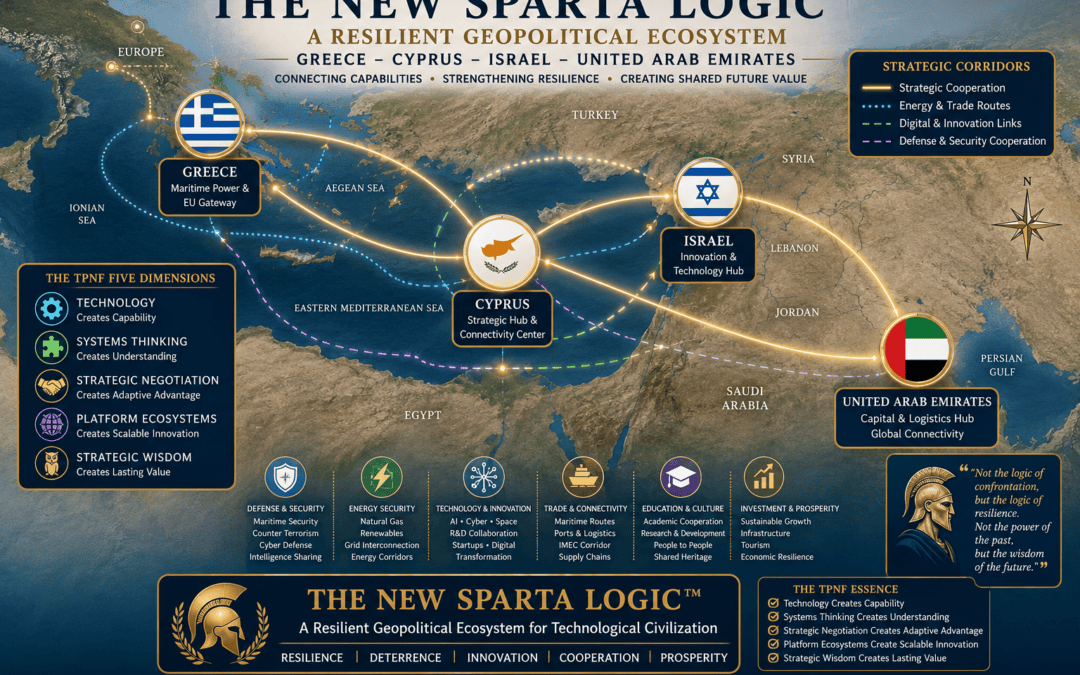
The emerging strategic partnership among Greece, Cyprus, Israel, and the United Arab Emirates illustrates a new model of regional power in which technological capability, strategic cooperation, ecosystem thinking, and practical wisdom collectively generate deterrence, resilience, and long-term geopolitical value.
Purpose of the Essay
This essay explains how the Techne–Phronesis Negotiation Framework™ (TPNF) interprets the evolving Greece–Israel–UAE relationship as an integrated geopolitical ecosystem. It introduces the concept of the “New Sparta Logic” to describe a modern strategic approach based on technological leadership, adaptive cooperation, and multidimensional security rather than territorial expansion or military dominance alone.
Introduction: From Geography to Strategic Ecosystems
The twenty-first century is witnessing a profound transformation in the nature of geopolitical power. Geography remains important, but technological capability, innovation ecosystems, critical infrastructure, digital connectivity, energy cooperation, and strategic partnerships increasingly determine regional influence.
Within this environment, Greece, Israel, and the United Arab Emirates have gradually developed a relationship extending well beyond traditional diplomacy. Their cooperation spans defense, energy, technology, cybersecurity, investment, maritime security, infrastructure, and regional stability.
Cyprus occupies a unique position within the emerging strategic ecosystem. Located at the crossroads of Europe, the Eastern Mediterranean and the Middle East, it functions as a natural platform connecting Greece, Israel and the Gulf region. Beyond its geographical importance, Cyprus increasingly contributes to regional energy cooperation, maritime connectivity, digital infrastructure, and institutional coordination, reinforcing the resilience of the entire ecosystem.
Viewed through the TPNF, this partnership represents the emergence of a strategic ecosystem rather than a conventional alliance.
Understanding the “New Sparta Logic”
The phrase “New Sparta Logic” should not be interpreted as a call for militarization.
Instead, it symbolizes a strategic philosophy emphasizing preparedness, resilience, disciplined governance, technological excellence, and credible deterrence.
In today’s technological civilization, resilience depends not only on military readiness but also on:
- advanced technological capabilities;
- innovation capacity;
- resilient institutions;
- strategic partnerships;
- adaptive decision-making;
- economic competitiveness.
The “New Sparta Logic” therefore reflects a comprehensive approach to national and regional security that integrates hard power with technological, economic, and institutional strength.
Technology Creates Capability
The first dimension of the TPNF highlights technology as the foundation of strategic capability.
Israel contributes world-class expertise in defense technologies, cybersecurity, artificial intelligence, unmanned systems, and innovation.
The UAE has invested heavily in digital transformation, smart infrastructure, renewable energy, aerospace, and advanced industries.
Greece increasingly strengthens its position through defense modernization, maritime capabilities, digital governance, energy infrastructure, and its role as a strategic gateway connecting Europe with the Eastern Mediterranean and the Middle East.
Cyprus complements the technological capabilities of Greece, Israel and the UAE through its growing role in offshore energy development, digital infrastructure, research cooperation, maritime services and regional connectivity. Together, the four countries form a complementary technological ecosystem whose strength derives from specialization rather than duplication.
Together, these complementary capabilities produce a regional technological ecosystem that enhances collective resilience.
Systems Thinking Creates Understanding
The partnership should be understood as an interconnected system rather than a collection of bilateral agreements.
Energy corridors, maritime routes, defense cooperation, investment flows, digital infrastructure, logistics, and diplomatic coordination reinforce one another.
The strategic value of the relationship lies in the interaction among these elements.
The TPNF therefore encourages decision-makers to move beyond isolated policy analysis and instead evaluate how multiple systems interact to create stability and adaptive capacity.
The quadrilateral ecosystem composed of Greece, Cyprus, Israel and the United Arab Emirates illustrates how geography, technology, diplomacy, infrastructure and innovation reinforce one another through continuous interaction.
Strategic Negotiation Creates Adaptive Advantage
Negotiation within the TPNF extends beyond diplomatic meetings.
It represents the continuous process through which governments, industries, research institutions, investors, and security organizations coordinate strategic adaptation.
Cyprus frequently serves as an institutional bridge connecting European, Eastern Mediterranean and Gulf interests, thereby strengthening strategic dialogue and long-term regional cooperation.
The Greece–Israel–UAE partnership demonstrates that successful geopolitical cooperation increasingly depends upon:
- long-term trust;
- institutional dialogue;
- policy coordination;
- joint exercises;
- technological collaboration;
- shared strategic objectives.
Adaptive negotiation allows the partnership to respond effectively to changing geopolitical realities without sacrificing long-term coherence.
Platform Ecosystems Create Scalable Innovation
The partnership also illustrates the growing importance of ecosystem thinking.
Innovation no longer occurs within isolated organizations.
Universities, startups, defense industries, logistics providers, technology companies, financial institutions, and governments increasingly operate through collaborative platforms.
The Greece–Cyprus–Israel–UAE strategic ecosystem triangle possesses significant potential to strengthen regional innovation by integrating research, investment, technological development, energy projects, maritime infrastructure, and digital transformation.
Such ecosystem cooperation creates value that no participant could generate independently.
Strategic Wisdom Creates Lasting Value
The final dimension of the TPNF emphasizes practical wisdom.
Technological superiority alone cannot ensure regional stability.
Lasting strategic value requires prudent leadership capable of balancing deterrence with diplomacy, competition with cooperation, and innovation with institutional responsibility.
The “New Sparta Logic” therefore represents disciplined strategic judgment rather than confrontation.
Its ultimate objective is not conflict but the preservation of stability through credible capability, trusted partnerships, and responsible governance.
Strategic Implications
The Greece–Cyprus–Israel–United Arab Emirates ecosystem demonstrates how medium-sized states can collectively generate strategic influence that exceeds the sum of their individual capabilities. By integrating maritime geography, technological innovation, energy infrastructure, financial investment and institutional cooperation, they establish a resilient geopolitical platform capable of contributing to regional stability, European connectivity and long-term strategic adaptation.
The Techne–Phronesis Negotiation Framework™ explains how Greece, Cyprus, Israel and the United Arab Emirates collectively demonstrate the evolution from traditional alliances toward resilient geopolitical ecosystems. Their cooperation illustrates that future influence will increasingly depend upon technological capability, adaptive governance, trusted partnerships and strategic wisdom operating through interconnected regional networks.
The concept of the “New Sparta Logic” captures a transition from traditional power politics toward technologically enabled resilience, ecosystem cooperation, adaptive negotiation, and strategic wisdom.
Rather than seeking dominance, this model emphasizes preparedness, innovation, institutional cooperation, and sustainable security.
In an era defined by technological civilization, enduring geopolitical influence will belong not to those who possess the greatest resources alone, but to those who most effectively transform technological capability into resilient partnerships and lasting strategic value.
Key Takeaways
- The Greece–Israel–UAE partnership represents a multidimensional strategic ecosystem rather than a traditional alliance.
- The “New Sparta Logic” emphasizes resilience, technological capability, disciplined governance, and credible deterrence.
- The TPNF explains how technology, systems thinking, negotiation, ecosystems, and strategic wisdom reinforce one another.
- Regional influence increasingly depends on adaptive cooperation rather than isolated national power.
- Long-term geopolitical stability is strengthened through integrated ecosystems that combine innovation, trust, and strategic leadership.
Author’s Reflection
The idea of the “New Sparta Logic” is not an appeal to recreate the military traditions of the ancient world. It is a metaphor for the strategic discipline required in an age where technology, economics, diplomacy, and security are inseparable. Within the TPNF, Greece, Israel, and the UAE demonstrate how geographically distinct states can create a resilient strategic ecosystem through complementary capabilities, continuous negotiation, and practical wisdom. If technological civilization rewards those who can connect rather than merely compete, then the true legacy of the “New Sparta Logic” lies not in conquest, but in the creation of trusted partnerships capable of generating security, innovation, and lasting value for future generations.
Source: Open Sources Analysis, Relative Data Analysis by Nikos Chatzis
© Nikolaos Chatzis. All Rights Reserved.
The Techne–Phronesis Negotiation Framework™
An Integrative Theory of Strategic Negotiation, Complex Adaptive Systems & Practical Wisdom
Technology Creates Capability • Systems Thinking Creates Understanding • Strategic Wisdom Creates Lasting Value.
Negotiation.gr | Strategic Wisdom for the Technological Age