Negotiation.gr | Strategic Wisdom for the Technological Age
“Strategic resilience emerges when technical capability (techne) is
continuously guided by practical wisdom (phronesis) through adaptive
negotiation across interconnected systems.”
Central Idea — Thesis
The rapid evolution of artificial intelligence is changing the drone threat from remotely controlled unmanned aircraft into increasingly autonomous, adaptive and potentially collaborative systems.
This transformation creates a fundamental challenge for counter-drone technology.
Traditional electronic warfare often seeks the communications or navigation links connecting a drone with its operator. But what happens when an AI-enabled drone requires progressively less external communication?
Through the Techne–Phronesis Negotiation Framework™ (TPNF), the answer requires moving beyond individual counter-drone technologies toward Adaptive Counter-UAS Ecosystems™ capable of continuously detecting, identifying, understanding and countering changing threats.
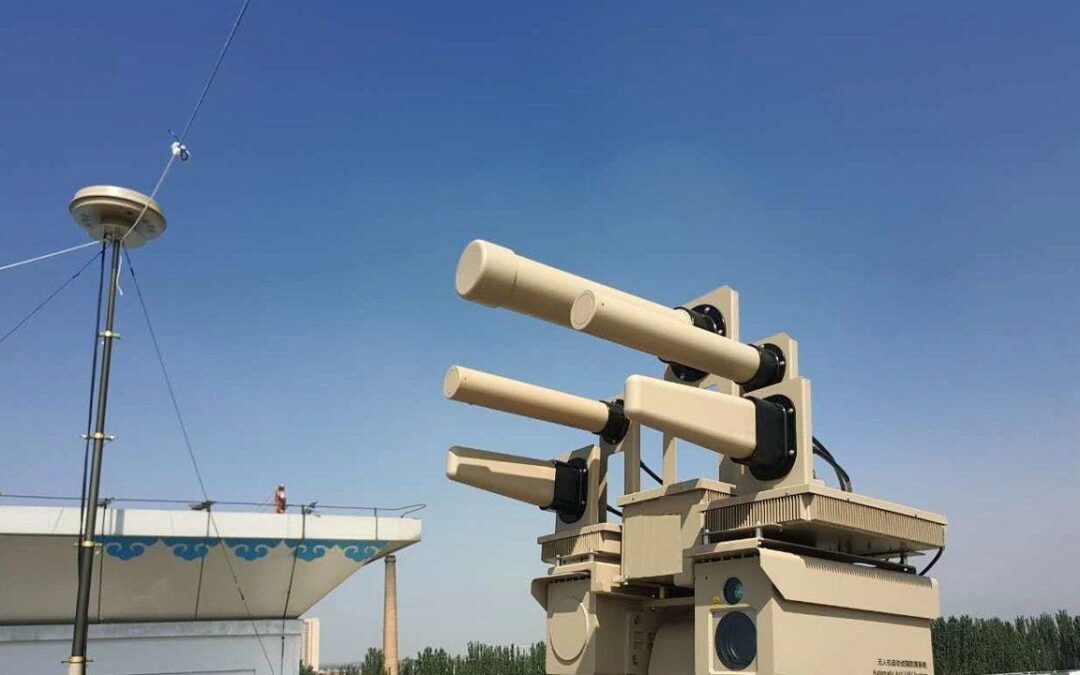
The Greek development of Centaurus, Telemachus and Hyperion provides an important example of this evolution.
The strategic challenge is becoming:
Drone Detection → Threat Identification → Electronic Suppression → Multi-Sensor Integration → AI-Assisted Threat Understanding → Adaptive Counter-UAS Ecosystem™.
Purpose of the Essay
This essay examines through TPNF how AI-enabled autonomy is transforming drone warfare and consequently changing the technological requirements of drone detection and counter-UAS systems.
Using Greece’s Centaurus, Telemachus and Hyperion programs, it argues that future counter-drone superiority will depend not upon one permanent technological solution, but upon the ability to continuously adapt the detection and response architecture faster than the threat evolves.
Abstract
Low-cost drones have transformed modern warfare.
Artificial intelligence may accelerate that transformation by enabling drones to navigate, identify objects, adapt to changing environments and potentially conduct missions with reduced dependence on continuous communications.
This challenges counter-drone systems heavily dependent upon detecting or disrupting radio-frequency links.
Greece’s developing counter-UAS architecture illustrates the technological response. Centaurus detects and counters medium and larger UAV threats and has already been operationally tested in the Red Sea. Telemachus addresses smaller Class 1 drones, while Hyperion is being developed to detect, identify and suppress swarms of Class 1 and Class 2 drones.
TPNF interprets this evolution as an emerging Detection–Autonomy Competition™: the continuous strategic contest between increasingly autonomous unmanned systems and increasingly adaptive technologies designed to discover, understand and neutralize them.
1. The Drone Threat Is Changing
The first major transformation of military drones concerned accessibility.
Capabilities once available primarily to advanced militaries became increasingly inexpensive and widely distributed.
Commercial drones could conduct reconnaissance. FPV drones could attack vehicles and personnel. Loitering munitions could remain airborne while searching for targets.
AI introduces another transformation:
Autonomy.
An increasingly intelligent drone may potentially navigate using onboard sensors, recognize environmental features, classify objects and modify its route without requiring continuous instructions from an operator.
The technological contest therefore changes.
The defender can no longer assume that every drone will continuously communicate.
2. From Communication Detection to Behaviour Detection
Traditional counter-UAS electronic warfare possesses an important advantage.
A remotely controlled drone frequently creates an electromagnetic signature.
Detect the signal and the defender may discover the drone.
Jam the connection and the defender may disrupt its mission.
But increasing autonomy can reduce this dependency.
This creates what TPNF can define as the Autonomy–Detection Paradox™:
As unmanned systems become more autonomous, their dependence upon externally detectable communication may decrease, potentially making some traditional detection and jamming methods less effective.
Counter-drone technology must consequently become multi-layered.
Radio-frequency detection remains important, but it increasingly needs to interact with radar, electro-optical systems, infrared sensors, acoustic detection, passive sensing and intelligent data fusion.
3. Centaurus: From Development to Combat Validation
Greece’s Centaurus represents an important stage in this evolution.
Developed by the Hellenic Aerospace Industry, the programme began as a self-funded research project in 2019. Construction and testing were completed in 2023 before the system entered production.
Its significance increased dramatically through operational deployment.
Centaurus was installed aboard the Greek frigate Psara during the European Union’s Operation Aspides in the Red Sea.
During operations against Houthi drone attacks, the system contributed to countering four UAVs, with two destroyed and two forced away.
This moved Centaurus across a crucial technological threshold:
Research → Prototype → Operational Testing → Combat Validation → Production → Capability Expansion.
The experience demonstrates a central TPNF principle:
Technological capability becomes strategically valuable when experimentation is converted into operational learning.
4. Electronic Warfare and the Economics of Interception
Centaurus also addresses another strategic problem.
Destroying an inexpensive drone with an expensive missile can create an unfavorable economic exchange.
Electronic warfare changes this equation.
Rather than necessarily destroying every UAV kinetically, Centaurus can detect radio-frequency emissions and disrupt communications or navigation.
The system can therefore help create a more sustainable defensive architecture.
This introduces **Counter-UAS Economic Sustainability™:
the capacity to maintain effective defence against persistent low-cost unmanned threats without imposing disproportionately greater financial and material costs upon the defender.**
Future drone warfare will be a technological contest, but also a contest of industrial and economic endurance.
5. Telemachus: Detecting the Smaller Threat
No single detection architecture is optimal against every drone.
This explains the importance of Telemachus.
According to Hellenic Aerospace Industry, Telemachus is an active detection and identification system designed for small Class 1 drones, including platforms comparable to the DJI Phantom category.
Its counter-drone subsystem, completed in 2024, added suppression capability.
The strategic lesson is significant.
The threat spectrum extends from larger military UAVs to extremely small commercial or modified platforms.
Counter-UAS defence therefore requires different technological layers.
Different Drone Classes → Different Signatures → Different Detection Problems → Different Countermeasures.
6. Hyperion and the Swarm Challenge
Hyperion represents another evolutionary step.
HAI describes it as a developing system for the detection, identification and suppression of swarms of Class 1 and Class 2 drones.
It incorporates passive three-dimensional detection and identification alongside modern suppression technology.
The word swarm changes the strategic problem.
A defensive system confronting one drone can concentrate resources upon one target.
A system confronting dozens—or eventually hundreds—of coordinated autonomous systems faces a problem of scale, classification and prioritization.
AI can intensify that challenge.
Future swarms may potentially distribute tasks, alter formations, respond to losses and approach targets from multiple directions.
The counter-UAS system must therefore increasingly understand the collective behaviour of the threat, not simply identify individual aircraft.
7. The Detection–Autonomy Competition™
Centaurus, Telemachus and Hyperion reveal a larger technological pattern.
Drone technology evolves.
Detection technology responds.
Drone autonomy increases.
Detection architecture adapts again.
Countermeasures improve.
Drone designers develop new methods of avoiding them.
This creates the Detection–Autonomy Competition™:
AI-Enabled Drone
↓
Reduced External Dependence
↓
Lower Communication Signature
↓
More Difficult Detection
↓
Multi-Sensor Counter-UAS
↓
AI-Assisted Sensor Fusion
↓
Improved Threat Classification
↓
Drone Adaptation
↓
Continuous Counter-Adaptation
There may therefore never be a final anti-drone solution.
The strategic advantage belongs to the system capable of learning faster.
8. AI Must Defend Against AI
The logical consequence is profound.
If AI increases the autonomy and adaptability of offensive drones, AI will increasingly become necessary on the defensive side as well.
Imagine multiple sensors observing the same battlespace:
radar detects movement;
RF sensors detect transmissions;
infrared sensors detect heat;
electro-optical cameras provide imagery;
acoustic sensors detect characteristic sound.
Individually, each produces information.
The strategic challenge is converting these signals into understanding.
AI-assisted sensor fusion could help determine:
What is it?
Is it hostile?
Is it operating independently or as part of a swarm?
Which target presents the greatest threat?
Which countermeasure should respond?
This represents a transition from Drone Detection toward Machine-Speed Threat Understanding™.
9. The Greek Innovation Model
The Greek example is also institutionally important.
The Ministry of National Defence has increasingly emphasized presenting the domestic innovation ecosystem with operational problems, rather than simply requesting predetermined products.
The question becomes:
“How do we counter a drone swarm?”
rather than:
“Which anti-drone system should we buy?”
The Hellenic Centre for Defence Innovation can then transmit the operational problem to companies and researchers, support prototypes, enable military testing and move successful solutions toward procurement.
This creates:
Operational Problem → Innovation Ecosystem → Prototype → Military Testing → Operational Feedback → Improvement → Production.
That architecture may ultimately be as strategically important as the individual technology.
10. Strategic Capability Regeneration™
The greatest danger in rapidly changing drone warfare is technological obsolescence.
Greek defence officials have emphasized how quickly drone technology can change.
A counter-UAS capability purchased today cannot simply remain technologically static for ten years.
It must regenerate.
This connects directly with the TPNF concept of Strategic Capability Regeneration™.
For counter-UAS defence:
Detection → Engagement → Operational Experience → Data → Learning → Software/Hardware Adaptation → Improved Detection → Renewed Capability.
The counter-drone system therefore becomes a learning system.
11. Toward the Adaptive Counter-UAS Ecosystem™
The future may consequently not belong to one Centaurus, Telemachus or Hyperion.
It may belong to their integration with other sensors and effectors.
The emerging architecture becomes:
RF Detection
Radar
Electro-Optical / Infrared
Passive Sensors
AI-Assisted Sensor Fusion
Electronic Warfare
Directed Energy
Kinetic Interception
Command-and-Control
=
Adaptive Counter-UAS Ecosystem™
The strategic objective is not merely to destroy drones.
It is to continuously understand and control the unmanned threat environment.
Strategic Implications
AI-enabled autonomy will progressively challenge counter-drone systems designed primarily around external communications.
Multi-sensor detection therefore becomes increasingly important.
Electronic warfare remains essential, particularly because of its favorable economics against inexpensive drones, but it must become part of a wider defensive architecture.
Greece’s Centaurus, Telemachus and Hyperion demonstrate how differentiated technologies can address different layers of the threat.
Most importantly, domestic innovation capability provides Greece with something more valuable than individual systems: the capacity to continuously modify them as the threat evolves.
Drone warfare is entering another technological phase.
The first revolution made drones inexpensive and widely accessible.
The emerging revolution makes them increasingly intelligent.
That transformation changes the strategic equation.
The future counter-UAS challenge will not simply be:
Can we detect the drone?
It will increasingly become:
Can we understand an autonomous threat quickly enough to defeat it before it adapts to our defence?
Centaurus, Telemachus and Hyperion represent important Greek answers to different dimensions of that question.
But their deeper strategic value lies in something beyond the individual systems.
They demonstrate the emergence of a national technological learning process connecting operational requirements, defence innovation, domestic industry, experimentation and battlefield experience.
Through TPNF, the ultimate strategic competition can therefore be expressed simply:
Autonomous Threat → Detection → Understanding → Countermeasure → Learning → Adaptation → Regenerated Capability.
The decisive advantage will not necessarily belong to the side possessing the best counter-drone technology at one moment.
It may belong to the side possessing the fastest learning and adaptation ecosystem over time.
Key Takeaways
- AI-enabled autonomy may reduce drones’ dependence on detectable communications, complicating traditional electronic-warfare approaches.
- Centaurus demonstrates Greece’s ability to convert domestic counter-UAS R&D into combat-validated capability.
- Telemachus and Hyperion extend the defensive architecture toward small drones and drone swarms.
- Detection–Autonomy Competition™ describes the continuing technological contest between autonomous drones and adaptive detection systems.
- Future resilience will depend increasingly upon Adaptive Counter-UAS Ecosystems™ capable of learning and regenerating capability as threats evolve.
Author’s Reflection
The evolution of drone warfare reveals a fundamental truth about technological civilization.
Technology does not remain still long enough for strategy to treat any technological advantage as permanent.
Artificial intelligence makes this even more important.
A drone can change.
Its software can change.
Its navigation can change.
Its communications can change.
Its autonomy can change.
Therefore, the defence against it must also change.
For Greece, Centaurus is important not merely because it has demonstrated operational effectiveness.
Its deeper significance is that Greece developed it, tested it, learned from it and can continue modifying it.
That creates something larger than a weapon.
It creates technological learning capability.
And in an age in which AI can accelerate technological adaptation, that capability may become one of the most important forms of strategic power.
Nikos Chatzis
Source: Open Sources Analysis, Relative Data Analysis by Nikos Chatzis
© Nikolaos Chatzis. All Rights Reserved.
The Techne–Phronesis Negotiation Framework™
An Integrative Theory of Strategic Negotiation, Complex Adaptive Systems and Practical Wisdom
Technology Creates Capability • Systems Thinking Creates Understanding • Strategic Wisdom Creates Lasting Value.
Negotiation.gr | Strategic Wisdom for the Technological Age