Negotiation.gr | Strategic Wisdom for the Technological Age
“Strategic resilience emerges when technical capability (techne) is
continuously guided by practical wisdom (phronesis) through adaptive
negotiation across interconnected systems.”
Space Exploration, Astrophysics, International Scientific Cooperation, and Strategic Wisdom | 1 November 2026
Central Idea (Thesis)
The strategic significance of space exploration extends beyond technological achievement: it lies in humanity’s ability to transform previously inaccessible cosmic phenomena into measurable knowledge.
The Japan-led XRISM observatory’s observations of stellar-wind plasma falling toward a neutron star demonstrate how advanced technology, systems thinking, and international scientific cooperation can expand humanity’s understanding of the universe.
Through the Techne–Phronesis Negotiation Framework™ (TPNF), this discovery illustrates a fundamental principle: technological capability becomes lasting intellectual and strategic value when it produces reliable knowledge and supports wiser decisions about future scientific exploration.
Purpose of the Essay
This TPNF essay examines the XRISM mission’s observations of the BP Crucis stellar system, the technological capabilities that enabled the discovery, and the implications for astrophysics and international space cooperation.
It applies TPNF to explain how sophisticated instruments, scientific interpretation, and strategic judgment interact to advance humanity’s understanding of the cosmos.
Abstract
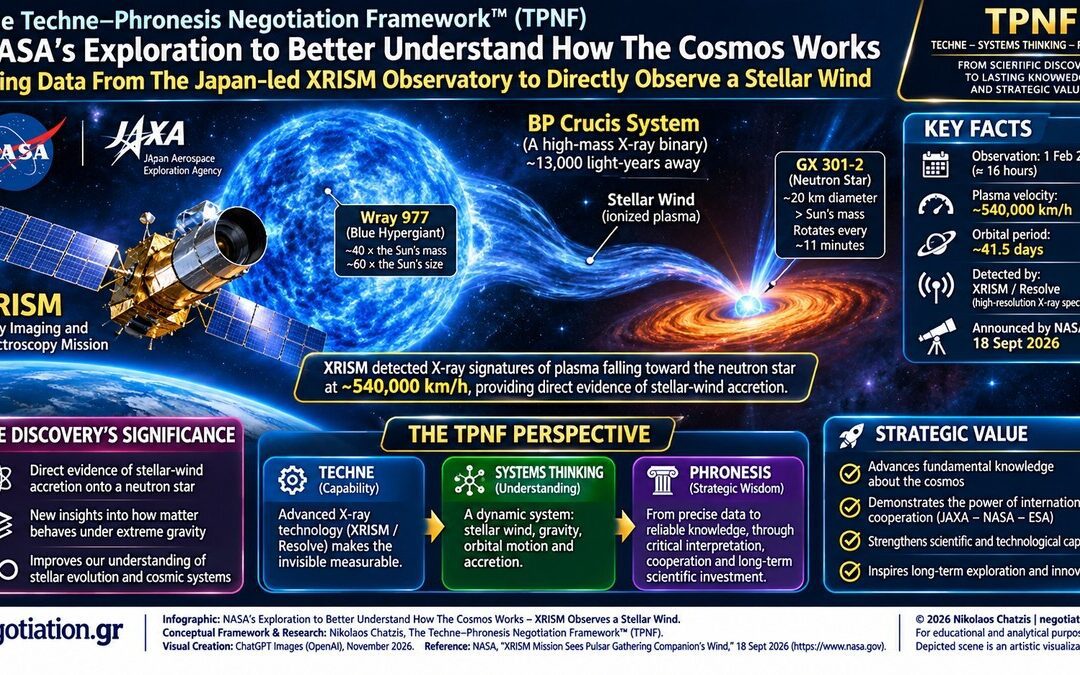
On 18 September 2026, NASA announced that researchers using the Japan-led X-ray Imaging and Spectroscopy Mission (XRISM) had obtained unprecedented evidence of stellar-wind plasma falling toward a compact stellar object.
The observations concern BP Crucis, a binary system approximately 13,000 light-years away, consisting of a massive blue hypergiant and a neutron star.
XRISM’s Resolve spectrometer measured X-ray signatures indicating that plasma was moving toward the neutron star at approximately 540,000 kilometers per hour.
The discovery offers new opportunities to investigate how matter behaves under extreme gravitational conditions.
TPNF provides an interdisciplinary perspective on the technological, scientific, and institutional processes that make such discoveries possible.
1. Exploring the Invisible Universe
Humanity’s understanding of the cosmos has evolved through successive technological revolutions.
Optical telescopes revealed distant planets, stars, and galaxies. Radio astronomy exposed previously invisible celestial processes. Space-based observatories subsequently expanded scientific investigation across the electromagnetic spectrum.
X-ray astronomy examines particularly energetic environments, including neutron stars, black holes, supernova remnants, and hot cosmic gas.
These objects frequently produce radiation that Earth’s atmosphere absorbs, making space-based instruments essential.
XRISM represents another step in this scientific evolution.
Launched in September 2023, the observatory is led by the Japan Aerospace Exploration Agency (JAXA), in collaboration with NASA and with contributions from the European Space Agency (ESA).
Its central mission is to investigate the physical processes governing the universe’s most extreme environments.
2. BP Crucis: A Laboratory of Extreme Astrophysics
The target of the recent investigation was BP Crucis, a high-mass X-ray binary in the constellation Crux.
The system contains two dramatically different celestial objects.
Wray 977 is a blue hypergiant approximately 40 times the Sun’s mass and 60 times its size.
Its enormous luminosity and temperature drive a continuous outflow of ionized gas, known as a stellar wind.
Its companion, GX 301-2, is a neutron star: the extraordinarily dense remnant of a massive star that previously exploded.
Although approximately 20 kilometers across, this compact object contains more mass than the Sun.
GX 301-2 rotates approximately once every 11 minutes and produces X-ray beams, identifying it as a pulsar.
The neutron star completes an orbit around its massive companion approximately every 41.5 days.
As it travels through the surrounding stellar wind, its gravity captures some of the escaping material.
This process is called accretion.
3. The Scientific Breakthrough: Observing Stellar-Wind Accretion
Astronomers have long investigated how compact objects capture matter from neighboring stars.
However, directly identifying the movement of this material close to a neutron star has remained difficult.
On 1 February 2025, XRISM observed BP Crucis for approximately 16 hours during a period associated with strong X-ray activity.
Its Resolve instrument captured exceptionally detailed X-ray spectra.
The researchers identified absorption features associated with highly ionized iron.
These spectral features were displaced toward lower energies, a phenomenon described as redshift.
Their measurements, interpreted through the geometry and physical conditions of the system, provided evidence that plasma was moving toward the neutron star.
The estimated velocity reached approximately 540,000 kilometers per hour.
The findings, published in Science Advances in September 2026, provided unusually direct observational evidence of wind-fed accretion onto a compact object.
Importantly, scientists did not photograph individual particles falling onto the neutron star.
They inferred their motion from high-resolution X-ray measurements, supported by physical models.
This distinction illustrates the importance of scientific precision.
4. Techne: Technology Creates Scientific Capability
Within TPNF, Techne represents the technical knowledge, instruments, and operational competencies that enable purposeful action.
XRISM’s scientific capabilities depend upon advanced spacecraft engineering, X-ray optics, detector technology, and sophisticated data processing.
Its Resolve instrument, jointly developed by NASA and JAXA, measures the energies of incoming X-ray photons with extraordinary precision.
This enables researchers to distinguish subtle spectral features associated with temperature, composition, and motion.
The instrument transforms radiation arriving from distant celestial objects into quantitative scientific evidence.
Without such capabilities, the observed plasma movement would remain difficult to characterize.
XRISM therefore demonstrates how technological innovation can extend the boundaries of human perception.
TPNF principle: Technology creates strategic scientific capability when it enables observations that were previously beyond practical reach.
5. Systems Thinking: Understanding Cosmic Interdependence
The BP Crucis discovery cannot be understood by examining its individual stars independently.
The system involves interacting physical processes.
The blue hypergiant continuously releases plasma.
The neutron star’s gravitational field captures part of that material.
Orbital motion changes the geometry of the interaction.
Angular momentum influences whether captured matter forms an accretion disk.
Magnetic fields, heating, and radiation contribute to the resulting X-ray emissions.
Researchers propose that the captured plasma sometimes forms a turbulent disk before falling toward the neutron star.
Under changing conditions, that disk may dissipate, allowing matter to descend more directly.
The disk may subsequently re-form with a different rotational direction.
These interpretations illustrate a dynamic system whose behavior emerges from interconnected processes.
Systems thinking therefore provides a useful conceptual parallel: understanding requires attention to relationships, feedback, changing conditions, and the behavior of the whole system.
6. Phronesis: Strategic Wisdom in Scientific Exploration
Within TPNF, Phronesis concerns practical wisdom and responsible judgment under uncertainty.
In scientific exploration, it involves selecting meaningful research questions, evaluating evidence critically, and allocating limited resources responsibly.
XRISM’s findings demonstrate the importance of distinguishing direct measurements from interpretations derived through scientific modeling.
The detected spectral shifts provide evidence of plasma motion.
The proposed evolution of the accretion disk remains a physical interpretation requiring continued investigation.
Strategic wisdom therefore discourages premature certainty.
It encourages further observations, independent verification, and the refinement of theoretical models.
For space agencies, Phronesis also concerns investment priorities.
Expensive scientific missions should be evaluated not merely through technological sophistication, but through the quality of knowledge they can produce.
TPNF principle: Scientific wisdom transforms measurement into understanding while preserving the distinction between evidence, interpretation, and uncertainty.
7. International Cooperation as a Scientific Ecosystem
XRISM demonstrates the importance of international collaboration in advanced space science.
Japan provides mission leadership through JAXA.
NASA contributes major scientific and technological capabilities.
ESA and other participating institutions strengthen the broader international research ecosystem.
Such cooperation enables organizations to combine expertise, distribute responsibilities, and pursue scientific objectives that may exceed the capabilities of individual institutions.
However, successful collaboration requires more than technological contributions.
It depends upon compatible scientific objectives, institutional trust, clear responsibilities, data-management arrangements, and long-term operational coordination.
From a TPNF perspective, international space cooperation represents an ecosystem in which shared capabilities can generate knowledge of global significance.
Its strategic value emerges through coordinated contributions rather than isolated institutional achievements.
8. From Observation to Scientific Understanding
The XRISM discovery illustrates a broader pathway through which scientific innovation creates value:
Technological Capability → Precise Measurement → Data Interpretation → Systems Understanding → Theory Testing → Scientific Knowledge → Future Research Capability
Each stage depends upon the preceding stages but introduces additional requirements.
Accurate instruments alone cannot guarantee accurate scientific conclusions.
Researchers must interpret observations within reliable theoretical frameworks.
Likewise, scientific models must remain open to revision when new evidence challenges existing assumptions.
The BP Crucis observations offer opportunities to test theories concerning stellar winds, accretion dynamics, and matter under extreme gravitational conditions.
Future measurements may determine whether the proposed accretion behavior occurs consistently across similar binary systems.
9. The Broader Strategic Value of Fundamental Science
Fundamental astrophysics does not always generate immediate commercial or industrial applications.
Its principal contribution may instead be the expansion of humanity’s scientific knowledge.
Nevertheless, developing sophisticated space observatories can strengthen expertise in engineering, precision measurement, computing, and international project management.
These capabilities may benefit other scientific and technological fields.
Such benefits should be evaluated rather than automatically assumed.
TPNF therefore distinguishes the direct scientific value of the discovery from its potential longer-term technological and institutional consequences.
The enduring contribution of XRISM lies in its capacity to generate knowledge that future generations of researchers can examine, challenge, and develop.
Strategic Lessons for Leaders
The XRISM case offers five important lessons.
First, technological innovation can expand the limits of observable reality.
Second, complex scientific problems require systems-level understanding.
Third, international cooperation can combine specialized capabilities around common objectives.
Fourth, reliable knowledge depends upon careful interpretation and acknowledgment of uncertainty.
Fifth, long-term scientific investment should be assessed through its contribution to cumulative knowledge and future research capabilities.
These lessons extend beyond astrophysics to other knowledge-intensive technological ecosystems.
The Japan-led XRISM mission has provided new evidence concerning how a neutron star captures plasma from the stellar wind of a massive companion.
The observations represent a significant advance in the investigation of matter under extreme gravitational conditions.
Through TPNF, the discovery illustrates the relationship between technological capability, systems understanding, and strategic wisdom.
XRISM demonstrates that scientific progress requires more than increasingly sophisticated instruments.
It requires institutions capable of cooperating, researchers capable of interpreting complex evidence, and leaders prepared to invest in long-term knowledge creation.
Technology makes the invisible measurable. Systems thinking makes complex interactions understandable. Strategic wisdom transforms scientific discovery into lasting intellectual value.
Key Takeaways
- XRISM obtained unprecedented spectroscopic evidence of stellar-wind plasma falling toward a neutron star.
- The BP Crucis system provides a natural laboratory for studying extreme astrophysical processes.
- Resolve’s high-resolution X-ray measurements revealed plasma velocities approaching 540,000 kilometers per hour.
- Systems thinking helps explain the interconnected dynamics of stellar winds, gravity, orbital motion, and accretion.
- International scientific cooperation strengthens humanity’s ability to investigate complex cosmic phenomena.
- TPNF connects technological capability with scientific understanding and responsible long-term research investment.
Author’s Reflection
The history of human civilization demonstrates that scientific progress begins when curiosity challenges the limits of existing knowledge.
From the philosophical investigations of ancient Greece to the sophisticated instruments of contemporary space exploration, humanity has continually sought to understand the principles governing nature.
XRISM represents another chapter in this intellectual journey.
Its importance lies not only in observing matter moving toward a distant neutron star, but in demonstrating how human ingenuity, international cooperation, and scientific reasoning can reveal previously inaccessible dimensions of the universe.
For TPNF, this is an enduring expression of strategic wisdom: technological progress achieves its highest intellectual value when it deepens humanity’s understanding of reality.
Nikolaos Chatzis
Scientific References
The essay is grounded primarily in NASA’s official announcement and XRISM mission documentation.
NASA — 18 September 2026
NASA–JAXA XRISM Mission Sees Pulsar Gathering Companion’s WindPrimary source for the BP Crucis observations, plasma velocity, and scientific interpretations.
NASA Science
NASA — XRISM Mission Overview
XRISM: X-ray Imaging and Spectroscopy MissionMission objectives, international partners, and scientific capabilities.
NASA Science
NASA Goddard — Scientific Visualization Studio
BP Crucis Scientific Animation and Spectroscopic ExplanationVisual explanation of stellar-wind accretion, including the proposed evolution of the accretion disk.
Source: Open Sources Analysis, Relative Data Analysis by Nikos Chatzis
© Nikolaos Chatzis. All Rights Reserved.
The Techne–Phronesis Negotiation Framework™
An Integrative Theory of Strategic Negotiation, Complex Adaptive Systems and Practical Wisdom
Technology Creates Capability • Systems Thinking Creates Understanding • Strategic Wisdom Creates Lasting Value.
Negotiation.gr | Strategic Wisdom for the Technological Age