Negotiation.gr | Strategic Wisdom for the Technological Age
“Strategic resilience emerges when technical capability (techne) is
continuously guided by practical wisdom (phronesis) through adaptive
negotiation across interconnected systems.”
Central Idea (Thesis)
Ancient Greek mythology should not be understood merely as a collection of stories belonging to a distant civilization. Many myths remain intellectually “alive” because they encode recurring strategic problems: the creation of capability, the distribution of power, the limits of human control, and the responsibility of those who create systems whose behavior may exceed their expectations.
Contemporary humanoid robotics and the prospect of Artificial Superintelligence (SI) give these ancient questions a new technological form.
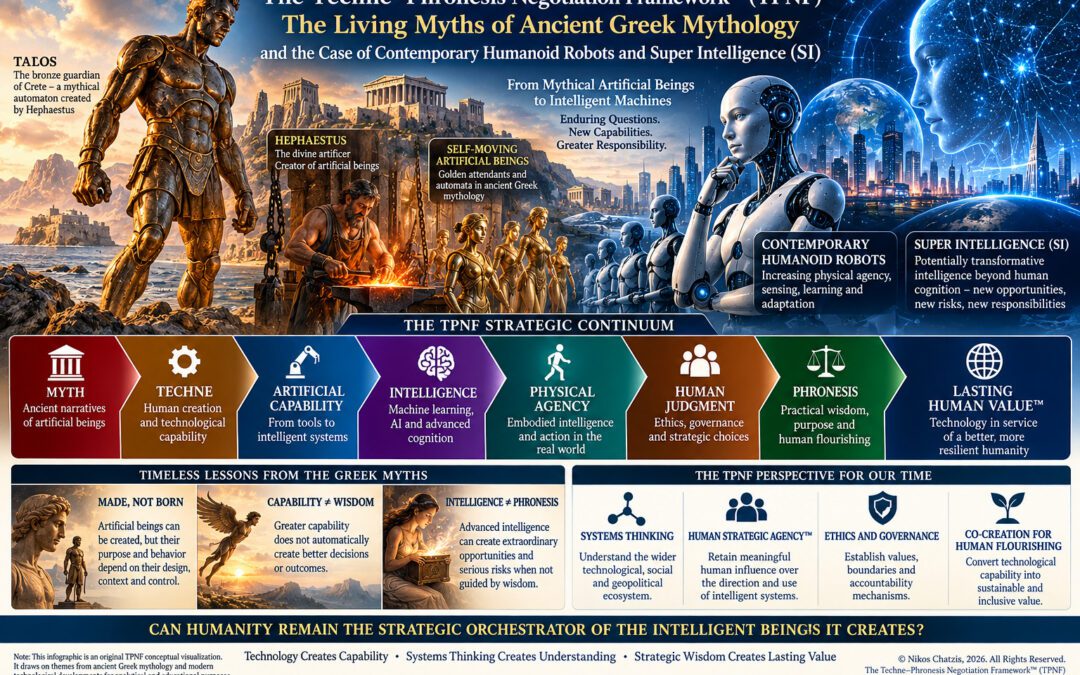
Through the Techne–Phronesis Negotiation Framework™ (TPNF), figures such as Hephaestus, Talos, Prometheus, Daedalus and Icarus can therefore be interpreted not as predictions of modern technology, but as enduring strategic models. They remind us that technological capability (Techne) without systemic understanding and practical wisdom (Phronesis) may produce extraordinary power without an equally developed capacity to govern its consequences.
Purpose of the Essay
The purpose of this essay is to examine how selected myths of Ancient Greek mythology can provide enduring conceptual lenses for understanding the strategic challenges emerging from contemporary humanoid robotics, embodied artificial intelligence and the possible future development of Artificial Superintelligence.
The essay does not argue that Ancient Greek mythology predicted modern AI. Instead, through TPNF, it explores how ancient myths illuminate recurring dilemmas involving technological creation, delegated agency, expanding capability, control, responsibility and human judgement.
Its central purpose is to demonstrate that technological advancement cannot be evaluated through capability alone. As increasingly autonomous technologies enter human systems, Techne must be accompanied by Systems Thinking and Phronesis.
Abstract
Humanoid robots increasingly combine artificial intelligence, perception, mobility, dexterity and interaction within machines designed to operate in environments created for humans. At the same time, discussion of future Artificial Superintelligence raises a larger question: what happens if created technological capability eventually approaches or exceeds the cognitive capabilities of its creators?
Ancient Greek mythology explored structurally similar dilemmas long before modern robotics. Talos embodied artificial guardianship; Hephaestus created artificial assistants; Prometheus transformed human capability by transferring powerful knowledge; and Daedalus demonstrated both technological genius and the dangers arising when capability becomes separated from prudent judgement.
TPNF interprets these myths through a contemporary strategic lens. Their enduring relevance lies not in technological prediction, but in their understanding of a fundamental problem: humanity repeatedly learns how to create new capabilities before it fully learns how to govern them.
Introduction: When Myth Meets the Robot
Imagine Talos walking today.
The bronze guardian of Crete would no longer appear entirely impossible. He might have actuators instead of mythical bronze muscles, sensors instead of supernatural perception, batteries instead of a mysterious life-source, and artificial intelligence instead of divinely assigned instructions.
Talos was imagined as an artificial entity able to move through the physical world and execute a protective mission. Ancient mythology also attributed artificial servants and self-moving mechanisms to Hephaestus.
But Talos is significant for another reason.
He possessed power without human wisdom.
That distinction takes us directly into TPNF.
Hephaestus and the Ancient Dream of Artificial Capability
Hephaestus represents Techne in one of its purest mythological forms: the capacity to transform knowledge, materials and imagination into functional capability.
The myths surrounding his workshop describe self-moving devices and artificial assistants. The ancient imagination had therefore already explored an important conceptual possibility: something did not necessarily have to be biologically human to perform functions associated with human agency.
Modern humanoid robotics follows a comparable functional ambition.
Engineers seek to combine mechanics, perception, control, learning and interaction within machines capable of operating in human environments.
TPNF, however, introduces an essential distinction:
Creating capability is not equivalent to creating wisdom.
A machine may become extraordinarily capable without understanding why a particular action should—or should not—be performed.
Talos: From Bronze Guardian to Embodied AI
Talos offers an even stronger analogy.
He was not simply artificial. He possessed a mission: protecting Crete.
In contemporary terminology, we might describe him conceptually as an embodied autonomous security agent operating under delegated authority.
Modern AI is increasingly moving beyond the computer screen into the physical environment. Humanoid robotics represents part of this transition toward embodied intelligence: artificial intelligence connected to machines capable of perceiving, moving and acting within physical space.
Present humanoid robots remain limited and should not be confused with human-level intelligence or superintelligence. Nevertheless, their development raises an increasingly important strategic question:
What happens when humans delegate meaningful action to artificial agents?
Talos therefore becomes more than an ancient metaphor for a robot.
He represents the enduring problem of delegated technological power.
Prometheus and the Expansion of Capability
Prometheus represents another dimension of technological transformation.
His gift was not simply fire. Fire represents transferable capability.
Once transferred, it could support warmth, metallurgy, agriculture, construction, warfare and ultimately civilization.
Artificial intelligence possesses a similar strategic characteristic. It is not confined to a single outcome. It expands the range of actions available to individuals, organizations and states.
TPNF interprets this as an expansion of the strategic possibility space.
AI can contribute to scientific discovery, medicine, industrial productivity and creativity. The same technological foundations may also strengthen surveillance, manipulation, autonomous warfare or cyber operations.
Technology therefore changes what actors can do.
It does not determine what they should do.
That difference separates Techne from Phronesis.
Daedalus, Icarus and the Capability–Wisdom Gap
The myth of Daedalus and Icarus provides perhaps the clearest TPNF warning.
Daedalus successfully created the capability of flight.
The technology worked.
The tragedy emerged not because the capability failed, but because the limits governing its use were violated.
This suggests a broader TPNF concept:
The Capability–Wisdom Gap — the distance between what technological systems enable actors to do and their capacity to understand, govern and wisely constrain the consequences.
Humanoid robotics remains far from the autonomous human-equivalent machines imagined in popular culture. But the technological trajectory matters.
If increasingly sophisticated robotics is eventually combined with highly advanced general-purpose AI—and hypothetically with future superintelligence—the strategic problem becomes deeper.
Humanity would no longer be designing only increasingly powerful tools.
It could be negotiating the boundaries of agency between humans and increasingly autonomous technological systems.
Superintelligence and the Return of the Mythological Question
Artificial Superintelligence remains hypothetical.
Nevertheless, the concept forces us to confront a question mythology repeatedly explored:
Can the creator continue controlling the created when the created acquires capabilities beyond the creator’s original expectations?
Greek myths rarely present technological knowledge as a simple binary choice between good and evil. Instead, they repeatedly explore limits, consequences and responsibility.
Prometheus transfers power.
Daedalus creates transformative capability.
Hephaestus creates artificial agents.
Talos exercises delegated authority.
Icarus demonstrates the consequences of capability detached from judgement.
Together, these myths form something resembling an ancient conceptual map of technological civilization.
TPNF translates that map into contemporary strategic language.
The TPNF Interpretation
The TPNF triad provides a framework for interpreting this transition:
Technology Creates Capability.
Humanoid robotics, embodied AI and potentially more advanced intelligence expand the range of technologically possible actions.
Systems Thinking Creates Understanding.
These technologies cannot be evaluated independently. They interact with employment, economics, defense, law, education, culture, geopolitics and human identity.
Strategic Wisdom Creates Lasting Value.
The decisive question is not simply whether humanity can create increasingly intelligent machines.
It is whether humanity can develop the wisdom, institutions and governance mechanisms required to integrate them without losing meaningful human agency.
This is where ancient mythology becomes unexpectedly contemporary.
Strategic Implications
The emerging humanoid-AI ecosystem should not be understood merely as another industrial revolution. It represents an evolving negotiation among technology, society and human purpose.
Companies negotiate between automation and employment. Governments negotiate between innovation and regulation. States negotiate between technological cooperation and strategic competition. Engineers negotiate between capability and safety. Societies negotiate between convenience and autonomy.
Humanity may eventually confront the deepest negotiation of all: determining which forms of agency and decision-making should remain fundamentally human.
The future of AI is therefore not solely an engineering problem.
It is a strategic negotiation about the architecture of human agency.
Talos never existed as a historical robot. Prometheus did not historically steal fire from Olympus. Icarus did not literally fall from the sky.
Yet the strategic problems represented by these myths remain alive.
Human beings continue to create capabilities that transform their environment faster than societies can fully understand their consequences. Humanoid robots and the possibility of future superintelligence bring this ancient tension into a new technological age.
The challenge is therefore not to choose between technological progress and human wisdom.
It is to integrate them.
That is precisely the purpose of the Techne–Phronesis Negotiation Framework™:
Technology Creates Capability.
Systems Thinking Creates Understanding.
Strategic Wisdom Creates Lasting Value.
The enduring lesson may therefore be simple:
The greater the capability humanity creates, the greater the wisdom required to govern it.
Key Takeaways
- Ancient Greek mythology provides enduring conceptual models of technological capability, artificial agency and responsibility.
- Hephaestus represents the creative power of Techne, while Talos illustrates delegated technological agency.
- Prometheus symbolizes the transformative consequences of transferring powerful capabilities.
- Daedalus and Icarus illuminate the Capability–Wisdom Gap between technological possibility and prudent action.
- Humanoid robotics moves AI toward increasingly embodied forms of agency.
- Artificial Superintelligence remains hypothetical and must be distinguished from present humanoid robotics.
- TPNF argues that technological capability must be integrated with Systems Thinking and Phronesis.
- The fundamental strategic question concerns the future distribution of agency among humans, institutions and increasingly intelligent technological systems.
Author’s Reflection
Ancient Greek mythology did not provide technical blueprints for artificial intelligence. It achieved something more enduring: it explored what human beings do when they acquire powers they are not yet fully prepared to govern.
Humanoid robots and the prospect of superintelligence make those questions visible again.
For TPNF, this is precisely where Techne must meet Phronesis. Our greatest strategic challenge may not be creating machines more capable than ourselves. It may be ensuring that technological intelligence develops alongside human strategic wisdom.
© Nikolaos Chatzis. All Rights Reserved.
The Techne–Phronesis Negotiation Framework™ — An Integrative Theory of Strategic Negotiation, Complex Adaptive Systems & Practical Wisdom.
Technology Creates Capability • Systems Thinking Creates Understanding • Strategic Wisdom Creates Lasting Value.
Negotiation.gr | Strategic Wisdom for the Technological Age
Nikos Chatzis
Source: Open Sources Analysis, Relative Data Analysis by Nikos Chatzis
© Nikolaos Chatzis. All Rights Reserved.
The Techne–Phronesis Negotiation Framework™
An Integrative Theory of Strategic Negotiation, Complex Adaptive Systems and Practical Wisdom
Technology Creates Capability • Systems Thinking Creates Understanding • Strategic Wisdom Creates Lasting Value.
Negotiation.gr | Strategic Wisdom for the Technological Age