Negotiation.gr | Strategic Wisdom for the Technological Age
“Strategic resilience emerges when technical capability (techne) is
continuously guided by practical wisdom (phronesis) through adaptive
negotiation across interconnected systems.”
Central Idea — Thesis
Alexander the Great’s strategic importance cannot be understood through battlefield victories alone.
His extraordinary expansion depended upon something more complex: the interaction of military capability, political adaptation, logistics, administration, cultural engagement, intelligence, leadership and strategic judgment.
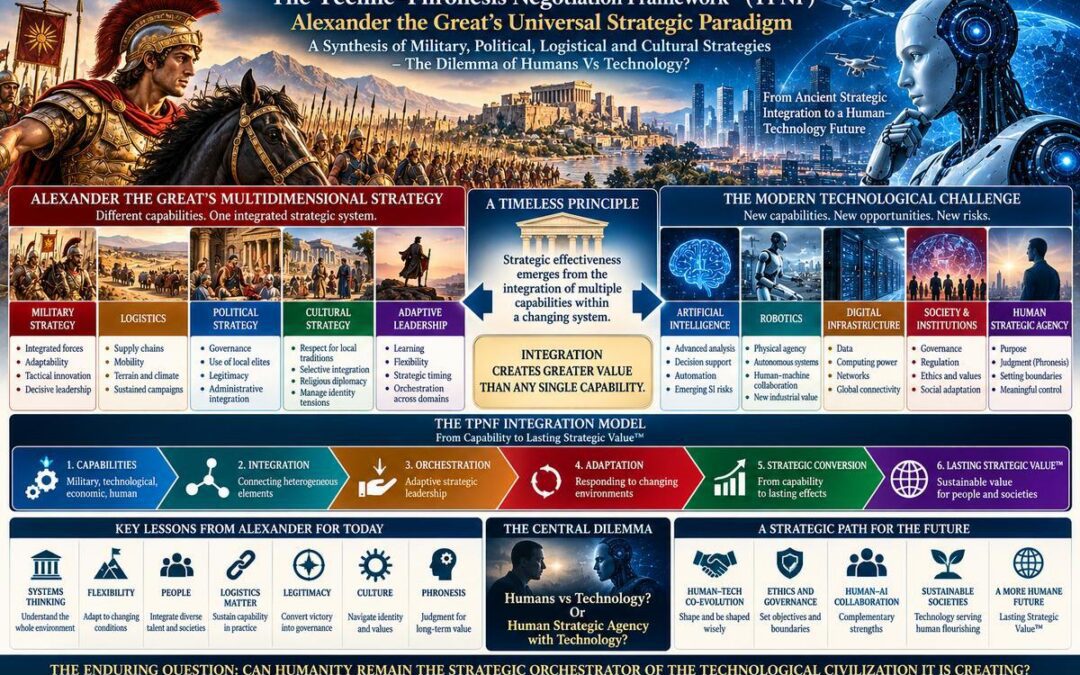
Alexander therefore offers the Techne–Phronesis Negotiation Framework™ (TPNF) a powerful historical paradigm of Integrated Strategic Capability™.
His experience suggests that capability creates lasting effects only when different forms of power can be connected, adapted and converted toward a wider strategic purpose.
The contemporary technological age confronts humanity with an analogous—but radically different—challenge.
Artificial Intelligence, robotics and potentially Super Intelligence increasingly expand technological capability.
The fundamental question becomes:
Will humans remain strategically capable of integrating, directing and converting increasingly powerful technologies toward human purposes, or will technological capability progressively redefine the purposes themselves?
Purpose of the Essay
This TPNF essay does not argue that Alexander developed a timeless strategic formula applicable directly to modern technology.
Nor does it idealize his empire or ignore its violence and contradictions.
Instead, Alexander provides a historical case through which TPNF can examine a broader principle:
Strategic effectiveness emerges from the integration of multiple capabilities within a changing system.
The modern dilemma of Humans versus Technology may therefore be incorrectly formulated.
The deeper question is whether humanity can remain the strategic orchestrator of the technological ecosystem it is creating.
Abstract
Alexander’s campaigns demonstrate that military superiority alone cannot explain sustained strategic expansion.
Military victories had to be supported by logistics.
Conquered territories required administration.
Political authority required legitimacy.
Different populations required varying forms of accommodation.
Infrastructure and cities supported communications and control.
Local elites could become participants in the emerging imperial system.
The resulting architecture was imperfect, contested and ultimately fragile, but it demonstrated a fundamental strategic reality: capabilities create greater effects when integrated across domains.
TPNF defines this as Multidimensional Strategic Integration™.
The technological age produces a comparable integration challenge involving humans, AI, robotics, digital infrastructure, institutions and society.
Humanity’s future strategic advantage may therefore depend less upon competing directly with machines and more upon retaining the capacity to integrate technological capability with human purpose, ethical judgment and Phronesis.
1. Alexander Beyond the Battlefield
Alexander is commonly remembered through battles:
Granicus.
Issus.
Gaugamela.
Hydaspes.
But battles explain only part of his achievement.
A victorious army that cannot move cannot conquer.
An army that cannot obtain food cannot campaign.
Territory that cannot be administered cannot remain controlled.
Populations that cannot be politically managed continuously consume military resources.
Alexander’s strategic system therefore operated across several interconnected dimensions.
TPNF describes this as:
Military Capability → Logistics → Political Control → Administrative Integration → Cultural Interaction → Strategic Adaptation.
Victory was an event.
Strategy was the system connecting events.
2. Military Strategy: Integration Rather Than a Single Weapon
Alexander’s military effectiveness emerged partly from combining capabilities.
The Macedonian phalanx provided cohesion.
Companion cavalry offered mobility and concentrated striking power.
Light infantry provided flexibility.
Engineers supported siege warfare and mobility.
Alexander repeatedly adapted these instruments to different opponents and environments.
This resembles a central TPNF proposition:
Capability Integration > Isolated Capability.
No single component necessarily explains strategic superiority.
Value emerges from relationships among components.
The same principle increasingly characterizes technological civilization.
AI, robotics, semiconductors, energy and digital networks become strategically significant through integration.
3. Logistics: The Invisible Architecture of Strategy
Alexander’s campaigns also depended heavily upon logistics.
Armies required food, water, animals, transport and access to supply routes.
Terrain, climate, geography and agricultural conditions constrained movement.
Logistics therefore shaped what military capability could actually accomplish.
TPNF calls this Enabling Capability Infrastructure™.
A powerful army without supplies possesses theoretical rather than sustainable capability.
Modern technology faces an analogous reality.
AI requires computational infrastructure.
Computation requires semiconductors.
Data centers require electricity.
Robotics requires materials, sensors and supply chains.
Technology therefore always rests upon deeper enabling systems.
4. Political Strategy: Victory Must Become Governance
Conquest created another challenge.
What happens after military victory?
Alexander frequently retained or adapted elements of existing administrative structures and incorporated local elites into governance.
This did not eliminate resistance.
Nor did it create a stable universal political settlement.
But it revealed an important strategic understanding:
destruction of an opposing capability is different from construction of a functioning system.
TPNF defines this distinction as the Victory–Governance Conversion Gap™.
Modern technological disruption creates a similar challenge.
Inventing AI is one problem.
Creating institutions capable of governing AI is another.
5. Cultural Strategy: Power Meets Identity
Alexander also encountered societies with established traditions, religions and political cultures.
In Egypt and Babylonia he demonstrated respect toward important local religious institutions.
Later, he adopted elements of Achaemenid royal practices and incorporated Iranians into parts of his administration and military.
These policies were controversial and generated opposition among Macedonians.
The lesson is therefore not simplistic “cultural fusion.”
It is more useful:
strategic expansion creates an Integration–Identity Tension™.
Systems can gain strength by incorporating diversity while simultaneously generating resistance among groups that perceive integration as a threat to established identity or privilege.
That remains profoundly contemporary.
6. Alexander as an Adaptive Strategic Orchestrator™
The military, logistical, political and cultural dimensions together suggest a higher-order TPNF concept:
Adaptive Strategic Orchestration™.
This is the capacity to coordinate heterogeneous capabilities and continuously modify their relationships as conditions change.
Alexander did not confront the same strategic environment in Macedonia, Egypt, Persia, Central Asia and India.
Different environments required different combinations of instruments.
This makes adaptation central.
The strategic actor does not merely possess capabilities.
The strategic actor reconfigures capabilities.
7. The Technological Parallel
Modern civilization increasingly operates within another multidimensional system.
Humans → AI → Robotics → Data → Networks → Institutions → Economy → Society.
No component operates independently.
AI influences decisions.
Robotics converts digital cognition into physical agency.
Platforms organize economic and social interaction.
Algorithms influence information environments.
Digital infrastructure connects institutions.
Technology increasingly becomes embedded within the operating architecture of civilization.
The challenge therefore resembles Alexander’s strategic problem at a much higher level of complexity:
How can heterogeneous capabilities be integrated without losing strategic coherence?
8. The False Dilemma: Humans Versus Technology
The phrase “Humans versus Technology” captures genuine anxiety.
But strategically it may be misleading.
Technology is not historically external to humanity.
Humans create tools, institutions and technological systems that subsequently reshape human behavior.
The relationship is recursive.
TPNF defines this as Human–Technology Strategic Co-Evolution™:
humans shape technology while technology progressively reshapes the capabilities, choices, institutions and environments within which humans act.
The real danger is therefore not simply machines becoming more capable.
It is humans losing the capacity to determine the purposes toward which technological capability is directed.
9. Human Strategic Agency™
This leads to the decisive concept.
Human Strategic Agency™ means the capacity of human beings and institutions to define objectives, establish boundaries, evaluate consequences and retain meaningful influence over technologically mediated decisions.
Humans do not need to outperform AI computationally.
They need to remain capable of deciding:
What are we optimizing?
For whom?
Under what constraints?
With what consequences?
Toward what future?
This is where Phronesis becomes strategically indispensable.
10. From Alexander’s Integration to Technological Integration
Alexander’s paradigm can therefore be translated carefully into a contemporary TPNF architecture.
Ancient strategic integration:
Military Capability → Logistics → Politics → Administration → Culture → Adaptation → Strategic Outcome.
Contemporary technological integration:
Technology → Capability → Infrastructure → AI → Institutions → Society → Systems Understanding → Phronesis → Human Strategic Agency → Lasting Strategic Value™.
The common mechanism is not conquest.
It is integration.
Strategic capability becomes valuable when heterogeneous components can operate coherently within a wider system.
Strategic Implications
Several implications follow.
First, technological leadership cannot be reduced to technological invention.
Second, enabling infrastructure is as strategically important as visible technological capability.
Third, technological disruption requires governance just as military victory requires political organization.
Fourth, integration inevitably creates tensions among institutions, identities and established interests.
Fifth, future leadership will increasingly involve orchestration across technological, economic, institutional and human systems.
Sixth, humans do not need to remain superior to machines in every cognitive function to preserve strategic relevance.
They must preserve the ability to determine purpose.
Finally, technological civilization requires Phronesis because capability without judgment can optimize objectives without determining whether those objectives create sustainable human value.
Alexander’s enduring strategic significance lies not solely in the territory he conquered.
It lies in the multidimensional character of the strategic problem he confronted.
Military capability had to be supplied.
Victory had to become governance.
Governance had to interact with culture.
Different capabilities had to be adapted to changing environments.
His system contained contradictions and eventually proved politically fragile.
That limitation is itself instructive.
Strategic integration must not only create capability.
It must create sustainable capability.
The technological age now confronts humanity with its own integration problem.
Artificial Intelligence can expand cognition.
Robotics can expand physical agency.
Digital infrastructure can expand connectivity.
But none independently determines whether civilization becomes better.
TPNF therefore reframes the dilemma.
The future is not necessarily:
Humans versus Technology.
It is:
Humans + Technology + Systems Understanding + Phronesis → Strategic Human Agency → Lasting Human Value™.
The strategic question is not whether technology will become more powerful.
It will.
The deeper question is whether humanity will become sufficiently wise to orchestrate the power it creates.
Key Takeaways
- Alexander’s strategic achievement cannot be explained by military victory alone.
- Logistics functioned as enabling strategic infrastructure.
- Victory had to be converted into governance and political legitimacy.
- Cultural integration created opportunities but also Integration–Identity Tension™.
- Alexander provides a paradigm of Adaptive Strategic Orchestration™.
- Modern technological civilization is similarly multidimensional.
- “Humans versus Technology” is an incomplete strategic framework.
- Humans and technology exist in Human–Technology Strategic Co-Evolution™.
- Human Strategic Agency™ depends upon retaining authority over purposes, boundaries and consequences.
- Lasting Strategic Value™ requires capability to be integrated with Systems Thinking and Phronesis.
Author’s Reflection
Alexander lived in a world without computers, Artificial Intelligence, autonomous robots or digital networks.
Yet his experience reveals something enduring about strategy.
Power alone is insufficient.
Capability must be connected.
Movement must be sustained.
Victory must be converted.
Different systems must be understood.
People must be governed.
Cultures must be navigated.
And changing circumstances demand adaptation.
Today humanity possesses capabilities Alexander could never have imagined.
Yet the underlying strategic question remains remarkably familiar.
Can we integrate the capabilities available to us into a coherent system capable of serving a meaningful purpose?
Artificial Intelligence may eventually know more than we do.
Robots may perform tasks better than we can.
Computational systems may make decisions at speeds we cannot match.
That does not necessarily make humanity strategically obsolete.
But it changes the source of human strategic advantage.
Our future relevance may increasingly depend not upon being the fastest calculator or the strongest physical actor.
It may depend upon our ability to understand systems, establish purposes, exercise ethical judgment and orchestrate different forms of capability toward sustainable human flourishing.
Alexander’s strategic paradigm therefore offers neither a technological prediction nor a formula for the future.
It offers a question.
Can humanity remain the strategic orchestrator of the technological civilization it has created?
The answer may determine whether technology becomes merely humanity’s greatest capability—or the foundation of its greatest lasting value.
Nikos Chatzis
Source: Open Sources Analysis, Relative Data Analysis by Nikos Chatzis
© Nikolaos Chatzis. All Rights Reserved.
The Techne–Phronesis Negotiation Framework™
An Integrative Theory of Strategic Negotiation, Complex Adaptive Systems and Practical Wisdom
Technology Creates Capability • Systems Thinking Creates Understanding • Strategic Wisdom Creates Lasting Value.
Negotiation.gr | Strategic Wisdom for the Technological Age