Negotiation.gr | Strategic Wisdom for the Technological Age
“Strategic resilience emerges when technical capability (techne) is
continuously guided by practical wisdom (phronesis) through adaptive
negotiation across interconnected systems.”
Central Idea
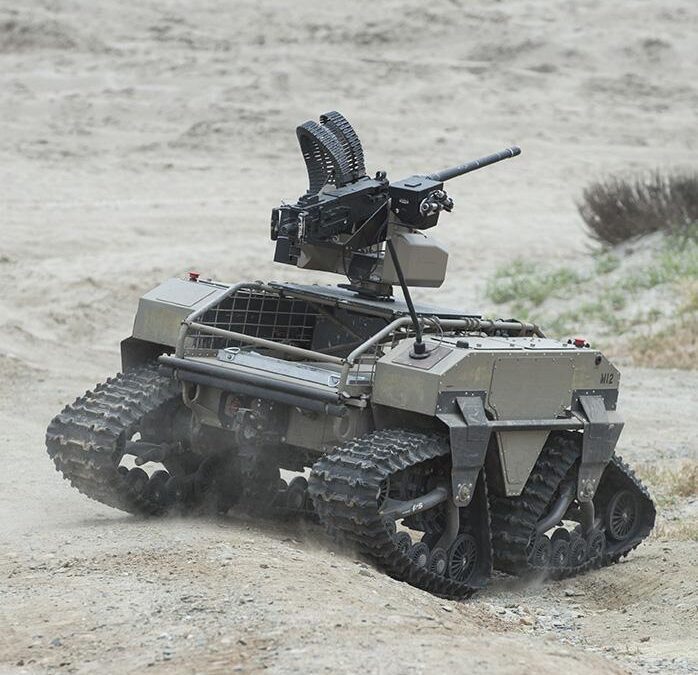
The deployment of an armed ground robot from an unmanned naval platform during combat represents more than a technological milestone; it signals the emergence of a new paradigm in warfare. Autonomous systems increasingly operate across land, sea, air, cyberspace, and the electromagnetic spectrum as interconnected ecosystems rather than isolated platforms. The Techne–Phronesis Negotiation Framework™ (TPNF) argues that this transformation reflects the evolution of Revolutionary War Robotics, where technical capability (techne), practical wisdom (phronesis), systems thinking, and adaptive strategic negotiation collectively shape the future of military innovation, strategic resilience, and responsible governance.
Purpose of the Essay
The purpose of this essay is to examine how recent battlefield developments illustrate a broader transformation in military affairs. Rather than viewing drones and robots as individual technologies, the essay explains how autonomous systems increasingly function as integrated operational ecosystems capable of coordinating intelligence, mobility, communications, logistics, and combat functions. Using the recent Ukrainian operation as a case study, the TPNF demonstrates how technological convergence is redefining operational concepts, defense innovation, and strategic adaptation.
Abstract
Recent developments in the Russo–Ukrainian War demonstrate the accelerating integration of autonomous technologies across multiple operational domains. The reported deployment of an armed ground robot from an unmanned naval platform illustrates a significant evolution in military operations, combining maritime autonomy, robotic mobility, remote command and control, and precision engagement into a unified operational concept. Rather than representing an isolated technological achievement, such operations illustrate the emergence of increasingly interconnected robotic ecosystems that redefine how military capability is generated. Recent reporting describes this as the first known combat mission of its kind.
The Techne–Phronesis Negotiation Framework™ (TPNF) interprets these developments as evidence of Revolutionary War Robotics, where technical capability (techne), practical wisdom (phronesis), systems thinking, and adaptive strategic negotiation interact continuously. The framework argues that future military effectiveness depends less upon individual autonomous platforms than upon the ability to integrate heterogeneous robotic systems into resilient, ethically governed, and strategically adaptive operational ecosystems.
Introduction
Military history has repeatedly been transformed by technological innovation.
Gunpowder altered the character of warfare.
Industrialization revolutionized logistics.
Aircraft expanded the battlespace.
Digital technologies transformed command and control.
Artificial Intelligence and autonomous systems now represent the next major transformation.
The integration of naval drones, ground robots, aerial systems, sensors, communications, and artificial intelligence demonstrates that military capability increasingly emerges through interconnected technological ecosystems rather than individual weapon platforms.
From Autonomous Platforms to Autonomous Ecosystems
Early military robotics emphasized replacing individual human tasks.
Contemporary robotic warfare increasingly integrates multiple autonomous systems into coordinated operational networks.
Unmanned surface vessels transport robotic ground vehicles.
Aerial drones provide reconnaissance.
Artificial intelligence supports decision-making.
Communication networks coordinate distributed operations.
Cyber capabilities protect digital infrastructure.
Operational effectiveness therefore emerges through ecosystem integration rather than technological isolation.
The Four Pillars of the TPNF
The emergence of Revolutionary War Robotics can be understood through the four foundational dimensions of the TPNF.
Techne develops robotics, artificial intelligence, engineering capability, autonomous navigation, sensing technologies, and operational innovation.
Phronesis provides ethical judgment, strategic prudence, proportionality, legal responsibility, and informed command decisions.
Systems Thinking explains the interaction of autonomous platforms, communications, logistics, intelligence, command structures, and operational environments.
Strategic Negotiation coordinates governments, defense industries, research institutions, military organizations, and international partners responsible for developing and governing emerging technologies.
Together these dimensions transform autonomous technologies into adaptive military ecosystems.
Revolutionary War Robotics
The defining characteristic of Revolutionary War Robotics is not autonomy alone.
It is interoperability.
Naval systems cooperate with ground robots.
Ground robots exchange information with aerial drones.
Artificial intelligence accelerates situational awareness.
Distributed sensors improve operational understanding.
Human commanders remain responsible for strategic judgment.
The result is a continuously adaptive operational ecosystem capable of learning, coordinating, and responding to dynamic battlefield conditions.
Strategic Leadership and Responsible Innovation
Technological superiority alone does not guarantee strategic success.
Military innovation must remain consistent with legal obligations, ethical principles, and political objectives.
Responsible governance therefore becomes increasingly important as autonomous systems assume more complex operational roles.
The TPNF argues that practical wisdom (phronesis) remains indispensable because strategic leadership ultimately requires human judgment regarding legitimacy, accountability, escalation management, and long-term security.
Strategic Implications
Governments should strengthen interdisciplinary research linking robotics, artificial intelligence, engineering, ethics, law, and strategic studies.
Defense industries should prioritize interoperability rather than isolated platform development.
Military organizations should develop doctrine supporting effective human–machine collaboration.
Universities should educate future leaders capable of integrating technological competence with strategic judgment.
International dialogue should continue to address responsible governance and confidence-building measures for increasingly autonomous military technologies.
Recent battlefield innovations illustrate that warfare is entering a new era characterized by increasingly integrated autonomous ecosystems operating across multiple domains.
The Techne–Phronesis Negotiation Framework™ (TPNF) explains these developments by demonstrating that sustainable military effectiveness emerges through the interaction of techne, phronesis, systems thinking, and adaptive strategic negotiation.
The future of military innovation will therefore depend not simply upon developing more sophisticated autonomous systems, but upon integrating technological capability with responsible governance, ethical leadership, institutional learning, and strategic adaptation.
Revolutionary War Robotics is ultimately not about replacing human decision-makers—it is about redefining how technological ecosystems support human strategic judgment in an increasingly complex security environment.
Source: Open Sources Analysis, Relative Data Analysis by Nikos Chatzis
© Nikolaos Chatzis. All Rights Reserved.
The Techne–Phronesis Negotiation Framework™
An Integrative Theory of Strategic Negotiation, Complex Adaptive Systems & Practical Wisdom
Technology Creates Capability • Systems Thinking Creates Understanding • Strategic Wisdom Creates Lasting Value.
Negotiation.gr | Strategic Wisdom for the Technological Age