Negotiation.gr | Strategic Wisdom for the Technological Age
Central Thesis
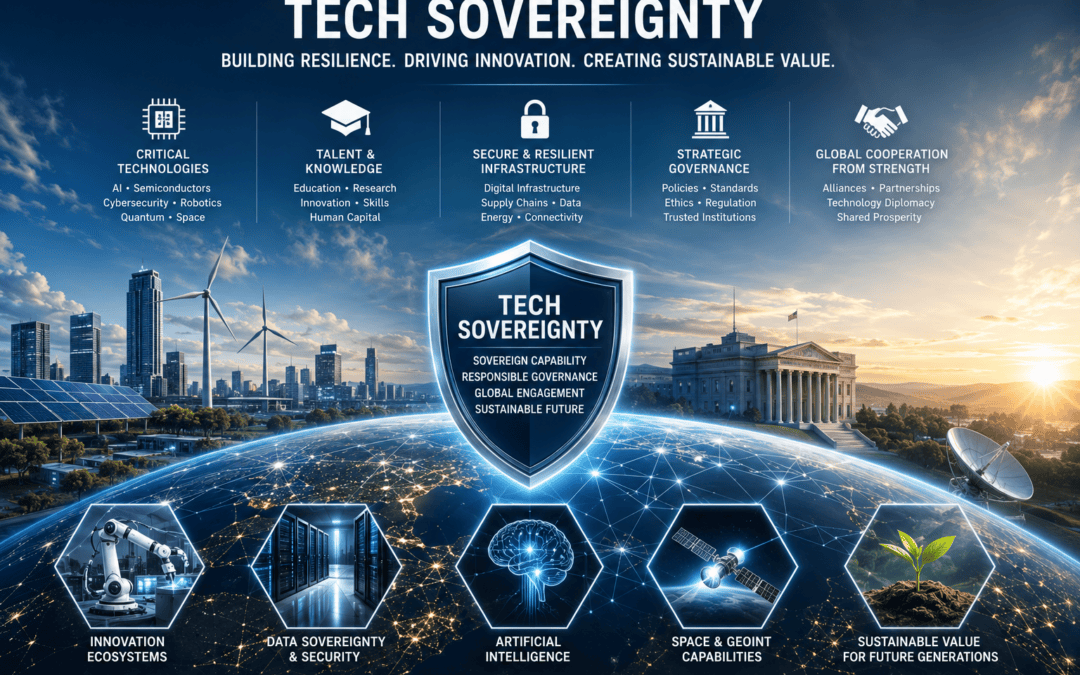
Tech Sovereignty is not merely the ability to produce advanced technologies domestically. It is the strategic capability to develop, govern, protect, and continuously innovate critical technologies while remaining an active participant in global innovation ecosystems. The Techne–Phronesis Negotiation Framework™ explains how Technology, Systems Thinking, Strategic Wisdom, Strategic Negotiation, and Platform Ecosystems transform Tech Sovereignty into sustainable value creation for future generations.
Abstract
Technological leadership has become one of the defining determinants of economic prosperity, geopolitical influence, and long-term resilience. Artificial Intelligence, semiconductors, robotics, drones, Geospatial Intelligence (GEOINT), cybersecurity, cloud computing, and digital platforms increasingly shape the strategic capabilities of nations and organizations. As a result, the concept of Tech Sovereignty has emerged as a central objective of contemporary strategy. However, Tech Sovereignty extends beyond technological self-sufficiency. It represents the capability to innovate, govern, protect, and responsibly apply critical technologies while participating effectively in global innovation ecosystems. This essay argues that The Techne–Phronesis Negotiation Framework™ provides an integrated perspective for understanding how Tech Sovereignty can become a foundation for sustainable value creation through the interaction of Technology (Techne), Systems Thinking, Strategic Wisdom (Phronesis), Strategic Negotiation, and Platform Ecosystems.
Introduction
The Human–Technology Revolution is transforming the strategic priorities of governments, industries, universities, and research institutions.
In previous decades, globalization emphasized efficiency, specialization, and internationally distributed production.
Today, increasing technological complexity, geopolitical uncertainty, cybersecurity risks, and supply chain disruptions have highlighted the importance of technological resilience.
Consequently, Tech Sovereignty has become a strategic priority.
Properly understood, it is not a withdrawal from international cooperation but the ability to innovate confidently, govern responsibly, and collaborate from a position of technological strength.
Understanding Tech Sovereignty
Tech Sovereignty is often misunderstood as technological isolation.
In reality, it is better understood as strategic capability.
It includes the capacity to:
- develop critical technologies,
- educate and attract highly skilled talent,
- secure digital infrastructure,
- protect intellectual property,
- strengthen resilient supply chains,
- support research and innovation,
- participate actively in international technological collaboration.
True sovereignty therefore combines independence of capability with openness to cooperation.
Systems Thinking and Technological Resilience
Technology ecosystems function through complex relationships among governments, industry, academia, investors, research laboratories, startups, and society.
Systems Thinking enables leaders to understand these interdependencies.
Rather than optimizing isolated organizations, strategic leaders strengthen the resilience of the entire ecosystem.
Resilient ecosystems adapt more rapidly to technological disruption, geopolitical uncertainty, and changing economic conditions.
Understanding the system becomes as important as mastering the technology itself.
The Techne–Phronesis Negotiation Framework™
The framework explains how Tech Sovereignty becomes sustainable strategic advantage.
Technology (Techne) creates capability through innovation and technical excellence.
Systems Thinking reveals the interdependence of institutions, industries, and technologies.
Strategic Wisdom (Phronesis) ensures that technological progress advances long-term human, economic, and societal objectives.
Strategic Negotiation aligns governments, companies, universities, investors, and international partners around shared strategic goals.
Platform Ecosystems integrate these capabilities into adaptive environments where innovation, learning, resilience, and collaboration continuously reinforce one another.
Together, these five dimensions transform technological capability into sustainable value.
From Capability to Sustainable Value Creation
Technological capability alone does not guarantee prosperity.
Lasting value emerges when innovation is combined with responsible governance, strategic investment, collaborative leadership, and ecosystem resilience.
Organizations and nations capable of continuously learning, adapting, and cooperating create competitive advantages that extend well beyond individual technologies or products.
Tech Sovereignty therefore becomes a long-term investment in innovation capacity rather than a short-term pursuit of technological independence.
Leadership for the Era of Tech Sovereignty
Strategic leaders increasingly serve as ecosystem architects.
Their role is to connect research with industry, innovation with regulation, national priorities with international cooperation, and technological capability with societal well-being.
Leadership therefore shifts from managing organizations toward cultivating resilient innovation ecosystems capable of generating sustainable value over time.
The Human–Technology Revolution has elevated Tech Sovereignty from a specialized policy concept to a central pillar of strategic leadership.
Its purpose is not technological isolation but the responsible development, governance, and continuous advancement of critical technologies within resilient innovation ecosystems.
The Techne–Phronesis Negotiation Framework™ explains this transformation by integrating Technology, Systems Thinking, Strategic Wisdom, Strategic Negotiation, and Platform Ecosystems into a coherent model for sustainable development.
Technology creates capability.
Systems Thinking creates understanding.
Strategic Wisdom creates direction.
Strategic Negotiation creates alignment.
Platform Ecosystems transform coordinated capabilities into resilient innovation and sustainable value.
Together, these principles demonstrate that today’s Tech Sovereignty is ultimately about creating the conditions for sustainable value creation tomorrow.
Source: Open Sources Analysis, Relative Data Analysis by Nikos Chatzis
© Nikolaos Chatzis. The Techne–Phronesis Negotiation Framework™
Technology Creates Capability • Systems Thinking Creates Understanding • Strategic Wisdom Creates Lasting Value.
Negotiation.gr | Strategic Wisdom for the Technological Age