Negotiation.gr | Strategic Wisdom for the Technological Age
Central Thesis: In technological ecosystems characterized by rapid innovation and uncertainty, sustainable competitive advantage increasingly depends on the speed of learning, adaptation, and ecosystem coordination. Efficiency remains essential, but it becomes most valuable when it supports strategic speed rather than slowing it. The Techne–Phronesis Negotiation Framework™ explains how technology, Systems Thinking, Strategic Wisdom, and negotiation enable organizations to move quickly while maintaining long-term direction.
Abstract
The accelerating pace of technological innovation is fundamentally changing the nature of competition. During the Industrial Age, organizations primarily achieved competitive advantage through operational efficiency, cost optimization, and standardized processes. In today’s technological ecosystems, however, Artificial Intelligence, drones, robotics, cloud computing, advanced communications, and digital platforms evolve so rapidly that strategic speed increasingly determines long-term success. This essay argues that sustainable competitive advantage is no longer defined solely by doing things efficiently, but by learning, adapting, collaborating, and innovating faster than competing ecosystems. The Techne–Phronesis Negotiation Framework™ explains why strategic speed, guided by Systems Thinking, Strategic Wisdom, and collaborative negotiation, has become the defining capability of technological civilization.
Introduction
Technological civilization is reshaping the meaning of strategy.
Industrial organizations competed primarily through efficiency.
Digital organizations increasingly compete through speed.
Markets evolve continuously.
Technologies become obsolete more rapidly.
Customer expectations change in real time.
Knowledge spreads instantly across global networks.
Competitive advantage therefore depends not only upon optimizing existing capabilities but also upon continuously developing new ones.
Within this environment, speed becomes a strategic capability rather than merely an operational characteristic.
The Industrial Logic of Efficiency
The Industrial Revolution rewarded organizations capable of producing standardized products with maximum efficiency and minimum cost.
Management emphasized:
- optimization,
- standardization,
- economies of scale,
- operational excellence,
- cost leadership.
These principles remain valuable today.
However, they were developed for relatively stable competitive environments.
Technological ecosystems operate under very different conditions.
The Digital Logic of Speed
Artificial Intelligence evolves within months rather than decades.
Drone technologies rapidly integrate new sensors, software, and autonomous capabilities.
Robotics continuously improve through advances in machine learning.
Platform ecosystems introduce new services at unprecedented speed.
Under these conditions, organizations waiting for perfect information frequently lose strategic opportunities.
Speed enables:
- rapid experimentation,
- continuous learning,
- accelerated innovation,
- ecosystem adaptation,
- faster customer feedback,
- earlier market positioning.
Strategic speed therefore creates options that pure efficiency cannot.
Systems Thinking Explains Strategic Speed
Speed is often misunderstood as moving quickly without direction.
Systems Thinking demonstrates the opposite.
Organizations capable of understanding relationships across technologies, institutions, supply chains, users, regulators, and markets make better decisions more rapidly because they recognize patterns earlier.
Feedback loops shorten.
Learning accelerates.
Adaptation becomes continuous.
Systems Thinking therefore transforms speed from simple acceleration into intelligent responsiveness.
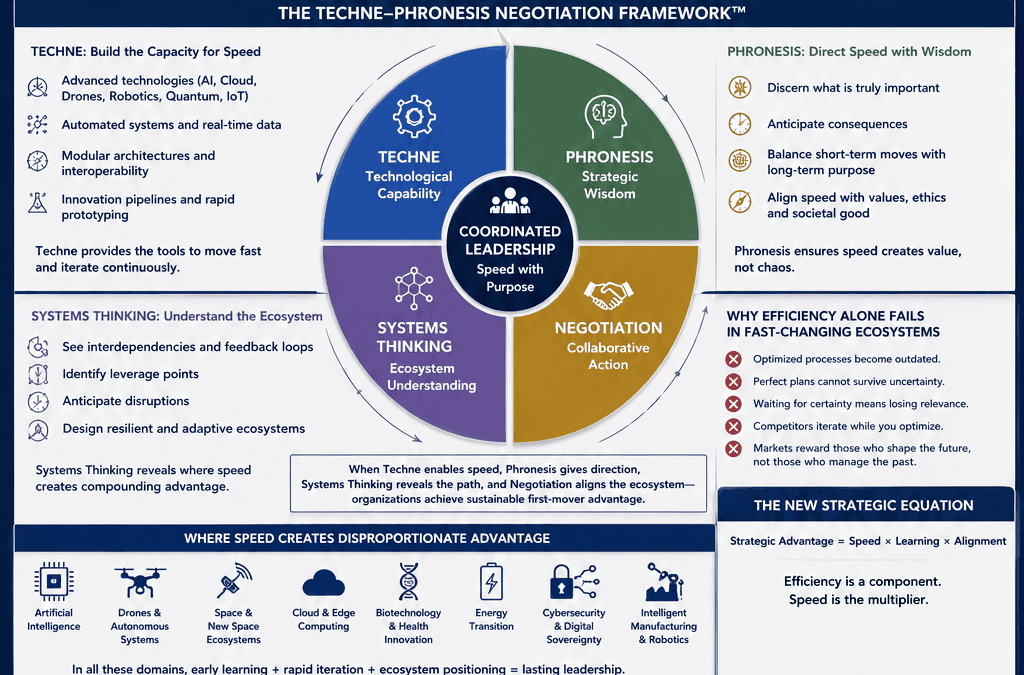
The Techne–Phronesis Negotiation Framework™
The framework explains strategic speed through four complementary dimensions.
Techne provides technological capability.
Advanced digital technologies enable rapid experimentation, automation, data analysis, and scalable innovation.
Systems Thinking provides ecosystem understanding.
Leaders recognize interdependencies and anticipate change rather than merely reacting to it.
Phronesis ensures that speed serves purpose.
Strategic Wisdom distinguishes between moving quickly and moving wisely.
It aligns rapid action with long-term value, ethical responsibility, and sustainable development.
Negotiation enables coordinated action.
Governments, companies, universities, investors, and international partners synchronize decisions, share knowledge, and build trust.
Collective speed often exceeds individual speed.
Why Efficiency Alone Is No Longer Enough
Efficiency remains indispensable.
Yet organizations optimized exclusively for efficiency frequently become less adaptable.
Processes become rigid.
Decision-making slows.
Innovation declines.
Risk avoidance replaces experimentation.
Technological ecosystems reward organizations capable of balancing operational excellence with continuous adaptation.
Efficiency supports competitiveness.
Strategic speed shapes the future.
Leadership in the Age of Strategic Speed
Leadership today requires a new mindset.
Rather than asking:
“How can we optimize existing operations?”
Leaders increasingly ask:
“How quickly can we learn, adapt, and create new value?”
Strategic leaders cultivate cultures that encourage experimentation, interdisciplinary collaboration, knowledge sharing, and continuous improvement.
They understand that resilience emerges through learning rather than perfection.
The Future of Strategy
The next generation of competitive advantage will increasingly depend upon ecosystems capable of integrating:
- Artificial Intelligence,
- autonomous systems,
- robotics,
- cloud computing,
- advanced manufacturing,
- human creativity,
- strategic collaboration.
Organizations that learn faster than their competitors will continuously redefine industry boundaries.
The future therefore belongs to ecosystems that combine technological capability with strategic wisdom.
The transition from industrial civilization to technological civilization is transforming the foundations of strategy.
Efficiency remains a vital organizational capability, but it no longer guarantees long-term leadership.
The Techne–Phronesis Negotiation Framework™ demonstrates that sustainable competitive advantage increasingly arises from the speed of learning, ecosystem coordination, Systems Thinking, Strategic Wisdom, and collaborative negotiation.
Technology creates capability.
Systems Thinking accelerates understanding.
Strategic Wisdom provides direction.
Negotiation synchronizes collective action.
Together, these principles enable organizations and societies not merely to respond to change, but to shape it.
In the age of technological ecosystems, efficiency remains essential.
But strategic speed—guided by wisdom—is what transforms innovation into lasting competitive advantage.
Source: Open Sources Analysis, Relative Data Analysis by Nikos Chatzis
© Nikolaos Chatzis. The Techne–Phronesis Negotiation Framework™
Technology Creates Capability • Systems Thinking Creates Understanding • Strategic Wisdom Creates Lasting Value.
Negotiation.gr | Strategic Wisdom for the Technological Age