Negotiation.gr | Strategic Wisdom for the Technological Age
Central Thesis
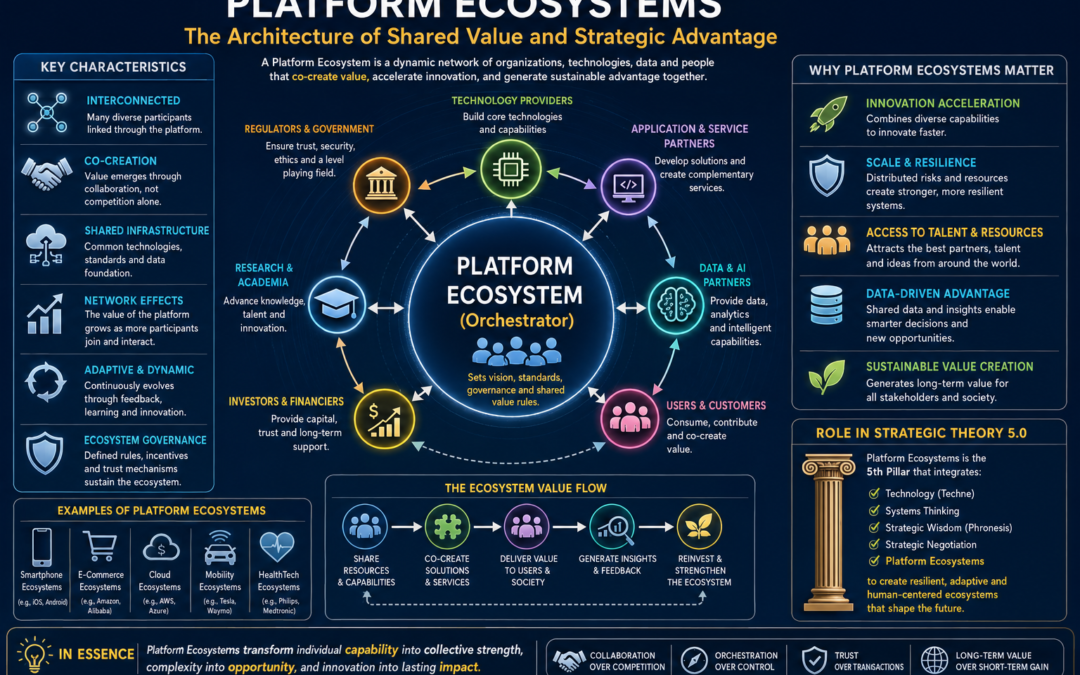
The Techne–Phronesis Negotiation Framework™ originally integrated four complementary dimensions—Technology (Techne), Systems Thinking, Strategic Wisdom (Phronesis), and Strategic Negotiation—to explain how complex technological ecosystems could be governed effectively. As technological civilization evolved, Platform Ecosystems emerged as the strategic environment in which these four dimensions operate. Rather than replacing the original framework, Platform Ecosystems became its fifth pillar, forming the conceptual foundation of Strategic Theory 5.0.
Abstract
Technological civilization continues to redefine the nature of leadership, innovation, and competitive advantage. As Artificial Intelligence, robotics, drones, digital platforms, and interconnected ecosystems reshape global markets, strategic thinking must evolve accordingly. The Techne–Phronesis Negotiation Framework™ was originally developed around four complementary pillars—Technology (Techne), Systems Thinking, Strategic Wisdom (Phronesis), and Strategic Negotiation—to explain how organizations could govern increasingly complex technological ecosystems. Continued research into platform-based competition, ecosystem strategy, and digital transformation has demonstrated that these four pillars operate within a broader strategic environment: Platform Ecosystems. This essay explains why Platform Ecosystems naturally emerged as the fifth pillar of the framework, providing the conceptual foundation for Strategic Theory 5.0.
Introduction
Every conceptual framework evolves as new evidence, technologies, and strategic realities emerge.
The Techne–Phronesis Negotiation Framework™ was initially designed to integrate technological capability with human judgment, Systems Thinking, and negotiation in order to explain the governance of increasingly complex technological ecosystems.
As the framework expanded through applications in drones, robotics, Geospatial Intelligence (GEOINT), Artificial Intelligence, technology diplomacy, innovation ecosystems, and digital transformation, a broader pattern became increasingly evident.
The principal unit of competition was no longer the individual organization.
It had become the platform ecosystem.
This realization represents an evolutionary step in the framework rather than a departure from its original philosophy.
The Original Four Pillars
The first stage of the framework rested upon four interconnected principles.
Technology (Techne)
Technology expands human capability by enabling innovation, automation, connectivity, and new forms of value creation.
Systems Thinking
Systems Thinking explains the relationships among technologies, organizations, institutions, knowledge, and society, allowing leaders to understand complexity rather than isolated events.
Strategic Wisdom (Phronesis)
Strategic Wisdom provides judgment, aligning technological capability with ethical responsibility, long-term resilience, and sustainable development.
Strategic Negotiation
Strategic Negotiation coordinates diverse stakeholders, creating trust, cooperation, and shared value across increasingly interconnected technological environments.
Together, these four pillars formed a coherent model for governing technological complexity.
Why the Framework Continued to Evolve
As research expanded across multiple technology sectors, a recurring observation emerged.
Artificial Intelligence, drone industries, robotics, cloud computing, advanced manufacturing, and digital platforms were not competing solely through products or individual organizations.
They increasingly competed through interconnected ecosystems that integrated technology developers, suppliers, universities, governments, investors, researchers, startups, regulators, and users.
The environment itself had become strategic.
Understanding leadership therefore required understanding ecosystems.
Platform Ecosystems as the Fifth Pillar
Platform Ecosystems represent the environment within which the original four pillars interact.
Technology generates capability.
Systems Thinking explains ecosystem dynamics.
Strategic Wisdom establishes long-term direction.
Strategic Negotiation aligns participants.
Platform Ecosystems provide the organizational architecture through which these capabilities create innovation, resilience, and sustained competitive advantage.
Rather than functioning as an additional independent concept, Platform Ecosystems integrate and amplify the contribution of every other pillar.
They transform individual capabilities into collective strategic performance.
From Four Pillars to Strategic Theory 5.0
The addition of Platform Ecosystems does not replace the original framework.
Instead, it extends it.
The resulting Strategic Theory 5.0 rests upon five complementary pillars:
- Technology (Techne) – Expanding human capability.
- Systems Thinking – Understanding complexity and interdependence.
- Strategic Wisdom (Phronesis) – Providing ethical and long-term direction.
- Strategic Negotiation – Aligning stakeholders through collaboration.
- Platform Ecosystems – Integrating capabilities into resilient systems that continuously generate innovation and value.
Together, these pillars reflect the strategic realities of technological civilization.
Leadership in Technological Civilization
Leadership increasingly involves orchestrating ecosystems rather than managing isolated organizations.
Strategic leaders cultivate collaboration among governments, universities, industries, research institutions, investors, and technology firms.
Their objective extends beyond organizational success to the long-term resilience of the ecosystem itself.
Within this perspective, competitive advantage emerges from coordination, adaptability, learning, and shared innovation.
The evolution of The Techne–Phronesis Negotiation Framework™ reflects the evolution of technological civilization itself.
The original four pillars continue to define the essential capabilities required for governing complexity.
The recognition of Platform Ecosystems as the fifth pillar acknowledges that these capabilities operate within interconnected environments where innovation increasingly emerges through collaboration rather than isolation.
Strategic Theory 5.0 therefore represents an evolutionary extension of the framework.
Technology creates capability.
Systems Thinking creates understanding.
Strategic Wisdom creates direction.
Strategic Negotiation creates alignment.
Platform Ecosystems transform coordinated capabilities into resilient innovation and sustainable value.
Together, these five pillars provide an integrated strategic perspective for leading organizations, industries, and societies within the Human–Technology Revolution.
Source: Open Sources Analysis, Relative Data Analysis by Nikos Chatzis
© Nikolaos Chatzis. The Techne–Phronesis Negotiation Framework™
Technology Creates Capability • Systems Thinking Creates Understanding • Strategic Wisdom Creates Lasting Value.
Negotiation.gr | Strategic Wisdom for the Technological Age