Negotiation.gr | Strategic Wisdom for the Technological Age
Abstract
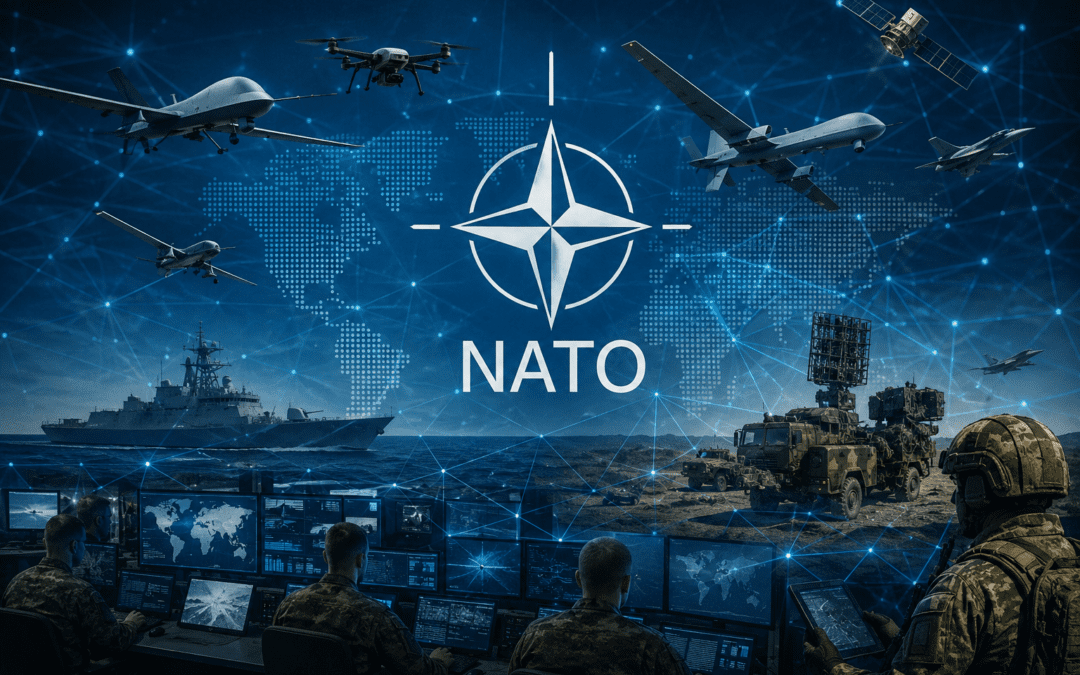
The North Atlantic Treaty Organization is undergoing one of the most significant transformations in its history. While NATO has traditionally been understood as a military alliance based on collective defense, the rapid evolution of Artificial Intelligence, autonomous systems, cybersecurity, space technologies, geospatial intelligence, and digital communications is fundamentally changing its operational structure. This essay argues that NATO is increasingly evolving into a multidomain technology ecosystem in which military capability depends upon the integration of innovation, digital infrastructure, research institutions, industry, governments, and allied cooperation. Within this transformation, drone technologies and network-centric warfare represent central pillars of NATO’s future operational effectiveness.
Introduction
Modern warfare is no longer determined solely by the number of soldiers, aircraft, or armored vehicles.
Victory increasingly depends upon information.
Connectivity.
Artificial Intelligence.
Autonomous systems.
Cybersecurity.
Space capabilities.
Geospatial intelligence.
These technologies transform military organizations into interconnected digital ecosystems.
NATO therefore evolves beyond a traditional military alliance.
It increasingly functions as a technology ecosystem capable of integrating innovation across multiple nations, industries, and operational domains.
The Transformation of NATO
During the Cold War, NATO’s strategic advantage relied primarily upon conventional military strength and nuclear deterrence.
Today’s security environment demands something different.
Modern deterrence increasingly depends upon:
- technological superiority,
- digital integration,
- resilient supply chains,
- innovation capacity,
- multinational interoperability,
- rapid decision-making.
Technology becomes an operational domain rather than merely a support function.
NATO as a Technology Ecosystem
A technology ecosystem integrates diverse participants that collectively generate innovation.
Within NATO these include:
- national governments,
- armed forces,
- defense industries,
- universities,
- research laboratories,
- technology companies,
- startups,
- venture capital,
- operational commands,
- allied institutions.
Innovation emerges through collaboration rather than isolated development.
The ecosystem itself becomes NATO’s strategic advantage.
Artificial Intelligence
Artificial Intelligence increasingly functions as NATO’s analytical engine.
AI supports:
- intelligence analysis,
- predictive logistics,
- cyber defense,
- autonomous navigation,
- decision support,
- battlefield awareness,
- maintenance planning,
- sensor fusion.
Rather than replacing military leadership, Artificial Intelligence expands human decision-making capacity.
Human judgment remains essential.
Drone Ecosystems
Drones represent one of the clearest examples of ecosystem integration.
A modern drone mission combines:
- aerospace engineering,
- satellite communications,
- Artificial Intelligence,
- geospatial intelligence,
- cloud computing,
- digital mapping,
- autonomous navigation,
- cybersecurity,
- electronic warfare.
The aircraft itself becomes only one component within a much larger technological ecosystem.
Military effectiveness therefore depends upon ecosystem performance rather than platform performance alone.
Network-Centric Warfare
Network-centric warfare fundamentally changes military operations.
Instead of individual platforms operating independently, every asset becomes connected.
Sensors detect.
Satellites communicate.
Artificial Intelligence analyzes.
Command centers coordinate.
Drones observe.
Ground forces respond.
Information flows continuously throughout the operational network.
Decision cycles become dramatically shorter.
This integration creates information superiority.
Geospatial Intelligence
Modern military operations increasingly depend upon geospatial intelligence.
Satellites.
Remote sensing.
Digital terrain models.
LiDAR.
Drone imagery.
Artificial Intelligence.
Together these systems create an extraordinarily detailed understanding of the operational environment.
The future battlefield becomes digitally mapped before military operations even begin.
Space and Cyber Integration
Space has become an operational domain.
Satellite communications enable:
- navigation,
- secure communications,
- missile warning,
- weather prediction,
- global positioning.
Simultaneously, cybersecurity protects the digital infrastructure supporting every military operation.
Without resilient cyber architecture, technological superiority cannot be maintained.
Innovation Ecosystems
Technological superiority cannot be achieved solely through government laboratories.
Modern defense innovation increasingly depends upon collaboration among:
- universities,
- startups,
- multinational companies,
- research institutions,
- military organizations,
- venture capital,
- public agencies.
Organizations such as the NATO Innovation Fund and the Defence Innovation Accelerator for the North Atlantic (DIANA) illustrate how the Alliance is strengthening innovation by supporting emerging and dual-use technologies across its member states.
Innovation therefore becomes decentralized.
Human Capital
Technology alone cannot guarantee military effectiveness.
Future armed forces require professionals capable of integrating:
- engineering,
- Artificial Intelligence,
- cybersecurity,
- geospatial intelligence,
- systems thinking,
- strategic leadership.
Continuous education becomes a permanent operational requirement.
Training evolves into ecosystem development.
Technology Diplomacy
NATO increasingly demonstrates that technological cooperation is also diplomatic cooperation.
Member states negotiate:
- interoperability,
- standards,
- cybersecurity,
- Artificial Intelligence governance,
- defense procurement,
- industrial cooperation.
Technology diplomacy strengthens alliance cohesion while accelerating innovation.
Strategic Resilience
Modern conflicts increasingly target societies rather than military forces alone.
Critical infrastructure.
Energy systems.
Digital communications.
Supply chains.
Cloud services.
Transportation.
Resilient ecosystems therefore become essential components of collective defense.
Military readiness and societal resilience become inseparable.
Looking Toward the Future
Future NATO operations will increasingly integrate:
- Artificial Intelligence,
- autonomous drones,
- drone swarms,
- quantum technologies,
- geospatial intelligence,
- satellite systems,
- digital twins,
- multidomain operations,
- cloud computing,
- resilient industrial ecosystems.
Technological superiority will increasingly depend upon ecosystem integration rather than individual weapons systems.
The transformation of NATO reflects one of the most important developments in contemporary security studies. The Alliance is evolving from a traditional military organization into a multidomain technology ecosystem where innovation, digital integration, Artificial Intelligence, geospatial intelligence, autonomous systems, and international cooperation determine operational effectiveness.
Within this transformation, drones and network-centric warfare represent far more than new military capabilities. They symbolize a broader shift toward interconnected technological ecosystems capable of integrating information, industry, research, diplomacy, and defense into resilient multinational networks.
The future of collective security will therefore depend not only upon military strength but upon the Alliance’s ability to continuously innovate, adapt, and cooperate across technological, industrial, academic, and governmental ecosystems.
In the twenty-first century, NATO’s greatest strategic advantage will increasingly be its capacity to function as an interconnected technology ecosystem capable of transforming knowledge into collective security.
Source: Open Sources Analysis, Relative Data Analysis by Nikos Chatzis
© Nikolaos Chatzis. The Techne–Phronesis Negotiation Framework™
Technology Creates Capability • Systems Thinking Creates Understanding • Strategic Wisdom Creates Lasting Value.
Negotiation.gr | Strategic Wisdom for the Technological Age