Negotiation.gr | Strategic Wisdom for the Technological Age
Abstract
Human civilization has experienced a series of profound transformations driven by technological innovation. The Agricultural Revolution reshaped food production, the Industrial Revolution transformed manufacturing, and the Information Revolution connected the world through digital communications. Today, humanity is entering a new phase—a technological civilization—where Artificial Intelligence, autonomous systems, geospatial intelligence, cloud computing, robotics, and interconnected innovation ecosystems increasingly define economic development, security, governance, and everyday life. Within this transformation, drones represent far more than flying machines. They have become intelligent platforms operating within complex technology ecosystems that are reshaping both civilian society and modern warfare. This essay argues that the evolution of drone technology reflects the broader transition from industrial civilization to technological civilization.
Introduction
Every great civilization has been shaped by its dominant technologies.
Steam engines transformed production.
Railways transformed transportation.
Electricity transformed industry.
Computers transformed information.
The Internet transformed communication.
Today, Artificial Intelligence and autonomous systems are transforming the relationship between humans, technology, and knowledge.
Drone technology stands at the center of this transformation.
Modern drones illustrate how technological civilization differs fundamentally from industrial civilization.
From Machines to Intelligent Systems
Industrial civilization focused primarily on machines.
Factories.
Assembly lines.
Mass production.
Mechanical engineering.
The primary objective was increasing productivity through mechanization.
Technological civilization pursues a different objective.
It creates intelligent systems capable of sensing, communicating, learning, adapting, and supporting decision-making.
Modern drones demonstrate this evolution.
They no longer function merely as aircraft.
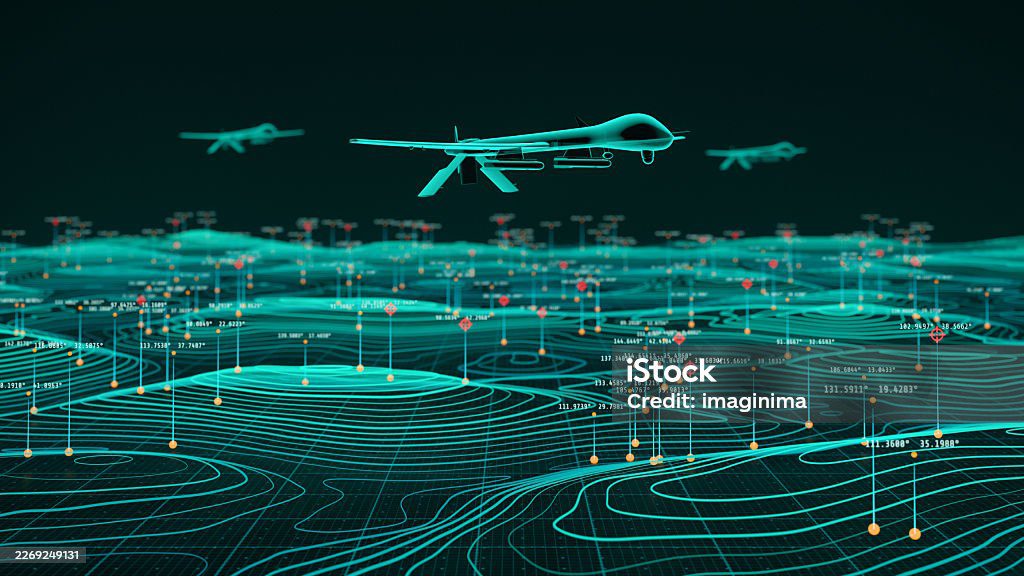
They operate as intelligent nodes within interconnected digital ecosystems.
The Evolution of Drone Technology
The earliest drones served primarily as remotely controlled platforms for reconnaissance or target practice.
Today’s systems integrate:
- Artificial Intelligence,
- geospatial intelligence,
- satellite communications,
- cloud computing,
- autonomous navigation,
- computer vision,
- cybersecurity,
- edge computing,
- advanced sensors.
The aircraft itself represents only one component of a much larger technological architecture.
Artificial Intelligence as the Cognitive Layer
Artificial Intelligence has transformed drones from remotely operated platforms into increasingly intelligent systems.
AI supports:
- object recognition,
- obstacle avoidance,
- route optimization,
- autonomous navigation,
- predictive maintenance,
- sensor fusion,
- mission planning.
Rather than simply extending human reach, drones increasingly extend human analytical capability.
GEOINT and Spatial Intelligence
Modern drone ecosystems depend upon Geospatial Intelligence.
Drone imagery becomes valuable only after it is integrated with:
- Geographic Information Systems,
- satellite imagery,
- remote sensing,
- digital terrain models,
- Artificial Intelligence,
- spatial analytics.
GEOINT transforms raw observations into actionable knowledge.
Spatial understanding becomes strategic understanding.
Civilian Transformation
The transition toward technological civilization is clearly visible in civilian drone applications.
Precision agriculture increases food security.
Infrastructure inspection improves public safety.
Digital twins support smart cities.
Environmental monitoring protects natural resources.
Emergency response accelerates disaster management.
Surveying and mapping improve infrastructure planning.
In each case, drones create value not simply through flight but through intelligent information.
Military Transformation
Military organizations have experienced a similar transformation.
Modern drones support:
- intelligence collection,
- target acquisition,
- electronic warfare,
- logistics,
- battle damage assessment,
- multidomain operations.
Their effectiveness increasingly depends upon integration with satellites, communications networks, Artificial Intelligence, and command systems.
Modern warfare therefore evolves toward interconnected defense technology ecosystems.
Drone Technology Ecosystems
The true revolution lies not within the aircraft itself but within the ecosystem surrounding it.
Drone ecosystems integrate:
- aerospace engineering,
- software development,
- Artificial Intelligence,
- geospatial intelligence,
- cybersecurity,
- cloud computing,
- communications,
- research institutions,
- universities,
- startups,
- industry,
- government.
Innovation emerges through collaboration across the entire ecosystem.
Technology Diplomacy
As drone technologies become globally important, international cooperation becomes increasingly necessary.
Technology diplomacy promotes:
- regulatory harmonization,
- research partnerships,
- safety standards,
- dual-use innovation,
- ethical governance,
- knowledge exchange.
Future technological leadership will increasingly depend upon international collaboration as well as national capability.
Human-Centered Innovation
Technological civilization does not eliminate the importance of people.
Engineers design.
Researchers innovate.
Pilots operate.
Analysts interpret.
Decision-makers establish priorities.
Artificial Intelligence accelerates analysis.
Human judgment provides purpose.
Technology remains a tool serving human society.
Strategic Wisdom
The transition toward technological civilization raises important philosophical questions.
How should emerging technologies be governed?
How can innovation remain ethical?
How should societies balance security with openness?
How can technological progress contribute to human flourishing?
These questions cannot be answered by technology alone.
They require strategic wisdom.
The Ancient Greek concept of phronesis reminds us that technical capability achieves its highest value only when guided by sound judgment, responsibility, and ethical leadership.
Looking Toward the Future
The next generation of drone ecosystems will likely include:
- fully autonomous collaborative systems,
- AI-assisted mission management,
- persistent Earth observation,
- real-time digital twins,
- advanced swarm coordination,
- predictive geospatial analytics,
- resilient communications,
- seamless civilian–military interoperability for disaster response and infrastructure protection where appropriate.
The future will increasingly be shaped by ecosystems rather than isolated technologies.
The evolution of drone technology reflects one of the defining transformations of the twenty-first century. Humanity is moving beyond an industrial civilization built upon mechanical production toward a technological civilization characterized by intelligent systems, interconnected ecosystems, digital infrastructure, and continuous innovation.
Within this transformation, drones have become far more than aerial platforms. They are intelligent components of integrated technology ecosystems connecting Artificial Intelligence, Geospatial Intelligence, cloud computing, communications, remote sensing, and human expertise.
The future of drone technology will therefore be determined not solely by advances in aerospace engineering but by the ability of societies to integrate innovation, governance, education, diplomacy, and strategic wisdom into resilient ecosystems that create lasting economic, societal, and strategic value.
The defining challenge of technological civilization is not simply inventing more advanced systems. It is ensuring that those systems remain guided by human judgment, international cooperation, and practical wisdom. In that sense, the evolution of drone technology is also the evolution of humanity’s relationship with knowledge, responsibility, and the future itself.
Source: Open Sources Analysis, Relative Data Analysis by Nikos Chatzis
© Nikolaos Chatzis. The Techne–Phronesis Negotiation Framework™
Technology Creates Capability • Systems Thinking Creates Understanding • Strategic Wisdom Creates Lasting Value.
Negotiation.gr | Strategic Wisdom for the Technological Age