Negotiation.gr | Strategic Wisdom for the Technological Age
Abstract
Human history is fundamentally a story of continuous advancement through knowledge, creativity, and innovation. Every major civilization has sought to overcome limitations by developing new tools, new ideas, and new ways of understanding the world. In the twenty-first century, this timeless aspiration has accelerated dramatically through technological breakthroughs in Artificial Intelligence, autonomous systems, biotechnology, geospatial intelligence, quantum computing, digital infrastructure, and advanced communications.
This essay argues that technology should not be viewed merely as a collection of machines or inventions but as a philosophical expression of humanity’s enduring desire to improve life, expand knowledge, solve complex problems, and create opportunities for future generations. Technological innovation is therefore not simply an economic activity; it is one of the most powerful manifestations of human curiosity, cooperation, resilience, and hope.
Introduction
Throughout history, humanity has continuously searched for better ways to live.
The invention of agriculture transformed survival.
The printing press transformed knowledge.
Electricity transformed industry.
The Internet transformed communication.
Artificial Intelligence is transforming decision-making.
Every technological breakthrough represents more than scientific progress.
It reflects humanity’s determination to move beyond existing limitations.
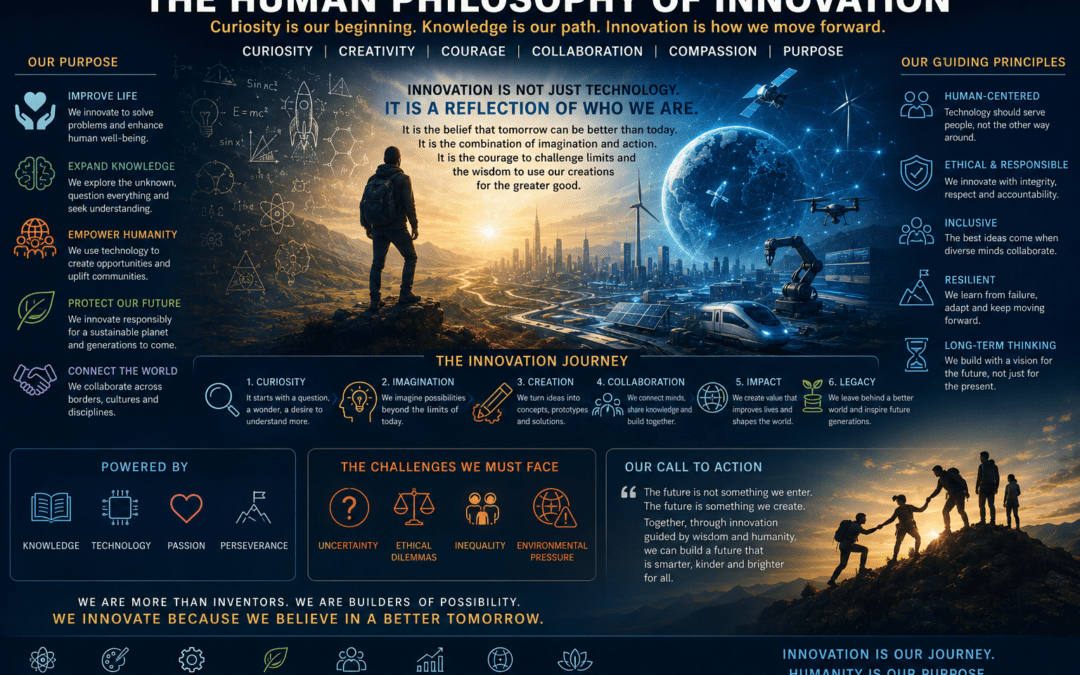
Technology therefore becomes an expression of human philosophy: the belief that tomorrow can be better than today.
Curiosity: The Beginning of Innovation
Every technological revolution begins with a question.
How can we travel farther?
How can we communicate faster?
How can we understand nature more deeply?
How can we solve problems more effectively?
Curiosity has always been humanity’s greatest innovation engine.
Scientific research, exploration, and experimentation transform curiosity into discovery.
Discovery becomes knowledge.
Knowledge becomes innovation.
Innovation becomes progress.
Knowledge as Humanity’s Greatest Resource
Natural resources may create wealth.
Knowledge creates civilizations.
Unlike physical resources, knowledge expands when shared.
Every scientific discovery becomes a foundation for future discoveries.
Every generation inherits accumulated knowledge while contributing new understanding.
The knowledge society therefore represents humanity’s most valuable ecosystem.
Technology accelerates this continuous cycle of learning and creation.
Technology as Human Extension
Technology has always extended human capabilities.
The wheel extended mobility.
The telescope extended vision.
The computer extended calculation.
Artificial Intelligence extends analytical capacity.
Modern technologies do not replace humanity.
They amplify human potential.
When combined with creativity, ethical judgment, and strategic thinking, technology enables individuals and societies to address challenges previously considered impossible.
Innovation Ecosystems and Collective Intelligence
Modern breakthroughs rarely emerge from isolated inventors.
They develop through interconnected ecosystems involving:
- universities,
- research institutions,
- governments,
- entrepreneurs,
- technology companies,
- investors,
- international organizations.
Innovation increasingly reflects collective intelligence rather than individual achievement.
Collaboration has become the new architecture of technological progress.
The Philosophy of Continuous Improvement
Human civilization advances because individuals refuse to accept permanent limitations.
Innovation embodies optimism.
It assumes that better solutions can always be discovered.
This philosophy encourages:
- lifelong learning,
- experimentation,
- adaptation,
- resilience,
- strategic thinking.
Progress therefore becomes a mindset before it becomes a technology.
Artificial Intelligence and Human Responsibility
Artificial Intelligence represents one of humanity’s most significant technological achievements.
Yet AI also reminds us that technological capability must be guided by human wisdom.
Innovation without ethics creates uncertainty.
Innovation guided by responsibility creates trust.
The future therefore depends upon maintaining a balance between technological capability and human values.
Technology should strengthen human dignity rather than replace it.
Technology and Global Cooperation
Many of today’s greatest challenges transcend national borders.
Climate change.
Public health.
Food security.
Energy transition.
Cybersecurity.
Space exploration.
Artificial Intelligence governance.
No single nation can solve these challenges alone.
Technological progress increasingly depends upon international cooperation, technology diplomacy, scientific exchange, and innovation ecosystems capable of connecting global expertise.
The Human Dimension of Technology
Technology ultimately serves people.
Its purpose is not innovation for its own sake.
Its purpose is improving quality of life.
Successful technological development strengthens:
- education,
- healthcare,
- communication,
- environmental sustainability,
- economic opportunity,
- public safety,
- human creativity.
The greatest technological achievements are therefore measured not solely by technical sophistication but by their positive contribution to humanity.
Leadership in the Innovation Age
The innovation age requires a new type of leadership.
Future leaders must combine:
- scientific understanding,
- strategic thinking,
- ethical responsibility,
- international cooperation,
- technological literacy,
- systems thinking.
Leadership increasingly involves connecting people, ideas, institutions, and technologies into collaborative ecosystems capable of generating sustainable innovation.
Moving Forward
Human progress has never followed a straight line.
Periods of uncertainty often produce the greatest breakthroughs.
Every technological revolution creates new opportunities alongside new responsibilities.
The defining question is not whether technology will continue evolving.
It certainly will.
The defining question is whether humanity will guide technological evolution with wisdom, responsibility, cooperation, and long-term vision.
That responsibility belongs not only to scientists and engineers but also to educators, policymakers, diplomats, entrepreneurs, negotiators, and informed citizens.
The philosophy of moving forward through technological innovation reflects one of humanity’s oldest aspirations: to improve the human condition through knowledge, creativity, and collaboration. Technological breakthroughs are not isolated events but milestones in a continuous journey of exploration and collective progress.
In the twenty-first century, innovation increasingly emerges from interconnected ecosystems where science, technology, diplomacy, governance, entrepreneurship, and strategic leadership converge. These ecosystems demonstrate that the greatest achievements are rarely the product of individual genius alone; they arise from communities capable of sharing knowledge, building trust, and pursuing common goals.
Ultimately, technology is neither an end in itself nor a substitute for human judgment. It is a powerful instrument that expands our capacity to learn, cooperate, create, and solve problems. The true measure of technological progress is therefore not simply the sophistication of our inventions but the extent to which they advance human dignity, strengthen international cooperation, and enable future generations to inherit a world that is more innovative, more resilient, and more hopeful than the one we know today.
Source: Open Sources Analysis, Relative Data Analysis by Nikos Chatzis
© Nikolaos Chatzis. The Techne–Phronesis Negotiation Framework™
Technology Creates Capability • Systems Thinking Creates Understanding • Strategic Wisdom Creates Lasting Value.
Negotiation.gr | Strategic Wisdom for the Technological Age