Negotiation.gr | Strategic Wisdom for the Technological Age
“Strategic resilience emerges when technical capability (techne) is
continuously guided by practical wisdom (phronesis) through adaptive
negotiation across interconnected systems.”
Central Idea — Thesis
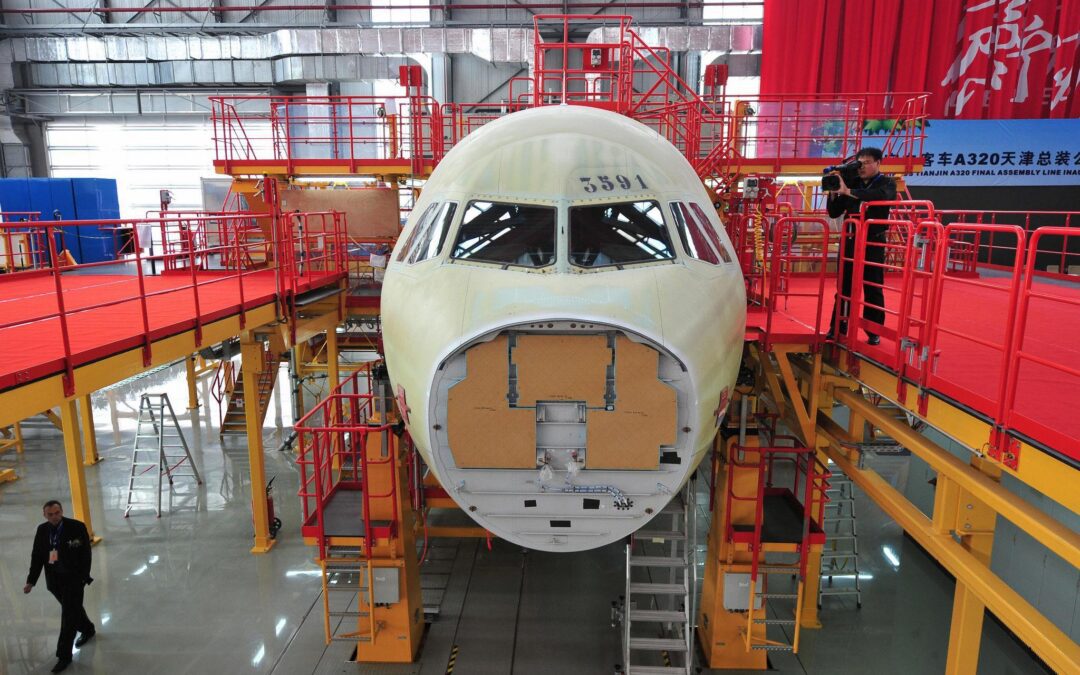
On September 16, 2026, Airbus delivered the first aircraft assembled at its second A320 Family Final Assembly Line in Tianjin, China—an A320neo delivered to China Eastern Airlines.
At first sight, this is an industrial milestone: another production line has begun delivering aircraft.
From the perspective of the Techne–Phronesis Negotiation Framework™ (TPNF), however, something strategically deeper is occurring.
Airbus is not simply manufacturing aircraft in China.
It is embedding production capacity inside one of the world’s largest aviation markets while connecting Chinese suppliers, workers, logistics infrastructure, customers and technological capabilities with its global industrial system.
The strategic progression is therefore:
Market Access → Local Production → Industrial Integration → Supply-Chain Learning → Ecosystem Embeddedness → Adaptive Global Capacity → Strategic Future Value™.
The central TPNF proposition is:
The long-term strategic value of international industrial expansion derives not merely from producing closer to customers, but from embedding productive capability within local ecosystems while preserving the capacity to integrate, coordinate and adapt those capabilities across a global technological network.
Purpose of the Essay
This TPNF essay examines Airbus’s second Tianjin Final Assembly Line as an example of how multinational technological corporations convert market presence into deeper industrial capability.
The central question is not simply why Airbus manufactures aircraft in China.
It is:
What happens when access to a major market evolves into participation within the market’s industrial ecosystem?
Abstract
Airbus delivered the first A320 Family aircraft assembled at its second Tianjin Final Assembly Line on September 16, 2026. The A320neo was delivered to China Eastern Airlines, which operates the largest Airbus fleet among mainland Chinese carriers.
The second Tianjin line was inaugurated in October 2025 and forms part of Airbus’s global production network of ten A320 Family Final Assembly Lines: four in Hamburg, two in Toulouse, two in Mobile and two in Tianjin.
The expansion supports Airbus’s objective of increasing A320 Family production capacity toward 75 aircraft per month. It also positions additional production capacity inside a market Airbus forecasts will require 8,830 new passenger aircraft between 2026 and 2045.
TPNF interprets the development through Industrial Ecosystem Embeddedness™, Distributed Production Resilience™, Market-to-Capability Conversion™ and Cumulative Industrial Learning™.
1. From Selling Aircraft to Building Aircraft
China and Airbus have developed an industrial relationship extending over four decades.
China’s first Airbus aircraft, an A310, was delivered in 1985.
In 2008, Airbus inaugurated its first Tianjin Final Assembly Line—the company’s first commercial-aircraft final assembly facility outside Europe.
More than 800 A320 Family aircraft have subsequently been assembled and delivered from Tianjin.
The second line represents another evolutionary step.
Airbus has moved progressively from:
Export → Market Presence → Local Assembly → Supplier Integration → Expanded Production → Ecosystem Participation.
This transformation matters because industrial presence creates capabilities that commercial transactions alone cannot generate.
2. Industrial Ecosystem Embeddedness™
TPNF can describe this development through Industrial Ecosystem Embeddedness™:
the degree to which a technological organization integrates its production, knowledge, suppliers, human capabilities, infrastructure and commercial relationships within a local industrial ecosystem while remaining connected to its wider global system.
An aircraft factory is therefore not an isolated building.
It depends upon transportation networks, suppliers, engineers, technicians, energy, logistics, digital systems, regulatory institutions and customers.
The strategic asset is consequently larger than the Final Assembly Line itself.
It is the network surrounding it.
3. China Is More Than a Market
Airbus forecasts that China will require 8,830 new passenger aircraft during 2026–2045, representing more than 20% of projected global passenger-aircraft demand.
Producing aircraft inside such a market creates several strategic advantages.
Production becomes geographically closer to major customers.
Industrial relationships deepen.
Local knowledge accumulates.
Supply networks develop.
Workforce experience increases.
Commercial relationships become interconnected with industrial relationships.
China therefore becomes simultaneously:
Market + Customer + Supplier + Manufacturing Location + Knowledge Environment + Industrial Partner.
That combination creates significantly deeper strategic relationships than exports alone.
4. Market-to-Capability Conversion™
This suggests another TPNF concept: Market-to-Capability Conversion™.
It can be defined as:
the process through which sustained access to a major market is transformed into productive, technological, organizational and relational capabilities that strengthen the wider industrial ecosystem.
A market creates demand.
But demand can stimulate investment.
Investment creates infrastructure.
Infrastructure develops skills.
Skills support production.
Production creates learning.
Learning strengthens future capability.
The progression becomes:
Demand → Investment → Production → Learning → Capability → Adaptation → Strategic Future Value™.
The most strategically valuable markets may therefore be those capable of becoming learning environments.
5. The Global Airbus Production Ecosystem
The second Tianjin line also demonstrates that Airbus production is becoming increasingly geographically distributed.
The company now has ten A320 Family Final Assembly Lines:
four in Hamburg,
two in Toulouse,
two in Mobile,
and two in Tianjin.
This is not simply geographical expansion.
It represents a Distributed Production Ecosystem™.
Different production centers remain connected through common aircraft designs, manufacturing standards, digital processes, suppliers, logistics systems and corporate knowledge.
The aircraft remains an Airbus product.
But the productive capability becomes geographically distributed.
6. Distributed Production Resilience™
Distributed manufacturing can provide strategic resilience.
If industrial capability is concentrated in a single location, disruption there can affect the entire system.
Geographical distribution creates alternatives.
TPNF therefore identifies Distributed Production Resilience™:
the capacity of an industrial ecosystem to preserve and adapt productive capability by distributing critical production functions across multiple interconnected locations.
But distribution does not automatically create resilience.
The locations must remain coordinated.
Suppliers must deliver.
Standards must remain consistent.
Information must circulate.
Logistics must function.
The strategic advantage comes from distributed capability combined with systemic integration.
7. The Supply Chain Becomes Strategic
Airbus executives have emphasized the increasing importance and resilience of Chinese suppliers within the company’s production system.
This illustrates another important transformation.
Suppliers are not merely companies delivering components.
Over time, they accumulate knowledge.
Production experience improves.
Quality systems mature.
Relationships deepen.
Engineering interaction expands.
The result is Cumulative Industrial Learning™.
Every aircraft assembled can contribute experience to the ecosystem that produces the next aircraft.
Industrial capability therefore becomes cumulative rather than static.
8. The Ecosystem Learning Loop™
TPNF can represent this process as:
Production → Experience → Knowledge → Process Improvement → Capability → Higher Production Capacity → New Experience.
This is the Ecosystem Learning Loop™.
Its importance extends beyond aviation.
Advanced technological industries—including semiconductors, robotics, electric vehicles, artificial intelligence infrastructure and aerospace—depend heavily upon cumulative knowledge.
Factories manufacture products.
Industrial ecosystems manufacture capabilities.
That distinction is strategically fundamental.
9. China Also Learns
The relationship creates value in both directions.
Airbus gains access to production capacity, suppliers and one of the world’s largest aviation markets.
China gains employment, industrial experience, manufacturing knowledge, supplier development and deeper participation in global aerospace production.
This does not mean that strategic interests are identical.
Airbus remains a European aerospace company.
China simultaneously supports development of its own aerospace industry, including COMAC.
Cooperation and competition can therefore exist simultaneously.
TPNF describes this broader condition as Selective Strategic Interdependence™.
Actors cooperate where relationships create value while retaining independent strategic objectives elsewhere.
10. The Interdependence–Competition Paradox™
This creates an Interdependence–Competition Paradox™:
Two technological ecosystems can become increasingly economically and industrially interconnected while simultaneously competing for technological capability, market position and long-term strategic advantage.
This is increasingly characteristic of the technological age.
The old binary distinction between partner and competitor becomes insufficient.
Modern industrial relationships frequently contain both.
11. Technology Transfer Is Not the Whole Story
Debates about international manufacturing often focus primarily on technology transfer.
That is important.
But Systems Thinking reveals a larger phenomenon.
What moves through industrial ecosystems is not merely technology.
Knowledge moves.
Standards move.
Management practices move.
Supplier relationships develop.
Workers accumulate experience.
Logistics systems improve.
Institutions learn.
The deeper strategic process is therefore Capability Diffusion™.
Technology may be transferred through specific agreements.
Capability can emerge gradually through repeated participation.
12. Airbus and Strategic Optionality™
For Airbus, geographically distributed production also creates Strategic Optionality™.
Toulouse, Hamburg, Mobile and Tianjin provide multiple centers of final assembly.
This gives Airbus additional capacity to respond to changing demand and production requirements.
The company explicitly describes the second Tianjin line as supporting flexibility and its A320 Family production ramp-up.
Strategic optionality therefore emerges not from possessing one extremely efficient factory, but from possessing a network capable of adapting collectively.
Strategic Implications
The Tianjin expansion illustrates several wider lessons.
First, major markets increasingly function as industrial ecosystems rather than merely destinations for exports.
Second, Industrial Ecosystem Embeddedness™ can deepen commercial relationships into productive and technological relationships.
Third, Market-to-Capability Conversion™ explains how demand can generate infrastructure, skills, learning and future productive capacity.
Fourth, geographically distributed manufacturing can create Distributed Production Resilience™, provided that the network remains integrated.
Fifth, repeated production generates Cumulative Industrial Learning™, allowing industrial ecosystems to become progressively more capable.
Finally, cooperation and competition can coexist through Selective Strategic Interdependence™.
The first A320neo delivered from Airbus’s second Tianjin Final Assembly Line is one aircraft.
But strategically, it represents something considerably larger.
Behind that aircraft stands a network of factories, suppliers, logistics systems, engineers, workers, customers, infrastructure and accumulated knowledge.
Techne creates the aircraft and the production technologies required to manufacture it.
Systems Thinking reveals the industrial ecosystem connecting Tianjin with Airbus’s wider global production architecture.
Ecosystem Orchestration™ coordinates distributed capabilities across countries and organizations.
Phronesis determines how such interdependence should be managed when commercial opportunity, technological competition and geopolitical uncertainty coexist.
Airbus’s expansion in China therefore demonstrates an important reality of contemporary technological civilization:
The factory creates the product. The ecosystem creates the capability. The learning generated by that ecosystem creates future strategic value.
Key Takeaways
- Airbus delivered the first aircraft from its second Tianjin A320 Family Final Assembly Line on September 16, 2026.
- China Eastern Airlines received the A320neo.
- Airbus now operates ten A320 Family Final Assembly Lines globally.
- China could represent more than 20% of global passenger-aircraft demand during 2026–2045.
- Industrial Ecosystem Embeddedness™ transforms market presence into deeper productive participation.
- Market-to-Capability Conversion™ transforms demand into accumulated industrial capability.
- Distributed Production Resilience™ can increase flexibility across the global manufacturing network.
- Cumulative Industrial Learning™ transforms repeated production into future capability.
- Selective Strategic Interdependence™ allows cooperation and competition to coexist.
- Long-term industrial advantage depends increasingly upon the capacity of ecosystems to learn, integrate and adapt.
Author’s Reflection
An aircraft leaving a production line is a visible event.
The knowledge accumulated while producing it is largely invisible.
Yet the invisible process may ultimately possess greater strategic value.
Workers become more experienced.
Suppliers become more capable.
Logistics networks become more efficient.
Institutions learn.
Industrial relationships deepen.
And the ecosystem becomes capable of producing the next aircraft more effectively.
This is why technological strategy cannot be understood by counting factories or products alone.
We must understand what capabilities are being created around them.
Airbus’s second Tianjin Final Assembly Line therefore represents more than additional production capacity.
It demonstrates how globalization is evolving from the international movement of products toward the international organization of technological capability.
And that leads to a fundamental TPNF principle:
The lasting strategic value of industrial expansion lies not simply in what an ecosystem produces today, but in the cumulative capabilities its production enables the ecosystem to create for tomorrow.
Nikos Chatzis
Source: Open Sources Analysis, Relative Data Analysis by Nikos Chatzis
© Nikolaos Chatzis. All Rights Reserved.
The Techne–Phronesis Negotiation Framework™
An Integrative Theory of Strategic Negotiation, Complex Adaptive Systems and Practical Wisdom
Technology Creates Capability • Systems Thinking Creates Understanding • Strategic Wisdom Creates Lasting Value.
Negotiation.gr | Strategic Wisdom for the Technological Age