Negotiation.gr | Strategic Wisdom for the Technological Age
“Strategic resilience emerges when technical capability (techne) is
continuously guided by practical wisdom (phronesis) through adaptive
negotiation across interconnected systems.”
Central Idea
Turkey’s preparation of draft maritime-jurisdiction legislation represents more than a bilateral legal disagreement with Greece and the Republic of Cyprus. It potentially represents an attempt to transform longstanding Turkish geopolitical positions concerning the Aegean and Eastern Mediterranean into a more permanent domestic legal and strategic architecture.
For Greece, the appropriate response should neither be passive legalism nor uncontrolled military escalation.
Through the Techne–Phronesis Negotiation Framework™ (TPNF), the appropriate strategy is Integrated Strategic Deterrence: the simultaneous reinforcement of international law, credible military capability, technological superiority, European institutional leverage, alliance diplomacy, maritime partnerships, domestic defense innovation and carefully calibrated strategic negotiation.
International law establishes legitimacy and rights. But in an international system where coercion remains possible, legitimacy must be accompanied by the capability and alliances necessary to protect the conditions under which law can operate.
The central strategic equation is therefore:
International Legitimacy + Technological Capability + Credible Deterrence + Alliance Architecture + Strategic Wisdom = Sustainable Sovereign Resilience
Purpose of the Essay
This essay examines Turkey’s draft maritime-jurisdiction legislation and the broader Greek–Turkish strategic relationship through the analytical architecture of the Techne–Phronesis Negotiation Framework™ (TPNF).
It addresses a difficult contemporary question:
What is the practical strategic value of international law when a state confronting coercive pressure does not possess sufficient capability to defend the rights that international law recognizes?
The answer proposed here is not that military power replaces law.
It is precisely the opposite.
A sophisticated state must combine law and power, legitimacy and deterrence, diplomacy and technology, alliances and national capability.
For Greece, the strategic objective should therefore be neither confrontation nor accommodation under pressure, but the construction of an ecosystem in which coercion becomes progressively less attractive, less effective and more costly.
Abstract
Turkey has prepared draft legislation intended to consolidate its maritime-jurisdiction unlawful framework across the Aegean, Mediterranean and Black Seas. The initiative has generated concern in Greece and Cyprus because Ankara’s maritime positions overlap with longstanding disputes concerning territorial waters, continental shelves, Exclusive Economic Zones, islands and the broader geopolitical balance of the Eastern Mediterranean.
The issue exists within a much deeper historical context. Turkey maintains military forces in northern Cyprus following the events of 1974. In the Aegean, the Turkish National Assembly’s 1995 resolution authorizing the government to use military means should Greece extend its territorial waters beyond six nautical miles remains in force. Greece maintains that extending territorial waters to twelve nautical miles is a sovereign right deriving from customary international law and codified by the United Nations Convention on the Law of the Sea.
Yet Turkey is simultaneously a NATO ally with substantial armed forces and an increasingly capable indigenous defense-industrial ecosystem.
This creates a strategic paradox.
Greece and Turkey are allies institutionally, competitors strategically and neighbors permanently.
TPNF argues that Greece should respond through an integrated strategy combining international law, technological capability, military deterrence, EU membership, NATO diplomacy, regional partnerships, defense innovation and Phronesis.
Introduction
When Domestic Legislation Meets International Geopolitics
A state can enact domestic legislation.
It cannot, through domestic legislation alone, unilaterally determine international maritime boundaries binding upon other states.
This distinction is essential.
Nevertheless, domestic codification matters strategically.
Legislation can institutionalize geopolitical doctrine.
It can create bureaucratic continuity.
It can influence military planning.
It can shape diplomatic negotiating positions.
It can educate future generations of policymakers around particular national interpretations.
And over time, it can attempt to transform a political claim into what appears domestically to be an established strategic reality.
Turkey’s proposed maritime legislation should therefore be evaluated not simply as a legal document but as part of a broader institutionalization of geopolitical positioning.
1. Cyprus: The Historical Strategic Context
Any comprehensive evaluation of Greek–Turkish strategic relations must include Cyprus.
Turkey intervened militarily in Cyprus in 1974 and continues to maintain substantial military forces in the northern part of the island. The internationally recognized Republic of Cyprus does not exercise effective control over that territory, while the self-declared “Turkish Republic of Northern Cyprus” is recognized only by Turkey.
For Greece and Cyprus, this is not simply historical memory.
It remains part of the contemporary Eastern Mediterranean security environment.
The Cyprus question consequently interacts with:
- maritime jurisdiction,
- energy resources,
- regional alliances,
- European security,
- Greek–Turkish relations,
- relations between Turkey and the European Union.
Within TPNF, Cyprus therefore constitutes part of the wider Eastern Mediterranean Strategic Ecosystem.
2. The Aegean and the Law of the Sea
Greece maintains that under international law it possesses the sovereign right to extend its territorial sea to 12 nautical miles.
Article 3 of UNCLOS provides that states may establish territorial seas up to twelve nautical miles.
Turkey is not a party to UNCLOS.
That fact, however, does not by itself resolve the dispute, because Greece argues that the twelve-mile rule also reflects customary international law.
Greece has already exercised this right in the Ionian Sea.
The central strategic contradiction is striking:
Turkey itself applies twelve-nautical-mile territorial waters in the Black Sea and Mediterranean while maintaining that a Greek extension beyond six nautical miles in the Aegean would constitute grounds for military action.
3. The Casus Belli: The Most Serious Strategic Anomaly
In 1995, the Turkish Grand National Assembly authorized the Turkish government to take measures, including military ones, should Greece extend its territorial waters beyond six nautical miles in the Aegean.
That authorization remains extraordinarily important.
Two NATO allies therefore coexist within the same collective-defense organization while one maintains an explicit threat involving the potential use of military force against the other under specified circumstances.
For TPNF, this creates a fundamental strategic asymmetry.
Negotiation conducted under an explicit threat of force is structurally different from negotiation among actors operating without such coercive pressure.
Greece should therefore continue systematically internationalizing the issue.
The objective should not be rhetorical confrontation.
The objective should be to establish consistently that credible European and Atlantic security cannot be fully separated from respect for the principles governing relations among allies themselves.
4. Does International Law Matter Without Military Power?
This leads to the hardest question in the essay.
What is international law worth if a country does not possess the military capability necessary to protect the rights it invokes?
The answer requires precision.
International law does not derive its legal validity from military strength.
A small state does not possess fewer legal rights simply because another state possesses a larger army.
But strategic reality introduces another dimension.
Law establishes legitimacy.
Diplomacy builds support.
Institutions create constraints.
Alliances generate collective leverage.
Military capability provides deterrence.
None can fully substitute for the others.
International law without capability may leave a state vulnerable to coercion.
Military capability without legitimacy can isolate a state and transform power into strategic liability.
The sophisticated strategy therefore combines both.
Law without power risks vulnerability.
Power without law risks illegitimacy.
Law supported by credible capability creates strategic resilience.
That is the TPNF synthesis.
5. Technology Creates Capability
The first foundational principle of TPNF states:
Technology Creates Capability.
This principle is particularly important for Greece.
Greece cannot—and should not—measure strategic strength simply by comparing the numerical size of its armed forces with Turkey’s.
Twenty-first-century military effectiveness increasingly depends upon:
- sensors,
- satellites,
- artificial intelligence,
- secure communications,
- drones,
- counter-drone technologies,
- electronic warfare,
- cyber capabilities,
- precision weapons,
- integrated air and missile defense,
- maritime domain awareness,
- network-centric command systems.
The relevant question is therefore not:
Who has more soldiers?
The more important question is:
Which state can integrate technology, intelligence, command, training, weapons, logistics and alliances into the more effective operational ecosystem?
6. Turkey’s Military Numbers — and Its Real Technological Progress
Turkey possesses NATO’s second-largest military by personnel.
But numbers alone are an inadequate measure of contemporary military power.
At the same time, Greece should avoid making the opposite analytical error: underestimating Turkish technological development.
Over the past two decades, Turkey has built a substantial defense-industrial ecosystem involving drones, missiles, electronic warfare, armored vehicles, naval systems, aerospace technologies and other military capabilities. Most of them by reverse engineering (the process of deconstructing a finished product, system, or software application to understand its inner workings, design, and functionality without access to the original plans).
Turkey’s defense exports have expanded substantially.
Therefore, the correct Greek strategic assumption is not that Turkish numerical superiority is decisive.
Nor should Athens assume that Turkish indigenous technology is insignificant.
The appropriate assumption is that Greece faces a large regional military power possessing an increasingly mature defense-technological ecosystem.
That assessment requires serious long-term strategic planning.
7. Greece Should Compete Through Quality, Integration and Innovation
Greece should not attempt to reproduce Turkey’s military structure symmetrically.
Its comparative advantage should increasingly lie in:
Quality over quantity.
Integration over mass.
Intelligence over numerical comparison.
Technological sophistication over platform accumulation.
Networked deterrence over isolated national capability.
This requires sustained investment in:
- fifth-generation aviation,
- advanced naval platforms,
- integrated air and missile defense,
- drones and autonomous systems,
- counter-drone systems,
- electronic warfare,
- cyber defense,
- artificial intelligence,
- space-based surveillance,
- precision strike,
- resilient communications.
But procurement alone is insufficient.
Greece must increasingly become a producer, integrator and innovator, not merely a purchaser of advanced foreign systems.
Greece’s Current Military Modernization: From Platform Acquisition to a Networked Defense Ecosystem
Greece’s current military modernization effort demonstrates that Athens has already begun moving toward a strategic model based increasingly on technological quality, operational integration, networked capability, and domestic defense innovation rather than numerical competition alone.
Under the broader Agenda 2030 modernization program, Greece is pursuing a long-term transformation of the Hellenic Armed Forces that extends beyond the acquisition of individual weapon systems. The objective increasingly encompasses force structure, command organization, air and missile defense, unmanned systems, digital capabilities, training, defense innovation, and greater participation by the domestic defense-industrial ecosystem.
This distinction is strategically important.
For decades, assessments of the Greek–Turkish military balance frequently concentrated on numerical comparisons: numbers of aircraft, ships, armored vehicles, personnel, and individual weapon platforms. Yet twenty-first-century warfare increasingly demonstrates that numerical superiority does not automatically translate into operational superiority.
The decisive variable is increasingly the capacity to connect sensors, platforms, weapons, communications, intelligence, electronic warfare, artificial intelligence, and command systems into a coherent operational network.
Achilles’ Shield and Integrated Defense
The emerging Achilles’ Shield architecture represents perhaps the clearest manifestation of this transition.
Rather than functioning as a single weapon system, it is intended to create a multilayered defense architecture incorporating capabilities against aircraft, missiles, drones, maritime threats, and other emerging challenges.
The strategic significance extends beyond interception.
When integrated effectively with surveillance networks, combat aircraft, naval platforms, electronic warfare, unmanned systems, and command-and-control infrastructure, such an architecture can contribute to the creation of a persistent national defensive ecosystem.
For an archipelagic country such as Greece, this could substantially increase the strategic cost and operational uncertainty confronting any actor contemplating coercive military action.
Air Power: Toward a High-Technology Combat Ecosystem
The modernization of Greek air power follows the same qualitative logic.
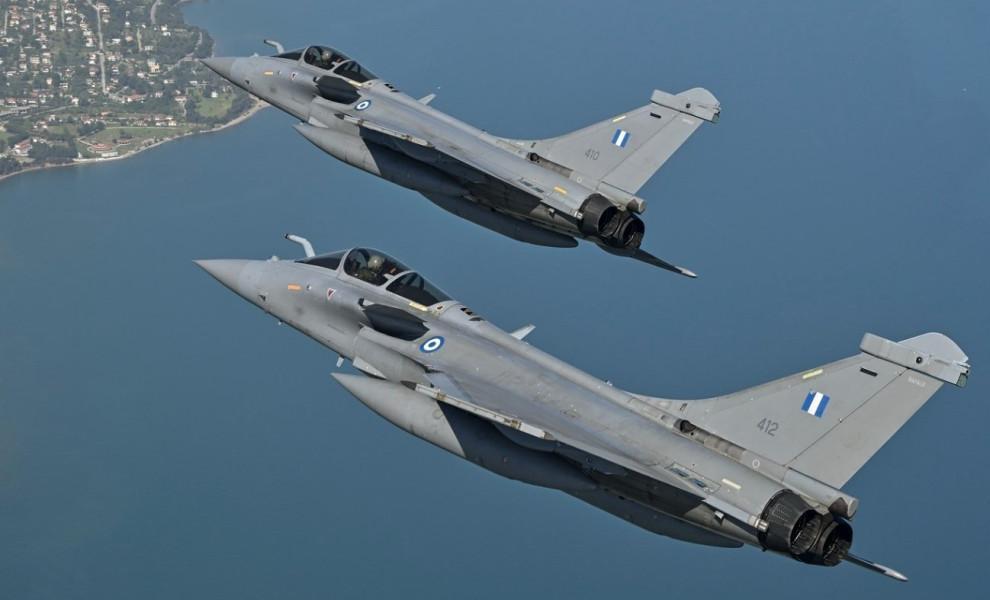
The combination of Rafale fighters, F-16 Vipers, further planned F-16 modernization, and eventually the F-35 creates the potential for a sophisticated air-combat ecosystem in which different aircraft perform complementary functions rather than operating merely as independent platforms.
The strategic question consequently becomes less:
How many aircraft does each country possess?
and increasingly:
Which force can detect first, understand the operational environment first, communicate securely, make decisions faster, and generate the appropriate military effect?
This represents a fundamental transformation in the measurement of military capability.
Maritime Power and Persistent Situational Awareness
The same principle applies at sea.
New frigates, modernization of existing MEKO vessels, submarines, unmanned aerial systems, underwater platforms, maritime sensors, and satellite capabilities can gradually create an increasingly integrated maritime-surveillance and combat network.
Greece’s geography makes such capabilities particularly significant.
Thousands of islands, extensive coastlines, maritime infrastructure, commercial shipping routes, and the strategic relationship between the Aegean and Eastern Mediterranean create an environment in which persistent maritime domain awareness can become an important national comparative advantage.
The objective should therefore extend beyond possessing advanced warships.
It should be the creation of a maritime ecosystem in which:
Satellites + UAVs + Ships + Submarines + Underwater Systems + Coastal Sensors + Aircraft + Electronic Intelligence + AI-Assisted Data Fusion
operate increasingly as components of a common strategic network.
Drones and the Emerging Greek Defense-Innovation Ecosystem
Another particularly important development is Greece’s growing emphasis on unmanned systems and domestic defense innovation.
The establishment of new drone-development and manufacturing capacity signals an important conceptual transition.
Greece should increasingly move from being predominantly a purchaser of advanced defense technology toward becoming simultaneously a:
User → Integrator → Developer → Producer → Innovator.
This transformation is strategically significant because genuine technological resilience cannot depend indefinitely upon importing every critical capability.
The development of the Hellenic Centre for Defence Innovation, closer cooperation among the Armed Forces, universities, research centers, startups, and established defense companies, and greater participation in European defense programs could gradually create a national Defense Technological Ecosystem.
Such an ecosystem represents something more valuable than any individual procurement.
It creates the capacity to continuously generate future capability.
The Critical Challenge: Integration
Nevertheless, procurement should not be confused with transformation.
The ultimate success of Greece’s modernization effort will depend upon whether its individual capabilities become genuinely integrated.
F-35s, Rafales, F-16s, frigates, submarines, drones, missile-defense systems, satellites, cyber capabilities, electronic warfare, and ground forces must increasingly exchange information and operate within a common command-and-control environment.
The strategic objective is therefore not simply a collection of advanced platforms.
It is a system of systems.
This is where the Techne–Phronesis Negotiation Framework™ (TPNF) provides an important analytical distinction:
Technology Creates Capability — Integration Creates Strategic Effect.
Sustainment, Munitions and Human Capital
Greece must simultaneously avoid another danger revealed by contemporary warfare.
Sophisticated platforms cannot maintain deterrence without sufficient:
- ammunition,
- spare parts,
- maintenance,
- industrial production,
- logistics,
- trained personnel.
Modernization must therefore extend into the less visible foundations of military power.
A fighter aircraft attracts public attention.
A resilient ammunition-production line rarely does.
Yet prolonged conflict demonstrates that both can become equally strategically important.
Human capital is similarly decisive.
Artificial intelligence, autonomous systems, cyber warfare, advanced sensors, fifth-generation aircraft, and integrated command networks require highly trained officers, NCOs, engineers, technicians, software specialists, data scientists, and drone operators.
The modernization of equipment must therefore be accompanied by the modernization of military knowledge.
Greece Should Not Become a Smaller Turkey
The strategic conclusion is particularly important.
Greece should not attempt to reproduce Turkey’s military architecture on a smaller scale.
Turkey possesses a larger population, substantially greater military manpower, and an increasingly capable domestic defense industry.
Attempting numerical symmetry would therefore be strategically inefficient.
Greece should instead seek asymmetric qualitative advantage in carefully selected domains.
Its model should increasingly emphasize:
Technological Sophistication
Operational Integration
Superior Situational Awareness
High Readiness
Domestic Innovation
European and NATO Interoperability
Strategic Partnerships
This can be described within TPNF as:
Qualitative Ecosystem Deterrence™
The concept recognizes that deterrence in technological civilization increasingly derives not simply from the number of military platforms available but from the quality and interconnectedness of the entire defense ecosystem supporting them.
From Military Modernization to TPNF Integrated Strategic Deterrence™
Greece’s current modernization effort therefore complements the broader strategic architecture proposed in this essay.
Military modernization becomes one component of:
TPNF Integrated Strategic Deterrence™
International Law & Legitimacy
↓
Advanced Military Capability
↓
Technological Innovation
↓
Integrated Situational Awareness
↓
Domestic Defense-Industrial Capacity
↓
EU & NATO Institutional Networks
↓
Regional Strategic Partnerships
↓
Geoeconomic Importance
↓
Credible Deterrence
↓
Phronesis — Strategic Wisdom
If Greece succeeds in completing this transformation, the result will not simply be a better-equipped Hellenic Armed Forces.
It will be a different form of national strategic power.
A country considerably smaller than Turkey in population and military manpower can compensate partly for numerical asymmetry through technological sophistication, operational integration, strategic networks, institutional credibility, and carefully cultivated alliances.
The ultimate objective is not military superiority for its own sake.
It is to create such a high degree of strategic uncertainty and potential cost for an aggressor that military coercion becomes an increasingly irrational policy option.
That is the essence of modern deterrence.
And through the TPNF perspective, it demonstrates a broader principle relevant far beyond Greece:
A smaller state does not necessarily need to become larger to become strategically stronger. It needs to become more technologically capable, more intelligently integrated, more institutionally connected, and more strategically resilient.
8. Build a Greek Defense Innovation Ecosystem
This is where TPNF becomes particularly relevant.
Greece needs an integrated Defense Technological Ecosystem connecting:
Armed Forces
↕
Universities
↕
Research Centers
↕
Greek Defense Companies
↕
Startups
↕
European Defense Programs
↕
Allied Technology Companies
The objective should be continuous innovation.
Drones provide an obvious example.
The lessons emerging from contemporary warfare demonstrate that inexpensive autonomous systems can impose disproportionate costs on conventional forces.
Greece’s geography—with thousands of islands, extensive coastlines and critical maritime infrastructure—makes autonomous surveillance, unmanned systems and networked maritime awareness particularly strategically relevant.
9. Turn EU Membership into Strategic Leverage
Greece possesses an advantage Turkey does not:
full membership of the European Union.
This should be treated not simply as diplomatic membership but as part of Greece’s strategic ecosystem.
Athens should connect Aegean and Eastern Mediterranean security increasingly with:
- European maritime security,
- EU external borders,
- energy security,
- critical infrastructure,
- defense industrial policy,
- European strategic autonomy.
Greece should participate aggressively in European joint procurement, defense innovation and industrial programs.
The objective should be to make Greek national resilience increasingly inseparable from European strategic resilience.
10. NATO: Alliance Without Strategic Illusions
Both Greece and Turkey belong to NATO.
That reality provides opportunities for dialogue, interoperability and crisis management.
But NATO membership does not eliminate bilateral strategic competition.
Greece should therefore pursue a dual approach.
It should remain a highly reliable NATO ally.
At the same time, it should continuously reinforce the principle that alliance solidarity requires respect for sovereignty, peaceful dispute resolution and restraint from threats of force between allies.
Reliability itself becomes strategic capital.
The more Greece is perceived as a predictable, technologically sophisticated and institutionally responsible ally, the greater its diplomatic leverage when confronting coercive behavior.
11. Regional Architecture: Greece Must Become Difficult to Isolate
Deterrence is stronger when embedded in networks.
Greece should therefore continue developing strategic relationships throughout the Eastern Mediterranean and beyond.
The objective should not be constructing an anti-Turkish coalition.
That would unnecessarily reduce diplomatic flexibility.
Instead, Greece should build a positive architecture of connectivity around:
- energy,
- infrastructure,
- maritime security,
- defense cooperation,
- digital connectivity,
- trade corridors,
- technological innovation.
Greece’s cooperation with Cyprus, Israel, France, the United States, Egypt, India, the United Arab Emirates and other partners can create strategic value independently of Turkey while simultaneously increasing the costs of destabilizing the regional ecosystem.
12. Greece as a Geoeconomic Node
Military deterrence represents only one component of national power.
Greece should strengthen its role as a strategic node connecting:
Europe
↕
Eastern Mediterranean
↕
Middle East
↕
India
This includes ports, shipping, energy corridors, electricity interconnections, data infrastructure and emerging trade architectures.
The stronger Greece becomes as a valuable node within international ecosystems, the greater the number of international actors possessing an interest in Greek stability.
This is Geoeconomic Deterrence.
Strategic relevance itself becomes a source of protection.
13. Systems Thinking Creates Understanding
The second foundational principle of TPNF states:
Systems Thinking Creates Understanding.
The Greek–Turkish relationship cannot be analyzed through military balance alone.
The complete ecosystem includes:
International Law
Military Capability
Defense Technology
EU Membership
NATO
Cyprus
Energy
Maritime Trade
Regional Partnerships
Economic Resilience
Diplomatic Credibility
A decision in one domain affects the others.
That is why Greece requires an integrated national strategy rather than disconnected foreign, defense, industrial and economic policies.
14. Strategic Negotiation: Dialogue From Strength, Not Fear
Greece should continue dialogue with Turkey.
Geography makes permanent communication unavoidable.
But dialogue should not mean strategic passivity.
Effective negotiation requires:
- clearly defined interests,
- credible alternatives,
- alliance support,
- economic resilience,
- military deterrence,
- political consistency.
TPNF therefore rejects the false choice between dialogue and deterrence.
The two reinforce each other.
Credible deterrence reduces incentives for coercion.
Negotiation creates pathways through which confrontation can be avoided.
Phronesis determines the appropriate balance.
15. Greece’s Integrated Strategic Deterrence Architecture
The proper Greek response can therefore be summarized through seven mutually reinforcing pillars:
1. Legal Deterrence
Systematically document, defend and internationalize Greek legal positions.
2. Military Deterrence
Maintain sufficient capability to make military coercion prohibitively costly and uncertain.
3. Technological Deterrence
Build superiority in selected high-value areas including AI, drones, sensors, cyber, electronic warfare and maritime surveillance.
4. Alliance Deterrence
Embed Greek security deeply within European, NATO and bilateral strategic relationships.
5. Geoeconomic Deterrence
Increase Greece’s importance to European energy, trade, logistics and connectivity.
6. Institutional Deterrence
Use EU institutions, international organizations and international legal mechanisms to increase the political costs of coercion.
7. Phronetic Deterrence
Maintain strategic patience, proportionality and judgment so that capability strengthens stability rather than creating uncontrolled escalation.
Together these create:
TPNF Integrated Strategic Deterrence
Strategic Implications
Turkey’s proposed maritime legislation should not trigger Greek strategic panic.
Nor should it be dismissed as symbolic domestic legislation.
Athens should treat it as part of a longer-term attempt to institutionalize Ankara’s maritime worldview.
The appropriate response is therefore equally long-term.
Greece should institutionalize its own strategy.
Not through maximalist rhetoric.
Through capability.
Through law.
Through technology.
Through alliances.
Through economic relevance.
Through institutional credibility.
And through strategic patience.
The fundamental Greek strategic challenge is not simply how to respond to one Turkish maritime law.
It is how to create a national ecosystem capable of protecting Greek sovereignty and sovereign rights throughout a period of prolonged geopolitical competition.
International law remains indispensable.
But law functions most effectively within a broader architecture of capability, institutions, diplomacy and deterrence.
Turkey’s large armed forces matter.
Its growing defense-industrial ecosystem matters.
Its geographic importance matters.
Its NATO membership matters.
But Greece possesses its own strategic advantages: EU membership, strong alliances, significant maritime geography, a modernizing military, an internationally oriented shipping sector, growing geoeconomic relevance and the capacity to build a highly sophisticated technological defense ecosystem.
The strategic objective should therefore not be to become a larger Turkey.
It should be to become a more technologically integrated, strategically networked and institutionally resilient Greece.
The Techne–Phronesis Negotiation Framework™ (TPNF) offers a clear synthesis:
International law establishes legitimacy.
Technology creates capability.
Military power creates credible deterrence.
Systems thinking creates strategic understanding.
Alliances multiply national capability.
Negotiation manages unavoidable competition.
Phronesis prevents strength from becoming strategic recklessness.
Greece’s most effective response is consequently neither submission nor uncontrolled confrontation.
It is the patient construction of an ecosystem in which its legal rights are supported by technological capability, military credibility, European integration, regional connectivity and strategic wisdom.
.That is how a smaller state can transform geography into strategic advantage, alliances into networked capability, international law into institutional leverage and technology into credible deterrence.
Key Takeaways
- Turkey’s proposed maritime legislation should be understood as an attempt to institutionalize longstanding strategic positions, not as something capable by itself of determining international maritime boundaries.
- Greece’s right to territorial waters up to twelve nautical miles rests on the Law of the Sea framework and its position that the rule also represents customary international law.
- The continuing Turkish casus belli creates an exceptional coercive dimension within relations between two NATO allies.
- International law remains legally meaningful without military power, but credible capability strengthens a state’s practical ability to resist coercion.
- Greece should not compete with Turkey primarily through military numbers; it should emphasize technology, integration, intelligence, innovation and networked deterrence.
- Turkey’s defense-technological progress should be assessed seriously rather than underestimated.
- EU membership, NATO reliability, regional partnerships and geoeconomic connectivity are strategic force multipliers for Greece.
- Greece needs an integrated domestic defense-innovation ecosystem rather than dependence exclusively on foreign procurement.
- Dialogue and deterrence are complementary rather than contradictory.
- The appropriate long-term objective is TPNF Integrated Strategic Deterrence: Law + Capability + Technology + Alliances + Geoeconomics + Institutions + Phronesis.
Author’s Reflection
The contemporary international environment demonstrates that international law, technological capability, military deterrence and strategic diplomacy cannot be treated as independent domains.
For Greece, defending sovereignty and sovereign rights requires neither abandoning international law in favor of power politics nor assuming that legal legitimacy alone eliminates geopolitical risk.
The Techne–Phronesis Negotiation Framework™ (TPNF) proposes an integrated alternative.
A resilient state strengthens the legitimacy of its positions through international law, develops the technological and military capability required to deter coercion, multiplies its national strength through alliances and geoeconomic networks, maintains channels of strategic negotiation and exercises Phronesis in determining when, where and how national power should be employed.
The ultimate objective is not conflict.
It is to construct a strategic environment in which conflict becomes unnecessary because coercion is unlikely to succeed.
For Greece, this means transforming technological innovation, European integration, maritime geography, alliances, military modernization and practical wisdom into a coherent ecosystem of national resilience and lasting strategic value.
Nikos Chatzis
Source: Open Sources Analysis, Relative Data Analysis by Nikos Chatzis
© Nikolaos Chatzis. All Rights Reserved.
The Techne–Phronesis Negotiation Framework™
An Integrative Theory of Strategic Negotiation, Complex Adaptive Systems and Practical Wisdom
Technology Creates Capability • Systems Thinking Creates Understanding • Strategic Wisdom Creates Lasting Value.
Negotiation.gr | Strategic Wisdom for the Technological Age