Negotiation.gr | Strategic Wisdom for the Technological Age
“Strategic resilience emerges when technical capability (techne) is
continuously guided by practical wisdom (phronesis) through adaptive
negotiation across interconnected systems.”
Central Idea
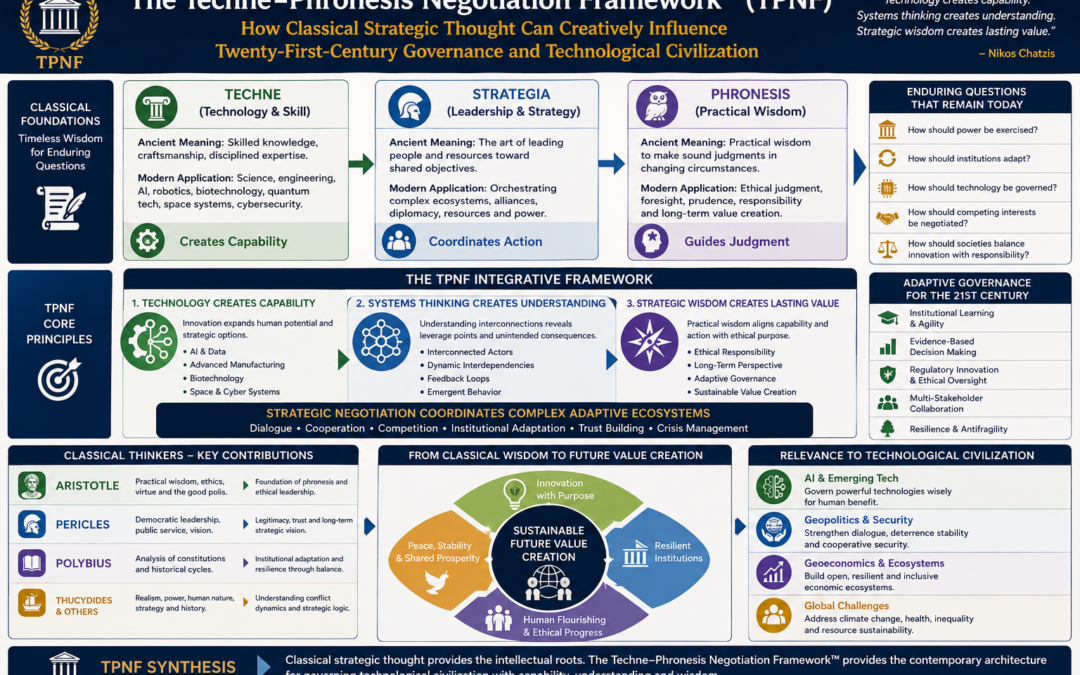
The accelerating transformation of technological civilization has increased—not diminished—the relevance of classical strategic thought. The enduring ideas of the classical Greek tradition concerning practical wisdom, leadership, governance, institutional resilience, historical understanding, and strategic judgment provide intellectual foundations for addressing the complex adaptive challenges of the twenty-first century. The Techne–Phronesis Negotiation Framework™ (TPNF) reinterprets these classical insights within the context of technological ecosystems, artificial intelligence, geoeconomics, and global governance.
Purpose of the Essay
This essay examines how classical strategic thought can contribute creatively to contemporary governance and technological civilization. Through the analytical perspective of the Techne–Phronesis Negotiation Framework™ (TPNF), it argues that the wisdom of classical thinkers should not be regarded merely as historical heritage but as an active intellectual resource for understanding and governing complex technological ecosystems.
Abstract
Contemporary societies increasingly rely on artificial intelligence, digital platforms, autonomous systems, biotechnology, space technologies, and globally interconnected economic networks. These developments have created unprecedented opportunities while simultaneously generating new ethical, institutional, geopolitical, and strategic challenges.
Although technological innovation continues to accelerate, the fundamental questions confronting leaders remain remarkably familiar:
- How should power be exercised?
- How should institutions adapt?
- How should technological capability be governed?
- How should competing interests be negotiated?
- How should societies balance innovation with responsibility?
The classical Greek tradition addressed these questions through philosophy, political thought, strategic leadership, and historical analysis. The Techne–Phronesis Negotiation Framework™ (TPNF) demonstrates that these classical insights remain highly relevant for explaining technological civilization.
Introduction
Classical Wisdom in a Technological Age
It is often assumed that technological progress renders historical ideas obsolete.
The opposite may be true.
As technology increases complexity, leaders require deeper conceptual frameworks capable of integrating ethics, governance, strategy, and institutional adaptation.
Classical strategic thought offers precisely such an intellectual foundation.
Rather than competing with modern technological knowledge, it complements it by strengthening strategic judgment.
Main Discussion
1. Techne: Technology Creates Capability
The first principle of TPNF states:
Technology Creates Capability.
The Greek concept of Techne referred to skilled knowledge, craftsmanship, disciplined expertise, and practical competence.
In technological civilization, Techne expands to include:
- Artificial Intelligence
- robotics
- quantum technologies
- autonomous systems
- biotechnology
- advanced manufacturing
- space systems
- cybersecurity
Technology continually expands human capability.
However, capability alone cannot determine strategic success.
2. Phronesis: Strategic Wisdom Creates Lasting Value
Aristotle described Phronesis as practical wisdom—the capacity to make sound judgments under changing circumstances.
TPNF extends this principle.
Modern leaders increasingly require practical wisdom to balance:
- technological innovation
- ethical responsibility
- institutional legitimacy
- national security
- economic competitiveness
- long-term sustainability
Technological capability without practical wisdom increases systemic risk.
3. Strategia: Leadership as Ecosystem Coordination
Classical Strategia extended beyond military command.
It integrated:
- political leadership
- diplomacy
- logistics
- economics
- coalition management
- institutional coordination
The twenty-first century requires similar capabilities.
Modern leaders increasingly coordinate:
- technological ecosystems
- geoeconomic ecosystems
- financial ecosystems
- innovation networks
- international alliances
- research partnerships
Leadership becomes the orchestration of complex adaptive systems.
4. Systems Thinking Creates Understanding
The second principle of TPNF states:
Systems Thinking Creates Understanding.
The classical thinkers recognized that political outcomes emerged through interactions among institutions, citizens, alliances, economics, and leadership.
Modern technological civilization exhibits similar complexity.
Artificial intelligence influences labor markets.
Labor markets influence education.
Education shapes innovation.
Innovation transforms competitiveness.
Competitiveness affects geopolitical stability.
Systems thinking therefore strengthens rather than replaces classical strategic reasoning.
5. Historical Analysis as Strategic Learning
History serves as a strategic laboratory.
Rather than predicting future events, historical analysis identifies recurring mechanisms including:
- institutional adaptation
- strategic innovation
- alliance formation
- technological disruption
- political legitimacy
- leadership under uncertainty
Historical understanding improves future strategic judgment.
6. Adaptive Governance
Technological civilization increasingly requires institutions capable of:
- continuous learning
- technological integration
- cross-sector coordination
- evidence-based policymaking
- regulatory innovation
- strategic foresight
Adaptive governance extends classical political thought into contemporary institutional environments.
7. Future Value Creation
The third principle of TPNF synthesizes these dimensions.
Future value creation depends upon integrating:
- technological capability
- systems thinking
- strategic negotiation
- adaptive governance
- institutional resilience
- practical wisdom
These relationships determine whether technological civilization remains resilient and sustainable.
Strategic Implications
The TPNF perspective suggests several important conclusions.
First, classical strategic thought remains directly relevant to technological civilization.
Second, technological innovation requires ethical leadership and institutional adaptation.
Third, systems thinking provides the analytical bridge connecting classical philosophy with modern complexity.
Fourth, strategic negotiation coordinates increasingly interconnected technological ecosystems.
Finally, practical wisdom remains the ultimate determinant of sustainable future value.
The strategic challenges of the twenty-first century differ profoundly from those of classical antiquity in their technological expression. Yet the underlying questions of governance, leadership, institutional resilience, strategic judgment, and human responsibility remain remarkably consistent. Classical strategic thought therefore continues to provide valuable guidance, not because it offers ready-made solutions, but because it cultivates the habits of reasoning necessary for navigating complexity.
The Techne–Phronesis Negotiation Framework™ (TPNF) builds upon this intellectual heritage by integrating technological capability, systems thinking, strategic negotiation, adaptive governance, and practical wisdom into a coherent framework for understanding technological civilization. Rather than treating classical wisdom as a historical artifact, TPNF demonstrates that it remains an active source of strategic insight capable of informing the governance of increasingly interconnected technological ecosystems.
Key Takeaways
- Classical strategic thought remains relevant because it addresses enduring questions of leadership and governance.
- Techne explains how technology expands human capability.
- Phronesis ensures that technological capability is guided by practical wisdom.
- Strategia evolves into the coordination of complex technological and institutional ecosystems.
- Systems thinking connects classical philosophy with contemporary technological civilization.
- Future value creation depends upon integrating innovation, governance, resilience, and ethical judgment.
Author’s Reflection
Technological civilization presents humanity with unprecedented capabilities, but it also renews timeless questions about leadership, responsibility, governance, and strategic judgment. The enduring value of classical strategic thought lies not in preserving the past but in illuminating the future. The Techne–Phronesis Negotiation Framework™ (TPNF) seeks to continue this tradition by integrating the wisdom of classical philosophy with the challenges of modern technological ecosystems, demonstrating that innovation achieves its greatest value when guided by practical wisdom and directed toward the long-term flourishing of society.
Author: Nikos Chatzis
Source: Open Sources Analysis, Relative Data Analysis by Nikos Chatzis
© Nikolaos Chatzis. All Rights Reserved.
The Techne–Phronesis Negotiation Framework™
An Integrative Theory of Strategic Negotiation, Complex Adaptive Systems and Practical Wisdom
Technology Creates Capability • Systems Thinking Creates Understanding • Strategic Wisdom Creates Lasting Value.
Negotiation.gr | Strategic Wisdom for the Technological Age