Negotiation.gr | Strategic Wisdom for the Technological Age
“Strategic resilience emerges when technical capability (techne) is
continuously guided by practical wisdom (phronesis) through adaptive
negotiation across interconnected systems.”
Central Idea
The Genghai No. 1 (“Blue Granary”) project demonstrates that the future of maritime development lies not simply in increasing fish production, but in creating integrated marine ecosystems where intelligent technology, ecological sustainability, tourism, scientific research, and strategic governance reinforce one another. Through the Techne–Phronesis Negotiation Framework™ (TPNF), Genghai No. 1 can be understood as a model of ecosystem innovation rather than merely an advanced aquaculture platform.
Purpose of the Essay
This essay examines the innovative Genghai No. 1 marine ranch in Yantai, Shandong Province, through the analytical lens of the Techne–Phronesis Negotiation Framework™ (TPNF). It argues that the project’s greatest significance lies in demonstrating how technology, systems thinking, strategic coordination, and practical wisdom can transform traditional fisheries into multidimensional blue economy ecosystems.
Abstract
Around the world, nations are searching for sustainable ways to secure future food supplies while protecting fragile marine ecosystems. China has responded by promoting the concept of the “Blue Granary”, which seeks to produce high-quality marine food through intelligent, environmentally responsible, and technologically advanced ocean management.
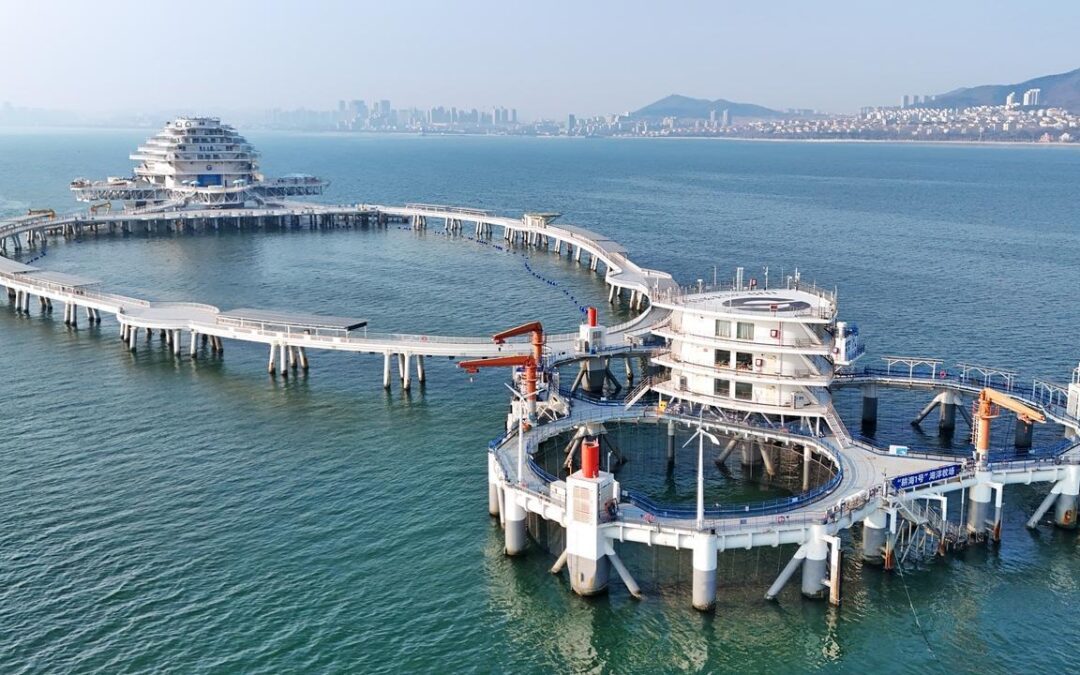
Among the most remarkable examples is Genghai No. 1, located off the coast of Yantai in east China’s Shandong Province. Rather than functioning solely as a fish farm, it integrates smart aquaculture, marine engineering, tourism, scientific research, environmental monitoring, renewable energy, and digital management into one coordinated ecosystem. The complex employs intelligent monitoring, automated feeding, and a “5G + marine ranch” approach while combining food production with education and tourism.
The Techne–Phronesis Negotiation Framework™ (TPNF) provides an ideal perspective for understanding why such integrated marine ecosystems represent an important evolution in technological civilization.
Introduction
Beyond Traditional Fisheries
For centuries, fisheries primarily focused on harvesting marine resources.
Today, however, ocean economies are undergoing a profound transformation.
Instead of simply extracting resources, governments increasingly seek to manage marine ecosystems through technology, environmental stewardship, scientific innovation, and sustainable economic development.
China’s Blue Granary initiative reflects this broader transformation.
Rather than maximizing short-term production, it seeks to build resilient marine ecosystems capable of generating food security, scientific knowledge, environmental sustainability, tourism, and long-term economic value simultaneously.
Main Discussion
1. Technology Creates Capability
The first principle of TPNF states:
Technology Creates Capability.
Genghai No. 1 illustrates this principle exceptionally well.
The platform incorporates:
- intelligent aquaculture
- automated feeding systems
- environmental monitoring
- underwater inspection technologies
- digital management
- 5G communications
- renewable energy
- marine engineering innovations
These technologies enable more precise production while reducing waste, improving ecological management, and increasing operational efficiency.
2. Systems Thinking Creates Understanding
Traditional fish farms focus primarily on production.
Genghai No. 1 operates differently.
It integrates:
- food production
- ecological protection
- tourism
- marine education
- scientific research
- engineering
- digital infrastructure
- renewable energy
- regional economic development
Each component strengthens the others.
This is precisely what TPNF defines as ecosystem thinking.
Instead of optimizing individual activities, the objective becomes optimizing the performance of the entire marine ecosystem.
3. From Fish Farm to Marine Innovation Ecosystem
Perhaps the project’s greatest innovation is conceptual rather than technological.
Genghai No. 1 demonstrates that modern marine development can simultaneously support:
- sustainable fisheries
- ocean science
- public education
- recreational tourism
- environmental conservation
- regional branding
- technological experimentation
The result is a diversified economic ecosystem instead of a single-industry operatio
4. Strategic Negotiation Coordinates Stakeholders
Projects of this complexity require extensive coordination among multiple actors:
- government agencies
- technology companies
- marine engineers
- research institutions
- environmental organizations
- tourism operators
- local communities
- investors
Within TPNF, negotiation is understood not merely as contract bargaining but as the strategic process through which these diverse interests are aligned into a coherent ecosystem.
5. The Blue Granary as a Model of Food Security
Food security has become a strategic priority for many nations.
The Blue Granary concept expands traditional agriculture into marine space.
Instead of viewing the ocean simply as a fishing ground, it becomes an intelligently managed food-production ecosystem capable of supporting long-term national resilience while reducing environmental pressure on wild fish stocks.
6. Ecological Sustainability and Technological Civilization
Technological civilization increasingly requires balancing innovation with ecological responsibility.
Genghai No. 1 incorporates renewable energy, intelligent monitoring, environmental management, and sustainable operational practices designed to reduce ecological impacts while maintaining productivity.
This reflects the growing recognition that technological capability alone is insufficient.
Long-term success depends upon responsible ecosystem governance.
7. Strategic Wisdom Creates Lasting Value
The third principle of TPNF states:
Strategic Wisdom Creates Lasting Value.
The long-term significance of Genghai No. 1 lies not only in producing seafood.
Its broader contribution includes:
- technological experimentation
- marine education
- ecosystem resilience
- scientific advancement
- regional innovation
- sustainable economic diversification
These dimensions collectively create value extending well beyond aquaculture itself.
Strategic Implications
The Genghai No. 1 model offers several strategic lessons.
First, future food security increasingly depends upon integrated technological ecosystems.
Second, marine resources should be managed through intelligent systems rather than simple extraction.
Third, technology generates greater value when connected with education, tourism, sustainability, and research.
Fourth, ecosystem governance requires strategic coordination among multiple stakeholders.
Finally, the Blue Granary concept illustrates how technological civilization can simultaneously strengthen economic development and environmental stewardship.
Genghai No. 1 represents far more than an innovative marine ranch. It is a practical demonstration of how intelligent technology, ecological management, strategic coordination, and long-term planning can transform traditional fisheries into resilient blue economy ecosystems. The project illustrates a broader evolution in development thinking: success is increasingly measured by the integration of multiple capabilities rather than by the output of a single sector.
The Techne–Phronesis Negotiation Framework™ (TPNF) explains this transformation by showing how technological capability, systems thinking, and strategic wisdom combine to create sustainable strategic value. As nations seek new approaches to food security, environmental resilience, and economic innovation, the Blue Granary model offers an instructive example of how technological civilization can evolve in harmony with the marine environment.
Key Takeaways
- Genghai No. 1 is an integrated intelligent marine ranch that combines aquaculture, research, tourism, and ecological management.
- The Blue Granary model demonstrates how technology can strengthen sustainable food security.
- Systems thinking transforms individual marine activities into a coordinated blue economy ecosystem.
- Strategic negotiation enables collaboration among governments, industry, researchers, and communities.
- TPNF provides an analytical framework for understanding intelligent marine ecosystems as part of the evolution of technological civilization.
Author’s Reflection
The future of maritime development will be determined not only by technological innovation but by the ability to integrate technology with ecological responsibility, systems thinking, and strategic governance. The Techne–Phronesis Negotiation Framework™ (TPNF) suggests that the most resilient blue economy models will be those capable of transforming marine resources into interconnected ecosystems that generate lasting value for society, the economy, and the environment.
Author: Nikos Chatzis
Source: Open Sources Analysis, Relative Data Analysis by Nikos Chatzis
© Nikolaos Chatzis. All Rights Reserved.
The Techne–Phronesis Negotiation Framework™
An Integrative Theory of Strategic Negotiation, Complex Adaptive Systems and Practical Wisdom
Technology Creates Capability • Systems Thinking Creates Understanding • Strategic Wisdom Creates Lasting Value.
Negotiation.gr | Strategic Wisdom for the Technological Age